In a wide-ranging CoinDesk interview released yesterday, Cardano founder Charles Hoskinson sharpened a years-long critique of Ethereum’s long-term viability, arguing that the network’s reliance on rollups and external scaling layers has created economic incentives that will ultimately hollow out the base chain. While acknowledging Ethereum’s technical progress, he contended that “as a general-purpose, smart-contract ledger,” the project has nurtured an ecosystem that “will slowly but surely eat [it] alive.” Why Ethereum Is Doomed To Fail: Cardano Founder Hoskinson framed the core problem as one of misaligned incentives between Ethereum’s L1 and its expanding constellation of L2s. “To make Ethereum better, they’ve had to embrace layer twos,” he said. “The layer twos are not strong allies… they’re partners of necessity.” In his view, rollup teams “don’t particularly care if they’re attached to Solana or they become a layer one,” so if better economics or user growth lie elsewhere, “they could simply migrate or go multi-chain.” New applications and liquidity, he added, are already “outside of the Ethereum ecosystem,” eroding the network’s historical network effects. Related Reading: Cardano Pushes Past $0.85: Falling Wedge Breakout Confirmed? “So if they’re gobbling up the transaction volume and gobbling up the users and they’re gobbling up the token appreciation, if there’s a more attractive target, they could simply migrate or go multi-chain,” Hoskinson said, adding that this trend is already observable with LayerZero and Espresso. That erosion, Hoskinson argued, is set to accelerate as two external forces gather momentum. First, he described Bitcoin DeFi as a “sleeping giant” that could attract “hundreds of billions” in total value once primitives such as stablecoins, DEXs and lending are built with credible security assumptions. “When Bitcoin wakes up… its TVL will be… larger than the market cap of Ethereum,” he said, noting that sovereigns and major asset managers would likely prefer to build around Bitcoin exposure. Second, he expects large technology platforms and traditional financial institutions to enter with their own infrastructure, adjacent to public chains but not economically dependent on Ethereum’s base layer—“Microsoft… Google… Amazon… have no incentive to go boost Ethereum or deploy on Ethereum,” he said. The technological arc, in Hoskinson’s telling, also tilts away from shared-state blockchains. As zero-knowledge proofs and “proof-carrying code” mature, more computation can be executed off-chain—in secure enclaves, on devices, or within MPC systems—leaving the chain to verify succinct proofs. “Why… spend billions of dollars a year maintaining this very weak computer that’s shared and replicated,” he asked, “when you can turn it into a distributed problem that runs everywhere?” Like Microsoft missing mobile and pivoting from Windows dominance to Azure, he suggested, Ethereum may ultimately need to “pivot to a new McGuffin” to retain relevance even if it remains present in the stack. Related Reading: Cardano Sentiment Crashes To 5-Month Low As ADA Defends Key Price Level Notably, Hoskinson’s assessment was not unqualified dismissal. He credited Ethereum for “keeping up with the times,” investing in rollups and zero-knowledge technology, and building a “Goliath” ecosystem that survived early funding scares and the DAO crisis. “They’ve done some really incredible things,” he said, and he allowed that “it’s entirely possible that Ethereum could pivot… and get very good at that” new role. The nub of his skepticism is not competence but structure: in his view, the more rollups succeed, the less compelling the L1 becomes as the economic hub. The remarks reprise and elaborate on a stance Hoskinson aired earlier this year, when he said during an AMA: “I don’t think Ethereum will survive more than 10 to 15 years,” predicting that L2s would “suckle out all of the alpha.” Hoskinson’s analysis also folds into his own current bets for Cardano. He cast Bitcoin-centric DeFi as a three-rule design target—security derived from Bitcoin, fees paid in Bitcoin, and yields returned in Bitcoin—and argued that companion chains and trust-minimized bridges will be necessary to make it work. He presented Cardano’s extended-UTXO design and its privacy sidechain Midnight as infrastructure positioned to serve that market while offering selective-disclosure compliance for institutions. At press time, ADA traded at $0.89. Featured image created with DALL.E, chart from TradingView.comIn a wide-ranging CoinDesk interview released yesterday, Cardano founder Charles Hoskinson sharpened a years-long critique of Ethereum’s long-term viability, arguing that the network’s reliance on rollups and external scaling layers has created economic incentives that will ultimately hollow out the base chain. While acknowledging Ethereum’s technical progress, he contended that “as a general-purpose, smart-contract ledger,” the project has nurtured an ecosystem that “will slowly but surely eat [it] alive.” Why Ethereum Is Doomed To Fail: Cardano Founder Hoskinson framed the core problem as one of misaligned incentives between Ethereum’s L1 and its expanding constellation of L2s. “To make Ethereum better, they’ve had to embrace layer twos,” he said. “The layer twos are not strong allies… they’re partners of necessity.” In his view, rollup teams “don’t particularly care if they’re attached to Solana or they become a layer one,” so if better economics or user growth lie elsewhere, “they could simply migrate or go multi-chain.” New applications and liquidity, he added, are already “outside of the Ethereum ecosystem,” eroding the network’s historical network effects. Related Reading: Cardano Pushes Past $0.85: Falling Wedge Breakout Confirmed? “So if they’re gobbling up the transaction volume and gobbling up the users and they’re gobbling up the token appreciation, if there’s a more attractive target, they could simply migrate or go multi-chain,” Hoskinson said, adding that this trend is already observable with LayerZero and Espresso. That erosion, Hoskinson argued, is set to accelerate as two external forces gather momentum. First, he described Bitcoin DeFi as a “sleeping giant” that could attract “hundreds of billions” in total value once primitives such as stablecoins, DEXs and lending are built with credible security assumptions. “When Bitcoin wakes up… its TVL will be… larger than the market cap of Ethereum,” he said, noting that sovereigns and major asset managers would likely prefer to build around Bitcoin exposure. Second, he expects large technology platforms and traditional financial institutions to enter with their own infrastructure, adjacent to public chains but not economically dependent on Ethereum’s base layer—“Microsoft… Google… Amazon… have no incentive to go boost Ethereum or deploy on Ethereum,” he said. The technological arc, in Hoskinson’s telling, also tilts away from shared-state blockchains. As zero-knowledge proofs and “proof-carrying code” mature, more computation can be executed off-chain—in secure enclaves, on devices, or within MPC systems—leaving the chain to verify succinct proofs. “Why… spend billions of dollars a year maintaining this very weak computer that’s shared and replicated,” he asked, “when you can turn it into a distributed problem that runs everywhere?” Like Microsoft missing mobile and pivoting from Windows dominance to Azure, he suggested, Ethereum may ultimately need to “pivot to a new McGuffin” to retain relevance even if it remains present in the stack. Related Reading: Cardano Sentiment Crashes To 5-Month Low As ADA Defends Key Price Level Notably, Hoskinson’s assessment was not unqualified dismissal. He credited Ethereum for “keeping up with the times,” investing in rollups and zero-knowledge technology, and building a “Goliath” ecosystem that survived early funding scares and the DAO crisis. “They’ve done some really incredible things,” he said, and he allowed that “it’s entirely possible that Ethereum could pivot… and get very good at that” new role. The nub of his skepticism is not competence but structure: in his view, the more rollups succeed, the less compelling the L1 becomes as the economic hub. The remarks reprise and elaborate on a stance Hoskinson aired earlier this year, when he said during an AMA: “I don’t think Ethereum will survive more than 10 to 15 years,” predicting that L2s would “suckle out all of the alpha.” Hoskinson’s analysis also folds into his own current bets for Cardano. He cast Bitcoin-centric DeFi as a three-rule design target—security derived from Bitcoin, fees paid in Bitcoin, and yields returned in Bitcoin—and argued that companion chains and trust-minimized bridges will be necessary to make it work. He presented Cardano’s extended-UTXO design and its privacy sidechain Midnight as infrastructure positioned to serve that market while offering selective-disclosure compliance for institutions. At press time, ADA traded at $0.89. Featured image created with DALL.E, chart from TradingView.com

Cardano Founder Hoskinson Says Ethereum Is Doomed To Fail: Here’s How

2025/09/11 10:00

In a wide-ranging CoinDesk interview released yesterday, Cardano founder Charles Hoskinson sharpened a years-long critique of Ethereum’s long-term viability, arguing that the network’s reliance on rollups and external scaling layers has created economic incentives that will ultimately hollow out the base chain. While acknowledging Ethereum’s technical progress, he contended that “as a general-purpose, smart-contract ledger,” the project has nurtured an ecosystem that “will slowly but surely eat [it] alive.”

Why Ethereum Is Doomed To Fail: Cardano Founder

Hoskinson framed the core problem as one of misaligned incentives between Ethereum’s L1 and its expanding constellation of L2s. “To make Ethereum better, they’ve had to embrace layer twos,” he said. “The layer twos are not strong allies… they’re partners of necessity.”

In his view, rollup teams “don’t particularly care if they’re attached to Solana or they become a layer one,” so if better economics or user growth lie elsewhere, “they could simply migrate or go multi-chain.” New applications and liquidity, he added, are already “outside of the Ethereum ecosystem,” eroding the network’s historical network effects.

“So if they’re gobbling up the transaction volume and gobbling up the users and they’re gobbling up the token appreciation, if there’s a more attractive target, they could simply migrate or go multi-chain,” Hoskinson said, adding that this trend is already observable with LayerZero and Espresso.

That erosion, Hoskinson argued, is set to accelerate as two external forces gather momentum. First, he described Bitcoin DeFi as a “sleeping giant” that could attract “hundreds of billions” in total value once primitives such as stablecoins, DEXs and lending are built with credible security assumptions. “When Bitcoin wakes up… its TVL will be… larger than the market cap of Ethereum,” he said, noting that sovereigns and major asset managers would likely prefer to build around Bitcoin exposure.

Second, he expects large technology platforms and traditional financial institutions to enter with their own infrastructure, adjacent to public chains but not economically dependent on Ethereum’s base layer—“Microsoft… Google… Amazon… have no incentive to go boost Ethereum or deploy on Ethereum,” he said.

The technological arc, in Hoskinson’s telling, also tilts away from shared-state blockchains. As zero-knowledge proofs and “proof-carrying code” mature, more computation can be executed off-chain—in secure enclaves, on devices, or within MPC systems—leaving the chain to verify succinct proofs. “Why… spend billions of dollars a year maintaining this very weak computer that’s shared and replicated,” he asked, “when you can turn it into a distributed problem that runs everywhere?”

Like Microsoft missing mobile and pivoting from Windows dominance to Azure, he suggested, Ethereum may ultimately need to “pivot to a new McGuffin” to retain relevance even if it remains present in the stack.

Notably, Hoskinson’s assessment was not unqualified dismissal. He credited Ethereum for “keeping up with the times,” investing in rollups and zero-knowledge technology, and building a “Goliath” ecosystem that survived early funding scares and the DAO crisis. “They’ve done some really incredible things,” he said, and he allowed that “it’s entirely possible that Ethereum could pivot… and get very good at that” new role. The nub of his skepticism is not competence but structure: in his view, the more rollups succeed, the less compelling the L1 becomes as the economic hub.

The remarks reprise and elaborate on a stance Hoskinson aired earlier this year, when he said during an AMA: “I don’t think Ethereum will survive more than 10 to 15 years,” predicting that L2s would “suckle out all of the alpha.”

Hoskinson’s analysis also folds into his own current bets for Cardano. He cast Bitcoin-centric DeFi as a three-rule design target—security derived from Bitcoin, fees paid in Bitcoin, and yields returned in Bitcoin—and argued that companion chains and trust-minimized bridges will be necessary to make it work. He presented Cardano’s extended-UTXO design and its privacy sidechain Midnight as infrastructure positioned to serve that market while offering selective-disclosure compliance for institutions.

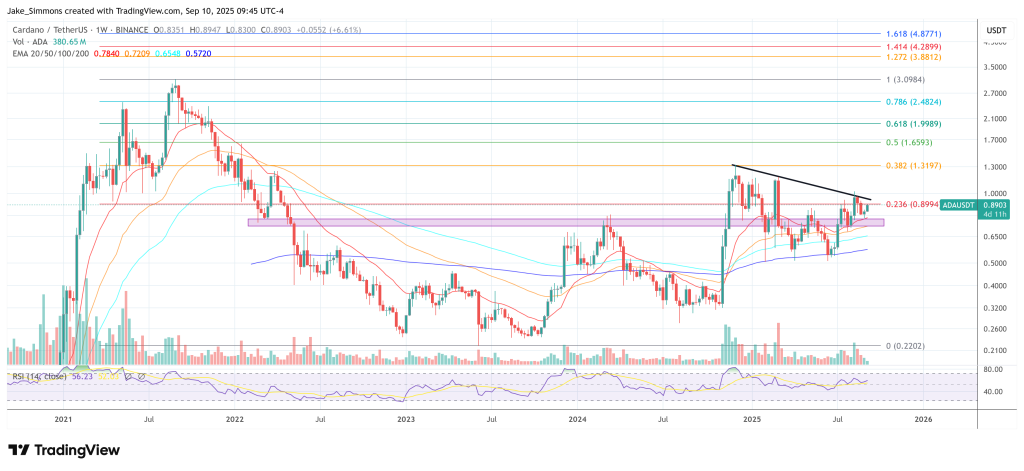
At press time, ADA traded at $0.89.

Cardano price
Market Opportunity
Threshold Logo
Threshold Price(T)
$0.010106
$0.010106$0.010106
+0.60%
USD
Threshold (T) Live Price Chart
Disclaimer: The articles reposted on this site are sourced from public platforms and are provided for informational purposes only. They do not necessarily reflect the views of MEXC. All rights remain with the original authors. If you believe any content infringes on third-party rights, please contact service@support.mexc.com for removal. MEXC makes no guarantees regarding the accuracy, completeness, or timeliness of the content and is not responsible for any actions taken based on the information provided. The content does not constitute financial, legal, or other professional advice, nor should it be considered a recommendation or endorsement by MEXC.

You May Also Like

Adam Wainwright Takes The Mound Again Honor Darryl Kile

Adam Wainwright Takes The Mound Again Honor Darryl Kile

The post Adam Wainwright Takes The Mound Again Honor Darryl Kile appeared on BitcoinEthereumNews.com. Adam Wainwright of the St. Louis Cardinals in the dugout during the second inning against the Miami Marlins at Busch Stadium on July 18, 2023 in St. Louis, Missouri. (Photo by Brandon Sloter/Image Of Sport/Getty Images) Getty Images St. Louis Cardinals lifer Adam Wainwright is a pretty easygoing guy, and not unlikely to talk with you about baseball traditions and barbecue, or even share a joke. That personality came out last week during our Zoom call when I mentioned for the first time that I’m a Chicago Cubs fan. He responded to the mention of my fandom, “So far, I don’t think this interview is going very well.” Yet, Wainwright will return to Busch Stadium on September 19 on a more serious note, this time to honor another former Cardinal and friend, the late Darryl Kile. Wainwright will take the mound not as a starting pitcher, but to throw out the game’s ceremonial first pitch. Joining him on the mound will be Kile’s daughter, Sierra, as the two help launch a new program called Playing with Heart. “Darryl’s passing was a reminder that heart disease doesn’t discriminate, even against elite athletes in peak physical shape,” Wainwright said. “This program is about helping people recognize the risks, take action, and hopefully save lives.” Wainwright, who played for the St. Louis Cardinals as a starting pitcher from 2005 to 2023, aims to merge the essence of baseball tradition with a crucial message about heart health. Kile, a beloved pitcher for the Cardinals, tragically passed away in 2002 at the age of 33 as a result of early-onset heart disease. His sudden death shook the baseball world and left a lasting impact on teammates, fans, and especially his family. Now, more than two decades later, Sierra Kile is stepping forward with Wainwright to…
Share
BitcoinEthereumNews2025/09/18 02:08
SUI Price Consolidation Suggests Bullish Breakout Above $1.84

SUI Price Consolidation Suggests Bullish Breakout Above $1.84

TLDR: SUI forms a bullish flag pattern, consolidating between $1.73 and $1.84 before a potential breakout. Wyckoff structure shows SUI may experience further downside
Share
Blockonomi2026/01/19 02:42
Stijgt de Solana koers door $1 miljard RWA en de institutionele adoptie?

Stijgt de Solana koers door $1 miljard RWA en de institutionele adoptie?

De totale waarde van realworld activa op Solana is opgelopen tot ongeveer $1 miljard. Daarmee staat de RWA activiteit op het netwerk op een nieuw all-time high.
Share
Coinstats2026/01/19 02:16