JanAI Launches India’s First Rural AI Ecosystem with Kyndryl
India’s First Rural AI Ecosystem: Can JanAI and Kyndryl Redefine CX from the Grassroots Up?
Imagine a farmer in a remote village asking an AI assistant, in her own language, about crop disease patterns.
Imagine a Self-Help Group leader using an AI dashboard to track micro-loans and predict repayment cycles.
Now, imagine a college student serving as an “AI Ambassador,” mapping local problems and building solutions with agentic AI tools.
This is not a pilot slide deck.
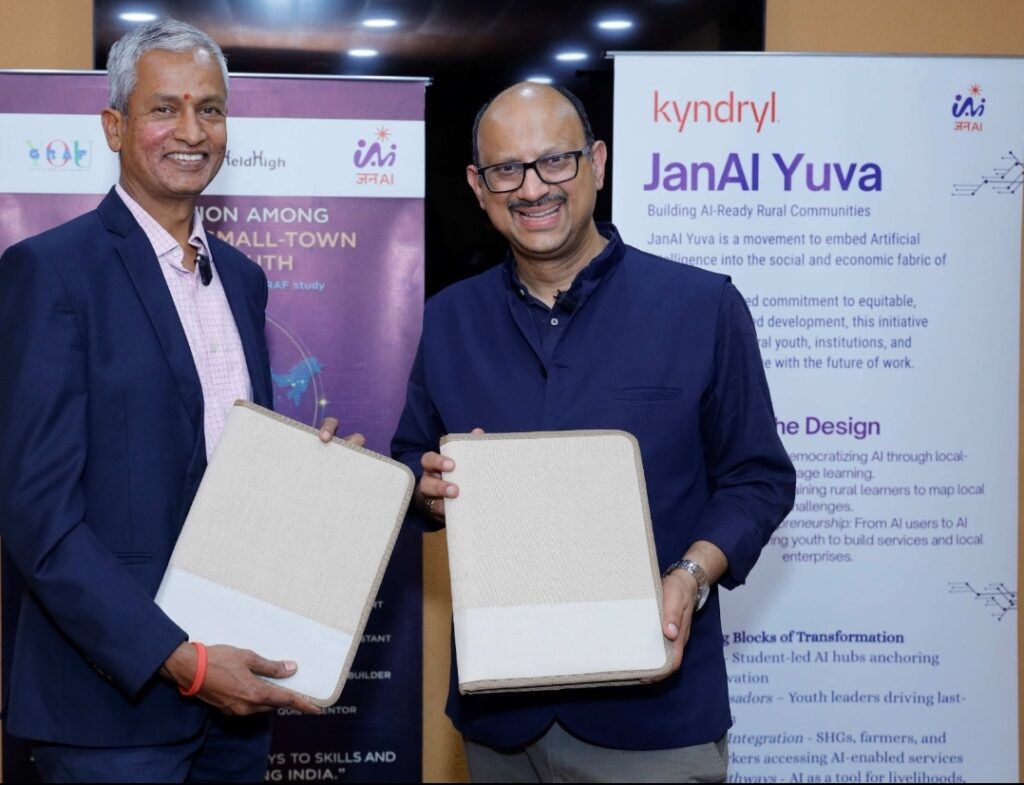
This is the ambition behind the new social impact initiative launched by Head Held High Foundation and Kyndryl at the AI Impact Summit 2026 in Delhi.
Under the banner of JanAI, the initiative aims to train 30,000 rural youth over three years and build India’s first rural AI ecosystem.
But for CX and EX leaders, this is more than a skills program.
It is a live case study in decentralized customer experience design, AI adoption at the edge, and journey orchestration in fragmented ecosystems.
Let’s unpack what this means for enterprise leaders navigating siloed teams, AI gaps, and journey fragmentation.
What Is JanAI and Why Should CX Leaders Care?
JanAI is a rural-first AI initiative designed to democratize AI literacy, build agentic AI capabilities, and create local AI ecosystems across India.
For CX leaders, it represents a blueprint for scaling AI in underserved, fragmented markets through community-driven design.
Founded by Madan Padaki under the Head Held High Foundation, JanAI positions AI as India’s “Digital Charkha” — a decentralized empowerment tool.
The latest initiative, powered by Kyndryl, introduces:
- A three-tier AI learning framework
- AI Ambassadors embedded in villages
- Youth-run AI support centers
- District-level dashboards for governance
- Agentic AI-first village prototypes
This is CX at ecosystem scale.
What Problem Is This Initiative Solving?
India’s AI growth has largely been urban-centric, leaving rural communities as passive consumers rather than active creators.
Over 800 million Indians live in rural areas.
Yet most AI solutions target enterprise or urban users.
The result?
- Low AI literacy
- Fragmented digital adoption
- Disconnected public services
- Weak last-mile engagement
From a CX perspective, this mirrors enterprise pain points:
| Rural Challenge | Enterprise CX Parallel |
|---|---|
| Low AI literacy | AI adoption gaps in frontline teams |
| Fragmented services | Siloed customer journeys |
| Lack of local ownership | Low employee engagement |
| Centralized innovation | Top-down tech rollouts that fail |
JanAI tackles these through structured ecosystem design.
How Does the Three-Tier Framework Work?
The initiative uses a Basic–Intermediate–Advanced model to build AI literacy, applied skills, and entrepreneurship pathways.
1. Basic Layer: AI Literacy for All
Mobile-first, multilingual modules designed for first-generation learners.
This layer reduces entry barriers and drives awareness.
CX Insight:
Adoption begins with comprehension.
If customers or employees don’t understand AI, they won’t trust it.
2. Intermediate Layer: Applied AI + Community Problem Solving
Youth are trained in:
- Agriculture AI tools
- Healthcare insights
- Governance interfaces
- AI-enabled micro-services
This layer translates literacy into utility.
CX Insight:
Move from awareness to use cases quickly.
AI must solve visible problems to sustain engagement.
3. Advanced Layer: Agentic AI and Entrepreneurship
Boot camps train graduates in:
- Agentic AI systems
- Workflow automation
- AI entrepreneurship
This creates employment pipelines and micro-enterprises.
CX Insight:
Sustainable AI adoption needs economic alignment.
Tie AI initiatives to outcomes and incentives.
Who Are the Strategic Partners — and Why Does That Matter?
JanAI’s power lies in its multi-stakeholder design.
Key alliances include:
• Wipro
• PwC
• Karnataka Digital Economy Mission
• EkStep Foundation
• Project NANDA led by Ramesh Raskar
This ecosystem blends:
° Technology infrastructure
° Governance frameworks
° Consulting rigor
° Academic research
° Startup networks
This ecosystem blends:
- Technology infrastructure
- Governance frameworks
- Consulting rigor
- Academic research
- Startup networks
CX Lesson:
Transformation fails in silos.
Scalable impact requires cross-functional and cross-institutional orchestration.
What Is an Agentic AI-First Village?
An Agentic AI-First Village uses AI agents that interact, transact, and automate tasks autonomously within a decentralized network.
Through collaboration with Project NANDA, JanAI aims to build the world’s first such framework.
Instead of static AI tools, agentic networks enable:
- Real-time service coordination
- Autonomous workflow execution
- Language-native interaction
- Micro-transactions across stakeholders
For CX leaders, this is the next frontier:
From chatbots to autonomous journey orchestration.
What Makes This a CX Case Study — Not Just a CSR Story?
At first glance, this looks like social impact.
In reality, it is a distributed experience architecture experiment.
Consider the structural elements:
1. AI Ambassadors as Experience Orchestrators
Trained college students act as:
- Literacy facilitators
- Problem mappers
- Prototype enablers
They bridge the gap between tech and user.
In enterprise terms?
They are AI change champions embedded at the edge.
2. District-Level AI Literacy & Usage Dashboard
The multi-party alliance with Wipro, PwC, and Karnataka Digital Economy Mission will build a district-level dashboard.
This dashboard measures:
- AI literacy levels
- Usage patterns
- Community adoption
- Impact metrics
CX Parallel:
If you cannot measure adoption, you cannot scale it.
3. Hybrid Learning Model
The first 5,000 students will be trained via:
- Online AI foundation modules
- Offline hands-on sessions
- University partnerships
This hybrid model reduces digital divide friction.
Enterprise Lesson:
Blended enablement beats digital-only rollouts.
Key Insights for CX and EX Leaders
1. Democratization Beats Centralization
AI cannot remain a headquarters experiment.
2. Literacy Precedes Automation
Education drives trust.
3. Ecosystems Outperform Silos
Multi-party alliances accelerate scaling.
4. Agentic AI Changes Governance Models
Autonomous agents require new oversight frameworks.
5. Economic Pathways Drive Adoption
Link AI to livelihood or performance incentives.
Common Pitfalls to Avoid
- Rolling out AI without frontline enablement
- Ignoring local language or cultural nuance
- Measuring deployment instead of usage
- Over-centralizing governance
- Treating AI as a tool, not an ecosystem
JanAI’s structure addresses each systematically.
How Can Enterprises Apply This Framework?
Here is a simplified adaptation model for CX teams:
Step 1: Define Your “AI Literacy Baseline”
Audit employee and customer understanding.
Step 2: Build Tiered Enablement
Basic → Applied → Advanced pathways.
Step 3: Appoint AI Ambassadors
Embed champions across business units.
Step 4: Create Usage Dashboards
Track literacy, adoption, and value realization.
Step 5: Align AI to Tangible Outcomes
Tie to revenue, cost savings, or engagement.
FAQ: What CX Leaders Are Asking
How does rural AI adoption differ from enterprise AI adoption?
Rural adoption prioritizes literacy and accessibility, while enterprises focus on integration and scale. Both require change management.
What is agentic AI and why is it relevant to CX?
Agentic AI refers to autonomous AI systems that execute tasks and coordinate workflows. It enables proactive, real-time journey orchestration.
How can dashboards improve AI adoption?
Dashboards reveal usage gaps, engagement patterns, and outcome correlations. Visibility drives accountability.
What role do AI Ambassadors play in transformation?
They act as on-ground change agents, accelerating adoption and feedback loops.
Can this model scale beyond rural India?
Yes. The decentralized, literacy-first model applies to enterprises entering emerging markets or underserved segments.
Why This Matters for India’s AI Journey
Madan Padaki describes this as a pivotal shift toward inclusive AI development.
Lingraju Sawkar, President of Kyndryl India, emphasizes AI literacy, agentic adoption, and entrepreneurship.
The stated goal aligns with Viksit Bharat 2047 — building AI-ready rural communities.
For CXQuest readers, this signals something larger:
Experience transformation is moving outward — from corporate headquarters to villages.
AI’s next billion users will not come from tech corridors.
They will come from ecosystems.
Actionable Takeaways for CX Leaders
- Conduct a rapid AI literacy audit across customer-facing teams.
- Design a three-tier enablement roadmap for your organization.
- Appoint AI champions in each business unit.
- Build an adoption and literacy dashboard within 90 days.
- Pilot agentic AI in one high-friction journey.
- Partner cross-functionally before scaling.
- Tie AI initiatives to measurable livelihood or revenue outcomes.
- Treat AI as a cultural shift, not a software deployment.
Summary:
India’s JanAI initiative, powered by Head Held High Foundation and Kyndryl, aims to train 30,000 rural youth and build the world’s first Agentic AI-First Villages. The program’s three-tier framework, AI Ambassadors, and district dashboards offer a scalable blueprint for decentralized AI adoption — with powerful lessons for CX and EX leaders tackling silos, AI gaps, and journey fragmentation.
For CXQuest.com, this is not just news.
It is a masterclass in ecosystem-led experience transformation.
The post JanAI Launches India’s First Rural AI Ecosystem with Kyndryl appeared first on CX Quest.


You May Also Like

Bitcoin hovers near $72,000 as traders weigh ‘fragile’ Iran truce prospects. Now they brace for the next price shock

Solana Rally Outlook Points to $120 if $90 Breaks Cleanly