XRP confirms death cross, signaling potential for further downside pressure. Major resistance cluster at $2.55-$2.60 halts XRP’s upward movement. Key support levels at $2.20 and $2.00 crucial for XRP. XRP has officially entered a bearish phase after its 50-day moving average (MA) crossed below the 200-day MA, signaling a death cross. This technical pattern is significant, as it marks the moment when short-term selling pressure overtakes long-term accumulation. Historically, death crosses have been indicators of a trend reversal, often pointing to further downside momentum. Although the immediate impact may not always trigger a steep decline, such formations typically set the tone for market sentiment in the weeks that follow. As XRP struggles beneath a major resistance cluster, it’s clear that sellers are firmly in control. The 50-day, 100-day, and 200-day moving averages have now merged around the $2.55-$2.60 range, creating a heavy ceiling that XRP has struggled to break through. Despite a few attempts, the market has failed to sustain any rallies above this level. The inability to push higher reinforces the idea that XRP is facing more selling pressure than buying interest at this point. This pattern suggests that XRP could continue to face downward pressure, as brief rallies are likely to be sold into. Source: Tradingview Also Read: Peter Schiff Slams Bitcoin’s Collapse Below $100,000: Is the Crypto Bubble Finally Bursting? Key Downside Targets and Support Zones for XRP After the formation of the death cross, several critical support levels have emerged, providing insight into potential price action. The first notable support zone is around $2.20, where XRP has previously found some buying interest in recent weeks. A consolidation around this level would suggest that market participants are waiting for further confirmation before committing to a more decisive move. However, should the selling momentum continue, XRP could face a deeper retracement. A break below the $2.20 mark would likely lead to a retest of the $2.00 level, which has acted as psychological and structural support in the past. This level is a crucial one to watch, as a retest could trigger a liquidity sweep, potentially flushing out weak hands and offering a better entry point for longer-term investors. The most extreme downside target is set at $1.80. A drop to this level would signal a complete trend reversal, with the market likely losing its footing under the $2.00 support zone. Such a move would likely trigger further panic selling, potentially marking the low for the current cycle. For XRP to reverse its bearish trend, it would need a significant catalyst, such as ETF approvals or regulatory clarity. Without such developments, the market is likely to remain under the influence of selling pressure. Also Read: Egrag Crypto: “XRP Still Has 13% to Go Before This Happens” The post XRP Faces a Bearish Shift After Death Cross Formation appeared first on 36Crypto. XRP confirms death cross, signaling potential for further downside pressure. Major resistance cluster at $2.55-$2.60 halts XRP’s upward movement. Key support levels at $2.20 and $2.00 crucial for XRP. XRP has officially entered a bearish phase after its 50-day moving average (MA) crossed below the 200-day MA, signaling a death cross. This technical pattern is significant, as it marks the moment when short-term selling pressure overtakes long-term accumulation. Historically, death crosses have been indicators of a trend reversal, often pointing to further downside momentum. Although the immediate impact may not always trigger a steep decline, such formations typically set the tone for market sentiment in the weeks that follow. As XRP struggles beneath a major resistance cluster, it’s clear that sellers are firmly in control. The 50-day, 100-day, and 200-day moving averages have now merged around the $2.55-$2.60 range, creating a heavy ceiling that XRP has struggled to break through. Despite a few attempts, the market has failed to sustain any rallies above this level. The inability to push higher reinforces the idea that XRP is facing more selling pressure than buying interest at this point. This pattern suggests that XRP could continue to face downward pressure, as brief rallies are likely to be sold into. Source: Tradingview Also Read: Peter Schiff Slams Bitcoin’s Collapse Below $100,000: Is the Crypto Bubble Finally Bursting? Key Downside Targets and Support Zones for XRP After the formation of the death cross, several critical support levels have emerged, providing insight into potential price action. The first notable support zone is around $2.20, where XRP has previously found some buying interest in recent weeks. A consolidation around this level would suggest that market participants are waiting for further confirmation before committing to a more decisive move. However, should the selling momentum continue, XRP could face a deeper retracement. A break below the $2.20 mark would likely lead to a retest of the $2.00 level, which has acted as psychological and structural support in the past. This level is a crucial one to watch, as a retest could trigger a liquidity sweep, potentially flushing out weak hands and offering a better entry point for longer-term investors. The most extreme downside target is set at $1.80. A drop to this level would signal a complete trend reversal, with the market likely losing its footing under the $2.00 support zone. Such a move would likely trigger further panic selling, potentially marking the low for the current cycle. For XRP to reverse its bearish trend, it would need a significant catalyst, such as ETF approvals or regulatory clarity. Without such developments, the market is likely to remain under the influence of selling pressure. Also Read: Egrag Crypto: “XRP Still Has 13% to Go Before This Happens” The post XRP Faces a Bearish Shift After Death Cross Formation appeared first on 36Crypto.

XRP Faces a Bearish Shift After Death Cross Formation

2025/11/14 22:30
3 min read
For feedback or concerns regarding this content, please contact us at crypto.news@mexc.com
  • XRP confirms death cross, signaling potential for further downside pressure.
  • Major resistance cluster at $2.55-$2.60 halts XRP’s upward movement.
  • Key support levels at $2.20 and $2.00 crucial for XRP.

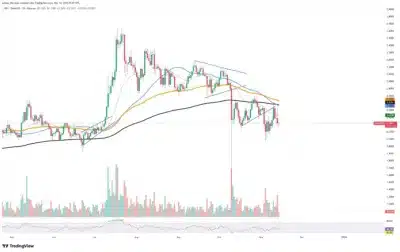
XRP has officially entered a bearish phase after its 50-day moving average (MA) crossed below the 200-day MA, signaling a death cross. This technical pattern is significant, as it marks the moment when short-term selling pressure overtakes long-term accumulation. Historically, death crosses have been indicators of a trend reversal, often pointing to further downside momentum. Although the immediate impact may not always trigger a steep decline, such formations typically set the tone for market sentiment in the weeks that follow.


As XRP struggles beneath a major resistance cluster, it’s clear that sellers are firmly in control. The 50-day, 100-day, and 200-day moving averages have now merged around the $2.55-$2.60 range, creating a heavy ceiling that XRP has struggled to break through. Despite a few attempts, the market has failed to sustain any rallies above this level. The inability to push higher reinforces the idea that XRP is facing more selling pressure than buying interest at this point. This pattern suggests that XRP could continue to face downward pressure, as brief rallies are likely to be sold into.

xrp

Source: Tradingview

Also Read: Peter Schiff Slams Bitcoin’s Collapse Below $100,000: Is the Crypto Bubble Finally Bursting?


Key Downside Targets and Support Zones for XRP

After the formation of the death cross, several critical support levels have emerged, providing insight into potential price action. The first notable support zone is around $2.20, where XRP has previously found some buying interest in recent weeks. A consolidation around this level would suggest that market participants are waiting for further confirmation before committing to a more decisive move.


However, should the selling momentum continue, XRP could face a deeper retracement. A break below the $2.20 mark would likely lead to a retest of the $2.00 level, which has acted as psychological and structural support in the past. This level is a crucial one to watch, as a retest could trigger a liquidity sweep, potentially flushing out weak hands and offering a better entry point for longer-term investors.


The most extreme downside target is set at $1.80. A drop to this level would signal a complete trend reversal, with the market likely losing its footing under the $2.00 support zone. Such a move would likely trigger further panic selling, potentially marking the low for the current cycle.


For XRP to reverse its bearish trend, it would need a significant catalyst, such as ETF approvals or regulatory clarity. Without such developments, the market is likely to remain under the influence of selling pressure.


Also Read: Egrag Crypto: “XRP Still Has 13% to Go Before This Happens”


The post XRP Faces a Bearish Shift After Death Cross Formation appeared first on 36Crypto.

Disclaimer: The articles reposted on this site are sourced from public platforms and are provided for informational purposes only. They do not necessarily reflect the views of MEXC. All rights remain with the original authors. If you believe any content infringes on third-party rights, please contact crypto.news@mexc.com for removal. MEXC makes no guarantees regarding the accuracy, completeness, or timeliness of the content and is not responsible for any actions taken based on the information provided. The content does not constitute financial, legal, or other professional advice, nor should it be considered a recommendation or endorsement by MEXC.
Tags:

You May Also Like

Franklin Templeton CEO Dismisses 50bps Rate Cut Ahead FOMC

Franklin Templeton CEO Dismisses 50bps Rate Cut Ahead FOMC

The post Franklin Templeton CEO Dismisses 50bps Rate Cut Ahead FOMC appeared on BitcoinEthereumNews.com. Franklin Templeton CEO Jenny Johnson has weighed in on whether the Federal Reserve should make a 25 basis points (bps) Fed rate cut or 50 bps cut. This comes ahead of the Fed decision today at today’s FOMC meeting, with the market pricing in a 25 bps cut. Bitcoin and the broader crypto market are currently trading flat ahead of the rate cut decision. Franklin Templeton CEO Weighs In On Potential FOMC Decision In a CNBC interview, Jenny Johnson said that she expects the Fed to make a 25 bps cut today instead of a 50 bps cut. She acknowledged the jobs data, which suggested that the labor market is weakening. However, she noted that this data is backward-looking, indicating that it doesn’t show the current state of the economy. She alluded to the wage growth, which she remarked is an indication of a robust labor market. She added that retail sales are up and that consumers are still spending, despite inflation being sticky at 3%, which makes a case for why the FOMC should opt against a 50-basis-point Fed rate cut. In line with this, the Franklin Templeton CEO said that she would go with a 25 bps rate cut if she were Jerome Powell. She remarked that the Fed still has the October and December FOMC meetings to make further cuts if the incoming data warrants it. Johnson also asserted that the data show a robust economy. However, she noted that there can’t be an argument for no Fed rate cut since Powell already signaled at Jackson Hole that they were likely to lower interest rates at this meeting due to concerns over a weakening labor market. Notably, her comment comes as experts argue for both sides on why the Fed should make a 25 bps cut or…
Share
BitcoinEthereumNews2025/09/18 00:36
Cashing In On University Patents Means Giving Up On Our Innovation Future

Cashing In On University Patents Means Giving Up On Our Innovation Future

The post Cashing In On University Patents Means Giving Up On Our Innovation Future appeared on BitcoinEthereumNews.com. “It’s a raid on American innovation that would deliver pennies to the Treasury while kneecapping the very engine of our economic and medical progress,” writes Pipes. Getty Images Washington is addicted to taxing success. Now, Commerce Secretary Howard Lutnick is floating a plan to skim half the patent earnings from inventions developed at universities with federal funding. It’s being sold as a way to shore up programs like Social Security. In reality, it’s a raid on American innovation that would deliver pennies to the Treasury while kneecapping the very engine of our economic and medical progress. Yes, taxpayer dollars support early-stage research. But the real payoff comes later—in the jobs created, cures discovered, and industries launched when universities and private industry turn those discoveries into real products. By comparison, the sums at stake in patent licensing are trivial. Universities collectively earn only about $3.6 billion annually in patent income—less than the federal government spends on Social Security in a single day. Even confiscating half would barely register against a $6 trillion federal budget. And yet the damage from such a policy would be anything but trivial. The true return on taxpayer investment isn’t in licensing checks sent to Washington, but in the downstream economic activity that federally supported research unleashes. Thanks to the bipartisan Bayh-Dole Act of 1980, universities and private industry have powerful incentives to translate early-stage discoveries into real-world products. Before Bayh-Dole, the government hoarded patents from federally funded research, and fewer than 5% were ever licensed. Once universities could own and license their own inventions, innovation exploded. The result has been one of the best returns on investment in government history. Since 1996, university research has added nearly $2 trillion to U.S. industrial output, supported 6.5 million jobs, and launched more than 19,000 startups. Those companies pay…
Share
BitcoinEthereumNews2025/09/18 03:26
Fed Makes First Rate Cut of the Year, Lowers Rates by 25 Bps

Fed Makes First Rate Cut of the Year, Lowers Rates by 25 Bps

The post Fed Makes First Rate Cut of the Year, Lowers Rates by 25 Bps appeared on BitcoinEthereumNews.com. The Federal Reserve has made its first Fed rate cut this year following today’s FOMC meeting, lowering interest rates by 25 basis points (bps). This comes in line with expectations, while the crypto market awaits Fed Chair Jerome Powell’s speech for guidance on the committee’s stance moving forward. FOMC Makes First Fed Rate Cut This Year With 25 Bps Cut In a press release, the committee announced that it has decided to lower the target range for the federal funds rate by 25 bps from between 4.25% and 4.5% to 4% and 4.25%. This comes in line with expectations as market participants were pricing in a 25 bps cut, as against a 50 bps cut. This marks the first Fed rate cut this year, with the last cut before this coming last year in December. Notably, the Fed also made the first cut last year in September, although it was a 50 bps cut back then. All Fed officials voted in favor of a 25 bps cut except Stephen Miran, who dissented in favor of a 50 bps cut. This rate cut decision comes amid concerns that the labor market may be softening, with recent U.S. jobs data pointing to a weak labor market. The committee noted in the release that job gains have slowed, and that the unemployment rate has edged up but remains low. They added that inflation has moved up and remains somewhat elevated. Fed Chair Jerome Powell had also already signaled at the Jackson Hole Conference that they were likely to lower interest rates with the downside risk in the labor market rising. The committee reiterated this in the release that downside risks to employment have risen. Before the Fed rate cut decision, experts weighed in on whether the FOMC should make a 25 bps cut or…
Share
BitcoinEthereumNews2025/09/18 04:36