

Michael Burry Says This Deal Is “The Beginning of the End.” Should Investors Follow His Shorts?
Key Stats
- Burry disclosed fresh short positions in six names: Micron, Nvidia, Tesla, Caterpillar, Applied Materials, and the SOXX semiconductor ETF.
- Samsung and SK Hynix announced a major new chip manufacturing hub in Korea, which Burry called “the beginning of the end.”
- Burry’s most notable recent miss was calling for a short on the S&P 500 in 2023, a rally that would have been deeply painful for anyone who followed him in.
Michael Burry doesn’t post often, but when he does, markets pay attention. The investor who shorted the housing market ahead of the 2008 collapse and was immortalized by Christian Bale in The Big Short resurfaced on July 1 with a Substack post reacting to Samsung and SK Hynix’s announcement of a major Korean chip manufacturing hub.
His reaction was characteristically blunt: “I see that as the beginning of the end.” He then disclosed fresh short positions in Micron (MU), NVIDIA (NVDA), Tesla (TSLA), Caterpillar (CAT), Applied Materials (AMAT), and the SOXX semiconductor ETF.
That kind of disclosure from that particular investor moves markets and dominates timelines, which is exactly what happened. But the question worth asking isn’t whether you should copy his trade. Blindly following anyone’s shorts is a lazy strategy, and with Burry specifically, the timing risk is very real. The better question is what the underlying thesis actually is, and what you’d need to see in the data for it to play out.
Rest assured, this isn’t a piece about whether Burry is right. It’s more about understanding the framework he’s using, what his track record actually looks like, and how you can stress-test the thesis yourself.
Now Live: Discover how much upside your favorite stocks could have using TIKR’s new Valuation Model (It’s free)>>>
The Thesis: Too Much Supply, Too Many Assumptions
Burry’s core argument appears to be that the memory and semiconductor complex is topping. Samsung and SK Hynix building out a massive new manufacturing hub in Korea is, in his framing, a classic late-cycle signal. Capacity is coming online at exactly the moment when the demand assumptions baked into current valuations are most vulnerable to being tested.
To be clear, this is not a new playbook. Memory chips are closer to commodities than most investors want to admit, and commodity-like industries tend to overshoot badly on capacity during boom cycles. When that supply hits the market, and demand softens even slightly, prices collapse quickly.
 Micron’s revenue is surging fast. (TIKR)
Micron has lived through this cycle multiple times. The real question is whether AI has genuinely changed the demand picture this time, or whether the same dynamics apply.
NVIDIA is a more complicated short. The stock is priced for years of continued dominance in AI infrastructure spending, and Burry’s bet seems to be that those assumptions are more fragile than the market thinks. The Samsung and SK Hynix announcement, in his view, suggests the buildout is further along than most people appreciate.
 NVIDIA’s LTM P/E, compressed. (TIKR)
See analysts’ growth forecasts and price targets for chip stocks (It’s free) >>>
Respect the Insight, Question the Timing
The 2008 trade was real and extraordinary. Burry saw something almost nobody else saw, held a painful position for longer than most people could stomach, and was proven right in spectacular fashion. Now, this reputation follows him everywhere, which is partly why his posts move markets.
But the record since then is worth knowing, as Burry’s call to short the S&P 500 in 2023 was wrong and badly timed. The market rallied hard, and anyone who followed him took real damage.
He’s made other calls that were directionally interesting but early enough to be painful in practice. In markets, being early and being wrong feel about the same when you’re living through it.
None of that disqualifies the semiconductor thesis, but it does likely mean you shouldn’t be outsourcing your thinking to him.
Estimate a company’s fair value instantly (Free with TIKR) >>>
What You Should Actually Be Watching
The most useful thing you can do right now is pull up Micron and NVIDIA in TIKR and see where they’re trading relative to their own history. If both stocks are near the high end of their five-year valuation ranges, there isn’t much cushion if earnings expectations start to slip.
After that, keep an eye on the estimates tab. In semiconductors, when analysts start cutting numbers, they tend to cut them more than once. Catching that first revision early matters.
It’s also worth checking whether management guidance is tracking with what the street is modeling, because when those two start to diverge, something is usually about to give.
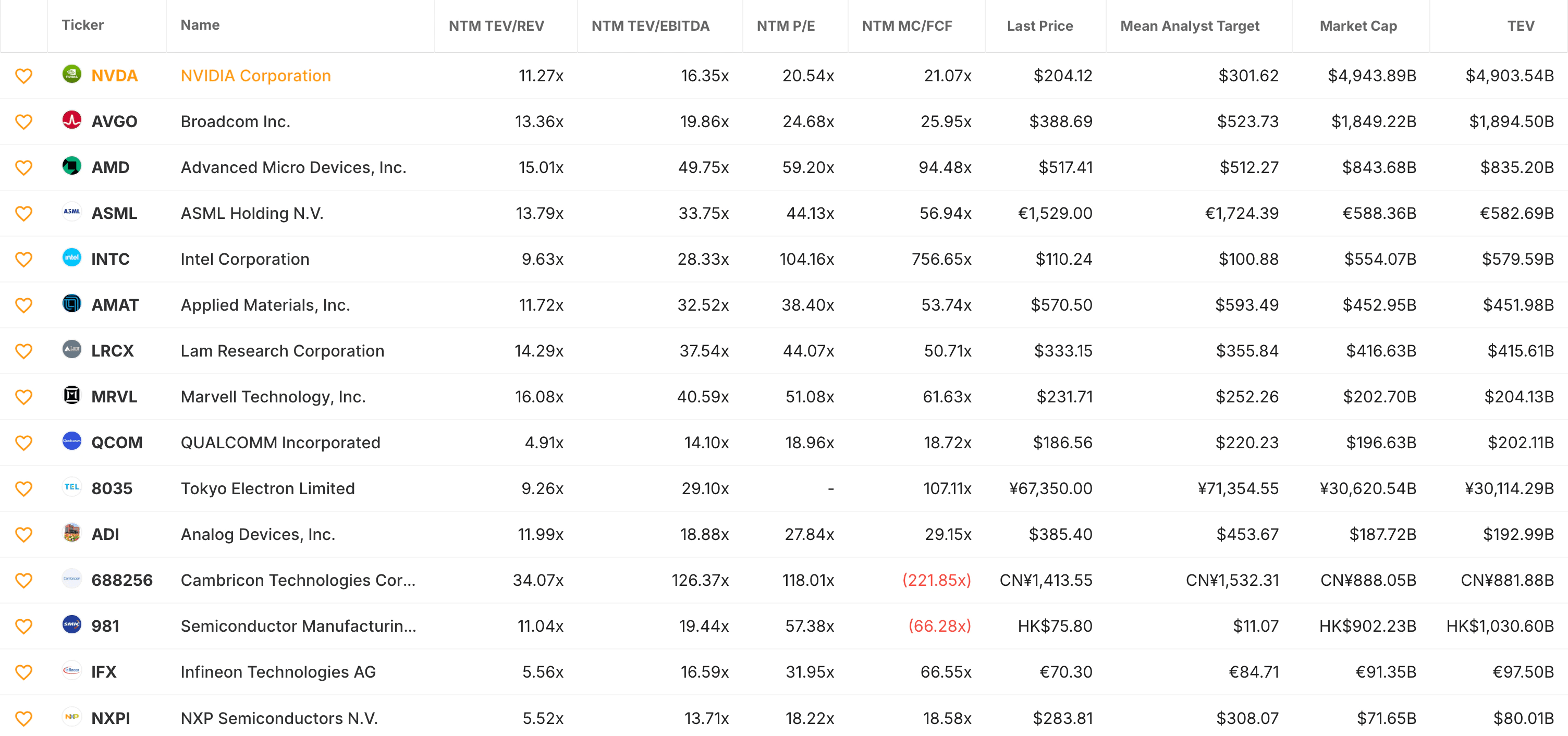 NVIDIA’s semiconductor peers, by multiple. (TIKR)
The Competitors table rounds out the picture. When the whole peer group is priced for a perfect outcome and one name cracks, the pressure tends to spread.
Seeing the full group laid out in one place makes that dynamic a lot easier to spot before it gets away from you.
See a stock’s true value in under 60 seconds (Free with TIKR) >>>
Looking for New Opportunities?
- See what stocks billionaire investors are buying so you can follow the smart money.
- Analyze stocks in as little as 5 minutes with TIKR’s all-in-one, easy-to-use platform.
- The more rocks you overturn… the more opportunities you’ll uncover. Search 100K+ global stocks, global top investor holdings, and more with TIKR.
Disclaimer:
Please note that the articles on TIKR are not intended to serve as investment or financial advice from TIKR or our content team, nor are they recommendations to buy or sell any stocks. We create our content based on TIKR Terminal’s investment data and analysts’ estimates. Our analysis might not include recent company news or important updates. TIKR has no position in any stocks mentioned. Thank you for reading, and happy investing!


You May Also Like
A New Era for Stablecoins — BIS Releases Podcast on Future Monetary Trust

Bitcoin treasury sell-off accelerates as Riot, Bhutan, and public companies exit positions

‘Everyone’ expects Spain to beat us, says Belgium coach



