

PayPal Stock Forecast as Low Valuation Persists and PYUSD Growth Returns
Key Insights
- PayPal stock has moved sideways in the past few months.
- The company has become one of the most undervalued in technology.
- The PYUSD market capitalization has jumped to $2.83 billion.
PayPal stock traded near $45 after months of weak momentum and limited investor conviction. PYPL remained above its 2026 low but far below its pandemic-era peak.
The valuation had compressed as revenue growth slowed and competition intensified across digital payments. Still, improving PYUSD activity, takeover interest, and a technical recovery setup gave investors several catalysts to track.
PayPal Stock Tracks PYUSD Stabilization
PayPal shares have lost most of their pandemic-era gains as investors reassessed the company’s growth profile. Competition across branded checkout and payment processing weakened the premium once attached to the stock.
That slowdown remained visible in analyst expectations. Revenue growth forecasts stayed in the low-single-digit range, far below the double-digit expansion recorded during earlier years.
PYUSD offered a separate growth avenue, though recent supply data required caution. The stablecoin exceeded $4 billion in market capitalization during March before retreating sharply.
Late-June data placed PYUSD near $2.70 billion. A move toward $2.83 billion would therefore represent a modest recovery from recent lows, not a new record expansion.
The distinction matters for PayPal stock. PYUSD can support payments, settlement and stablecoin-related revenue, but the token still operates in a crowded market.
Paxos issues PYUSD, while reserves include cash and short-term government-backed assets. PayPal’s direct economics therefore depend on its commercial arrangements rather than reserve growth alone.
Competition also increased after Open Standard announced Open USD. The consortium brought together more than 140 businesses and planned to launch the stablecoin later in 2026.
Its participants span payments, finance, and crypto. Open USD also plans to share reserve earnings with partners after a management fee, creating another enterprise distribution model.
PYPL Stock Has Become a Bargain
In an era when investors are highly concerned about valuations, PayPal has become one of the most affordable bargains. Its forward price-to-earnings ratio has slipped to 8.56, a tiny figure compared with its five-year average of 20. The multiple is also smaller than the financial services sector average of 11.37.
This cheap valuation is because the company has transitioned from a growth company into a value one. Indeed, its recent earnings show that the company’s growth has slowed. It made $8.3 billion in the first quarter, up by 7% from the same period last year.
Active accounts were flat at 439 million, while the number of payment transactions rose by 7%.
Still, on the positive side, the cheaper valuation means that the company may become an acquisition target. Indeed, a Bloomberg report in January showed that Stripe was considering a bid. And with such a low valuation, it’s likely to be acquired by a private equity company.
PYPL Stock Price Forecast: Technical Analysis
Technicals point to a strong rebound in the near term. It formed a double-bottom-like pattern at $40.15 and a neckline at $52, its highest point on April 20th. This pattern is one of the most popular bullish reversal patterns.
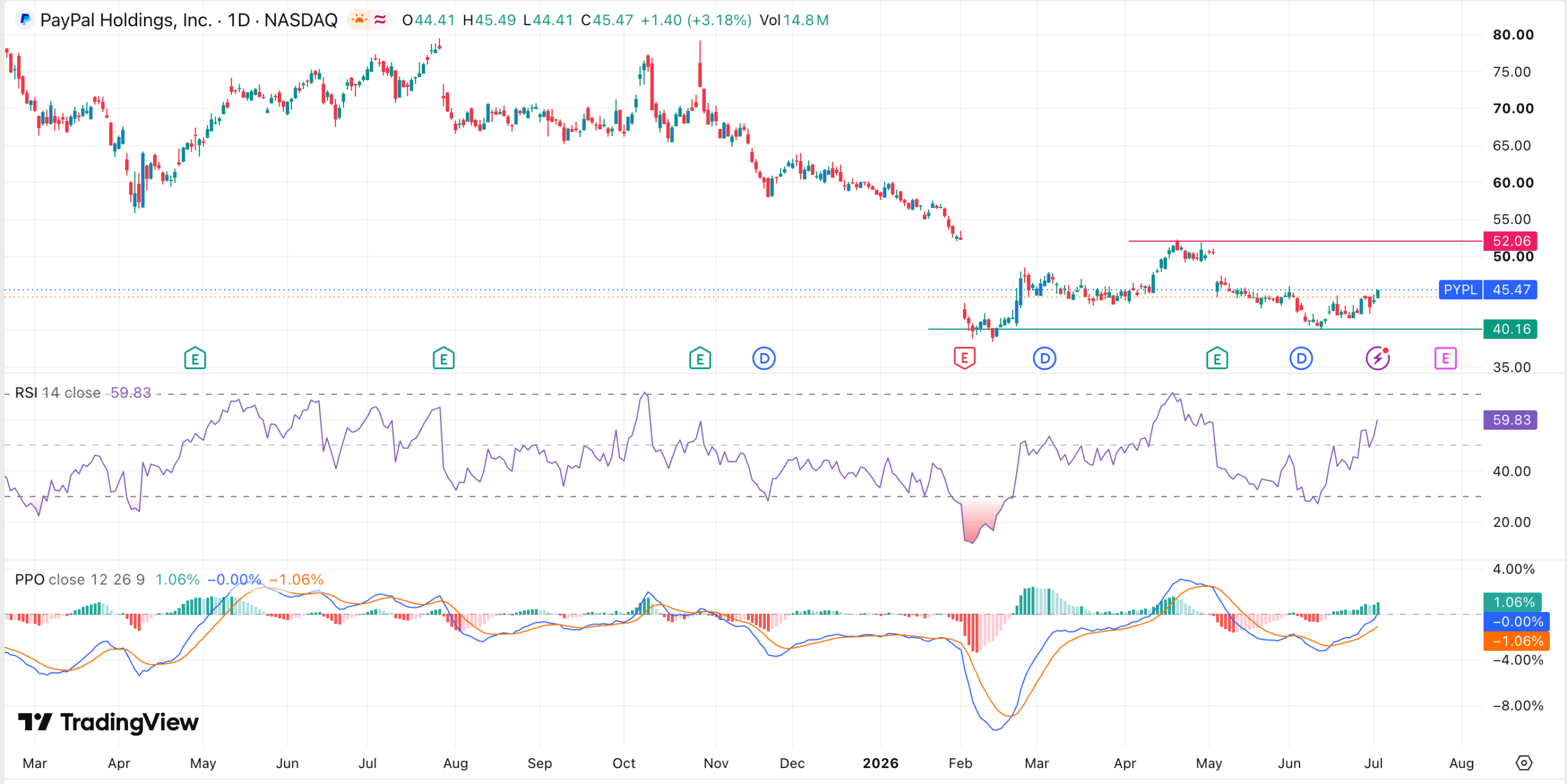 PayPal stock chart | Source: TradingView
The stock has also formed an island reversal pattern, which often leads to a strong reversal over time. Also, the Relative Strength Index (RSI) has continued rising and has recently crossed the neutral point of 50. The two lines of the MACD indicator have formed a bullish crossover.
Therefore, PayPal stock may rebound soon, potentially after it publishes its earnings on July 28th. If this happens, it may soar to the next key resistance level of $60.
The post PayPal Stock Forecast as Low Valuation Persists and PYUSD Growth Returns appeared first on The Market Periodical.


You May Also Like

AI data centers push Rush Belt manufacturers power costs to record levels

Mexico probing if US violated sovereignty in 2024 druglord capture

How to Spot a South African Cyber-Scam Before You Click “Pay”



