The market will show a downward trend in the short term, and then rebound and set new highs in the second half of the year.The market will show a downward trend in the short term, and then rebound and set new highs in the second half of the year.

Q2 Market Insights: Bitcoin regains dominance in risk-averse environment, ETFs remain critical to market structure

2025/04/28 19:40

Author:Coinbase & Glassnode

Compiled by: Felix, PANews

Crypto markets are experiencing a major correction as we head into the second quarter of 2025. Amid heightened macro uncertainty, investor sentiment has turned defensive, with funds flocking to high-cap assets such as Bitcoin. Despite the pressure on the altcoin market, core infrastructure continues to strengthen, on-chain fundamentals remain strong, and institutional interest remains stable through ETF channels and platform development.

This report, produced jointly by Coinbase and Glassnode, focuses on market structure, position trends, and key indicators in a complex and rapidly evolving environment. The following is the essence of the report:

Crypto Market Pullback Highlights Defensive Positioning
Q2 Market Insights: Bitcoin regains dominance in risk-averse environment, ETFs remain critical to market structure

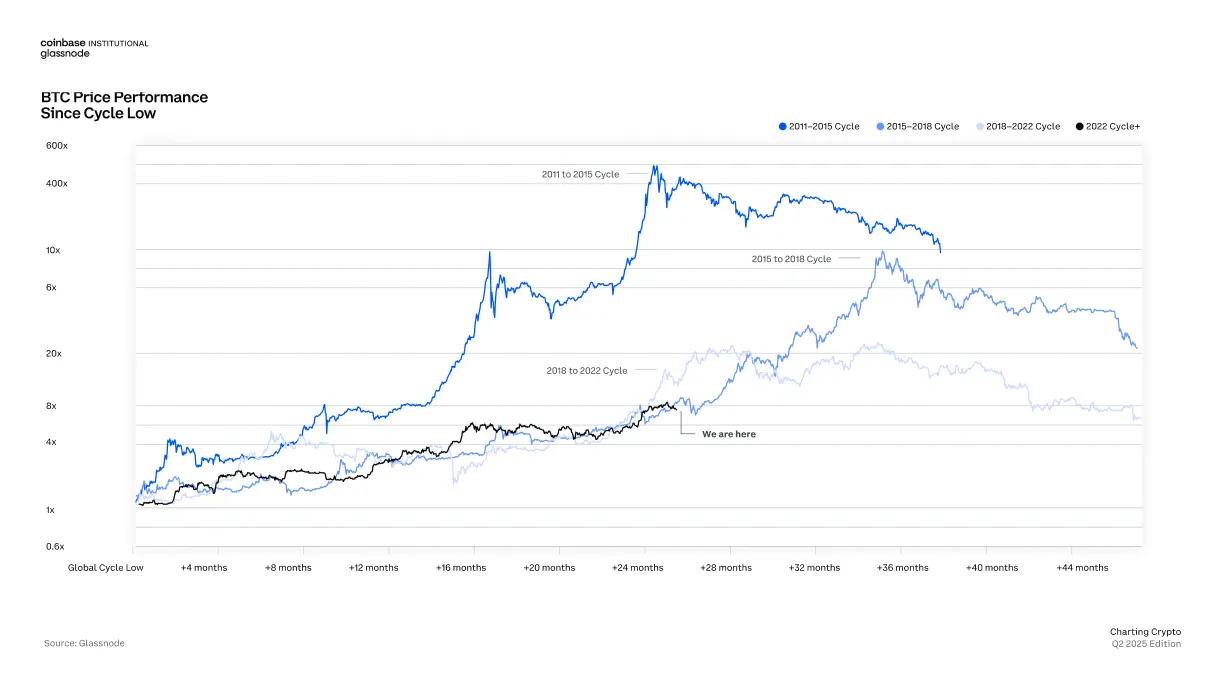
 Bitcoin 's cycle in 2022 and beyond is different from previous trends, and the recovery process is slower against the backdrop of macro uncertainty

Investor sentiment has changed dramatically since the beginning of 2025. Growing concerns about a potential US recession, fiscal tightening, and global trade frictions have triggered risk aversion in the digital asset market. Excluding BTC, the total cryptocurrency market cap is $950 billion, a sharp drop of 41% from the high of $1.6 trillion in December 2024 and a 17% drop from the same period last year. Venture capital inflows have fallen back to the levels of 2017-2018. Both Bitcoin and the COIN50 index have fallen below their 200-day moving averages. This suggests that the current correction may extend until mid-2025.

Bitcoin regains dominance amid risk-off environment
Q2 Market Insights: Bitcoin regains dominance in risk-averse environment, ETFs remain critical to market structure

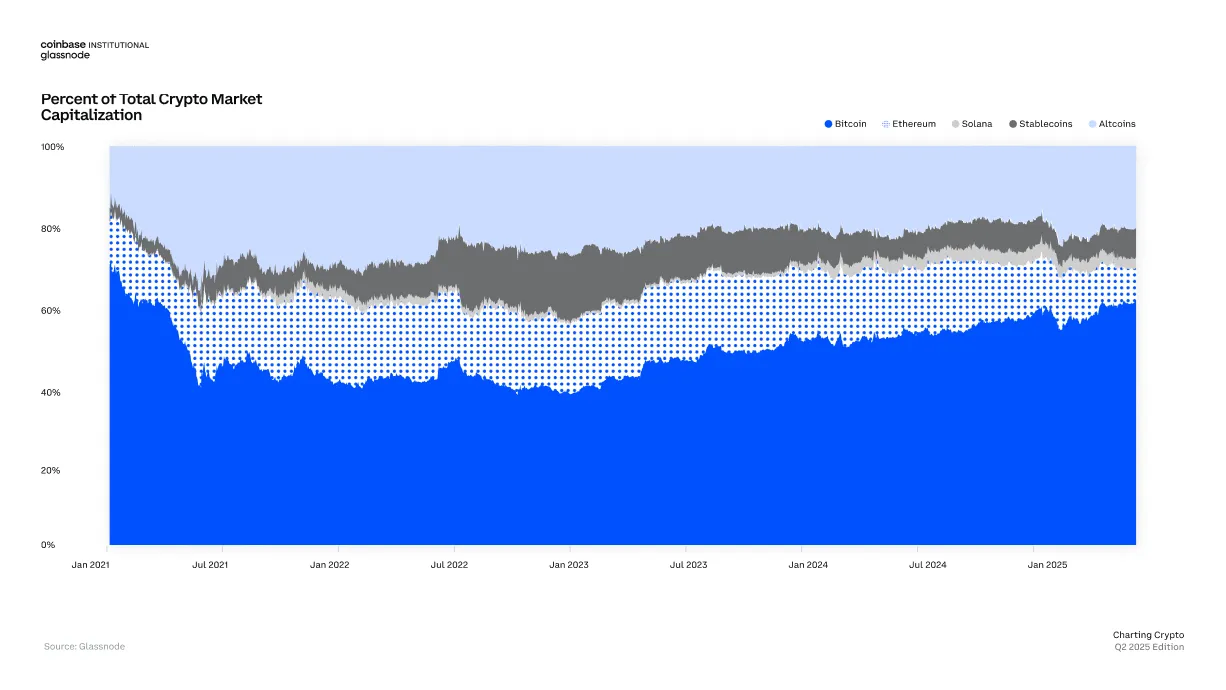
 Bitcoin dominance rises to 63% , highest level since early 2021 as investors turn to high-trust assets

During times of turmoil, capital moves to perceived quality assets — and Bitcoin benefits from this. Bitcoin currently accounts for 63% of the total crypto market cap, its highest level since early 2021. Meanwhile, Ethereum’s share of the total cryptocurrency market cap has shrunk over the past six months, while Solana’s share has remained stable since early 2024.

Bitcoin's dominance reflects investors' preference for assets with the highest institutional accessibility and macro correlation. Despite the price drop, long-term Bitcoin holders are still accumulating, as evidenced by the reduction in liquidity supply and the sharp rise in the number of Bitcoins held at a loss, indicating renewed confidence among strategic allocators.

Cash ETFs remain critical to market structure
Q2 Market Insights: Bitcoin regains dominance in risk-averse environment, ETFs remain critical to market structure

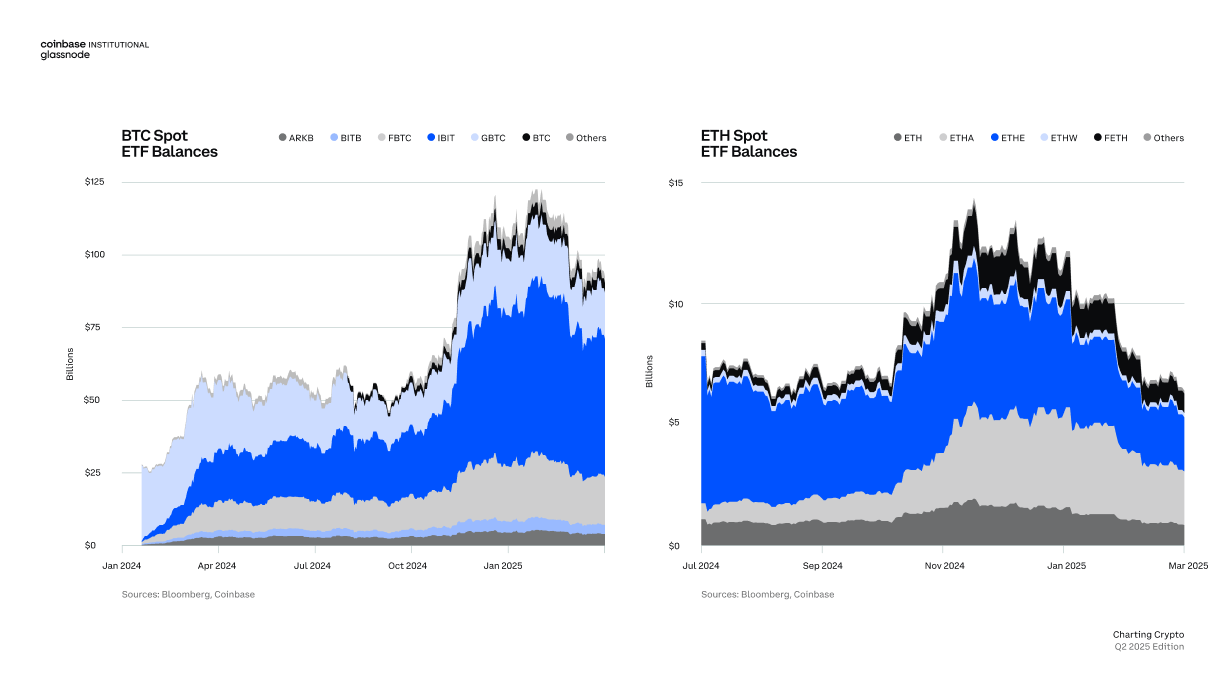
 Despite recent outflows, Bitcoin and Ethereum ETFs maintain sizeable holdings, indicating continued institutional interest

ETF flows remain a key indicator of institutional investor sentiment. In the first quarter, inflows into Bitcoin and Ethereum spot ETFs were subdued but continued, with total Bitcoin ETF balances approaching $125 billion. Although funding rates in the futures market have fallen, indicating a weakening of speculative appetite, spot ETF activity reflects long-term positioning.
Q2 Market Insights: Bitcoin regains dominance in risk-averse environment, ETFs remain critical to market structure

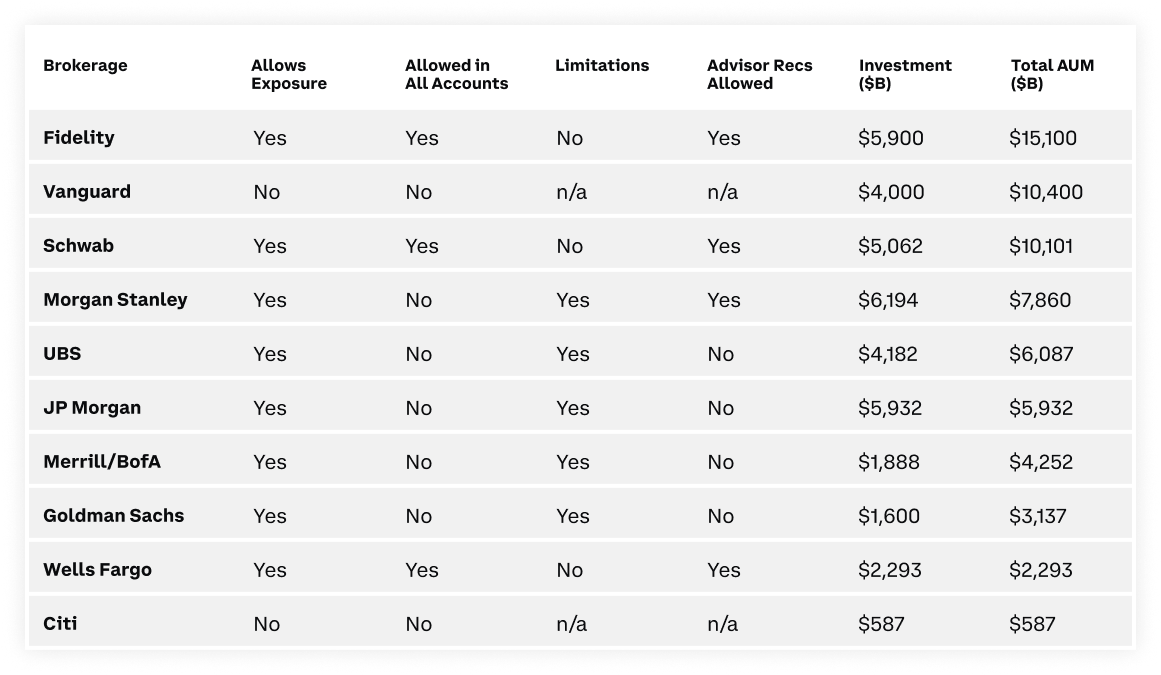
 Large brokerages are still limiting clients’ investments in Bitcoin ETFs . If these platforms set a 2% Bitcoin allocation, it would mean that ETF net inflows would be 22 times that of 2024.

Notably, investment restrictions by large brokerages hint at a potential wave of demand if entry restrictions are relaxed.

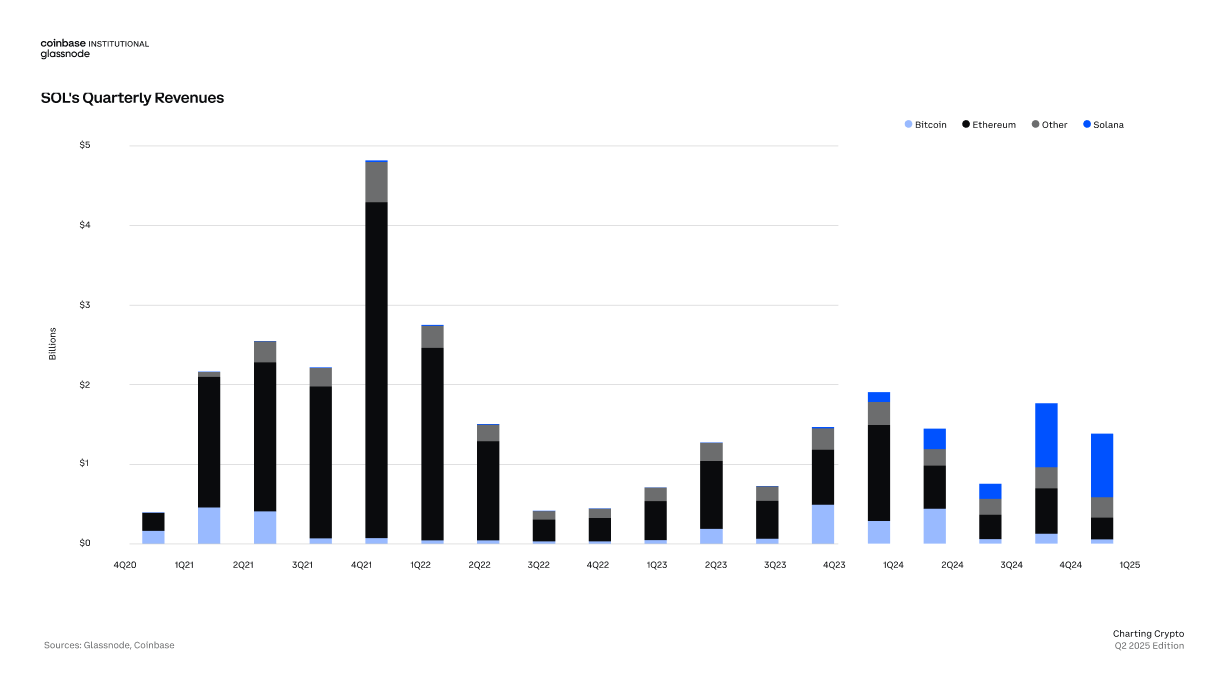
Solana revenue exceeds all other L1 and L2 platforms
Q2 Market Insights: Bitcoin regains dominance in risk-averse environment, ETFs remain critical to market structure

Solana surpassed all other blockchains in the first quarter, with revenue exceeding that of Bitcoin, Ethereum, and other blockchains combined.

Despite the macroeconomic shocks facing the market and the turbulent negative discussions around memecoin, Solana's revenue in the first quarter still exceeded the sum of all other L1 and L2 networks. This revenue highlights the continued stickiness of ecosystem users and shows that the capital efficiency and developer activity of the Solana ecosystem remain strong.

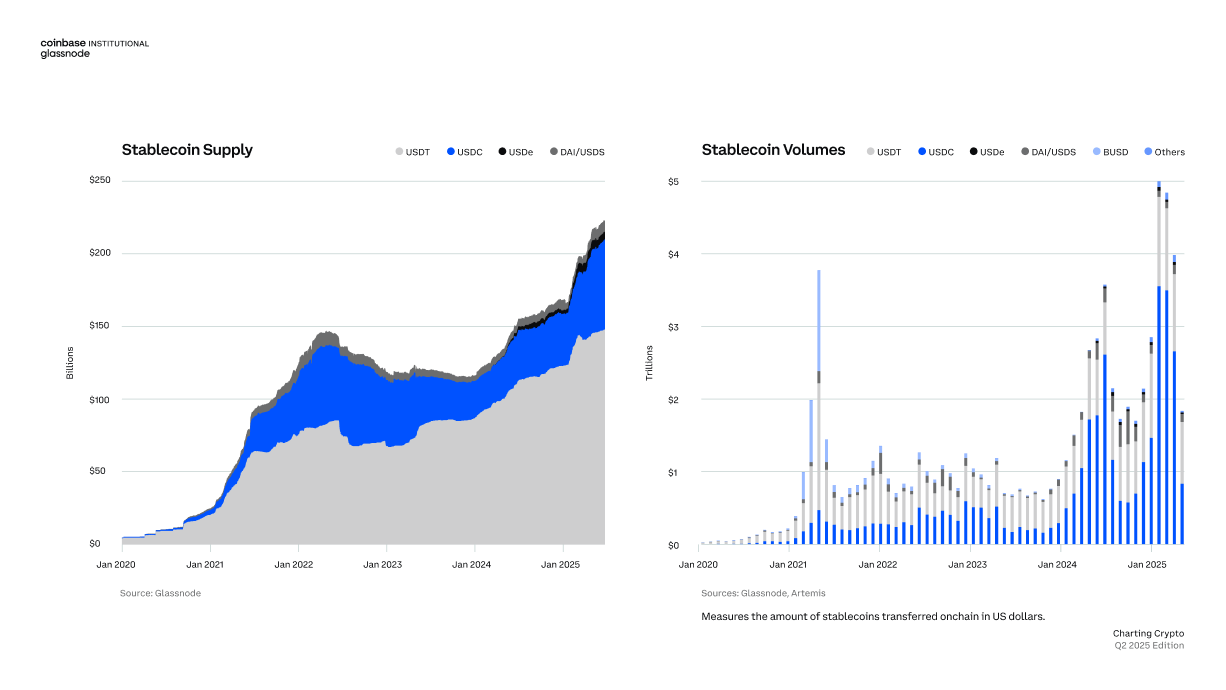
Stablecoins solidify their place as the backbone of crypto finance
Q2 Market Insights: Bitcoin regains dominance in risk-averse environment, ETFs remain critical to market structure

Stablecoin supply and on-chain transaction volume hit record highs, highlighting their increasingly important role in global digital payments.

As a core component of the crypto-financial system, stablecoins continue to attract attention. Adjusted for inactive transactions, stablecoin trading volume hit an all-time high last quarter. With falling fees and expanding use cases (from remittances to corporate payments), stablecoins are expected to attract more institutional and retail investors in 2025, especially in high-inflation economies.

Conclusion

The report believes that the crypto market may bottom out in the middle and late second quarter of 2025, laying the foundation for the trend in the third quarter of 2025. Overall, the market will show a downward trend in the short term, and then rebound and set a new high in the second half of the year. However, if the following factors occur, the above view will be invalid:

If the Fed ends quantitative tightening, it will increase global liquidity and support the crypto market. Similarly, if major economies such as the EU or China introduce more global fiscal stimulus, it may increase the M2 money supply and push up the capital available in the market.

More worryingly, further uncertainty over the trade war could prolong negative market sentiment, while global shocks could further reduce liquidity.

Related reading: Cryptocurrency Industry Report for the First Quarter of 2025: DeFi and NFT Ecosystem Trends, CEX and DEX Market Performance


Disclaimer: The articles reposted on this site are sourced from public platforms and are provided for informational purposes only. They do not necessarily reflect the views of MEXC. All rights remain with the original authors. If you believe any content infringes on third-party rights, please contact service@support.mexc.com for removal. MEXC makes no guarantees regarding the accuracy, completeness, or timeliness of the content and is not responsible for any actions taken based on the information provided. The content does not constitute financial, legal, or other professional advice, nor should it be considered a recommendation or endorsement by MEXC.

You May Also Like

Fed rate decision September 2025

Fed rate decision September 2025

The post Fed rate decision September 2025 appeared on BitcoinEthereumNews.com. WASHINGTON – The Federal Reserve on Wednesday approved a widely anticipated rate cut and signaled that two more are on the way before the end of the year as concerns intensified over the U.S. labor market. In an 11-to-1 vote signaling less dissent than Wall Street had anticipated, the Federal Open Market Committee lowered its benchmark overnight lending rate by a quarter percentage point. The decision puts the overnight funds rate in a range between 4.00%-4.25%. Newly-installed Governor Stephen Miran was the only policymaker voting against the quarter-point move, instead advocating for a half-point cut. Governors Michelle Bowman and Christopher Waller, looked at for possible additional dissents, both voted for the 25-basis point reduction. All were appointed by President Donald Trump, who has badgered the Fed all summer to cut not merely in its traditional quarter-point moves but to lower the fed funds rate quickly and aggressively. In the post-meeting statement, the committee again characterized economic activity as having “moderated” but added language saying that “job gains have slowed” and noted that inflation “has moved up and remains somewhat elevated.” Lower job growth and higher inflation are in conflict with the Fed’s twin goals of stable prices and full employment.  “Uncertainty about the economic outlook remains elevated” the Fed statement said. “The Committee is attentive to the risks to both sides of its dual mandate and judges that downside risks to employment have risen.” Markets showed mixed reaction to the developments, with the Dow Jones Industrial Average up more than 300 points but the S&P 500 and Nasdaq Composite posting losses. Treasury yields were modestly lower. At his post-meeting news conference, Fed Chair Jerome Powell echoed the concerns about the labor market. “The marked slowing in both the supply of and demand for workers is unusual in this less dynamic…
Share
BitcoinEthereumNews2025/09/18 02:44
3 Paradoxes of Altcoin Season in September

3 Paradoxes of Altcoin Season in September

The post 3 Paradoxes of Altcoin Season in September appeared on BitcoinEthereumNews.com. Analyses and data indicate that the crypto market is experiencing its most active altcoin season since early 2025, with many altcoins outperforming Bitcoin. However, behind this excitement lies a paradox. Most retail investors remain uneasy as their portfolios show little to no profit. This article outlines the main reasons behind this situation. Altcoin Market Cap Rises but Dominance Shrinks Sponsored TradingView data shows that the TOTAL3 market cap (excluding BTC and ETH) reached a new high of over $1.1 trillion in September. Yet the share of OTHERS (excluding the top 10) has declined since 2022, now standing at just 8%. OTHERS Dominance And TOTAL3 Capitalization. Source: TradingView. In past cycles, such as 2017 and 2021, TOTAL3 and OTHERS.D rose together. That trend reflected capital flowing not only into large-cap altcoins but also into mid-cap and low-cap ones. The current divergence shows that capital is concentrated in stablecoins and a handful of top-10 altcoins such as SOL, XRP, BNB, DOG, HYPE, and LINK. Smaller altcoins receive far less liquidity, making it hard for their prices to return to levels where investors previously bought. This creates a situation where only a few win while most face losses. Retail investors also tend to diversify across many coins instead of adding size to top altcoins. That explains why many portfolios remain stagnant despite a broader market rally. Sponsored “Position sizing is everything. Many people hold 25–30 tokens at once. A 100x on a token that makes up only 1% of your portfolio won’t meaningfully change your life. It’s better to make a few high-conviction bets than to overdiversify,” analyst The DeFi Investor said. Altcoin Index Surges but Investor Sentiment Remains Cautious The Altcoin Season Index from Blockchain Center now stands at 80 points. This indicates that over 80% of the top 50 altcoins outperformed…
Share
BitcoinEthereumNews2025/09/18 01:43
Bitcoin devs cheer block reconstruction stats, ignore security budget concerns

Bitcoin devs cheer block reconstruction stats, ignore security budget concerns

The post Bitcoin devs cheer block reconstruction stats, ignore security budget concerns appeared on BitcoinEthereumNews.com. This morning, Bitcoin Core developers celebrated improved block reconstruction statistics for node operators while conveniently ignoring the reason for these statistics — the downward trend in fees for Bitcoin’s security budget. Reacting with heart emojis and thumbs up to a green chart showing over 80% “successful compact block reconstructions without any requested transactions,” they conveniently omitted red trend lines of the fees that Bitcoin users pay for mining security which powered those green statistics. Block reconstructions occur when a node requests additional information about transactions within a compact block. Although compact blocks allow nodes to quickly relay valid bundles of transactions across the internet, the more frequently that nodes can reconstruct without extra, cumbersome transaction requests from their peers is a positive trend. Because so many nodes switched over in August to relay transactions bidding 0.1 sat/vB across their mempools, nodes now have to request less transaction data to reconstruct blocks containing sub-1 sat/vB transactions. After nodes switched over in August to accept and relay pending transactions bidding less than 1 sat/vB, disparate mempools became harmonized as most nodes had a better view of which transactions would likely join upcoming blocks. As a result, block reconstruction times improved, as nodes needed less information about these sub-1 sat/vB transactions. In July, several miners admitted that user demand for Bitcoin blockspace had persisted at such a low that they were willing to accept transaction fees of just 0.1 satoshi per virtual byte — 90% lower than their prior 1 sat/vB minimum. With so many blocks partially empty, they succumbed to the temptation to accept at least something — even 1 billionth of one bitcoin (BTC) — rather than $0 to fill up some of the excess blockspace. Read more: Bitcoin’s transaction fees have fallen to a multi-year low Green stats for block reconstruction after transaction fees crash After…
Share
BitcoinEthereumNews2025/09/18 04:07




