

US-Regulated Bitcoin Perpetuals May Reshape Crypto Trading
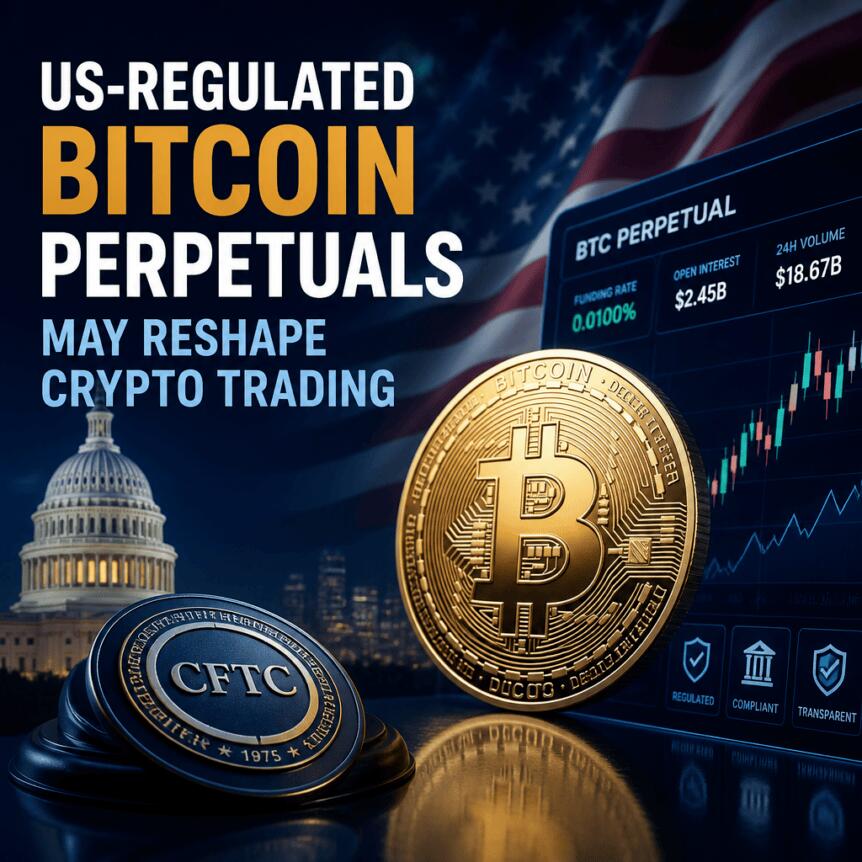
Perpetual futures have long been one of crypto’s most important trading tools, but for much of the industry’s growth they largely operated outside regulated US markets. That is starting to change: in late May 2026, the US Commodity Futures Trading Commission (CFTC) approved KalshiEX to list the BTCPERP contract, a Bitcoin perpetual futures product tied to the spot price of Bitcoin.
The approval matters beyond the contract itself. It signals that one of crypto’s most widely used leverage instruments may finally gain a clearer path within the federal regulatory framework—potentially reshaping how both retail and institutional participants access leveraged Bitcoin exposure in the United States.
Key takeaways
- The CFTC approved KalshiEX to list BTCPERP, bringing a Bitcoin perpetual futures product under a US-regulated listing framework.
- Perpetual futures differ from traditional futures in that they have no set expiration date, relying on funding payments to stay aligned with spot prices.
- US-regulated venues are expected to impose stricter compliance and risk controls than many offshore platforms, including KYC/AML and enhanced oversight.
- For institutions, regulated perps may remove some compliance barriers that previously limited participation in offshore markets.
- Crypto exchanges may face a new competitive dynamic as onshore regulated perpetuals potentially draw some liquidity over time.
Why BTCPERP’s approval is a market-structure milestone
According to the CFTC’s press release from late May 2026, the regulator approved KalshiEX to list BTCPERP. While regulated US derivatives have existed for years, perpetual contracts—popular across crypto markets globally—have historically been harder to place cleanly within traditional rulesets.
The regulatory move provides a specific reference point for how perpetual products can fit under existing futures market oversight, rather than being treated as an entirely separate category that regulators must address from scratch. It also increases “market clarity” around the treatment of perpetual contracts, including how they can be listed when safeguards are in place. That broader clarity is reflected in a federal register policy statement concerning the listing of perpetual contracts, published in early June 2026.
For traders, that distinction is important. Perpetuals are not just a niche product; they are a core mechanism for leverage, hedging, and short-term positioning. Bringing them into a more regulated US environment could change how risk is managed and how market participants decide between US and offshore execution.
Perpetual futures: how they work and why they spread
Perpetual futures, commonly called “perps,” are derivatives that let traders take exposure to Bitcoin’s price movement without holding the underlying asset. Unlike traditional futures, perpetual contracts do not come with a fixed expiration date—positions can remain open as long as margin requirements are met.
To prevent the contract price from drifting too far from Bitcoin’s spot price, perpetuals typically use a funding rate mechanism. Depending on prevailing market conditions, traders holding long positions may pay shorts (or vice versa) at periodic intervals. This funding exchange helps keep perp prices closer to spot.
That design has helped explain why perpetuals became a dominant product in crypto trading. They provide leverage and allow traders to express both bullish and bearish views without the operational friction of rolling expiring futures contracts. Over time, speculators, hedge funds, market makers, and arbitrage traders all adopted perps as a key part of their strategy toolkits.
What kept US markets on the sidelines—and what changes now
For years, US regulators were cautious about approving products that resembled the perpetuals widely offered on offshore crypto platforms. The concern was not about derivatives trading in general—regulated futures markets already exist in the United States. Instead, the hesitancy centered on features commonly associated with certain offshore venues, including very high leverage, limited customer protections, weaker transparency, and risks related to market manipulation.
As a result, many US participants had fewer options. They could either use offshore platforms where permitted, rely on other regulated derivatives such as CME Bitcoin futures, or use alternative regulated exposure such as spot Bitcoin exchange-traded funds (ETFs). This created an unusual imbalance: one of the most widely used crypto trading products stayed largely outside the mainstream of regulated US financial infrastructure.
BTCPERP’s approval is a step toward closing that gap. It also raises an immediate question for market participants: will regulated perpetuals offer enough liquidity and competitive execution to justify switching, particularly for strategies that rely on tight spreads and reliable order-book depth?
How regulated perps may differ for traders and institutions
While regulated perpetual contracts and offshore versions may appear similar from a distance—both can provide leveraged exposure to Bitcoin without requiring traders to hold BTC—US-regulated products are expected to operate under stricter market and compliance standards.
Under US regulatory oversight, exchanges are generally required to implement safeguards such as know-your-customer (KYC) and anti-money laundering (AML) checks, along with monitoring for potential abuse and regulatory review of risk management practices. Margin rules are also commonly more conservative than those found on many offshore venues, which can matter significantly for traders accustomed to very high leverage.
That trade-off is particularly relevant for retail participants. Regulation does not eliminate the core risk that perpetual futures carry: high leverage can amplify losses and lead to rapid liquidations during volatility spikes. The shift toward regulated venues may reduce certain market-structure risks, but it does not change that perpetuals remain leveraged derivatives where adverse moves can happen quickly.
For institutions, the impact could be more pronounced. Hedge funds, asset managers, and proprietary trading firms have often been constrained by internal compliance and risk policies when it comes to offshore derivatives exposure. A US-regulated listing framework may lower those barriers and help institutions build strategies that combine leveraged tools with more traditional oversight.
The potential upside for market quality is also tied to participation. If more institutional capital can access Bitcoin perps through regulated channels, that can improve liquidity and potentially make market pricing more efficient—though the timing and scale of any shift remain uncertain.
Competition may intensify as derivatives access becomes more “onshore”
BTCPERP’s approval also sets up a competitive test for trading platforms. Cointelegraph previously reported that KalshiEX secured the first approval for a regulated Bitcoin perpetual contract, and it is unlikely to be the last if the CFTC continues reviewing perpetual products under this framework.
Some exchanges have already been positioning for derivatives expansion and regulatory engagement. Cointelegraph coverage has noted Coinbase’s activity in crypto derivatives and its broader regulatory efforts connected to CFTC-regulated frameworks, including through a futures commission merchant arrangement.
Whether liquidity moves from offshore venues to regulated US platforms is not straightforward. Offshore exchanges still offer deep liquidity and established user bases. Any migration is likely to occur gradually—driven by factors such as available leverage, trading costs, market depth, institutional participation, and the predictability of the regulatory environment.
What regulators are still focused on
Even with approval, regulators’ concerns about perpetual futures remain. Leverage is at the center of the risk debate: during fast and large market swings, heavily leveraged positions can trigger liquidation cascades that can worsen volatility. Regulated venues may add safeguards around market structure, but they cannot remove the fundamental risks embedded in leveraged trading.
For readers, the key takeaway is that regulation primarily targets how the market operates—who is allowed to trade, how platforms are supervised, and what protections and controls exist—rather than guaranteeing that the investment outcome will be safe.
Traders and investors should watch how BTCPERP launches in practice: the contract’s terms, the depth of liquidity it attracts, and whether additional regulated perpetual approvals follow. Those developments will help determine whether regulated Bitcoin perps become a meaningful “mainstream” venue in the US—or whether offshore platforms retain their dominance for much of the market.
This article was originally published as US-Regulated Bitcoin Perpetuals May Reshape Crypto Trading on Crypto Breaking News – your trusted source for crypto news, Bitcoin news, and blockchain updates.


You May Also Like

Robotics Automation Prototyping: Engineering Kinetic Agility into End-Effectors

Kaiko Highlights Wrapped BTC Market Dynamics — What’s Next for Investors?

Fed Governor Calls For Strong Stablecoin Oversight As CLARITY Act’s Final Text Gets Delayed



