

Crypto Fantasy Sports in 2026: How Blockchain DFS Platforms Are Changing the Game
Daily fantasy sports and crypto were always going to end up together. DFS is a game built on information, speed, and the ability to move money quickly. These all happen to be three things crypto does better than traditional finance. Add blockchain’s ability to create verifiable digital ownership and you have the foundation for an entirely new category of sports gaming that traditional platforms like DraftKings and FanDuel were never built to deliver.
This guide covers how crypto fantasy sports platforms work, who the major players are, what makes them different from conventional DFS, and where the legal picture sits for US players in 2026.
What Is Daily Fantasy Sports?
Daily fantasy sports (DFS) is an online contest format where you build a virtual team of real professional athletes and compete against other players based on those athletes’ real-world statistical performance, all within a single day or week rather than a full season.
Here’s how it works in practice. You’re given a salary cap, and every available player is assigned a dollar value based on their expected performance. Your job is to build the highest scoring lineup possible without exceeding the cap. Once the games are played, your roster earns points based on what those real players actually do such as touchdowns thrown, goals scored, home runs hit, and so on. The player with the highest scoring lineup at the end of the day wins a share of the prize pool.
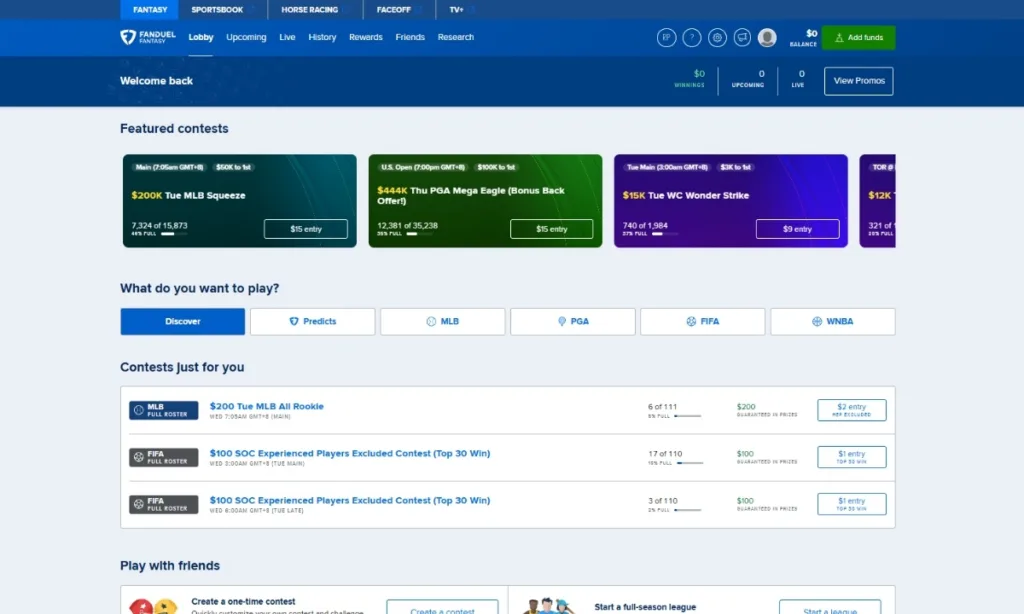 Daily Fantasy Sports lobby on FanDuel
It differs from traditional season-long fantasy leagues in one key way. It resets constantly. There’s no year long commitment to a fixed team or league. You can enter a new contest every day, play multiple contests simultaneously, and collect winnings immediately after games end. That speed and flexibility is a big part of what made DFS popular and it’s also what makes it a natural fit for crypto.
The two dominant platforms in the US are DraftKings and FanDuel, which between them handle the vast majority of DFS contest volume. Both are licensed operators in states where DFS is legal, which, as we’ll cover below, is an increasingly complicated picture.
What Makes Crypto DFS Different From Traditional Fantasy Sports
Standard DFS platforms like DraftKings work through the existing financial system. You deposit via credit card or bank transfer, build your lineup, and if you win, you wait for a payout to clear through the same slow banking rails. The platforms are centralized, meaning they hold your funds, control the prize pool, and act as the sole arbiter of results.
Crypto DFS flips that model in several meaningful ways
Settlement Speed
Settlement speed is the most immediate difference. Because blockchain transactions remove traditional banking intermediaries, deposits can process in minutes and winnings go directly to your wallet as soon as contests resolve. There are no processing windows, no bank holds, no waiting for a wire to clear.
Borderless Access
Borderless access is where it gets relevant for the US market specifically. The legal patchwork governing DFS in America, where some states have banned it entirely, others regulate it heavily, and the federal picture remains unsettled following recent Attorney General opinions, doesn’t apply in the same way to blockchain platforms operating outside the US system. That’s a significant draw for players in restricted states.
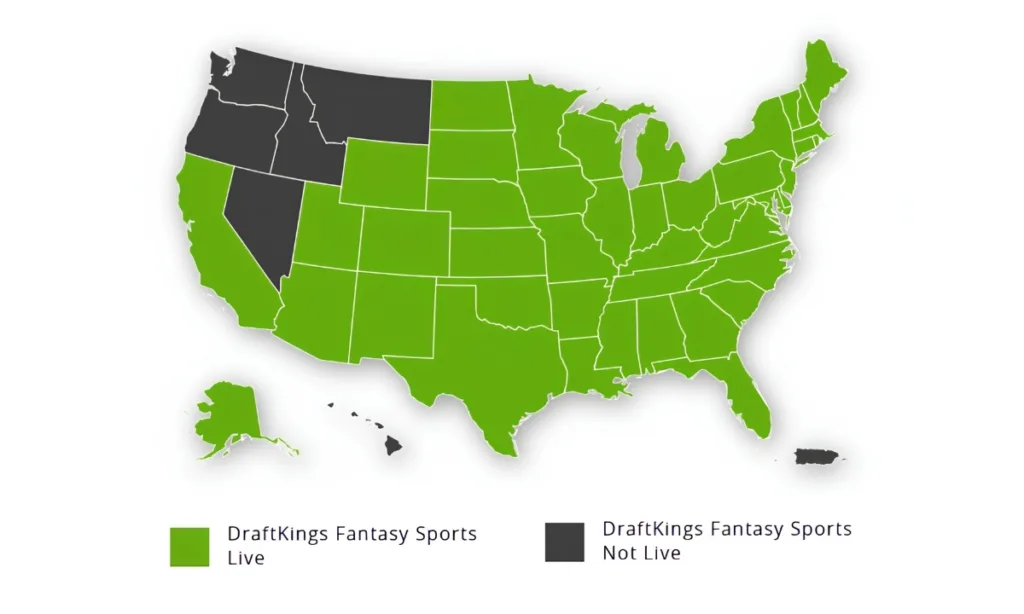 DraftKings Daily Fantasy Sports availability across US states highlights the fragmented regulatory landscape.
True Asset Ownership
True asset ownership is the more interesting innovation. On traditional platforms, the players in your lineup are just names tied to your account. They disappear when the season ends. On blockchain based platforms, those player representations can exist as NFTs. NFT’s are digital assets you actually own, can trade, and can carry value independent of any single contest.
Transparency
Transparency is a structural advantage. Smart contracts on a public blockchain execute and settle contests automatically according to pre-written rules. Anyone can audit how scores are calculated and how prizes are distributed.
The Best DFS Crypto Platforms
Sorare

Sorare is the most significant crypto fantasy sports platform in the world right now, and the one most relevant to a crypto audience. Founded in Paris in 2018 by Nicolas Julia and Adrien Montfort, it has grown into a global platform covering football (soccer), basketball (NBA), and baseball (MLB) as of 2026.
The model works differently from standard DFS. Rather than drafting players from a salary cap, you collect officially licensed digital player cards issued as NFTs on the blockchain. Each card represents a real professional athlete and comes in different scarcity tiers: Common, Limited, Rare, Super Rare, and Unique. Common cards are free to play with and can’t be traded. Limited and above exist on-chain, can be bought and sold on Sorare’s marketplace, and carry real monetary value based on the player’s performance and card rarity.
To compete in prize tournaments, you build a lineup of five cards and enter weekly competitions. Cards score points based on real-world match performances like goals, assists, saves, clean sheets, and so on depending on the sport. The higher your lineup scores relative to other managers, the better your prize.
Prizes include ETH, additional NFT cards, and real-world rewards like match tickets and VIP experiences. All transactions such as buying cards, entering tournaments and receiving prizes, run through a digital wallet, with ETH as the primary currency alongside card marketplace trading.
One significant development in 2026 is Sorare’s migration from Ethereum to Solana for its core game infrastructure. The move is designed to reduce transaction costs and improve platform speed while maintaining Ethereum access via Base for existing users. For players who have been frustrated by gas fees on card purchases and trades, this is a meaningful upgrade.
 Who it suits: Sorare rewards the intersection of sports knowledge and collectible strategy. It’s more like building a portfolio than picking a daily lineup.
Card values fluctuate based on player form, injury news, and market demand. If you understand both crypto markets and football, it’s a genuinely compelling combination.
Sport.Fun

Sport.Fun launched in late 2025 and has positioned itself as a crypto DFS platform taking direct aim at the mainstream incumbents. Where Sorare is built around collectibles, Sport.Fun is closer to traditional DFS mechanics. You draft lineups, compete in contests, and win prizes, but with a native token (FUN) at the center of the economy.
The FUN token launched in January 2026 with a revenue-sharing model that distributes platform income in a 40-40-20 split: 40% goes toward buying back FUN on the open market, 40% into USDC liquidity, and 20% toward platform growth. The intent is to create direct alignment between how well the platform performs and the value of the token its players hold.
Sport.Fun has partnered with MoonPay to allow fiat onboarding, which lowers the barrier for players who aren’t yet comfortable buying crypto first. The platform has been building its NBA integration and expanding its sportsbook of contests through 2026, with an eye on mainstream fantasy sports audiences beyond the crypto early adopters.
Who it suits: Players who want more familiar DFS mechanics, but want crypto settlement and the potential upside of holding a platform token. Lower barrier to entry than Sorare given the fiat onboarding option.
HotStreak
HotStreak stands out for its fully on-chain approach combined with innovative gameplay features. The platform emphasizes data science and has built a reputation for offering 10,000+ daily projections, advanced research tools, and very fast payouts. It was an early mover in features like injury insurance for players, live in-game entries, and fully customizable player lines (where users can set their own over/under thresholds).
In 2025 it moved to a fully on-chain model where balances, contest entries, and payouts occur on blockchain, giving users custody of their funds throughout. It also incorporates sportsbook style elements alongside DFS contests.
Who it suits: Data driven players who value projection depth, customization, and the transparency/speed of on-chain settlement without wanting to manage NFTs or platform tokens as a primary focus.
aiSports CryptoDFS

A pure blockchain native daily fantasy experience built on the Flow blockchain. Players connect a Flow wallet, draft NBA lineups within a salary cap, and compete in daily contests for crypto prizes (including the platform’s $JUICE token, which can be redeemed for NFTs or contest entries). It also features “Fast Break Vaults” where users can stake $FLOW into shared prize pools.
The platform leverages composability with NBA Top Shot, allowing collectors to use their existing NFTs in fantasy gameplay. While currently NBA focused, it aims to expand to additional major sports.
Who it suits: NBA fans already engaged with on-chain collectibles (especially Top Shot) who want a straightforward salary cap DFS format delivered entirely on blockchain with crypto-native rewards.
Blockchain Enhanced Traditional DFS
It’s also worth noting that some newer traditional DFS platforms are incorporating crypto payment options without going fully blockchain. Platforms like Underdog and Boom, which FOX Sports ranks among the top DFS apps of 2026, increasingly support crypto deposits and withdrawals alongside conventional payment methods. This isn’t the same as a blockchain-first as the underlying platform remains centralized, but for players who just want faster payouts and crypto deposit options without jumping into NFTs, it’s a middle path.
The US Legal Angle
This is where crypto DFS gets genuinely interesting for American players, and where the connection to the sweepstakes casino story becomes clear.
Traditional DFS operators like DraftKings and FanDuel have spent years arguing that their contests are games of skill, not chance and therefore not gambling under state law. That argument has been challenged with increasing success.
BIG LEGAL SIGNAL
A July 2025 California Attorney General opinion classified paid DFS as illegal sports wagering, joining a growing list of states where the legal foundation for conventional DFS is eroding.
Blockchain platforms operating from offshore jurisdictions sit outside this legal framework in a similar way to crypto casinos. They’re not licensed under US state DFS regulations because they don’t operate under them. For players in states where DFS has been restricted or is legally contested, this is a meaningful practical distinction.
The individual player risk profile mirrors what we cover in our US state gambling guides: US law on online gambling has historically focused enforcement on operators rather than players accessing foreign licensed platforms. That doesn’t make it zero risk, and consumer protections that apply to state licensed DFS operators don’t extend to blockchain platforms. Disputes go through the platform’s own resolution processes, not through a state gaming board.
For players in states with fully regulated iGaming, New Jersey, Michigan, Pennsylvania, Connecticut, and others, this is less of a factor. For players in restricted states, it’s a significant part of why crypto DFS is gaining traction.
How Crypto Payouts Work in DFS
The mechanics are worth understanding before you commit funds to any platform.
When you win on a platform like Sorare, prizes are distributed directly to the digital wallet connected to your account. Depending on the platform, winnings arrive in ETH, stablecoins like USDC, or the platform’s native token. The transaction happens on-chain, which means it’s verifiable and doesn’t require the platform to manually process a withdrawal.
The practical implications:
- Speed: On-chain distributions typically settle within minutes once a contest ends, versus hours or days on traditional platforms.
- Currency risk: If you’re paid in ETH and ETH drops 15% before you convert to fiat, your actual dollar winnings shrink accordingly. Stablecoin payouts eliminate this, so it’s worth checking which platforms offer USDC or USDT settlement.
- Tax treatment: Crypto winnings from DFS are still income under US federal tax law. The IRS treats gambling winnings as taxable regardless of the currency they arrive in, and crypto received as income is valued at fair market price on the day of receipt. Keep records of every payout.
- Wallet requirements: Most blockchain DFS platforms require you to connect a non-custodial wallet. MetaMask is the standard for Ethereum-based platforms, though Phantom is relevant for the Solana ecosystem that Sorare is migrating toward. Make sure you understand the wallet setup before depositing.
What to Look For in a Crypto DFS Platform
Not all platforms are equal, and the crypto space has its share of projects with more marketing than substance. A few things worth checking:
Licensing history of the underlying sports data
Sorare’s key differentiator is that its player cards are officially licensed by real leagues and clubs. That matters for both legal standing and card value. Platforms using player likenesses without official licensing are operating in murkier territory.
Smart contract audits
Reputable blockchain platforms have their smart contracts audited by independent security firms. If a platform can’t point you to an audit, treat that as a red flag.
Liquidity on the card marketplace
For NFT-based platforms like Sorare, the ability to sell cards you no longer want depends on there being active buyers. Check marketplace volume before buying expensive cards on a platform with thin trading activity.
Token economics
For platforms with native tokens like Sport.Fun’s FUN, understand how the token is actually used and what happens to its value if the platform’s user base doesn’t grow as projected. Token models that depend on continuous new user acquisition to sustain value are higher risk.
Withdrawal track record
Search Reddit and community forums for withdrawal complaints before depositing significant amounts. A platform’s responsiveness when things go wrong tells you more about it than its marketing does.
The Bigger Picture
Crypto DFS is still in it’s early phase. Sorare is the most mature platform in the space and it’s still working through growing pains. The Solana migration being the most recent example of infrastructure that’s still being built out. Sport.Fun is newer and unproven at scale. Some mainstream DFS incumbents may accept crypto but are not blockchain based.
What’s clear is that the structural advantages of blockchain inlcluding ownership, transparency, settlement speed, and borderless access, map well onto what DFS players actually want. The question isn’t whether crypto and fantasy sports belong together. It’s which platforms will execute well enough to make that combination work at meaningful scale.
For now, Sorare is the most experienced entry point for crypto players who want to combine sports knowledge with digital asset ownership. For those who want familiar DFS mechanics with crypto settlement, Sport.Fun is the most interesting emerging option to watch.
Information in this guide reflects the landscape as of June 2026. Platform terms, token economics, and legal status can change — always verify current conditions before depositing funds.
Sign up for our twice-weekly email promos and bonuses.
Sign up
Thanks for signing up!
Welcome to our community! Keep an eye out for our mailer twice a week, packed with the latest promotions, top bonuses, and special offers!
The post Crypto Fantasy Sports in 2026: How Blockchain DFS Platforms Are Changing the Game appeared first on BitcoinChaser.


You May Also Like

Robotics Automation Prototyping: Engineering Kinetic Agility into End-Effectors

Craving work-life balance is a huge red flag, says Fortune 500 Europe CEO—and like Barack Obama, he happily works through weekends

China Nabs Another Huione Group Core Member in Cambodia Extradition



