

Why the US Can’t Simply Ban Offshore Crypto Casinos — And How Regulators Are Trying Anyway
If the US government wants to stop Americans from gambling at offshore crypto casinos, why doesn’t it just pass a law banning offshore casinos from accepting US players?
It seems like the obvious solution. It is also, for reasons that reveal a great deal about how internet regulation actually works, essentially unenforceable, and the attempts to work around that fundamental limitation explain most of the regulatory history of US online gambling since 2006.
The Jurisdictional Problem
A US law is binding on entities subject to US jurisdiction. A casino licensed in Curaçao, operating servers in Malta, owned by a company incorporated in Cyprus, and accepting Bitcoin deposits from a blockchain address has no US presence. Congress passing a law saying “offshore casinos cannot accept US players” is passing a law aimed at a foreign company in a foreign country that has no obligation to comply and no US assets for federal authorities to seize.
It is the same reason the US cannot pass a law requiring French restaurants to use American ingredients. The legal principle is sovereignty.Each jurisdiction governs what happens within its own territory. An offshore casino is not within US territory. Its players might be, but the operator is not.
This is not a technicality that clever legislation could fix. It is a structural feature of how international law works. The only way to directly regulate an offshore casino is through international agreements, extradition treaties, or the physical presence of its executives in the United States, which is precisely why Jay Cohen of World Sports Exchange became the most prosecuted figure in US online gambling history, not because he ran an offshore sportsbook, but because he did so as a US citizen who returned to the country. The moment he stepped on US soil, he stepped into US jurisdiction.
The Curaçao-licensed operator who has never visited the US is legally untouchable by US domestic legislation.
UIGEA: The Workaround That Worked for Most Offshore Casinos
Facing this jurisdictional wall, Congress in 2006 found an elegant workaround. Rather than trying to regulate the offshore casino it couldn’t reach, it regulated the domestic financial institutions it could.
The Unlawful Internet Gambling Enforcement Act made it illegal for banks, credit card networks, and payment processors, all of which operate in the US, hold US licences, and are thoroughly subject to US law, to process payments to unlicensed online gambling operators. Crucially, UIGEA did not ban online gambling or criminalise individual players. Nor did it attempt to regulate offshore casinos directly. Its focus was on the domestic financial system, telling Visa, Mastercard, Bank of America, and every other US financial institution to stop facilitating payments to these merchants.
The effect was dramatic. Within weeks of UIGEA’s passage, major offshore operators including PartyGaming, 888, and Ladbrokes withdrew from the US market. Not because a law banned them as they remained legally untouchable offshorek, but because cutting off the payment flow made serving US players commercially unviable. UIGEA didn’t shut down offshore gambling for Americans. It made it sufficiently difficult that most major operators decided the market wasn’t worth the complexity.
The Black Friday poker prosecutions of 2011 followed the same principle, targeting PokerStars, Full Tilt Poker, and Absolute Poker with indictments. The charges were not for accepting US players. They were for bank fraud and money laundering. The operators had disguised gambling transactions as purchases from fictitious golf equipment companies and other legitimate businesses to circumvent the UIGEA payment blocks. The crime was the circumvention of US financial regulation, not the offshore gambling itself.
UIGEA was a genuinely effective piece of legislation within the limits of its design. Those limits became visible the moment cryptocurrency entered the picture
Why Crypto Broke the UIGEA Model
UIGEA’s entire mechanism depends on a domestic financial intermediary sitting between the player and the casino. The bank processes the credit card transaction. The payment processor clears the ACH transfer. Each of these intermediaries is a US regulated entity with compliance obligations. Block them, and you block the money.
A Bitcoin transaction from a self-custodial wallet to a casino deposit address has no US intermediary. The transaction is executed on a decentralized blockchain network. There is no bank to pressure, no payment processor to threaten, no domestic entity in the middle whose cooperation is required or can be compelled.
This is not a grey area or a technicality. It is the fundamental architecture of self-custodial cryptocurrency. A US player who buys USDT on an exchange, transfers it to a personal Trust Wallet, and sends it to a Curaçao licensed casino has completed a transaction in which the only US regulated entity involved was the original exchange purchase. From wallet to casino, the funds moved on a blockchain network that no US regulator controls.
UIGEA’s authors could not have anticipated this in 2006. The result is that the mechanism which reshaped the US online gambling market for 15 years simply does not apply to the transaction type that now dominates offshore gambling for American players.
The WTO Problem
Before crypto made UIGEA partially redundant, the US faced a separate challenge from international trade law.
Antigua and Barbuda, whose offshore gambling industry was significantly affected by UIGEA, filed a complaint with the World Trade Organisation arguing that the US was discriminating against foreign gambling services while permitting domestic equivalents. The WTO dispute resolution process ruled in Antigua’s favour. The US was found to be in breach of its trade commitments.
The US response was to modify its schedule of commitments to carve out gambling, essentially withdrawing the relevant trade obligation rather than complying with the ruling, and to negotiate compensation with most affected parties. Antigua received authorization to suspend US intellectual property protections in retaliation, though it has not fully exercised this right.
The episode illustrated a broader truth: even when the US has clear policy goals around offshore gambling, the international legal framework creates constraints that purely domestic legislation cannot overcome. The sovereignty problem operates in multiple directions.
The Current Regulatory Framework and Its Limits
In 2025 and 2026, US regulators are assembling a new toolkit for addressing offshore crypto gambling. None of it replicates UIGEA’s clean mechanism. Each tool works through a different route and reaches a different part of the problem.
Exchange level pressure
This is the closest equivalent to the UIGEA approach. Regulated US exchanges like Coinbase, Kraken and Gemini, are Money Services Businesses registered with FinCEN and subject to Bank Secrecy Act requirements.
As 1099-DA reporting makes crypto gambling transactions more visible to the IRS, and as CARF (Crypto Asset Reporting Framework) from 2027 extends that visibility to foreign exchange activity, exchanges face increasing pressure to flag or restrict transfers to known gambling wallet addresses.
This is not a legal mandate yet, but the the path seems clear. The exchange is the new payment processor in the UIGEA framework, and regulators know it.
The GENIUS Act (July 2025)

This legislation brought payment stablecoins under the (BSA) Bank Secrecy Act for the first time. On 8 April 2026, FinCEN (Financial Crimes Enforcement Network) and OFAC (Office of Foregn Asset Control) issued a joint proposed rule implementing GENIUS Act requirements for stablecoin issuers which mandates AML compliance, transaction monitoring, suspicious activity reporting, and OFAC screening.
With final enforcement beginning to ramp up in 2027, stablecoin issuers will eventually face the same compliance obligations as banks. For offshore casinos that rely on USDT deposits from US players, this creates a new pressure point.
Tether and Circle, as US adjacent stablecoin issuers, may face pressure to freeze addresses associated with unlicensed gambling activity, just as OFAC designated entities are already frozen from global dollar denominated transactions.
FinCEN’s proposed BSA expansion to crypto gambling:
This is the most direct regulatory attempt yet to reach offshore platforms. FinCEN has proposed extending Bank Secrecy Act suspicious activity reporting requirements to cover crypto gambling platforms, imposing the same obligations that apply to traditional casinos.
The proposal remains under review but signals the clear regulatory intent to treat crypto gambling operators as financial institutions subject to domestic AML requirements regardless of where they are headquartered. Whether this can be enforced against an entirely offshore operator with no US presence remains the same jurisdictional question UIGEA’s authors faced.
OFAC sanctions
This represent the most powerful available tool and the one that has already been used against gambling adjacent crypto operators. On 23 April 2026, OFAC designated a Cambodian casino operator,Crown Resorts and associated entities, for facilitating pig butchering scam compounds and money laundering through casino operations.
OFAC designations effectively cut designated entities off from the global US dollar financial system. Any US person or entity that transacts with a designated party faces severe penalties, and foreign banks that want to maintain access to US dollar correspondent banking generally comply with OFAC designations voluntarily.
OFAC is theoretically available as a tool against offshore crypto casinos that facilitate US player gambling, but using it against legitimate casino operators serving recreational US players would be a dramatic escalation that the current political environment makes highly unlikely.
The Trump Administration’s Pivot Changes the Calculation
Any analysis of US crypto gambling regulation in 2026 that ignores the political context is incomplete.
The Biden administration took an enforcement forward posture toward crypto generally. The SEC pursued high-profile actions against Coinbase and Binance, and the DOJ brought criminal charges against Binance and its founder Changpeng Zhao for AML violations. That approach created a regulatory climate in which pressure on offshore crypto gambling operators felt like a natural extension of broader crypto enforcement.
The Trump administration reversed this posture explicitly. The SEC dropped its enforcement actions against Coinbase and Binance. Zhao received a presidential pardon. The administration declared that “the Biden administration’s war on crypto is over” and advanced the GENIUS Act as a structured regulatory framework rather than an enforcement led approach.
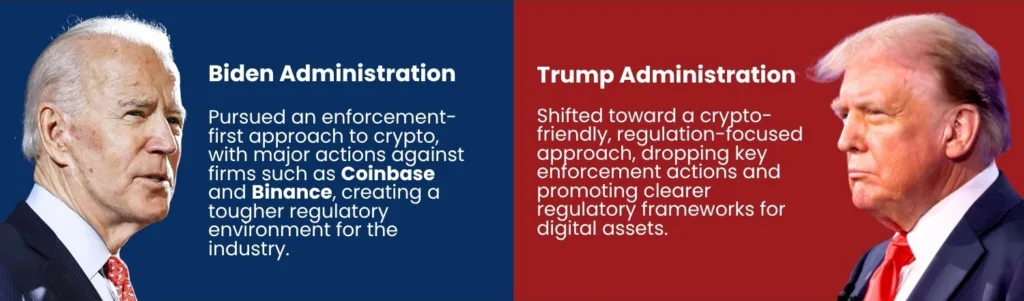
This matters for offshore crypto casino regulation in a specific way. The administration that controls DOJ prosecution priorities, FinCEN rulemaking, and OFAC designation decisions is now led by a president who has declared crypto friendly policies and whose political coalition includes significant crypto industry interests. The probability of aggressive enforcement action against offshore crypto casinos serving US recreational players, already low on its own merits, is lower still in this political environment.
The regulatory squeeze on offshore crypto gambling is coming through technical, structural mechanisms such as reporting requirements, exchange obligations, stablecoin compliance, rather than through the kind of aggressive enforcement posture that produced Black Friday in 2011.
What Regulators Are Actually Achieving
Despite the jurisdictional constraints and political headwinds, US regulators are achieving meaningful results through indirect pressure:
Visibility is increasing
1099-DA reporting from US exchanges, CARF from 2027, and the GENIUS Act stablecoin compliance framework are collectively creating a level of IRS and FinCEN visibility over crypto gambling flows that did not exist two years ago. Although The offshore casino remains out of reach, the money trail leading to it is increasingly visible.
Exchange relationships are tightening
Coinbase and Kraken, as publicly listed or heavily regulated US entities, face reputational and compliance pressure to distance themselves from obvious gambling flows. This is not a formal legal mandate today, but the trajectory is toward exchanges exercising more discretion over gambling-related transfers, voluntarily or under future FinCEN guidance.
The CLARITY Act creates a framework
The CLARITY Act, which cleared the Senate Banking Committee in May 2026, would formally classify many cryptocurrencies as digital commodities under primary CFTC oversight. Although it still needs to clear additional legislative hurdles, including full Senate passage and reconciliation with the House version, if enacted it would create a comprehensive federal framework for digital asset markets that includes provisions for combating illicit finance, potentially aiding efforts against offshore gambling, in an area that currently lacks specific crypto focused federal rules.
International coordination is expanding
The US participates in FATF (Financial Action Task Force) guidance on virtual assets that is increasingly incorporated by offshore jurisdictions. Curaçao’s own December 2024 licensing reform which abolishes the sub-licensing model and establishing the Curaçao Gaming Authority as sole regulator, was partly driven by FATF pressure on Curaçao to tighten its gaming regulatory framework. Regulators are working multilaterally even when bilateral US enforcement cannot reach offshore operators directly.
The Honest Assessment
The US cannot ban offshore crypto casinos from accepting US players in any direct, enforceable sense. The jurisdictional problem that prevented direct legislation before UIGEA still exists. Moreover, the UIGEA mechanism that worked for 15 years does not apply cleanly to self-custodial crypto transactions. The political environment under the current administration reduces the probability of aggressive enforcement action.
What is happening instead is a gradual tightening of the conditions under which offshore crypto gambling operates for US players. Not a ban, but an increasing tax and compliance burden on the flows that make it possible. Exchange reporting obligations make the activity visible. Stablecoin compliance requirements create new pressure points. Exchange level discretion is tightening. CARF extends IRS visibility to foreign exchange activity from 2027.
The offshore crypto casino is not going to be shut down by US regulation. It is going to be made progressively less private, progressively more visible to tax authorities, and progressively more dependent on players who understand and accept those conditions. That is a meaningfully different environment from the one that existed when offshore crypto casinos first began serving US players at scale, but it is also very different from the clean shutdown that UIGEA achieved against fiat payment processors in 2006.
The regulatory story of US offshore crypto gambling is not a story about prohibition. It is a story about visibility, and the visibility is increasing faster than most players realise.
This article is for informational purposes only and does not constitute legal or tax advice. Consult a qualified professional for guidance on your specific situation.
Related Articles on BitcoinChaser:
- US Crypto Gambling Legality Map 2026
- The End of Anonymous Gambling: How 2026’s Global Privacy Crackdown Is Reshaping Crypto Casinos
- The Sweepstakes Casino Crackdown: What US Players Need to Know
- Why US Players Get a Different Game Library at Offshore Casinos
- Best Bitcoin Casinos for US Players 2026
The post Why the US Can’t Simply Ban Offshore Crypto Casinos — And How Regulators Are Trying Anyway appeared first on BitcoinChaser.


You May Also Like

Exclusive interview with Smokey The Bera, co-founder of Berachain: How the innovative PoL public chain solves the liquidity problem and may be launched in a few months

Conservative columnist torches Trump 'cultists' paying $270 to fill their tank

Q2 Market Insights: Bitcoin regains dominance in risk-averse environment, ETFs remain critical to market structure



