

Customer Trust in CX: Designing Scalable, Human-Centric Experience Systems
Customer Trust in CX is no longer abstract—it is engineered through data, governance, and experience design. This analysis explores how enterprises can scale personalization, simplify omnichannel complexity, and balance operational efficiency with emotional resonance.
The Tension Defining Modern CX
Enterprises today are scaling automation at unprecedented levels—yet customers are simultaneously demanding more human, transparent, and trustworthy interactions. This is the central contradiction shaping modern customer experience.
Customer Trust in CX has emerged as the defining variable in resolving this tension. It is no longer sufficient for organizations to deliver fast or efficient service; they must ensure that every interaction is perceived as reliable, explainable, and aligned with customer intent.
What is changing is not just execution—but philosophy. Experience design is shifting from optimizing isolated touchpoints to engineering trust across entire customer journeys. In this environment, trust becomes both a strategic asset and an operational outcome.
This transition is being accelerated by the increasing use of AI in decision-making, the complexity of omnichannel ecosystems, and the growing scrutiny around data usage. As a result, Customer Trust in CX is becoming the foundation upon which long-term customer relationships are built.
Rising Expectations and Systemic Complexity
Customer expectations have evolved from transactional efficiency to relational confidence. Today’s customers evaluate experiences based on:
- How transparent decisions are
- Whether interactions feel consistent across channels
- How responsibly their data is used
- Whether personalization feels helpful rather than intrusive
This shift reflects a broader maturity in digital behavior. Customers are no longer passive recipients of service—they are active evaluators of how organizations operate.
At the same time, enterprises are navigating increasing operational complexity:
- Fragmented digital ecosystems across mobile, web, contact centers, and physical channels
- Legacy systems that limit real-time orchestration
- Rising cost pressures that demand automation at scale
- Regulatory environments emphasizing privacy, consent, and accountability
Industry benchmarks indicate that organizations prioritizing trust-centric strategies see stronger retention and reduced churn, suggesting that Customer Trust in CX is directly linked to economic outcomes, not just perception.
Technology trends are reinforcing this shift:
- AI-driven decision systems enabling real-time personalization
- Customer data platforms integrating fragmented data sources
- Journey orchestration tools coordinating cross-channel interactions
For CX leaders, the implication is structural. The challenge is no longer about improving isolated metrics like response time or resolution rate—it is about ensuring that every system contributing to the experience operates in a way that builds trust.
From Experience Optimization to Trust Engineering
The rise of Customer Trust in CX represents a strategic reorientation.
Historically, organizations approached CX through:
- Efficiency metrics (AHT, cost per contact)
- Channel optimization
- Reactive service recovery
This model is now insufficient. The emerging paradigm focuses on:
- Predictive engagement
- Journey orchestration
- Trust-centric design
This is both an offensive and transformational shift.
- Offensive, because trust becomes a competitive differentiator
- Transformational, because it requires rethinking operating models, governance, and metrics
Organizations are moving from:
to:
This shift also redefines competition. Enterprises are no longer compared solely on product or price—they are evaluated on how credible, consistent, and transparent their experience systems are.
In this context, Customer Trust in CX becomes a strategic positioning lever, influencing brand perception, retention, and long-term value creation.
Architecting Trust at Scale
Delivering Customer Trust in CX requires an integrated system architecture rather than isolated tools.
Frontend (CX Layer)
This is where customers directly interact with the organization:
- Unified interfaces across mobile, web, and support channels
- Consistent messaging and design language
- Clear communication of actions and decisions
Middleware (Orchestration Layer)
This layer coordinates experiences across systems:
- Journey orchestration engines
- Decisioning platforms
- API-based integrations across touchpoints
Backend (Data & AI Infrastructure)
The foundation of trust lies here:
- Real-time data platforms
- AI/ML models driving personalization and predictions
- Governance frameworks ensuring compliance and consistency
AI plays a critical role—but introduces risk if not governed effectively.
Without proper oversight:
- Personalization can feel invasive
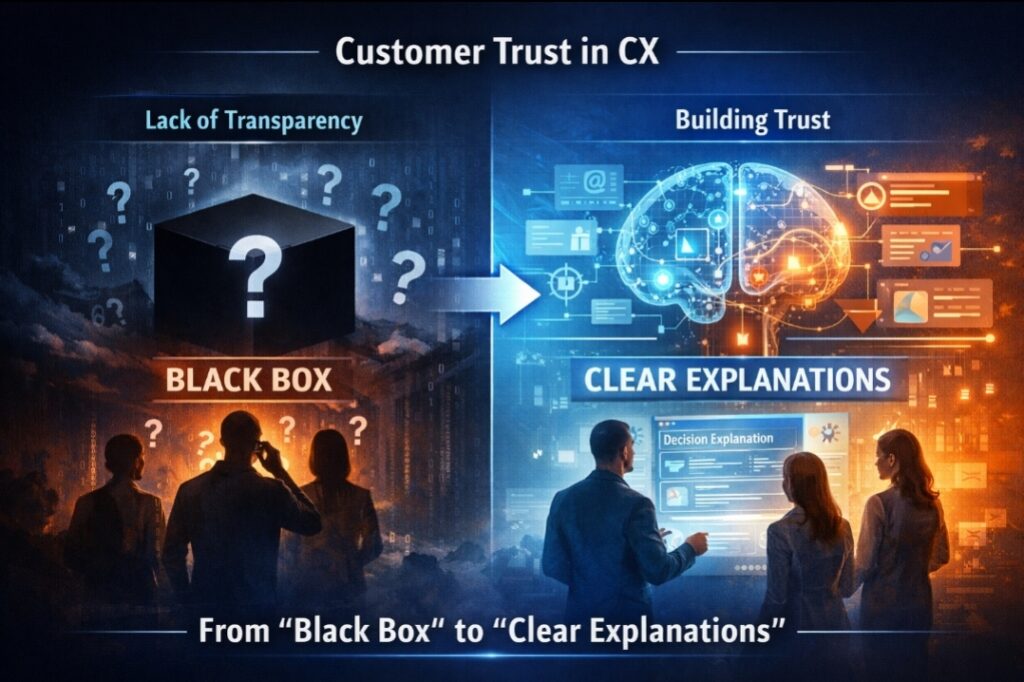
- Decisions can appear opaque
- Inconsistencies can erode confidence
With governance:
- AI becomes explainable
- Decisions become predictable
- Experiences become consistent
Key enabling systems include:
- Customer Data Platforms (CDPs)
- Consent and privacy management systems
- Explainable AI frameworks
These components collectively enable organizations to design experiences that are not only efficient—but credible.
From Fragmentation to Trust-Centric Journeys
The transition to Customer Trust in CX fundamentally reshapes customer journeys.
Before
- Disconnected channels leading to repeated effort
- Inconsistent messaging across touchpoints
- Limited visibility into decision logic
- Reactive service interactions
After
- Seamless omnichannel experiences
- Consistent and predictable interactions
- Transparent communication on decisions
- Proactive engagement driven by insights
Impact Dimensions
Speed
Predictive systems reduce response times and anticipate needs
Reliability
Consistent execution across channels builds confidence
Transparency
Clear explanations of decisions reduce uncertainty
Consistency
Unified systems eliminate contradictions across interactions
Personalization
Context-aware engagement improves relevance without overreach
Cause → Effect Mapping
- Integrated data → better context → more accurate personalization → higher trust
- Governance frameworks → reduced variability → improved reliability
- Orchestration engines → seamless journeys → lower friction
Operating Model Translation
Achieving this requires organizational change:
- CX teams must collaborate with data and AI teams
- Governance must extend beyond compliance into experience design
- Decision-making must be cross-functional and aligned
This elevates CX from a functional role to a system-level capability.
Trust as Infrastructure
The emergence of Customer Trust in CX signals a structural shift across industries.
Trust as a KPI
Organizations will increasingly measure:
- Trust indices
- Transparency scores
- Experience consistency metrics
Competitive Response
To remain relevant, competitors must:
- Invest in integrated data infrastructure
- Simplify omnichannel ecosystems
- Establish governance frameworks for AI and CX
Structural Shift
Customer experience is evolving into a cross-functional discipline integrating:
- Technology
- Operations
- Governance
- Strategy
Time Horizon
Short-Term (0–2 years)
- Rapid adoption of AI-driven CX systems
- Increased focus on omnichannel consistency
Medium-Term (3–5 years)
- Formalization of trust metrics
- Governance embedded in CX strategy
- Emergence of “responsible personalization” as a standard
Operationalizing Trust
Build vs Buy vs Partner
- Build when trust differentiation is a core strategic asset
- Buy when speed and scalability are priorities
- Partner when ecosystem integration is complex
Adoption Readiness
Organizations must assess:
- Data maturity (availability, quality, integration)
- Organizational alignment across CX, IT, and operations
- Change management capability
Risk Assessment
- Execution Risk: Integration failures across systems
- CX Risk: Over-automation reducing human connection
- Governance Risk: Misuse or misinterpretation of data
Implementation Complexity
Medium to High
Driven by:
- Cross-functional coordination
- System integration challenges
- Governance and compliance requirements
Toward Trust-Centric Enterprises
The trajectory of Customer Trust in CX points toward a new operating paradigm.
Future organizations will:
- Anticipate customer needs proactively
- Provide transparent explanations for decisions
- Balance automation with human oversight
This evolution represents a shift from:
- Experience optimization
to - Trust engineering at scale
As AI becomes more embedded in decision-making, the organizations that succeed will be those that:
- Align technology with governance
- Design systems for consistency and transparency
- Embed trust into every layer of the experience
Ultimately, Customer Trust in CX will define long-term competitive advantage—not as a soft metric, but as a measurable, operational, and strategic capability.
KEY INSIGHTS FOR CX LEADERS
1. Trust Must Be Designed, Not Assumed
Customer Trust in CX is no longer an emergent outcome of good service—it is a system-level construct that must be intentionally designed. This requires aligning data, decisioning logic, and experience flows to produce consistent and predictable outcomes. Organizations that rely on fragmented systems will struggle to maintain trust at scale. Designing for trust means embedding transparency, reliability, and accountability into every interaction.
Action: Define and operationalize trust design principles across CX systems and journeys.
2. Personalization Without Governance Erodes Trust
While AI-driven personalization enhances relevance, it also introduces risks when decisions are opaque or overly intrusive. Customers increasingly expect control and clarity over how their data is used. Without governance, personalization can quickly shift from helpful to invasive. Customer Trust in CX depends on balancing intelligence with ethical and transparent execution.
Action: Implement governance frameworks that ensure responsible, explainable personalization.
3. Omnichannel Complexity Is the Biggest Barrier to Trust
Most enterprises operate across fragmented channels that create inconsistent experiences. This inconsistency is one of the primary drivers of distrust. Simplifying and orchestrating omnichannel ecosystems is not just an operational priority—it is a trust imperative. Consistency across touchpoints signals reliability to customers.
Action: Conduct a cross-channel CX audit and eliminate inconsistencies in journeys and messaging.
4. Trust Will Become a Core CX Performance Metric
Traditional CX metrics like CSAT and NPS are insufficient to capture the full spectrum of customer perception. Organizations are moving toward measuring trust directly through indicators such as transparency, consistency, and confidence. Elevating Customer Trust in CX into a formal KPI will redefine how performance is evaluated and optimized.
Action: Integrate trust-focused metrics into CX dashboards and executive reporting.
5. AI Must Be Explainable to Sustain Customer Confidence
AI is central to scaling CX, but black-box decisioning undermines credibility. Customers are more likely to trust systems that can explain outcomes clearly. Explainability transforms AI from a risk factor into a trust enabler. In the future, Customer Trust in CX will depend as much on how decisions are explained as on the decisions themselves.
Action: Prioritize explainable AI models and embed decision transparency into customer interactions.
The post Customer Trust in CX: Designing Scalable, Human-Centric Experience Systems appeared first on CX Quest.


You May Also Like

Spot CVD Chart Reveals Critical Bitcoin Support Levels as Institutional Orders Surge on April 2

Xi Denies Arming Iran in Trump Letter




