

👨🏿🚀TechCabal Daily – Optasia takes interest in banks
Happy salary day. 
If you’re often missing TC Daily in your inbox, check your Promotions folder and move any edition of TC Daily from “Promotions” to your “Main” or “Primary” folder, and TC Daily will always come to you. 7 AM WAT. Daily.
Let’s dive in.
- Optasia wants to sell its technology to banks
- NBK posts profit after Access Bank purchase
- Namibia rejects Starlink
- Circle, Cassava partner to launch stablecoin payments
- World Wide Web 3
- Opportunities
Fintech
Optasia pitches AI-based lending technology to banks
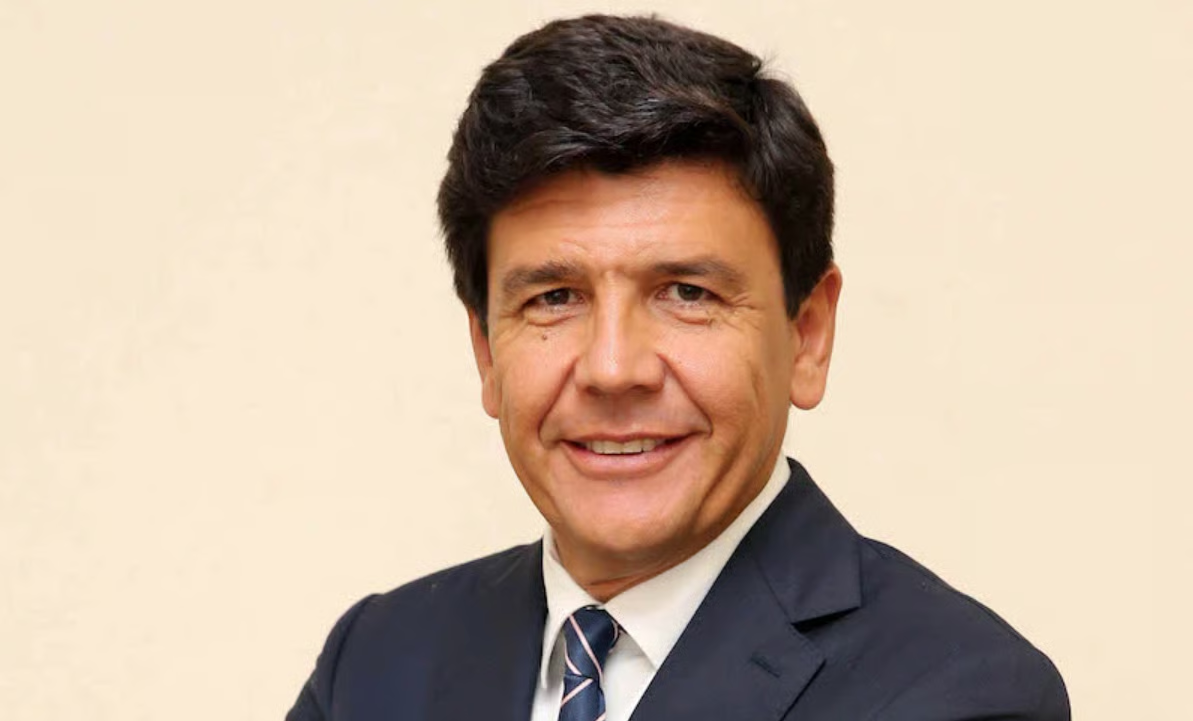 Optasia CEO Salvador Anglada. Image Source: Africa Report
After a spell servicing telecoms and their mobile money arms, including MTN MoMo, the profitable lending-as-a-service fintech, Optasia, which went public in 2025, said it wants to turn its attention to banks. In an interview with local publication TechCentral, CEO Salvador Anglada said that the company wants to bring its credit-vetting systems to banks because he thinks “they cannot do so themselves.”
Between the lines: Banks across Africa’s biggest markets are still wrestling with bad loans in high-value retail segments. Nigeria’s banking non-performing loan (NPL) ratio climbed back to about 7%, above the prudential ceiling, after regulators ended post-pandemic forbearance; Kenya’s system-wide NPL ratio eased to 15.5% in February, but remains high; and South African lenders have warned that credit losses remain elevated for stressed households and SMEs. Optasia, with its AI-driven technology, is basically promising banks better underwriting for thin-file and lower-income customers that banks have either priced expensively or avoided.
State of play: While this is not Optasia’s first foray into the banking sector, it is making this its beachhead. The company’s reported blended default rate in 2025 climbed by 30 basis points (bps) to 1.2%, with the company saying the rise is “an expected consequence of Optasia’s microfinancing business overtaking its airtime advance business as the company’s largest revenue generator.”
That shift matters: Microloans are riskier than airtime advances, so holding defaults near 1% while ramping higher-yield credit is the core of the pitch it now wants to sell to banks. On that record, Optasia looks poised to offer a sharper, more data-rich credit decisioning layer to banks that struggle to lend profitably at the bottom of the pyramid, though the real test will be how its models perform through a full credit cycle.
Then, as expected, its shareholder FirstRand, one of South Africa’s largest banking groups, will be the first to plug into this plumbing, via FNB’s revamped eWallet and other products, just as we predicted in 2025. Optasia could ride on FirstRand’s scale and influence to pitch its AI-based technology to other banks in South Africa.
Fincra is now licenced in Canada.
Fincra has secured a PSP licence in Canada, adding a regulated connection between Africa and one of the world’s most trusted financial systems. See what this means for your business.
Banking
National Bank of Kenya’s profit doubles under Access Bank
 Image Source: Make a meme?TechCabal
When Access Bank, a Nigerian tier-1 bank, acquired the National Bank of Kenya (NBK), a mid-tier lender formerly owned by KCB, in May 2025, the latter was a struggling business recovering from a loss. However, NBK seems to have repaid that faith and turned a profit in its full-year results ending December 31, 2025.
The event is remarkable because NBK more than doubled its profitability at the bank level, with profit after tax rising to KES 2.23 billion ($17.2 million) in 2025 from KES 993 million ($7.7 million) in 2024. Group profit after tax also improved, climbing to KES 2.39 billion ($18.4 million) from KES 1.06 billion ($8.1 million) the previous year.
The slow unravelling of NBK: After a steady run in the early 2010s, NBK ran into trouble around 2015 when bad loans started to sour. In that year, a KES 3.72 billion ($28.6 million) loan loss provision produced a pre-tax loss of KES 1.64 billion ($12.6 million).
By 2023, the clean‑up was still unfinished: NBK reported a KES 3.49 billion ($26.9 million) pre‑tax loss and carried a heavy non‑performing loan book.
By the time KCB Group, another bank, took over in 2019 through a share swap, NBK was in repair mode. This takeover helped stabilise NBK, but it didn’t fully rescue it. Losses still persisted, including a rough 2023 that saw the worst recorded loss in its history, which ultimately set up the sale to Access.
Access the saviour? NBK became profitable in 2024 after its initial loss, but what the results show is that Access has tightened the bank’s operations. In 2025, total operating expenses fell by about 14% to KES 9.97 billion ($77 million) as NBK cut back on ‘other operating expenses’ and rent, even though staff, depreciation, and amortisation costs edged higher; its gross bad loans and advances shrank significantly.
NBK’s impairment charges on loans also declined by 37%, and its loan book shrank by about a third as Access pulled back from risky lending. Net customer loans fell from KES 74.9 billion ($577.5 million) in 2024 to KES 50.7 billion ($391 million) in 2025.
Is this shaping up to be a good buy? So far, it looks like Access bought the bank at its lowest and stabilised it fast. NBK’s capital ratios have also improved, with core capital‑to‑deposits climbing from 9.0% in 2024 to 11.5% in 2025, and total capital‑to‑risk‑weighted assets rising from 34.4% to 65.3%, giving Access more loss‑absorption room than KCB ever had.
But this is still phase one. KCB’s era saw uneven profits and losses. For this to become a truly strong acquisition, Access has to prove it can now grow a smaller, cleaner loan book and deliver stable earnings year in, year out.
Internet
Namibia just said no to Starlink
 Image Source: Tenor
The Communications Regulatory Authority of Namibia (CRAN), the country’s telecoms regulator, has rejected Starlink’s application for a telecom licence and access to radio spectrum. While CRAN said it would issue a statement later, and there is a 90‑day window to revisit the decision, for Starlink, which has been steadily expanding across Africa, it’s a no for now.
The regulator did not specify a reason for the licence rejection, but Starlink will be sitting puppy-eyed, hoping the regulator overturns the decision within 90 days.
Catch up: Starlink’s planned entry into Namibia began in 2024, when it met with President Nangolo Mbumba to discuss possible investments in the country. Since then, its motive has been viewed suspiciously, with economic analysts, Mally Likukela and Josef Kefas Sheehama saying it would threaten competition in Namibia’s telecom market. In November 2024, CRAN issued a cease-and-desist, saying Starlink was operating without a licence and warned consumers against using its kits.
Open to telecoms sector expansion, just not this one: Namibia’s regulator has recently publicly supported expanding the country’s telecoms sector, even stating that the market can accommodate more players.
Its mobile data prices sit somewhere in the regional middle, with 1GB of data averaging around $1.2 in 2023, higher than in cheap‑data markets like Nigeria or Ghana but far below the most expensive countries in Africa.
In African markets where Starlink is already live—from Kenya and Mozambique to Zambia, Malawi, Liberia, and others—standard residential subscriptions typically range from about $30 to $50 a month, with hardware kits often priced above $200, putting the service firmly in premium territory relative to what most people spend on mobile data.
That helps explain the regulator’s caution. Starlink is not a cheap retail substitute for mobile data; it is a high‑capacity satellite pipe that can make sense for businesses, farms, schools, and Internet service providers (ISPs) that sit far from fibre, but it also hands a lot of pricing power to one foreign operator in a small market. While Namibia says it wants more competition, it may not want a player whose model could pull profitable, high‑value customers off local networks while leaving incumbents to serve everyone else.
Starlink problem or industry pattern? Starlink has faced regulatory friction in multiple African markets, most notably South Africa, where licencing remains stuck in policy debates. Yet, the satellite Internet company successfully entered the Central African Republic in December 2025 and Senegal in February 2026, revealing how regulators are split about the technology’s role in their local telecoms markets and broader economies.
Today, Starlink is available in 26 African countries, but Namibia’s pushback is a reminder that not every regulator wants the same kind of disruption at the same time.
Cryptocurrency
Circle’s USDC stablecoin finds a new home in Cassava’s African wallets
 Image Source: Imgflip/TechCabal
Circle, the US company that issues the USDC dollar stablecoin, has picked Africa for its first deal with Cassava Technologies, a pan-African digital infrastructure group backed by US chipmaker Nvidia.
State of play: Clients of Cassava’s Sasai Fintech unit, which runs a money-transfer and mobile wallet app across 30 African markets, will soon be able to make local and cross‑border payments in USDC instead of relying only on banks, cash, or traditional remittance firms.
Between the lines: This matters if you earn or pay in shaky local currencies, send money across borders, or run a small business trading in dollars. Stablecoins already sit on critical usage mass globally; the market is worth over $310 billion, and African users have been some of the fastest adopters, using dollar‑backed tokens to dodge currency devaluations, forex (FX) shortages, and high remittance fees. Sasai can become a “dollar wallet in your phone” that moves money faster and often cheaper than bank wires, while giving traders and households a way to park value in a currency that does not swing as violently as the naira, cedi, or kwacha.
For Circle, whose USDC has grown into one of the world’s main payment stablecoins, this is a way to plug straight into Africa’s mobile‑first rails instead of trying to build distribution from scratch. For Cassava, it turns its fintech arm into a bridge between African users and on‑chain dollars.
CRYPTO TRACKER
The World Wide Web3
Source:

|
Coin Name |
Current Value |
Day |
Month |
|---|---|---|---|
| Bitcoin | $70,045 |
– 1.19% |
+ 3.86% |
| Ether | $2,145 |
– 0.50% |
+ 10.53% |
| Bittensor | $325.21 |
+ 13.51% |
+ 90.06% |
| Solana | $89.99 |
– 1.72% |
+ 8.33% |
* Data as of 00.00 AM WAT, March 25, 2026.
Opportunities
- Applications are open for ClimateLaunchpad, the world’s largest green business ideas competition run by Climate-KIC. The programme helps early-stage climate founders turn rough ideas into viable startups through training, mentorship, and pitch competitions. Entrepreneurs from around the world, including Africa, can apply for the 2026 cohort and compete for up to €10,000 in prize money and access to a global cleantech network. Apply here.
- Google for Startups: Africa, a three-month hybrid accelerator for growth-stage startups on the continent, is now accepting applications. The accelerator will provides equity-free support for the duration of the programme, mentorship, training, cloud credits, and access to Google’s AI products designed to bring the best of its programmes, products, people, and technology to communities across Africa. Apply here.
- Applications are open for the 2026 FINCA Ventures Prize Competition, which offers up to $100,000 in catalytic grant funding to early-stage African startups. The programme targets founders building tech-driven solutions in financial inclusion and sustainable agriculture and food systems, with additional technical support available for selected agri-focused startups through the CLIC Connector. Shortlisted applicants will be notified in June 2026. Apply by April 10.
- Jump Shot 2026 is now accepting applications for its second edition, offering African startups a shot at $160,000 in equity-free funding. Backed by the NBPA and Mohammed VI Polytechnic University, the three-month virtual accelerator supports founders building scalable, impact-driven solutions across 12 African countries. Selected startups will gain access to mentorship, investor exposure, and partnership opportunities, with the top winner also securing access to UNGA 2026 and a US exposure trip. Apply by March 30.
- Starlink wants to wire Francophone Africa. Regulators hold the switch.
- Nigeria to spend $6.1 million on consultants for national fibre project
- OpenAI just gave up on Sora and its billion-dollar Disney deal
- “It feels like Squid Game”: China’s workers scramble to keep up in the AI race
Written by: Emmanuel Nwosu and Opeyemi Kareem
Edited by: Emmanuel Nwosu
Want more of TechCabal?
Sign up for our insightful newsletters on the business and economy of tech in Africa.
- The Next Wave: futuristic analysis of the business of tech in Africa.
- Francophone Weekly by TechCabal: insider insights and analysis of Francophone’s tech ecosystem
P:S If you’re often missing TC Daily in your inbox, check your Promotions folder and move any edition of TC Daily from “Promotions” to your “Main” or “Primary” folder and TC Daily will always come to you.



אולי תאהב גם

Binance Teases Pi Network V23, Community Speculates

Dogecoin Quietly Builds Strength While Most Investors Wait




