Resolv's goal is to build an efficient revenue cycle that continuously returns value to RESOLV holders.Resolv's goal is to build an efficient revenue cycle that continuously returns value to RESOLV holders.

Resolv: 340 million TVL + 50,000 users endorsement, a Delta neutral stablecoin protocol with a dual token model

2025/05/08 18:30

Author: Pink Brains

Compiled by: Tim, PANews

Interest-bearing stablecoins have become the focus of the current cycle with their three characteristics of real returns, low volatility, and airdrop opportunities. Resolv is about to become the next stablecoin protocol to issue tokens.

Here are the key things you need to know about Resolv and the RESOLV token:

Resolv: 340 million TVL + 50,000 users endorsement, a Delta neutral stablecoin protocol with a dual token model

Resolv is a stablecoin protocol that aims to solve the following specific problem: How to build a stablecoin that can obtain real and sustainable returns without taking unnecessary risks? Their answer is: scalable structure, transparency and yield mechanism.

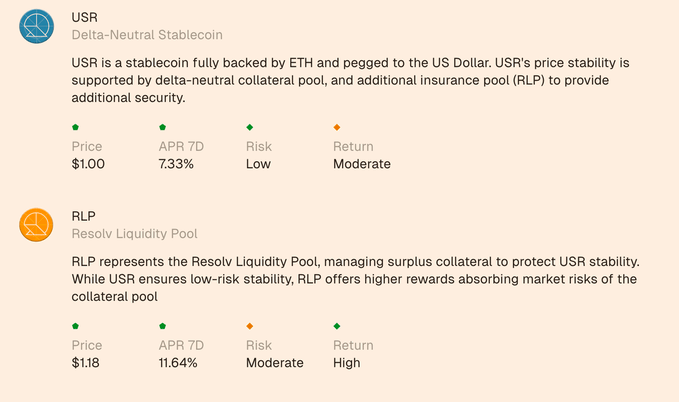
Resolv's core product is the stablecoin USR, which is backed by ETH and BTC. The platform uses a Delta-neutral strategy (mainly hedging with perpetual contracts) to transform highly volatile assets into productive collateral while maintaining price stability. This is not a pioneering model (such as Ethena's USDe), but Resolv has also found a point of fit between product and market.

Resolv divides risk into two parts:

  • stUSR: Low-risk, interest-earning stablecoin
  • RLP: A medium-risk, high-return position that earns returns by taking on protocol performance risk

This dual structure is crucial as it allows capital to make autonomous choices based on risk appetite, which is also the common way traditional finance handles returns.
Resolv: 340 million TVL + 50,000 users endorsement, a Delta neutral stablecoin protocol with a dual token model

Where does the income come from?

Resolv has three ways to realize stablecoin income:

1. ETH/BTC staking via Lido and Binance

2. Perpetual contracts on Binance, Hyperliquid, and Deribit

3. US dollar neutral strategy (Superstate USCC)

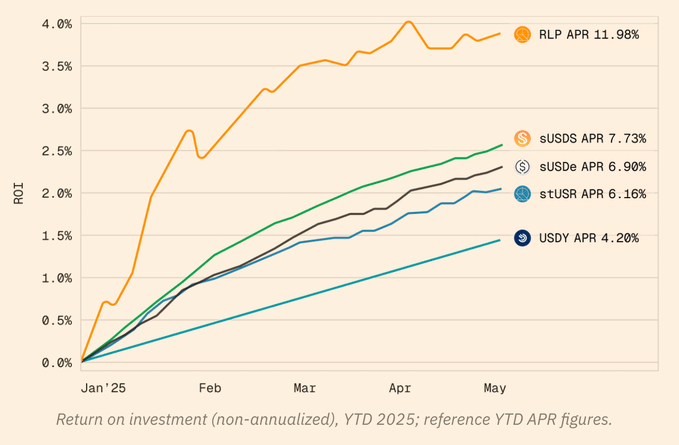
stUSR offers a yield comparable to sUSDe and sUSDS, while enhancing the insurance mechanism through RLP.

At the same time, RLP’s high yield is also reflected in another aspect. By capturing the upside of the Resolv strategy, it outperforms stablecoins backed by U.S. Treasuries such as $USDY.
Resolv: 340 million TVL + 50,000 users endorsement, a Delta neutral stablecoin protocol with a dual token model

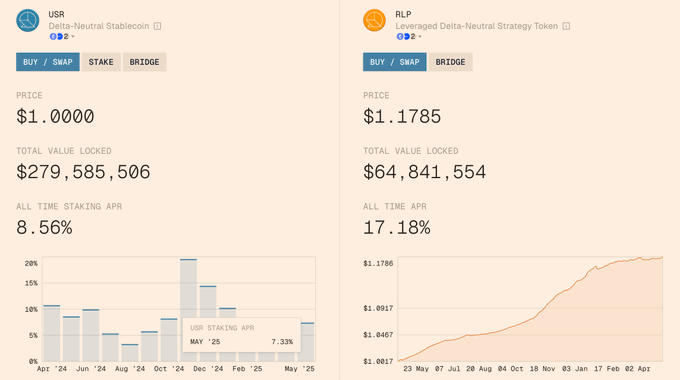
Since its public launch in September 2024, Resolv has achieved the following: $344.1 million TVL (across Ethereum, Base, and BNB chains); over $1.7 billion in total minting and redemption; over $10 million in actual earnings distributed; over 50,000 users (56% of monthly active users)

In addition, USR and stUSR are jointly managed by top DeFi protocols (such as Pendle, Morpho, Euler, Curve, Hyperliquid, etc.) and other capital allocators.

This is quite impressive performance for a newly launched stablecoin protocol.
Resolv: 340 million TVL + 50,000 users endorsement, a Delta neutral stablecoin protocol with a dual token model

Now, Resolv plans to launch its native token, RESOLV, in the first two weeks of this month.

RESOLV Token Economics:

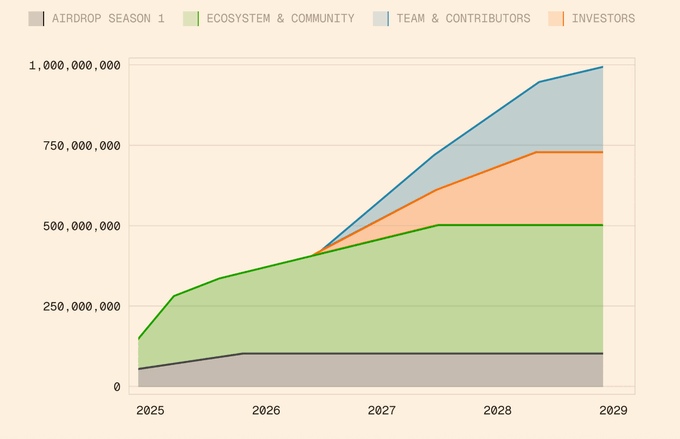
  • Total supply: 1 billion
  • Season 1 airdrop: 10% (unlocked at TGE)
  • Ecosystem and community: 40.9% (10% unlocked at TGE, remaining tokens released linearly over 24 months)
  • Team: 26.7% (1 year lock-up period, followed by 30 months of linear release)
  • Investors: 22.4% (1-year lock-up period, followed by linear unlocking over 24 months)
Resolv: 340 million TVL + 50,000 users endorsement, a Delta neutral stablecoin protocol with a dual token model

Token Utility:

  • Governance (treasury strategy + incentive plan);
  • Double rewards (token issuance + external partner benefits);
  • Points multiplier; obtain the qualification of future airdrops from partners;

After TGE, what are Resolv’s next plans?

Resolv aims to be an architecture that seamlessly integrates stable yield into every layer of on-chain finance.

1. Optimizing the Segregated Vault for Delta Neutral Returns

2. Allocate funds to treasury bonds and stablecoins backed by RWA

3. Altcoin Vault

4. External income (treasury cooperation, swap instruments and redemption)

Resolv's goal is to build an efficient revenue cycle that continuously returns value to RESOLV holders.
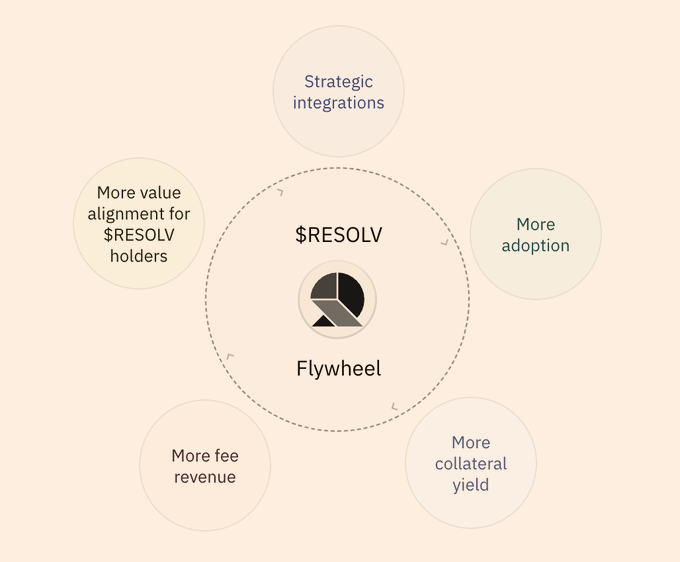
Resolv: 340 million TVL + 50,000 users endorsement, a Delta neutral stablecoin protocol with a dual token model

Resolv is not just a stablecoin, it is evolving into an on-chain currency. If you have been using USR and stUSR to gain experience points, now is the time to reap the rewards! TGE and airdrops are coming soon, stay tuned!

Disclaimer: The articles reposted on this site are sourced from public platforms and are provided for informational purposes only. They do not necessarily reflect the views of MEXC. All rights remain with the original authors. If you believe any content infringes on third-party rights, please contact service@support.mexc.com for removal. MEXC makes no guarantees regarding the accuracy, completeness, or timeliness of the content and is not responsible for any actions taken based on the information provided. The content does not constitute financial, legal, or other professional advice, nor should it be considered a recommendation or endorsement by MEXC.

You May Also Like

The Future of Secure Messaging: Why Decentralization Matters

The Future of Secure Messaging: Why Decentralization Matters

The post The Future of Secure Messaging: Why Decentralization Matters appeared on BitcoinEthereumNews.com. From encrypted chats to decentralized messaging Encrypted messengers are having a second wave. Apps like WhatsApp, iMessage and Signal made end-to-end encryption (E2EE) a default expectation. But most still hinge on phone numbers, centralized servers and a lot of metadata, such as who you talk to, when, from which IP and on which device. That is what Vitalik Buterin is aiming at in his recent X post and donation. He argues the next steps for secure messaging are permissionless account creation with no phone numbers or Know Your Customer (KYC) and much stronger metadata privacy. In that context he highlighted Session and SimpleX and sent 128 Ether (ETH) to each to keep pushing in that direction. Session is a good case study because it tries to combine E2E encryption with decentralization. There is no central message server, traffic is routed through onion paths, and user IDs are keys instead of phone numbers. Did you know? Forty-three percent of people who use public WiFi report experiencing a data breach, with man-in-the-middle attacks and packet sniffing against unencrypted traffic among the most common causes. How Session stores your messages Session is built around public key identities. When you sign up, the app generates a keypair locally and derives a Session ID from it with no phone number or email required. Messages travel through a network of service nodes using onion routing so that no single node can see both the sender and the recipient. (You can see your message’s node path in the settings.) For asynchronous delivery when you are offline, messages are stored in small groups of nodes called “swarms.” Each Session ID is mapped to a specific swarm, and your messages are stored there encrypted until your client fetches them. Historically, messages had a default time-to-live of about two weeks…
Share
BitcoinEthereumNews2025/12/08 14:40
Grayscale Files Sui Trust as 21Shares Launches First SUI ETF Amid Rising Demand

Grayscale Files Sui Trust as 21Shares Launches First SUI ETF Amid Rising Demand

The post Grayscale Files Sui Trust as 21Shares Launches First SUI ETF Amid Rising Demand appeared on BitcoinEthereumNews.com. The Grayscale Sui Trust filing and 21Shares’ launch of the first SUI ETF highlight surging interest in regulated Sui investments. These products offer investors direct exposure to the SUI token through spot-style structures, simplifying access to the Sui blockchain’s growth without direct custody needs, amid expanding altcoin ETF options. Grayscale’s spot Sui Trust seeks to track SUI price performance for long-term holders. 21Shares’ SUI ETF provides leveraged exposure, targeting traders with 2x daily returns. Early trading data shows over 4,700 shares exchanged, with volumes exceeding $24 per unit in the debut session. Explore Grayscale Sui Trust filing and 21Shares SUI ETF launch: Key developments in regulated Sui investments for 2025. Stay informed on altcoin ETF trends. What is the Grayscale Sui Trust? The Grayscale Sui Trust is a proposed spot-style investment product filed via S-1 registration with the U.S. Securities and Exchange Commission, aimed at providing investors with direct exposure to the SUI token’s price movements. This trust mirrors the performance of SUI, the native cryptocurrency of the Sui blockchain, minus applicable fees, offering a regulated avenue for long-term participation in the network’s ecosystem. By holding SUI assets on behalf of investors, it eliminates the need for individuals to manage token storage or transactions directly. ⚡ LATEST: GRAYSCALE FILES S-1 FOR $SUI TRUSTThe “Grayscale Sui Trust,” is a spot-style ETF designed to provide direct exposure to the $SUI token. Grayscale’s goal is to mirror SUI’s market performance, minus fees, giving long-term investors a regulated, hassle-free way to… pic.twitter.com/mPQMINLrYC — CryptosRus (@CryptosR_Us) December 6, 2025 How does the 21Shares SUI ETF differ from traditional funds? The 21Shares SUI ETF, launched under the ticker TXXS, introduces a leveraged approach with 2x daily exposure to SUI’s price fluctuations, utilizing derivatives for amplified returns rather than direct spot holdings. This structure appeals to short-term…
Share
BitcoinEthereumNews2025/12/08 14:20