

Qubic Reveals How Its Dogecoin Mining Launch Will Work Starting April 1
Qubic used a March 30 AMA to lay out the mechanics behind its Dogecoin mining rollout, with core tech lead Joetom outlining a three-phase mainnet transition that begins April 1. The shift matters because it is designed to move Qubic away from its current split between Monero-linked outsourced mining and AI training into a model where both activities run at full scale in parallel.
The presentation centered on what Qubic calls its internal “Doge Connect” architecture, a bridge that links external Scrypt miners to Qubic’s network while redirecting Qubic’s own CPU and GPU resources fully toward its AI initiative, Aigarth. Joetom said the system relies on a dispatcher that connects to pools, translates mining tasks between the Dogecoin and Qubic networks, validates shares, and feeds results back through Qubic’s infrastructure.
“So how does this work? We call it internally Dodge Connect,” he said. “We bridge basically the mining power from outside … with ASIC miners, we use the Scrypt algorithm and you can connect to any of the Qubic pools. So for you as a miner, nothing changes.”
That bridge is not limited to a single coin, at least in theory. Joetom said the task and messaging system was built generically enough that Qubic could support multiple chains or switch to other mineable assets later. For now, the focus is Dogecoin, with the longer-term goal of running Qubic’s AI research at full capacity while using outsourced mining as a revenue engine.
Qubic Starts Dogecoin Mining Transition
The rollout itself will happen in three stages, with each phase expected to last one to two weeks if testing goes as planned. Phase one begins on mainnet April 1 and is framed as a validation period, covering task distribution, solution handling, pool communications, and public statistics. During that phase, Qubic will reduce its current Monero “marathons” from three days per week to two, beginning a gradual shift away from XMR mining.
Joetom described the process as a controlled crossover rather than a hard cut. “We will reduce this starting with phase one to two days per week,” he said. “So they will basically cross each other and at the end of phase two the Monero stuff will be removed.”
By the final state, he said, the network is meant to reach “100% AI training and 100% outsourced mining.” In practice, that means Qubic’s CPUs and GPUs would be dedicated to Aigarth research, while Dogecoin mining would be handled externally by ASIC miners connected through Qubic pools.
One of the more important economic details from the AMA was the payout model. Rather than distributing DOGE directly, Qubic plans to sell outsourced mining proceeds for stablecoins, use those funds to buy back Cubics, and then redistribute Cubics to miners. Joetom called the mechanism a “buyback” system and said the team expects it to make mining through Qubic more attractive than mining Dogecoin alone.
“We assume that we will see an acceleration for the DOGE revenue,” he said. “Meaning that the Qubic revenue when you mine DOGE via Qubic you will see approximately 10% more revenue than if you would go only for doge.”
The technical path also leans heavily on Qubic’s oracle infrastructure. Shares submitted through the network are validated internally, with oracle machines acting as the source of truth for whether a mined share is accepted. That makes the integration more than a simple mining proxy; it effectively routes Dogecoin-related work through Qubic’s own validation and accounting model.
For miners, the immediate takeaway is operational rather than conceptual. Joetom said older hardware such as Antminer L3 units can still participate, even if newer machines like the L9 offer stronger economics. Public testing is expected to open April 1, with connection details to be shared through Qubic’s Discord and pool operators.
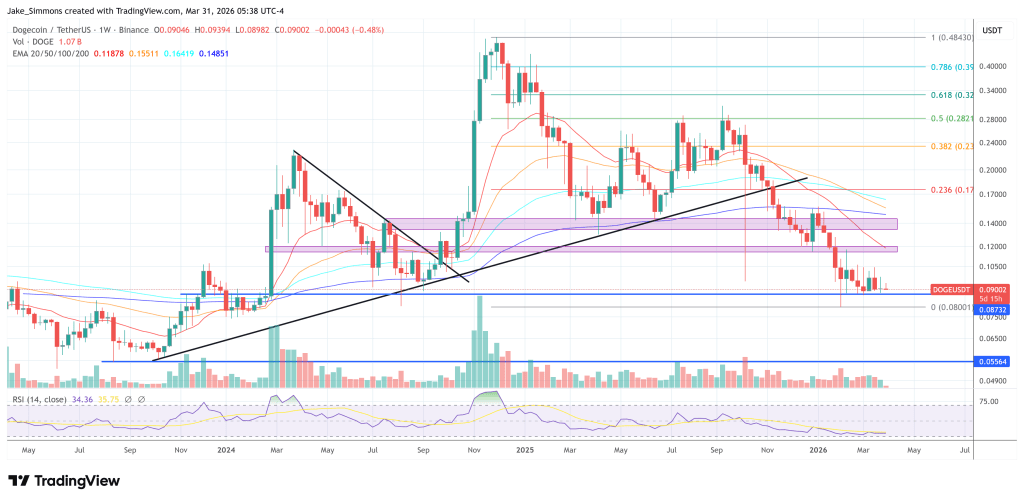
At press time, DOGE traded at $0.09.


You May Also Like
Cathie Wood’s ARK Invest Buys $13.7M in Circle Shares While Selling Robinhood Stock

The changing face of elder care in Malaysia — Sayed Mohammad Reza Yamani Sayed Umar

Not a loophole: Singapore AI export controls let China tap US AI legally



