

DeFi set to hit $1.4 trillion by 2033 as Real-World Assets grow
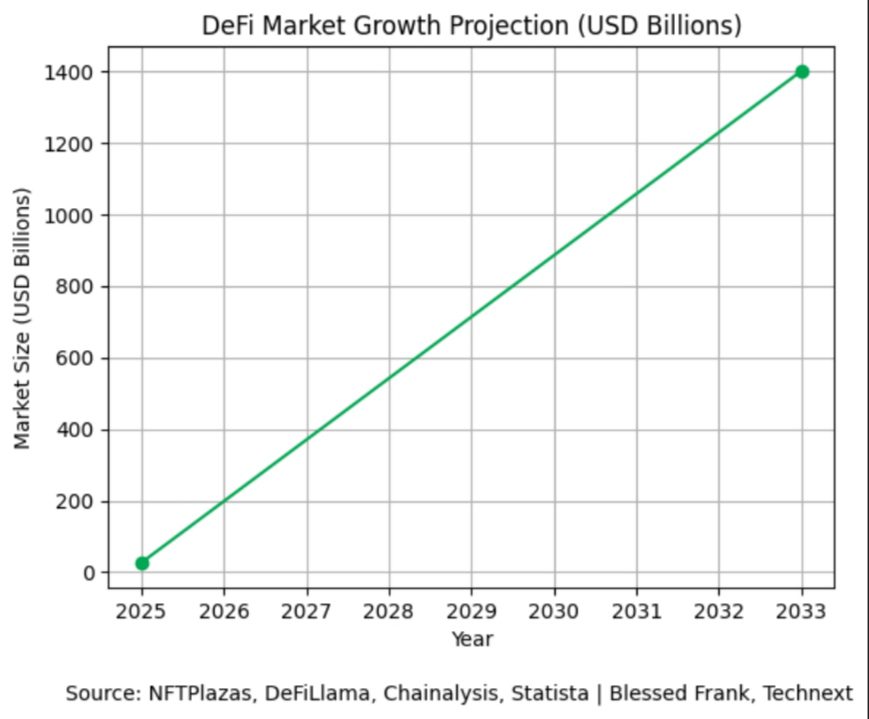
A new report reveals that Real-World Assets (RWAs) have overtaken decentralised exchanges (DEXs) in total value locked (TVL) for the first time. The asset class climbed to $17 billion in 2025, signalling a major shift in the decentralised finance landscape. The overall DeFi market is on track to grow from $26.9 billion this year to $1.4 trillion by 2033 at a compound annual growth rate (CAGR) of 68%.
The analysis, contained in NFTPlazas’ recently released report, draws on fresh data from DeFiLlama, Chainalysis, Statista, and other industry trackers. It paints a picture of a sector where newer niches like RWAs and prediction markets are surging ahead even as the broader crypto market continues to fluctuate. Multichain DeFi TVL reached a high of $171.9 billion in early October before pulling back by 25.5% to finish the year at $116.7 billion. On-chain value across DeFi still touched $2.5 trillion over the course of 2025, and the sector’s total market capitalisation peaked at $181 billion in late September before sliding by 37.2% to $100.9 billion by December.
RWAs posted one of the strongest performances, with TVL rising 139% and moving into the fifth-largest DeFi category after overtaking DEXs on December 29. Within this sector, tokenised stocks stood out dramatically: their market capitalisation exploded 2,695% in a single year to reach $1.2 billion. The wider asset tokenisation space brought in $1.71 billion in revenue during 2025 and is expected to hit $95.4 billion by 2033 at a 69.4% CAGR.
Prediction markets grew even faster, with TVL jumping 233% and notional trading volume surging 302.7% to $63.5 billion. The sector generated $2.03 billion in revenue last year and is projected to reach $99.4 billion by 2033 at a 66.7% CAGR. Meanwhile, more traditional segments, including spot DEXs, derivatives, restaking, and yield farms, saw liquidity pull back.
Perpetual futures on DEXs delivered the biggest volume spike of all. Trading jumped 346% from $1.5 trillion in 2024 to $6.7 trillion in 2025, lifting the DEX-to-CEX perpetual ratio from 6.3% to 18.7%. Hyperliquid led the pack with $2.9 trillion, followed by Lighter at $1.3 trillion. Spot DEX volume, by contrast, stayed well below 20% of centralised exchange activity, though performance varied sharply by chain, Solana spot volume fell 66.7% while BNB Chain volume quadrupled.
Security remains a persistent challenge in DeFi
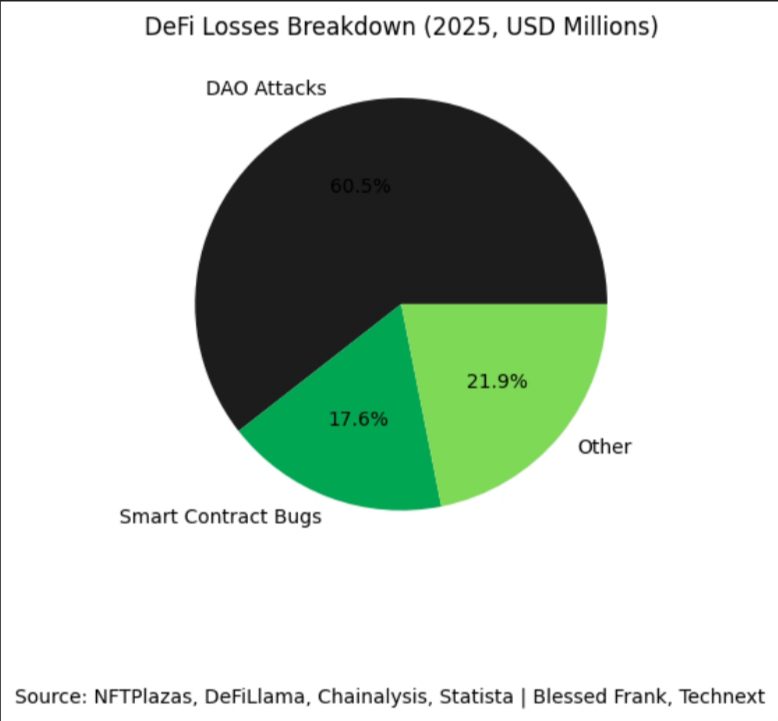
Growth hasn’t come without setbacks. DeFi protocols lost roughly $512 million to hacks and exploits in 2025. DAO-related attacks alone topped $310 million, and smart-contract vulnerabilities in DAO projects added more than $90 million in losses. The second quarter was especially brutal, the worst period for the sector since early 2023, with nearly $300 million stolen, 88% of it tied to smart-contract bugs. In the first half of the year, smart-contract exploits made up about 8% of all Web3 thefts and totalled $263 million.
High-profile incidents included an $8.2 million smart-contract breach on the newly launched Bunni protocol (the first major hack on Unichain) and a March sandwich attack on Uniswap that cost one trader more than $700,000.
Users, adoption, and ecosystem highlights
On the adoption front, the numbers stayed solid. Roughly 27.7 million unique users interacted with DeFi protocols, and monthly active addresses ranged between 300 million and 390 million. Average weekly DEX trading volume hit $18.6 billion by mid-year, backed by more than 9.7 million unique wallets. Chainalysis ranked India, the United States, and Nigeria as the top three countries by DeFi value received.
Also read: Inside the 2026 blockchain graveyard: 20+ crypto projects that died in Q1
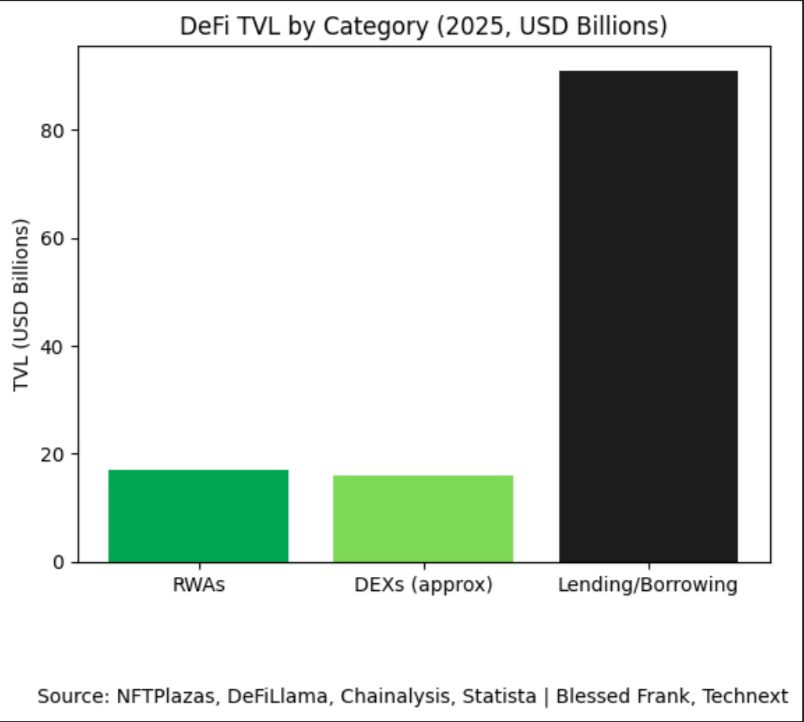
Lending and borrowing continued to command the largest share of TVL at 27.33%, starting the year at $48 billion and peaking above $91 billion in October. Stablecoin supply expanded 49% to around $300 billion, while bridge TVL dropped 26.8% to $40.8 billion by year-end. More than 13,000 active DAOs managed $21.4 billion in liquid treasuries and allocated over $35 million to charitable causes and impact projects.
Mid-year leaders by TVL included Aave at $24.4 billion and Lido at $22.6 billion, according to DeFiLlama figures cited in the report.
The NFTPlazas analysis shows a DeFi market that is maturing quickly. Real-world utility and high-growth pockets are powering the next wave of expansion, even as the industry grapples with ongoing security risks and market swings. With most segments still forecast to deliver strong double-digit CAGRs through 2033, the sector looks poised for further growth so long as it can keep tightening up its defences against hacks and exploits.
The post DeFi set to hit $1.4 trillion by 2033 as Real-World Assets grow first appeared on Technext.


You May Also Like

Metaplanet Stock Passes MARA to Become Third-Largest BTC Holder — Stock Slips Anyway

Crypto-Fueled Peptide Boom Surges Past US$100M as Biohacking Meets Looksmaxxing

Flux Price Prediction 2026, 2027 – 2030: Is FLUX A Good Investment?


Trending News
More24/7 Live News
MoreQuick Reads
More
