TLDR JPMorgan lowered its 2026 S&P 500 year-end target from 7,500 to 7,200 Oil prices have surged over 40%, with supply shut-ins at a historic 8 million barrelsTLDR JPMorgan lowered its 2026 S&P 500 year-end target from 7,500 to 7,200 Oil prices have surged over 40%, with supply shut-ins at a historic 8 million barrels

JPMorgan Cuts S&P 500 Target as Oil Shock and Middle East Risks Rattle Markets

2026/03/19 23:50
3 min read
For feedback or concerns regarding this content, please contact us at crypto.news@mexc.com

TLDR

  • JPMorgan lowered its 2026 S&P 500 year-end target from 7,500 to 7,200
  • Oil prices have surged over 40%, with supply shut-ins at a historic 8 million barrels per day
  • Investors are hedging but not fully de-risking, with gross leverage near all-time highs
  • If oil holds near $110, S&P 500 earnings estimates could drop 2–5%
  • JPMorgan favors Defense, Energy, Utilities, and Cybersecurity sectors

JPMorgan has cut its year-end 2026 S&P 500 price target to 7,200, down from 7,500. The bank says markets are not fully pricing in the risks from the Middle East conflict, rising oil prices, and investor overconfidence.
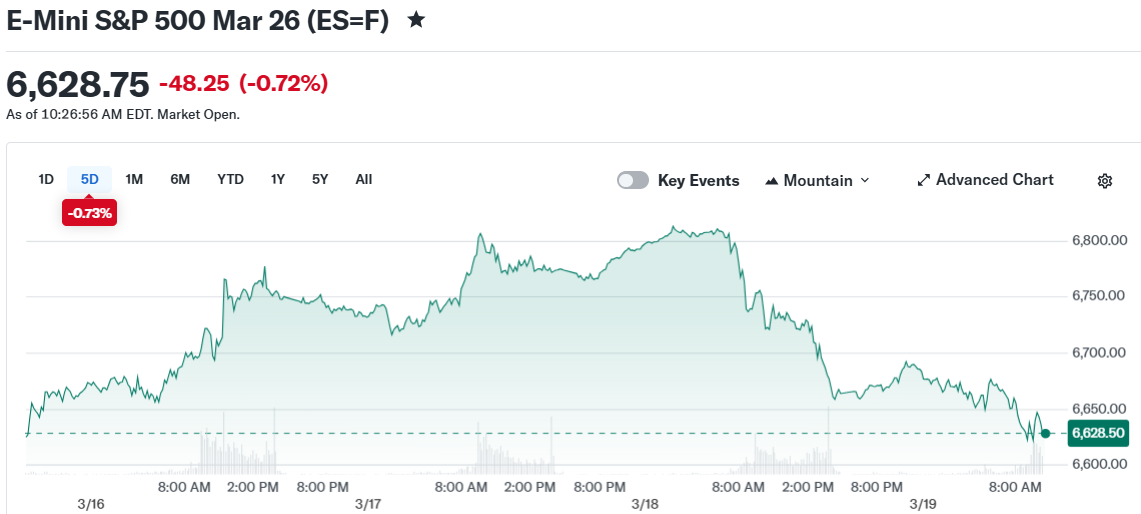
E-Mini S&P 500 Mar 26 (ES=F)E-Mini S&P 500 Mar 26 (ES=F)

The note was written by analyst Dubravko Lakos-Bujas. He said the S&P 500 has only fallen about 3% even as oil prices have jumped more than 40%.

He attributed that resilience to flight-to-quality flows into U.S. assets. But he warned the calm may be misleading.

Lakos-Bujas said investors have mostly been hedging their positions rather than reducing risk outright. Gross leverage remains near the 95th percentile historically, which he flagged as a concern.

JPMorgan said markets appear to be pricing in a quick end to the Middle East conflict and a reopening of the Strait. The bank called that assumption “high-risk.”

Oil and equity prices tend to move in opposite directions once crude spikes more than 30%. That threshold has already been crossed.

Oil Supply at Historic Lows

Oil supply shut-ins have reached 8 million barrels per day, the highest ever recorded. JPMorgan expects that number could climb to 12 million barrels per day, roughly 11% of total global production.

The bank said the bigger threat is not inflation. It is the risk that prolonged disruption reduces demand, forcing GDP, corporate revenues, and earnings lower through what it calls “forced demand destruction.”

If oil stays around $110 a barrel, JPMorgan estimates consensus S&P 500 earnings forecasts could be cut by 2 to 5%.

The index faces other headwinds too. Lakos-Bujas cited stress in private credit markets, signs that enthusiasm around artificial intelligence is fading, and low consumer affordability.

What JPMorgan Is Watching

If the S&P 500 falls below its 200-day moving average, JPMorgan sees little support until the 6,000–6,200 range. That would represent a steep drop from current levels.

The bank is not calling for a crash, but it is urging caution. It recommends investors shift toward Low Volatility and Quality Growth stocks.

Preferred sectors named in the note include Defense, Energy, Utilities, Materials, Cybersecurity, and Hyperscalers.

The note did not mention cryptocurrency directly, but rising oil prices and macro uncertainty have historically affected risk assets including Bitcoin and other digital currencies.

JPMorgan’s revised target of 7,200 is its latest public forecast as of March 19, 2026.

The post JPMorgan Cuts S&P 500 Target as Oil Shock and Middle East Risks Rattle Markets appeared first on CoinCentral.


Market Opportunity
NEAR Logo
NEAR Price(NEAR)
$1,3244
$1,3244$1,3244
-%0,80
USD
NEAR (NEAR) Live Price Chart
Disclaimer: The articles reposted on this site are sourced from public platforms and are provided for informational purposes only. They do not necessarily reflect the views of MEXC. All rights remain with the original authors. If you believe any content infringes on third-party rights, please contact crypto.news@mexc.com for removal. MEXC makes no guarantees regarding the accuracy, completeness, or timeliness of the content and is not responsible for any actions taken based on the information provided. The content does not constitute financial, legal, or other professional advice, nor should it be considered a recommendation or endorsement by MEXC.

You May Also Like

World Gold Council’s Pivotal Framework Promises Unprecedented Market Trust

World Gold Council’s Pivotal Framework Promises Unprecedented Market Trust

The post World Gold Council’s Pivotal Framework Promises Unprecedented Market Trust appeared on BitcoinEthereumNews.com. Tokenized Gold Revolution: World Gold Council
Share
BitcoinEthereumNews2026/03/20 03:58
Aave DAO to Shut Down 50% of L2s While Doubling Down on GHO

Aave DAO to Shut Down 50% of L2s While Doubling Down on GHO

The post Aave DAO to Shut Down 50% of L2s While Doubling Down on GHO appeared on BitcoinEthereumNews.com. Aave DAO is gearing up for a significant overhaul by shutting down over 50% of underperforming L2 instances. It is also restructuring its governance framework and deploying over $100 million to boost GHO. This could be a pivotal moment that propels Aave back to the forefront of on-chain lending or sparks unprecedented controversy within the DeFi community. Sponsored Sponsored ACI Proposes Shutting Down 50% of L2s The “State of the Union” report by the Aave Chan Initiative (ACI) paints a candid picture. After a turbulent period in the DeFi market and internal challenges, Aave (AAVE) now leads in key metrics: TVL, revenue, market share, and borrowing volume. Aave’s annual revenue of $130 million surpasses the combined cash reserves of its competitors. Tokenomics improvements and the AAVE token buyback program have also contributed to the ecosystem’s growth. Aave global metrics. Source: Aave However, the ACI’s report also highlights several pain points. First, regarding the Layer-2 (L2) strategy. While Aave’s L2 strategy was once a key driver of success, it is no longer fit for purpose. Over half of Aave’s instances on L2s and alt-L1s are not economically viable. Based on year-to-date data, over 86.6% of Aave’s revenue comes from the mainnet, indicating that everything else is a side quest. On this basis, ACI proposes closing underperforming networks. The DAO should invest in key networks with significant differentiators. Second, ACI is pushing for a complete overhaul of the “friendly fork” framework, as most have been unimpressive regarding TVL and revenue. In some cases, attackers have exploited them to Aave’s detriment, as seen with Spark. Sponsored Sponsored “The friendly fork model had a good intention but bad execution where the DAO was too friendly towards these forks, allowing the DAO only little upside,” the report states. Third, the instance model, once a smart…
Share
BitcoinEthereumNews2025/09/18 02:28
Shiba Inu Price Prediction 2026: SHIB Fights to Reclaim Its Glory While Pepeto Offers the 150x Early Window That SHIB Already Closed

Shiba Inu Price Prediction 2026: SHIB Fights to Reclaim Its Glory While Pepeto Offers the 150x Early Window That SHIB Already Closed

A truck driver put $650 into Shiba Inu in 2020 and quit his job after his bag grew to $1.7 million. Two brothers invested $7,900 during the COVID lockdowns and
Share
Blockonomi2026/03/20 04:32





