The security architecture surrounding Bitcoin continues to evolve as new infrastructure emerges to support self-custody and advanced on-chain protections. A notableThe security architecture surrounding Bitcoin continues to evolve as new infrastructure emerges to support self-custody and advanced on-chain protections. A notable

Bitcoin Vault Security Advances With Babylon-Ledger Integration

2026/03/12 05:00
3 min read
For feedback or concerns regarding this content, please contact us at crypto.news@mexc.com

The security architecture surrounding Bitcoin continues to evolve as new infrastructure emerges to support self-custody and advanced on-chain protections. A notable step in this direction is the integration between Babylon Labs and Ledger. By combining Babylon’s protocol-level vault system with Ledger’s hardware wallet security, the collaboration seeks to strengthen how users store, manage, and interact with BTC in decentralized environments.

How Babylon And Ledger Aim To Strengthen Bitcoin Self-Custody

The Babylon platform is expanding access to Trustless Bitcoin Vaults through a new integration with Ledger. According to the Babylon Labs post on X, once the integration goes live in the second half of the year, users will be able to authorize BTCVault transactions directly from a ledger device using clear signing. This will allow 8 million Ledger users to review and approve vault operations on a secure hardware screen.

These Trustless BTC Vaults are anchored directly on the BTC base layer and enable external applications to verify that BTC collateral remains locked in place while enforcing predefined collateralization conditions. This vault architecture utilizes cryptographic mechanisms to execute rules, such as unlocking funds or triggering a liquidation event, rather than relying on discretionary control.

By combining Babylon’s vault architecture with Ledger’s secure signing infrastructure, BTCVault workflows can connect with the hardware security that many BTC holders already rely on for self-custody. As part of the broader rollout, Ledger devices will also support Babylon’s native asset, BABY, on Ledger devices.

A Familiar Pattern Emerges In Bitcoin’s Orderbook Data

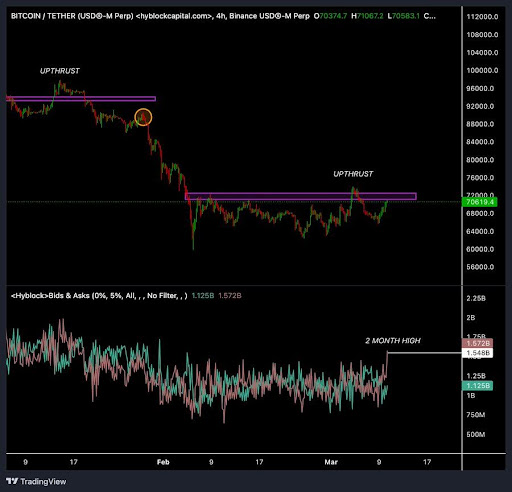
As noted by Crypto analyst Ardi, the latest order book data is showing a pattern that has appeared at key moments in the market before. Currently, asks on Bitcoin have climbed to a two-month high, with roughly $1.57 billion in sell-side liquidity stacked above the current price compared with about $1.125 billion in bids below. This shift indicates around 40% more supply than demand within 5% of the market price.

Ardi pointed out that the last time the asks reached a similar high level was during the retest that followed the $98,000 fakeout in January. In that case, BTC briefly broke above the fakeout range, price re-entered it, and then retested the level while the sell-side liquidity accumulated heavily above the retest price.
Bitcoin

Now, the BTC market structure appears to be retesting after the $72,000 fakeout, with orderbook data showing a similar signature. In this setup, bids below the price act as a support cushion, while asks above the price form a resistance wall.

When Asks liquidity spikes to multi-month highs during a retest, it suggests that participants are using price rebounds as opportunities to sell into strength. However, Ardi cautions that orderbook liquidity can be removed at any time, and the recurring pattern of elevated asks during post-fakeout retests has shown a specific track record on this chart.


Bitcoin
Market Opportunity
Bitcoin Logo
Bitcoin Price(BTC)
$69,646.32
$69,646.32$69,646.32
-0.81%
USD
Bitcoin (BTC) Live Price Chart
Disclaimer: The articles reposted on this site are sourced from public platforms and are provided for informational purposes only. They do not necessarily reflect the views of MEXC. All rights remain with the original authors. If you believe any content infringes on third-party rights, please contact crypto.news@mexc.com for removal. MEXC makes no guarantees regarding the accuracy, completeness, or timeliness of the content and is not responsible for any actions taken based on the information provided. The content does not constitute financial, legal, or other professional advice, nor should it be considered a recommendation or endorsement by MEXC.

You May Also Like

The Channel Factories We’ve Been Waiting For

The Channel Factories We’ve Been Waiting For

The post The Channel Factories We’ve Been Waiting For appeared on BitcoinEthereumNews.com. Visions of future technology are often prescient about the broad strokes while flubbing the details. The tablets in “2001: A Space Odyssey” do indeed look like iPads, but you never see the astronauts paying for subscriptions or wasting hours on Candy Crush.  Channel factories are one vision that arose early in the history of the Lightning Network to address some challenges that Lightning has faced from the beginning. Despite having grown to become Bitcoin’s most successful layer-2 scaling solution, with instant and low-fee payments, Lightning’s scale is limited by its reliance on payment channels. Although Lightning shifts most transactions off-chain, each payment channel still requires an on-chain transaction to open and (usually) another to close. As adoption grows, pressure on the blockchain grows with it. The need for a more scalable approach to managing channels is clear. Channel factories were supposed to meet this need, but where are they? In 2025, subnetworks are emerging that revive the impetus of channel factories with some new details that vastly increase their potential. They are natively interoperable with Lightning and achieve greater scale by allowing a group of participants to open a shared multisig UTXO and create multiple bilateral channels, which reduces the number of on-chain transactions and improves capital efficiency. Achieving greater scale by reducing complexity, Ark and Spark perform the same function as traditional channel factories with new designs and additional capabilities based on shared UTXOs.  Channel Factories 101 Channel factories have been around since the inception of Lightning. A factory is a multiparty contract where multiple users (not just two, as in a Dryja-Poon channel) cooperatively lock funds in a single multisig UTXO. They can open, close and update channels off-chain without updating the blockchain for each operation. Only when participants leave or the factory dissolves is an on-chain transaction…
Share
BitcoinEthereumNews2025/09/18 00:09
Stablecoins firm as Mastercard enables stablecoin settlement

Stablecoins firm as Mastercard enables stablecoin settlement

The post Stablecoins firm as Mastercard enables stablecoin settlement appeared on BitcoinEthereumNews.com. What Mastercard’s Crypto Partner Program is and how it
Share
BitcoinEthereumNews2026/03/12 10:44
South Africa launches HIV vaccine trial

South Africa launches HIV vaccine trial

South Africa HIV vaccine trial efforts are advancing after researchers launched the first locally developed HIV vaccine study on the continent.   South Africa expands
Share
Furtherafrica2026/03/12 09:30