

DeepSeek AI Predicts the Price of Solana and XRP If the War Ends
In the last two weeks, the tension between the US and Iran has been a cause of concern for the markets. Threats and military postures from both sides have left investors taking cover.
Oil prices have shot up as investors are worried about the supply of crude, and traditional safe havens like Gold and Silver have been seeing their own roller coaster ride – falling one day and rising the next. Crypto wasn’t spared either, with prices getting knocked around by every headline.
But today, things took an interesting turn. Al Jazeera reported on X that Iran is now requiring a ceasefire and assurances of no future attacks as a condition of mediation.
Finally, after weeks of escalating rhetoric, it appears both sides are ready to negotiate, which, if this war is indeed coming to a close, could mean a huge relief rally for the markets.
So what does that mean for crypto? More specifically, what happens to XRP and Solana?
We asked DeepSeek to run the numbers based on current charts and market conditions. Here’s what their AI is predicting.
Here’s What XRP Chart Is Showing
If we take a look at the chart provided, we are seeing some very interesting trends. The price is currently at $1.4025 after a slight pullback following the recent price spike from the news.
The volume profile is looking very good in the $1.20-$1.40 range. If peace actually breaks out, that accumulated volume could fuel a serious move.
On the support side, $1.37 has been acting as the recent low, with stronger support down at $1.27 if things go south. Upward, $1.46 was yesterday’s high, and beyond that sits $1.60 as the next real test.
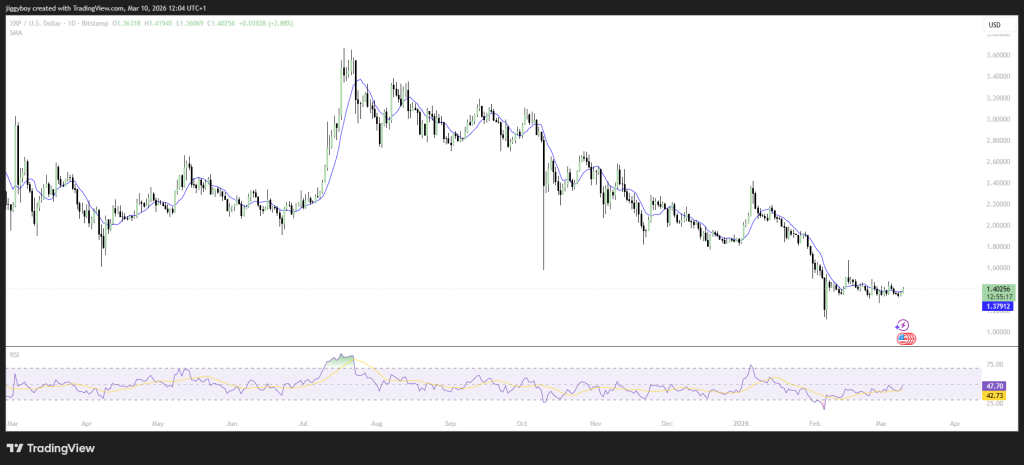 Source: TradingView.com
DeepSeek’s XRP Prediction If the War Ends
If Iran and the US actually hammer out a ceasefire or peace agreement, we’re looking at a classic relief rally scenario. With global tension removed, money flows back into risk assets fast.
The recent run from $1.35 to $1.46 on rumors of peace talks is evidence of just how sensitive XRP is to positive news flow. A confirmed peace agreement could easily send XRP to the $1.60 to $1.80 price range.
If the crypto market catches fire like the peace rally, it wouldn’t be surprising to see the XRP price reach $2.00. The fundamentals are already there, ETF inflows have been steady, and Ripple’s institutional partnerships haven’t gone away just because the news cycle shifted to war.
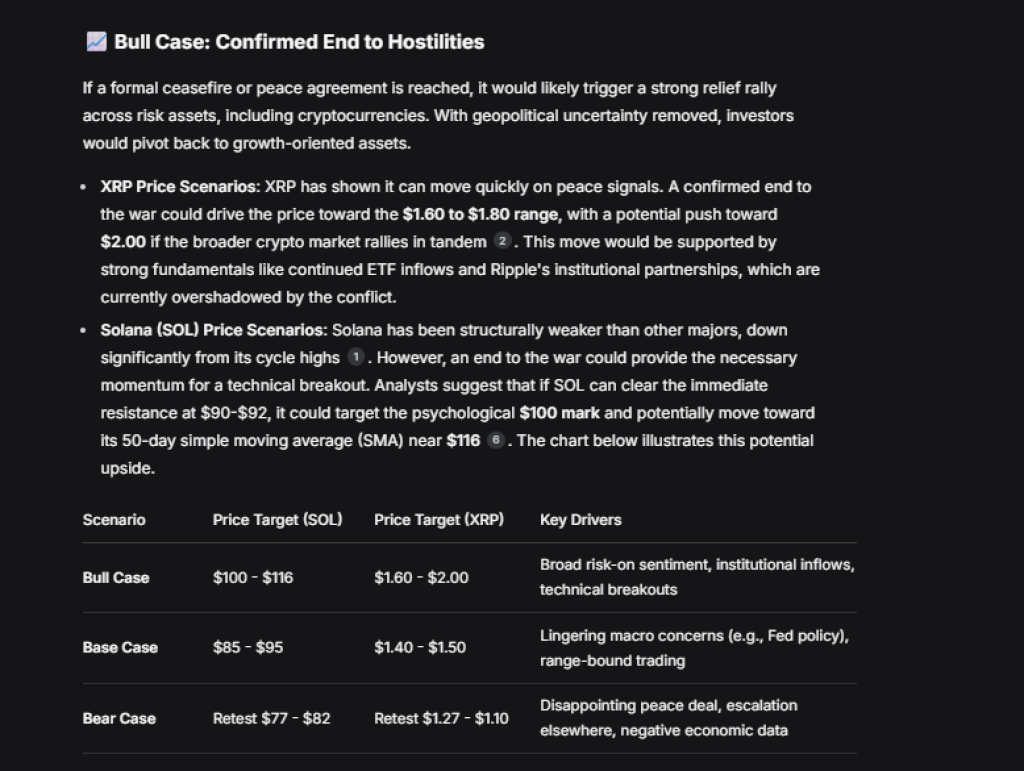 Source: Deepseek
Here’s What Solana Chart Is Showing
The chart tells a slightly different story. At $86.95, the SOL price has been struggling compared to some other majors. The weekly chart shows a clear downtrend from the $260 highs, with price respecting descending resistance.
But here’s the interesting part, momentum indicators are showing early signs of basing. The sell volume has been drying up, and each lower low has been met with less enthusiasm from sellers. This is exactly what you want to see before a potential reversal.
On the support side, $86.08 is the recent low, with stronger support down at $80 if selling pressure returns. Upward, $90 to $92 is the immediate hurdle that needs to be cleared, with the psychological $100 level sitting right above that.
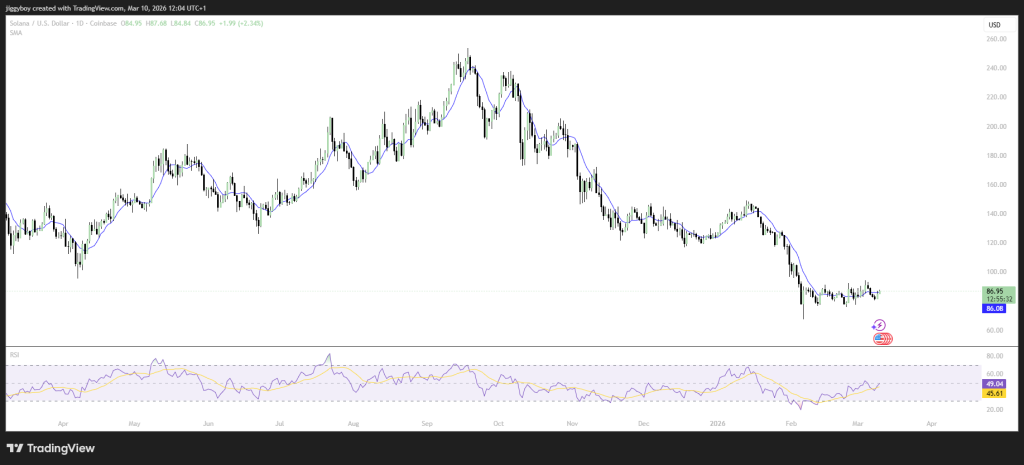 Source: Tradingview.com
DeepSeek’s Solana Prediction If the War Ends
The Solana price needs to clear that $90-$92 resistance first. If it does, the psychological $100 mark becomes the immediate target.
From there, momentum could carry it toward the 50-day SMA near $116. Solana’s been structurally weaker lately, but that just means it has more room to run when sentiment turns.
Read Also: ONDO Price Prediction: Analyst Says ONDO Could Rally 24x From Here Despite the 90% Crash
What About the Other Scenarios?
Of course, things may not go exactly as planned. If we get a ceasefire but still have distrust between the warring parties, sanctions are still in place, and everybody is waiting to see if all of these parties are actually abiding by the agreement, then XRP will likely continue to hover in the $1.40 to $1.50 range, with Solana similarly hovering in the $85 to $95 price range.
Everybody breathes a sigh of relief but waits for the next catalyst, which will likely be the Fed meeting on March 17-18.
But if peace talks fail, or are weak and fail to hold, or another geopolitical hotspot erupts… Markets hate uncertainty. The XRP price would likely retest $1.27 and possibly $1.10 if selling accelerates. Solana would head back to the $77-$82 support zone.
However, markets hate uncertainty, and the Iran conflict has been nothing but uncertainty for weeks. If that cloud lifts, even partially, you’re going to see money rotate back into assets that got sold off unfairly.
The XRP price has already shown it can jump nearly 10% on just talk of peace. Imagine what happens when it’s official.
Solana needs to prove it can break that $90 wall. If it does, the short squeeze could be violent.
The charts are set up for a move. The headlines just turned positive. Now we wait and see if both sides can actually get this done.
Subscribe to our YouTube channel for daily crypto updates, market insights, and expert analysis.
The post DeepSeek AI Predicts the Price of Solana and XRP If the War Ends appeared first on CaptainAltcoin.
You May Also Like

Cashing In On University Patents Means Giving Up On Our Innovation Future
Trump admin may be forced to reveal military-election plot with new lawsuit
