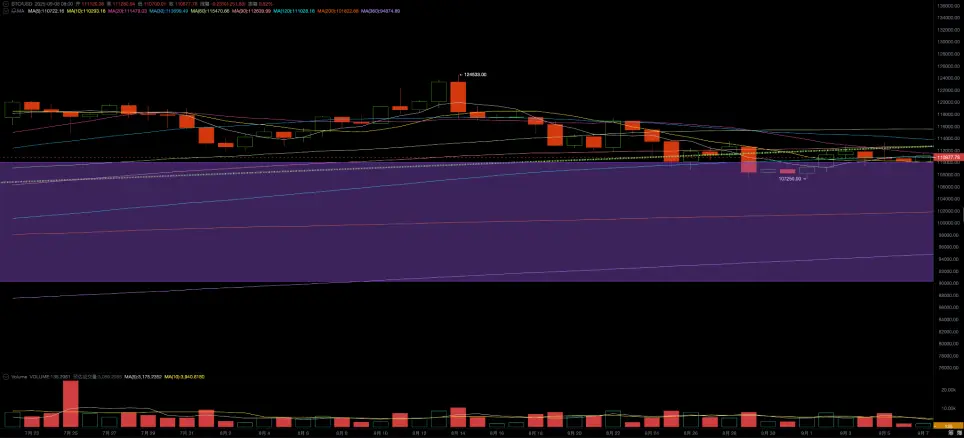
Author: 0xBrooker BTC daily trend BTC opened at $108,247.95 this week and closed at $113,478.00, with a low of $111,129.61 and a high of $113,390.00, a decrease of 3.41% and an increase of 2.66%. The trading volume shrank compared with last week. From a medium-term perspective, BTC remains mired in market turmoil, fueled by the "revision of interest rate cuts" and the "Federal Reserve independence debate." From a short-term perspective, BTC prices have fluctuated over the past week, driven by employment data and changes in industrial policy. The overall employment data is in line with the expectation of a "mild cold snap", which pushes the probability of a rate cut in September to around 90%. The expectation of three rate cuts this year has rebounded, but is still very low. The SEC said it will strengthen supervision of crypto treasury companies' issuance of additional shares to acquire cryptocurrencies. This has suppressed the financing activities of treasury companies, the current largest source of purchasing power in the market, and is also one of the reasons for the market's decline. EMC Labs maintains a cautiously optimistic attitude in the medium term. The rebalancing of market forces before and after the interest rate cut is bound to be bumpy, but the overall US economy is safe, and the restart of the interest rate cut cycle will support the upward pricing of risky assets, which is still certain. Policy, macro-financial and economic data On September 4, the JOLTS job vacancy data was first released. The announced value of 8.4 million was lower than the expected 8.7 million and the previous value of 8.9 million, and it fell to a three-year low, further confirming that labor demand is cooling. On September 5th, the weekly initial jobless claims data came in at 232,000, slightly exceeding market expectations of 230,000. Continuing claims were also slightly higher at 1.751 million, also slightly exceeding market expectations of 1.740 million. Both figures suggest a slowing labor market. On September 6th, non-farm payroll data showed that 173,000 new jobs were added in August, below market expectations of 180,000 and the previous reading of 190,000. The unemployment rate also rose from 4.0% to 4.1%, reaching its highest point since 2021, indicating a significant cooling in the labor market. The mild cooling of the employment data suggests that the economy and employment are cooling, which has reaffirmed market expectations of a September rate cut. FedWatch shows a near 90% probability of a September rate cut, with a small probability of a 75 basis point cut. This is a slight revision to last week's expectations. This correction led to a rebound in US stocks after two consecutive weeks of decline. The Nasdaq rose 1.14% and the S&P 500 rose 0.33%, with all three major indexes hitting record highs. Yields on both long- and short-term US Treasury bonds continued to decline, falling by 2.3% and 2.03%, respectively. There's no risk of an interest rate cut, and the magnitude and frequency of these cuts remain priced in. The US dollar index, while fluctuating, fell 0.11% this week to 97.737. Gold surged 3.52% to $3,639 per ounce. Crypto Market Following a sharp decline last week, BTC rebounded 2.66% this week, barely breaking through the "Trump bottom" (90,000-110,000 US dollars frame), but was still suppressed by the "bull market first rising trend line" and still fell below the 20-day line. Over the past two months, BTC's attempt to start the "fourth wave of rise" ultimately failed and returned to the adjustment range. In addition to the impact of the interest rate cut cycle, it is also related to the shift of funds and the "cold reception" of policies. According to eMerge Engine data, BTC Spot ETF channel funds have weakened for several consecutive weeks, and the procurement scale of treasury companies has also declined significantly. On the regulatory front, the SEC this week issued updated guidance on crypto treasury companies (DATs), adding them to the regulatory agenda for national exchanges/ATSs and requiring them to obtain shareholder approval before diluting their holdings to finance crypto asset purchases. This new regulation will undoubtedly slow the pace and scale of acquisitions by treasury companies, and the market sees it as a significant negative. The stock prices of many DATs have plummeted, negatively impacting the trading prices of Bitcoin, Ether, and other cryptocurrencies. In addition to cooling industrial policies and a cooling capital inflow, long-term selling also played a significant role in the weakening BTC price. According to on-chain data, long-term holders reduced their holdings by over 40,000 BTC this week, significantly higher than last week. The current price of the currency is close to the short-term holding price, indicating that the downside risk has been reduced. Cycle indicators According to eMerge Engine, the EMC BTC Cycle Metrics indicator is 0.375, which is in the rising relay period.Author: 0xBrooker BTC daily trend BTC opened at $108,247.95 this week and closed at $113,478.00, with a low of $111,129.61 and a high of $113,390.00, a decrease of 3.41% and an increase of 2.66%. The trading volume shrank compared with last week. From a medium-term perspective, BTC remains mired in market turmoil, fueled by the "revision of interest rate cuts" and the "Federal Reserve independence debate." From a short-term perspective, BTC prices have fluctuated over the past week, driven by employment data and changes in industrial policy. The overall employment data is in line with the expectation of a "mild cold snap", which pushes the probability of a rate cut in September to around 90%. The expectation of three rate cuts this year has rebounded, but is still very low. The SEC said it will strengthen supervision of crypto treasury companies' issuance of additional shares to acquire cryptocurrencies. This has suppressed the financing activities of treasury companies, the current largest source of purchasing power in the market, and is also one of the reasons for the market's decline. EMC Labs maintains a cautiously optimistic attitude in the medium term. The rebalancing of market forces before and after the interest rate cut is bound to be bumpy, but the overall US economy is safe, and the restart of the interest rate cut cycle will support the upward pricing of risky assets, which is still certain. Policy, macro-financial and economic data On September 4, the JOLTS job vacancy data was first released. The announced value of 8.4 million was lower than the expected 8.7 million and the previous value of 8.9 million, and it fell to a three-year low, further confirming that labor demand is cooling. On September 5th, the weekly initial jobless claims data came in at 232,000, slightly exceeding market expectations of 230,000. Continuing claims were also slightly higher at 1.751 million, also slightly exceeding market expectations of 1.740 million. Both figures suggest a slowing labor market. On September 6th, non-farm payroll data showed that 173,000 new jobs were added in August, below market expectations of 180,000 and the previous reading of 190,000. The unemployment rate also rose from 4.0% to 4.1%, reaching its highest point since 2021, indicating a significant cooling in the labor market. The mild cooling of the employment data suggests that the economy and employment are cooling, which has reaffirmed market expectations of a September rate cut. FedWatch shows a near 90% probability of a September rate cut, with a small probability of a 75 basis point cut. This is a slight revision to last week's expectations. This correction led to a rebound in US stocks after two consecutive weeks of decline. The Nasdaq rose 1.14% and the S&P 500 rose 0.33%, with all three major indexes hitting record highs. Yields on both long- and short-term US Treasury bonds continued to decline, falling by 2.3% and 2.03%, respectively. There's no risk of an interest rate cut, and the magnitude and frequency of these cuts remain priced in. The US dollar index, while fluctuating, fell 0.11% this week to 97.737. Gold surged 3.52% to $3,639 per ounce. Crypto Market Following a sharp decline last week, BTC rebounded 2.66% this week, barely breaking through the "Trump bottom" (90,000-110,000 US dollars frame), but was still suppressed by the "bull market first rising trend line" and still fell below the 20-day line. Over the past two months, BTC's attempt to start the "fourth wave of rise" ultimately failed and returned to the adjustment range. In addition to the impact of the interest rate cut cycle, it is also related to the shift of funds and the "cold reception" of policies. According to eMerge Engine data, BTC Spot ETF channel funds have weakened for several consecutive weeks, and the procurement scale of treasury companies has also declined significantly. On the regulatory front, the SEC this week issued updated guidance on crypto treasury companies (DATs), adding them to the regulatory agenda for national exchanges/ATSs and requiring them to obtain shareholder approval before diluting their holdings to finance crypto asset purchases. This new regulation will undoubtedly slow the pace and scale of acquisitions by treasury companies, and the market sees it as a significant negative. The stock prices of many DATs have plummeted, negatively impacting the trading prices of Bitcoin, Ether, and other cryptocurrencies. In addition to cooling industrial policies and a cooling capital inflow, long-term selling also played a significant role in the weakening BTC price. According to on-chain data, long-term holders reduced their holdings by over 40,000 BTC this week, significantly higher than last week. The current price of the currency is close to the short-term holding price, indicating that the downside risk has been reduced. Cycle indicators According to eMerge Engine, the EMC BTC Cycle Metrics indicator is 0.375, which is in the rising relay period.


Crypto Market Weekly Review (September 1-7): US employment data supports a resumption of interest rate cuts in September, while new SEC regulations cool down treasury companies.

2025/09/08 20:00

Author: 0xBrooker

 BTC daily trend

BTC opened at $108,247.95 this week and closed at $113,478.00, with a low of $111,129.61 and a high of $113,390.00, a decrease of 3.41% and an increase of 2.66%. The trading volume shrank compared with last week.

From a medium-term perspective, BTC remains mired in market turmoil, fueled by the "revision of interest rate cuts" and the "Federal Reserve independence debate." From a short-term perspective, BTC prices have fluctuated over the past week, driven by employment data and changes in industrial policy.

The overall employment data is in line with the expectation of a "mild cold snap", which pushes the probability of a rate cut in September to around 90%. The expectation of three rate cuts this year has rebounded, but is still very low.

The SEC said it will strengthen supervision of crypto treasury companies' issuance of additional shares to acquire cryptocurrencies. This has suppressed the financing activities of treasury companies, the current largest source of purchasing power in the market, and is also one of the reasons for the market's decline.

EMC Labs maintains a cautiously optimistic attitude in the medium term. The rebalancing of market forces before and after the interest rate cut is bound to be bumpy, but the overall US economy is safe, and the restart of the interest rate cut cycle will support the upward pricing of risky assets, which is still certain.

Policy, macro-financial and economic data

On September 4, the JOLTS job vacancy data was first released. The announced value of 8.4 million was lower than the expected 8.7 million and the previous value of 8.9 million, and it fell to a three-year low, further confirming that labor demand is cooling.

On September 5th, the weekly initial jobless claims data came in at 232,000, slightly exceeding market expectations of 230,000. Continuing claims were also slightly higher at 1.751 million, also slightly exceeding market expectations of 1.740 million. Both figures suggest a slowing labor market.

On September 6th, non-farm payroll data showed that 173,000 new jobs were added in August, below market expectations of 180,000 and the previous reading of 190,000. The unemployment rate also rose from 4.0% to 4.1%, reaching its highest point since 2021, indicating a significant cooling in the labor market.

The mild cooling of the employment data suggests that the economy and employment are cooling, which has reaffirmed market expectations of a September rate cut. FedWatch shows a near 90% probability of a September rate cut, with a small probability of a 75 basis point cut. This is a slight revision to last week's expectations.

This correction led to a rebound in US stocks after two consecutive weeks of decline. The Nasdaq rose 1.14% and the S&P 500 rose 0.33%, with all three major indexes hitting record highs. Yields on both long- and short-term US Treasury bonds continued to decline, falling by 2.3% and 2.03%, respectively.

There's no risk of an interest rate cut, and the magnitude and frequency of these cuts remain priced in. The US dollar index, while fluctuating, fell 0.11% this week to 97.737. Gold surged 3.52% to $3,639 per ounce.

Crypto Market

Following a sharp decline last week, BTC rebounded 2.66% this week, barely breaking through the "Trump bottom" (90,000-110,000 US dollars frame), but was still suppressed by the "bull market first rising trend line" and still fell below the 20-day line.

Over the past two months, BTC's attempt to start the "fourth wave of rise" ultimately failed and returned to the adjustment range. In addition to the impact of the interest rate cut cycle, it is also related to the shift of funds and the "cold reception" of policies.

According to eMerge Engine data, BTC Spot ETF channel funds have weakened for several consecutive weeks, and the procurement scale of treasury companies has also declined significantly.

On the regulatory front, the SEC this week issued updated guidance on crypto treasury companies (DATs), adding them to the regulatory agenda for national exchanges/ATSs and requiring them to obtain shareholder approval before diluting their holdings to finance crypto asset purchases. This new regulation will undoubtedly slow the pace and scale of acquisitions by treasury companies, and the market sees it as a significant negative. The stock prices of many DATs have plummeted, negatively impacting the trading prices of Bitcoin, Ether, and other cryptocurrencies.

In addition to cooling industrial policies and a cooling capital inflow, long-term selling also played a significant role in the weakening BTC price. According to on-chain data, long-term holders reduced their holdings by over 40,000 BTC this week, significantly higher than last week.

The current price of the currency is close to the short-term holding price, indicating that the downside risk has been reduced.

Cycle indicators

According to eMerge Engine, the EMC BTC Cycle Metrics indicator is 0.375, which is in the rising relay period.

Market Opportunity
NEAR Logo
NEAR Price(NEAR)
$1.713
$1.713$1.713
-4.14%
USD
NEAR (NEAR) Live Price Chart
Disclaimer: The articles reposted on this site are sourced from public platforms and are provided for informational purposes only. They do not necessarily reflect the views of MEXC. All rights remain with the original authors. If you believe any content infringes on third-party rights, please contact service@support.mexc.com for removal. MEXC makes no guarantees regarding the accuracy, completeness, or timeliness of the content and is not responsible for any actions taken based on the information provided. The content does not constitute financial, legal, or other professional advice, nor should it be considered a recommendation or endorsement by MEXC.

You May Also Like

Gold Hits $3,700 as Sprott’s Wong Says Dollar’s Store-of-Value Crown May Slip

Gold Hits $3,700 as Sprott’s Wong Says Dollar’s Store-of-Value Crown May Slip

The post Gold Hits $3,700 as Sprott’s Wong Says Dollar’s Store-of-Value Crown May Slip appeared on BitcoinEthereumNews.com. Gold is strutting its way into record territory, smashing through $3,700 an ounce Wednesday morning, as Sprott Asset Management strategist Paul Wong says the yellow metal may finally snatch the dollar’s most coveted role: store of value. Wong Warns: Fiscal Dominance Puts U.S. Dollar on Notice, Gold on Top Gold prices eased slightly to $3,678.9 […] Source: https://news.bitcoin.com/gold-hits-3700-as-sprotts-wong-says-dollars-store-of-value-crown-may-slip/
Share
BitcoinEthereumNews2025/09/18 00:33
Why Institutional Capital Chooses Gold Over Bitcoin Amid Yen Currency Crisis

Why Institutional Capital Chooses Gold Over Bitcoin Amid Yen Currency Crisis

TLDR: Yen’s managed devaluation artificially strengthens the dollar, creating headwinds for Bitcoin price action. Gold has surged 61.4% while Bitcoin stagnates
Share
Blockonomi2026/01/18 12:09
Franklin Templeton CEO Dismisses 50bps Rate Cut Ahead FOMC

Franklin Templeton CEO Dismisses 50bps Rate Cut Ahead FOMC

The post Franklin Templeton CEO Dismisses 50bps Rate Cut Ahead FOMC appeared on BitcoinEthereumNews.com. Franklin Templeton CEO Jenny Johnson has weighed in on whether the Federal Reserve should make a 25 basis points (bps) Fed rate cut or 50 bps cut. This comes ahead of the Fed decision today at today’s FOMC meeting, with the market pricing in a 25 bps cut. Bitcoin and the broader crypto market are currently trading flat ahead of the rate cut decision. Franklin Templeton CEO Weighs In On Potential FOMC Decision In a CNBC interview, Jenny Johnson said that she expects the Fed to make a 25 bps cut today instead of a 50 bps cut. She acknowledged the jobs data, which suggested that the labor market is weakening. However, she noted that this data is backward-looking, indicating that it doesn’t show the current state of the economy. She alluded to the wage growth, which she remarked is an indication of a robust labor market. She added that retail sales are up and that consumers are still spending, despite inflation being sticky at 3%, which makes a case for why the FOMC should opt against a 50-basis-point Fed rate cut. In line with this, the Franklin Templeton CEO said that she would go with a 25 bps rate cut if she were Jerome Powell. She remarked that the Fed still has the October and December FOMC meetings to make further cuts if the incoming data warrants it. Johnson also asserted that the data show a robust economy. However, she noted that there can’t be an argument for no Fed rate cut since Powell already signaled at Jackson Hole that they were likely to lower interest rates at this meeting due to concerns over a weakening labor market. Notably, her comment comes as experts argue for both sides on why the Fed should make a 25 bps cut or…
Share
BitcoinEthereumNews2025/09/18 00:36