Complicated rules and regulations have long been the tightest noose around crypto’s neck – but that’s now changing rapidly with Donald Trump back in the president’s seat for a second term. The latest sign of the US government’s pro-crypto stance is the Senate’s new bill, the Responsible Financial Innovation Act of 2025. Most notably, the […]Complicated rules and regulations have long been the tightest noose around crypto’s neck – but that’s now changing rapidly with Donald Trump back in the president’s seat for a second term. The latest sign of the US government’s pro-crypto stance is the Senate’s new bill, the Responsible Financial Innovation Act of 2025. Most notably, the […]

Best Altcoins to Buy After US Senate Confirms Tokenized Stocks Are Still Securities

2025/09/08 00:43
5 min read
For feedback or concerns regarding this content, please contact us at crypto.news@mexc.com

Complicated rules and regulations have long been the tightest noose around crypto’s neck – but that’s now changing rapidly with Donald Trump back in the president’s seat for a second term.

The latest sign of the US government’s pro-crypto stance is the Senate’s new bill, the Responsible Financial Innovation Act of 2025.

Most notably, the bill introduces a crucial provision clarifying that tokenized stocks and similar assets will remain classified as securities.

Keep reading to learn why this clarification is a win for crypto, how it simplifies things for blockchain businesses, and which are the best altcoins to buy to make the most from the momentum this regulatory shift is set to create.

Why the Senate’s 2025 Bill Could Supercharge the Crypto Market

The Senate’s latest bill is crucial because it ensures that companies involved in tokenization can continue operating within familiar frameworks, including broker-dealer systems, clearing mechanisms, and trading platforms.

Even better, the bill also lays out clear guidelines on when digital assets will fall under the jurisdiction of the Securities and Exchange Commission (SEC) versus the Commodity Futures Trading Commission (CFTC).

Wyoming Senator Cynthia Lummis reinforced the urgency, saying, ‘We want this on the president’s desk before the end of the year,’ showing that the Senate isn’t just committed to pro-crypto changes but also to rolling them out quickly for maximum impact.

Combined with the prospect of multiple Federal Reserve rate cuts in 2025, there may not be a better time to load up your portfolio with explode-worthy altcoins like the following.

1. Snorter Token ($SNORT) – New Telegram-Based Trading Bot Helping Retail Meme Coin Traders

Snorter Token ($SNORT) powers a new Telegram trading bot built to restore parity in the meme coin trading space.

Right now, deep-pocketed investors with advanced tools and algorithms scoop up most of the liquidity in newly listed tokens, effectively shutting out retail traders from those early meme coin pumps.

Snorter Bot’s automatic execution changes that. It lets you place buy/sell orders in advance and then executes them the moment liquidity becomes available – something nearly impossible to do manually.

This gives you the chance to ride the earliest (and often biggest) price jumps in new meme coins.
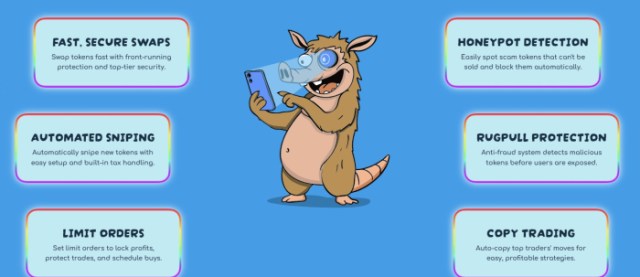
Snorter Bot features.

On top of that, the bot is loaded with robust safeguards against common on-chain threats, including rug pulls, honeypots, front-running, and sandwich attacks.

Why buy $SNORT, Snorter Bot’s native cryptocurrency?

  • A potential 800% ROI by year-end, according to our $SNORT price prediction
  • No daily sniping limits
  • Advanced analytics
  • Generous staking rewards, currently yielding 123%
  • Reduced trading fees: just 0.85% vs. 1.5% charged to non-holders

Interested? Join the $SNORT presale, which has already pulled in over $3.77M from early investors. And each token is currently priced at just $0.1037.

Check out Snorter Token’s official website for more information.

2. Maxi Doge ($MAXI) – Dogecoin-Themed Meme Coin with Aggressive Marketing Plans

Maxi Doge ($MAXI) might not have an other-worldly staking mechanism or any underlying utility, but its raw, laser-focused mission to overshadow Dogecoin has crypto degens hooked.

Simply put, Maxi is Dogecoin’s distant cousin who, thanks to Doge’s pomp and show as the best meme coin ever, grew up in the shadows. This left Maxi licking his paws in frustration.

That’s why Maxi harbors an undying hatred for Dogecoin. The million-dollar question, however, is whether $MAXI is capable of being the next 1000x crypto.
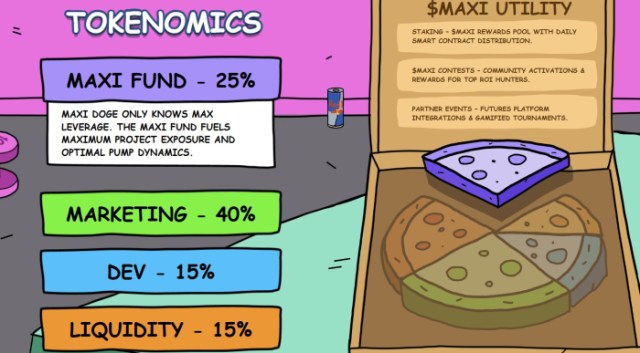
$MAXI Tokenomics as illustrated on the presale website.

The answer? A resounding yes. With over 40% of its total token supply reserved for marketing (think PR campaigns, influencer partnerships, and social media blitzes), $MAXI has locked in a solid plan to go viral.

Additionally, it won’t stop at DEX and CEX listings – $MAXI is also eyeing a futures platform launch.

This could make it even more popular among high-risk, high-reward traders, who will be able to take leveraged positions and chase potentially life-changing gains.

Join the tribe by buying $MAXI while it’s still in presale at just $0.000256. The project has already amassed $1.9M in funding within just a few weeks.

For more information, check out Maxi Doge’s official website.

3. Comedian ($BAN) – Viral Meme Coin Based on Controversial Artwork

Comedian ($BAN)’s 130%+ rise over the past month is already impressive, but its additional 22% gain this past week is particularly noteworthy, as it comes right after a major breakout.

The breakout in question was a run-up out of a descending triangle pattern – the same formation that pushed the token into a nearly 90% drawdown back in February-April this year.

According to textbook technical analysis, by measuring the width of the triangle and projecting it from the breakout, $BAN could be on its way to $1.419360 – an eye-popping 1,000% gain from current price levels.
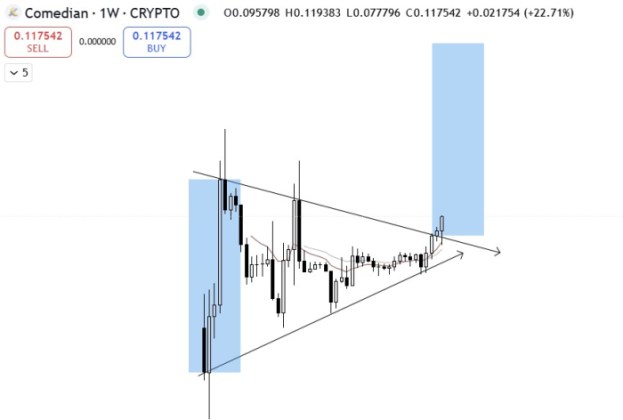
Comedian ($BAN) price chart CoinMarketCap

For context, Comedian is based on the controversial artwork featuring a banana taped to a wall.

This so-called piece of ‘modern’ art that has sparked endless online debate about whether it represents brilliance or just lazy absurdity.

Wrapping Up

With the US government showing no signs of slowing down its pro-crypto stance, the stage is set for the crypto market to rise by leaps and bounds in the coming weeks.

If you wish to make the most of this golden opportunity, consider loading up on low-priced, high-potential tokens like Snorter Token ($SNORT), Maxi Doge ($MAXI), and Comedian ($BAN).

However, kindly keep in mind that crypto investments are inherently risky. This article is not financial advice, and you must always do your own research before investing.

Market Opportunity
OFFICIAL TRUMP Logo
OFFICIAL TRUMP Price(TRUMP)
$3.328
$3.328$3.328
-1.21%
USD
OFFICIAL TRUMP (TRUMP) Live Price Chart
Disclaimer: The articles reposted on this site are sourced from public platforms and are provided for informational purposes only. They do not necessarily reflect the views of MEXC. All rights remain with the original authors. If you believe any content infringes on third-party rights, please contact crypto.news@mexc.com for removal. MEXC makes no guarantees regarding the accuracy, completeness, or timeliness of the content and is not responsible for any actions taken based on the information provided. The content does not constitute financial, legal, or other professional advice, nor should it be considered a recommendation or endorsement by MEXC.

You May Also Like

Trump-backed WLFI  launches AgentPay SDK open-source payment toolkit for AI agents

Trump-backed WLFI  launches AgentPay SDK open-source payment toolkit for AI agents

The Trump family has expanded its presence in the crypto community with a major development for artificial intelligence (AI) agents. According to reports, World
Share
Cryptopolitan2026/03/20 19:03
Summarize Any Stock’s Earnings Call in Seconds Using FMP API

Summarize Any Stock’s Earnings Call in Seconds Using FMP API

Turn lengthy earnings call transcripts into one-page insights using the Financial Modeling Prep APIPhoto by Bich Tran Earnings calls are packed with insights. They tell you how a company performed, what management expects in the future, and what analysts are worried about. The challenge is that these transcripts often stretch across dozens of pages, making it tough to separate the key takeaways from the noise. With the right tools, you don’t need to spend hours reading every line. By combining the Financial Modeling Prep (FMP) API with Groq’s lightning-fast LLMs, you can transform any earnings call into a concise summary in seconds. The FMP API provides reliable access to complete transcripts, while Groq handles the heavy lifting of distilling them into clear, actionable highlights. In this article, we’ll build a Python workflow that brings these two together. You’ll see how to fetch transcripts for any stock, prepare the text, and instantly generate a one-page summary. Whether you’re tracking Apple, NVIDIA, or your favorite growth stock, the process works the same — fast, accurate, and ready whenever you are. Fetching Earnings Transcripts with FMP API The first step is to pull the raw transcript data. FMP makes this simple with dedicated endpoints for earnings calls. If you want the latest transcripts across the market, you can use the stable endpoint /stable/earning-call-transcript-latest. For a specific stock, the v3 endpoint lets you request transcripts by symbol, quarter, and year using the pattern: https://financialmodelingprep.com/api/v3/earning_call_transcript/{symbol}?quarter={q}&year={y}&apikey=YOUR_API_KEY here’s how you can fetch NVIDIA’s transcript for a given quarter: import requestsAPI_KEY = "your_api_key"symbol = "NVDA"quarter = 2year = 2024url = f"https://financialmodelingprep.com/api/v3/earning_call_transcript/{symbol}?quarter={quarter}&year={year}&apikey={API_KEY}"response = requests.get(url)data = response.json()# Inspect the keysprint(data.keys())# Access transcript contentif "content" in data[0]: transcript_text = data[0]["content"] print(transcript_text[:500]) # preview first 500 characters The response typically includes details like the company symbol, quarter, year, and the full transcript text. If you aren’t sure which quarter to query, the “latest transcripts” endpoint is the quickest way to always stay up to date. Cleaning and Preparing Transcript Data Raw transcripts from the API often include long paragraphs, speaker tags, and formatting artifacts. Before sending them to an LLM, it helps to organize the text into a cleaner structure. Most transcripts follow a pattern: prepared remarks from executives first, followed by a Q&A session with analysts. Separating these sections gives better control when prompting the model. In Python, you can parse the transcript and strip out unnecessary characters. A simple way is to split by markers such as “Operator” or “Question-and-Answer.” Once separated, you can create two blocks — Prepared Remarks and Q&A — that will later be summarized independently. This ensures the model handles each section within context and avoids missing important details. Here’s a small example of how you might start preparing the data: import re# Example: using the transcript_text we fetched earliertext = transcript_text# Remove extra spaces and line breaksclean_text = re.sub(r'\s+', ' ', text).strip()# Split sections (this is a heuristic; real-world transcripts vary slightly)if "Question-and-Answer" in clean_text: prepared, qna = clean_text.split("Question-and-Answer", 1)else: prepared, qna = clean_text, ""print("Prepared Remarks Preview:\n", prepared[:500])print("\nQ&A Preview:\n", qna[:500]) With the transcript cleaned and divided, you’re ready to feed it into Groq’s LLM. Chunking may be necessary if the text is very long. A good approach is to break it into segments of a few thousand tokens, summarize each part, and then merge the summaries in a final pass. Summarizing with Groq LLM Now that the transcript is clean and split into Prepared Remarks and Q&A, we’ll use Groq to generate a crisp one-pager. The idea is simple: summarize each section separately (for focus and accuracy), then synthesize a final brief. Prompt design (concise and factual) Use a short, repeatable template that pushes for neutral, investor-ready language: You are an equity research analyst. Summarize the following earnings call sectionfor {symbol} ({quarter} {year}). Be factual and concise.Return:1) TL;DR (3–5 bullets)2) Results vs. guidance (what improved/worsened)3) Forward outlook (specific statements)4) Risks / watch-outs5) Q&A takeaways (if present)Text:<<<{section_text}>>> Python: calling Groq and getting a clean summary Groq provides an OpenAI-compatible API. Set your GROQ_API_KEY and pick a fast, high-quality model (e.g., a Llama-3.1 70B variant). We’ll write a helper to summarize any text block, then run it for both sections and merge. import osimport textwrapimport requestsGROQ_API_KEY = os.environ.get("GROQ_API_KEY") or "your_groq_api_key"GROQ_BASE_URL = "https://api.groq.com/openai/v1" # OpenAI-compatibleMODEL = "llama-3.1-70b" # choose your preferred Groq modeldef call_groq(prompt, temperature=0.2, max_tokens=1200): url = f"{GROQ_BASE_URL}/chat/completions" headers = { "Authorization": f"Bearer {GROQ_API_KEY}", "Content-Type": "application/json", } payload = { "model": MODEL, "messages": [ {"role": "system", "content": "You are a precise, neutral equity research analyst."}, {"role": "user", "content": prompt}, ], "temperature": temperature, "max_tokens": max_tokens, } r = requests.post(url, headers=headers, json=payload, timeout=60) r.raise_for_status() return r.json()["choices"][0]["message"]["content"].strip()def build_prompt(section_text, symbol, quarter, year): template = """ You are an equity research analyst. Summarize the following earnings call section for {symbol} ({quarter} {year}). Be factual and concise. Return: 1) TL;DR (3–5 bullets) 2) Results vs. guidance (what improved/worsened) 3) Forward outlook (specific statements) 4) Risks / watch-outs 5) Q&A takeaways (if present) Text: <<< {section_text} >>> """ return textwrap.dedent(template).format( symbol=symbol, quarter=quarter, year=year, section_text=section_text )def summarize_section(section_text, symbol="NVDA", quarter="Q2", year="2024"): if not section_text or section_text.strip() == "": return "(No content found for this section.)" prompt = build_prompt(section_text, symbol, quarter, year) return call_groq(prompt)# Example usage with the cleaned splits from Section 3prepared_summary = summarize_section(prepared, symbol="NVDA", quarter="Q2", year="2024")qna_summary = summarize_section(qna, symbol="NVDA", quarter="Q2", year="2024")final_one_pager = f"""# {symbol} Earnings One-Pager — {quarter} {year}## Prepared Remarks — Key Points{prepared_summary}## Q&A Highlights{qna_summary}""".strip()print(final_one_pager[:1200]) # preview Tips that keep quality high: Keep temperature low (≈0.2) for factual tone. If a section is extremely long, chunk at ~5–8k tokens, summarize each chunk with the same prompt, then ask the model to merge chunk summaries into one section summary before producing the final one-pager. If you also fetched headline numbers (EPS/revenue, guidance) earlier, prepend them to the prompt as brief context to help the model anchor on the right outcomes. Building the End-to-End Pipeline At this point, we have all the building blocks: the FMP API to fetch transcripts, a cleaning step to structure the data, and Groq LLM to generate concise summaries. The final step is to connect everything into a single workflow that can take any ticker and return a one-page earnings call summary. The flow looks like this: Input a stock ticker (for example, NVDA). Use FMP to fetch the latest transcript. Clean and split the text into Prepared Remarks and Q&A. Send each section to Groq for summarization. Merge the outputs into a neatly formatted earnings one-pager. Here’s how it comes together in Python: def summarize_earnings_call(symbol, quarter, year, api_key, groq_key): # Step 1: Fetch transcript from FMP url = f"https://financialmodelingprep.com/api/v3/earning_call_transcript/{symbol}?quarter={quarter}&year={year}&apikey={api_key}" resp = requests.get(url) resp.raise_for_status() data = resp.json() if not data or "content" not in data[0]: return f"No transcript found for {symbol} {quarter} {year}" text = data[0]["content"] # Step 2: Clean and split clean_text = re.sub(r'\s+', ' ', text).strip() if "Question-and-Answer" in clean_text: prepared, qna = clean_text.split("Question-and-Answer", 1) else: prepared, qna = clean_text, "" # Step 3: Summarize with Groq prepared_summary = summarize_section(prepared, symbol, quarter, year) qna_summary = summarize_section(qna, symbol, quarter, year) # Step 4: Merge into final one-pager return f"""# {symbol} Earnings One-Pager — {quarter} {year}## Prepared Remarks{prepared_summary}## Q&A Highlights{qna_summary}""".strip()# Example runprint(summarize_earnings_call("NVDA", 2, 2024, API_KEY, GROQ_API_KEY)) With this setup, generating a summary becomes as simple as calling one function with a ticker and date. You can run it inside a notebook, integrate it into a research workflow, or even schedule it to trigger after each new earnings release. Free Stock Market API and Financial Statements API... Conclusion Earnings calls no longer need to feel overwhelming. With the Financial Modeling Prep API, you can instantly access any company’s transcript, and with Groq LLM, you can turn that raw text into a sharp, actionable summary in seconds. This pipeline saves hours of reading and ensures you never miss the key results, guidance, or risks hidden in lengthy remarks. Whether you track tech giants like NVIDIA or smaller growth stocks, the process is the same — fast, reliable, and powered by the flexibility of FMP’s data. Summarize Any Stock’s Earnings Call in Seconds Using FMP API was originally published in Coinmonks on Medium, where people are continuing the conversation by highlighting and responding to this story
Share
Medium2025/09/18 14:40
Tom Lee Declares That Ethereum Has Bottomed Out

Tom Lee Declares That Ethereum Has Bottomed Out

Experienced analyst Tom Lee conducted an in-depth analysis of the Ethereum price. Here are some of the highlights from Lee's findings. Continue Reading: Tom Lee
Share
Bitcoinsistemi2026/03/20 19:05