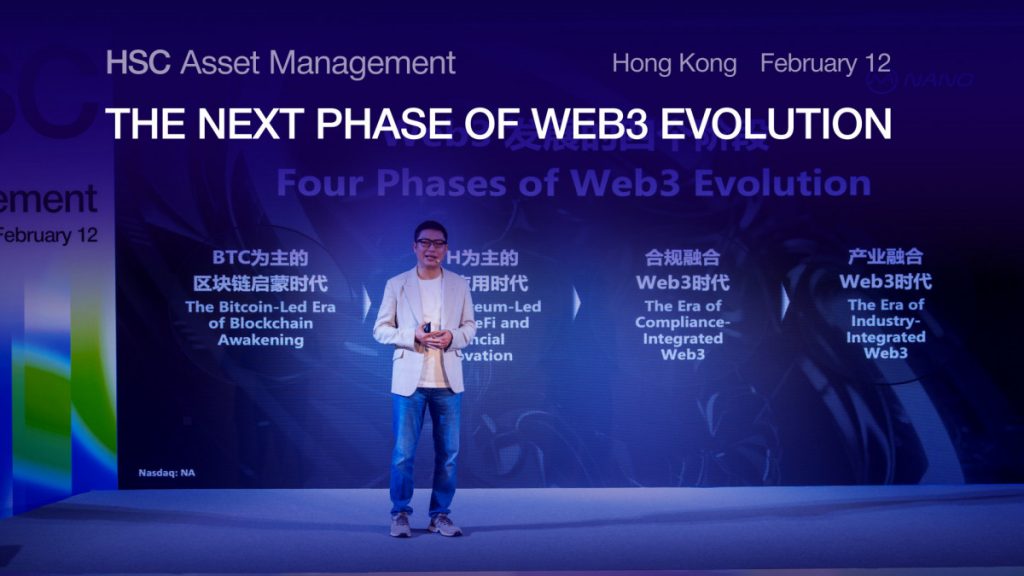
Web3 has evolved from Bitcoin’s decentralized money and Ethereum’s smart contracts to a new phase of institutional adoption, regulatory integration, and real-worldWeb3 has evolved from Bitcoin’s decentralized money and Ethereum’s smart contracts to a new phase of institutional adoption, regulatory integration, and real-world

From Narrative To Necessity: DePIN And AI Gain Real Economic Utility
2026/03/04 22:00
4 min read
For feedback or concerns regarding this content, please contact us at crypto.news@mexc.com
From Narrative To Necessity: DePIN And AI Gain Real Economic Utility

Dr. Kong Jianping of Nano Labs and the Hong Kong Cyberport Board shows that Web3 has reached specific developmental stages over the last 10 years. The initial stage was characterized by Bitcoin who brought about decentralized digital money. The second wave was led by Ethereum, which diversified blockchain use by introducing smart contracts and decentralized applications.

The third phase of Web3 is currently underway, as it involves integration into regulatory policies, institutional involvement, and physical financial usage. The acceptance of Bitcoin exchange-traded funds (ETFs) in the United States and Hong Kong is now a new stage that indicates increasing acceptance of blockchain by traditional financial systems. In the next two years, Dr. Kong thinks that additional financial assets and services will be shifted on-chain as blockchain penetration into mainstream finance continues.

Stablecoins Are the Most Successful Real-World Web3 Application

Stablecoins are the most successful example of blockchain application in the real world, compared to other Web3 sectors. Their development took place in three surges, and each of them extended their influence in the world financial system.

The initial wave was fueled by crypto trading, where stablecoins have offered liquidity to those markets that do not have access to a traditional banking system. This allowed transactions and users to efficiently interact without the need to use the infrastructure of fiat currency.

The second wave encountered decentralized finance (DeFi), in which stablecoins were necessary in lending, borrowing, and providing liquidity. This largely increased their usage and made stablecoins a fundamental part of blockchain financial infrastructure.

The third and most recent wave revolves around payments, particularly on cross-border payments. Stablecoins can also be used to conduct international transactions faster and cheaper than financial systems, which is considered to be of enormous value. In the global Real-world asset (RWA) tokenization is an emerging focus of significant Web3 growth. It is associated with the registration of ownership of traditional assets (stock, currency, or commodity) on blockchain networks.

Dr. Kong pointed to the fact that effective RWA applications should provide clear benefits, whether in the form of enhancing financial efficiency, lowering operational costs, or enabling new economic value. Stablecoins in themselves can be considered a successful model of tokenized real-world assets, which proves that blockchain can revolutionize traditional finance.

The use of tokenized stocks, financial products, and payment systems are highly likely to become increasingly prevalent in the years ahead, further narrowing the divide between traditional finance and the decentralized infrastructure.

Hong Kong Is Positioning Itself as a Global Web3 Hub

Hong Kong has become one of the most active regions that promotes the development of Web3. Regulatory clarity and legal frameworks. Since 2023, government policy frameworks have put in place regulatory clarity and legal frameworks to facilitate blockchain innovation, such as stablecoin regulation and licensing of digital asset exchanges.

Several digital asset exchanges have already been approved in the region, and the regulatory infrastructure is still being expanded. Future stablecoin issuance platforms and over-the-counter trading systems will only enhance the position of Hong Kong as a global Web3 center.

Hong Kong Cyberport is at the heart of this ecosystem and provides over 2,000 tech firms, many of which are more than 300 Web3 firms. The government is still allocating funds and infrastructure incentives to drive blockchain and fintech innovation.

Along with the use of blockchain, Hong Kong spends a lot of money on the development of artificial intelligence infrastructure. Cyberport has formed one of the largest AI computing centers in the area due to the increased integration of AI and Web3 technologies.

Such an intersection is likely to push forth fresh applications in finance, automation, and digital ownership. Blockchain can offer a safe, open architecture to the management of digital assets, whereas AI enhances the demand for decentralized data, computer systems, and financial systems. The tendencies demonstrate that blockchain-based assets are able to enjoy greater efficiency, economy of money, and financial opportunities.

The post From Narrative To Necessity: DePIN And AI Gain Real Economic Utility appeared first on Metaverse Post.


Market Opportunity
Griffin AI Logo
Griffin AI Price(GAIN)
$0.000862
$0.000862$0.000862
-5.99%
USD
Griffin AI (GAIN) Live Price Chart
Disclaimer: The articles reposted on this site are sourced from public platforms and are provided for informational purposes only. They do not necessarily reflect the views of MEXC. All rights remain with the original authors. If you believe any content infringes on third-party rights, please contact crypto.news@mexc.com for removal. MEXC makes no guarantees regarding the accuracy, completeness, or timeliness of the content and is not responsible for any actions taken based on the information provided. The content does not constitute financial, legal, or other professional advice, nor should it be considered a recommendation or endorsement by MEXC.

You May Also Like

The Federal Reserve cut interest rates by 25 basis points, and Powell said this was a risk management cut

The Federal Reserve cut interest rates by 25 basis points, and Powell said this was a risk management cut

PANews reported on September 18th, according to the Securities Times, that at 2:00 AM Beijing time on September 18th, the Federal Reserve announced a 25 basis point interest rate cut, lowering the federal funds rate from 4.25%-4.50% to 4.00%-4.25%, in line with market expectations. The Fed's interest rate announcement triggered a sharp market reaction, with the three major US stock indices rising briefly before quickly plunging. The US dollar index plummeted, briefly hitting a new low since 2025, before rebounding sharply, turning a decline into an upward trend. The sharp market volatility was closely tied to the subsequent monetary policy press conference held by Federal Reserve Chairman Powell. He stated that the 50 basis point rate cut lacked broad support and that there was no need for a swift adjustment. Today's move could be viewed as a risk-management cut, suggesting the Fed will not enter a sustained cycle of rate cuts. Powell reiterated the Fed's unwavering commitment to maintaining its independence. Market participants are currently unaware of the risks to the Fed's independence. The latest published interest rate dot plot shows that the median expectation of Fed officials is to cut interest rates twice more this year (by 25 basis points each), one more than predicted in June this year. At the same time, Fed officials expect that after three rate cuts this year, there will be another 25 basis point cut in 2026 and 2027.
Share
PANews2025/09/18 06:54
SEC Approves Generic Listing Standards for Crypto ETFs

SEC Approves Generic Listing Standards for Crypto ETFs

In a bombshell filing, the SEC is prepared to allow generic listing standards for crypto ETFs. This would permit ETF listings without a specific case-by-case approval process. The filing’s language rests on cryptoassets that are commodities, not securities. However, the Commission is reclassifying many such assets, theoretically enabling an XRP ETF alongside many other new products. Why Generic Listing Standards Matter The SEC has been tacitly approving new crypto ETFs like XRP and DOGE-based products, but there hasn’t been an unambiguously clear signal of greater acceptance. Huge waves of altcoin ETF filings keep reaching the Commission, but there hasn’t been a corresponding show of confidence. Until today, that is, as the SEC just took a sweeping measure to approve generic listing standards for crypto ETFs: “[Several leading exchanges] filed with the SEC proposed rule changes to adopt generic listing standards for Commodity-Based Trust Shares. Each of the foregoing proposed rule changes… were subject to notice and comment. This order approves the Proposals on an accelerated basis,” the SEC’s filing claimed. The proposals came from the Nasdaq, CBOE, and NYSE Arca, which all the ETF issuers have been using to funnel their proposals. In other words, this decision on generic listing standards could genuinely transform crypto ETF approvals. A New Era for Crypto ETFs Specifically, these new standards would allow issuers to tailor-make compliant crypto ETF proposals. If these filings meet all the Commission’s criteria, the underlying ETFs could trade on the market without direct SEC approval. This would remove a huge bottleneck in the coveted ETF creation process. “By approving these generic listing standards, we are ensuring that our capital markets remain the best place in the world to engage in the cutting-edge innovation of digital assets. This approval helps to maximize investor choice and foster innovation by streamlining the listing process,” SEC Chair Paul Atkins claimed in a press release. The SEC has already been working on a streamlined approval process for crypto ETFs, but these generic listing standards could accomplish the task. This rule change would rely on considering tokens as commodities instead of securities, but federal regulators have been reclassifying assets like XRP. If these standards work as advertised, ETFs based on XRP, Solana, and many other cryptos could be coming very soon. This quiet announcement may have huge implications.
Share
Coinstats2025/09/18 06:14
South Korea Halts Trading as Global Markets Plunge

South Korea Halts Trading as Global Markets Plunge

The post South Korea Halts Trading as Global Markets Plunge appeared on BitcoinEthereumNews.com. The Korean Stock Exchange was forced to halt trading after the
Share
BitcoinEthereumNews2026/03/05 07:04