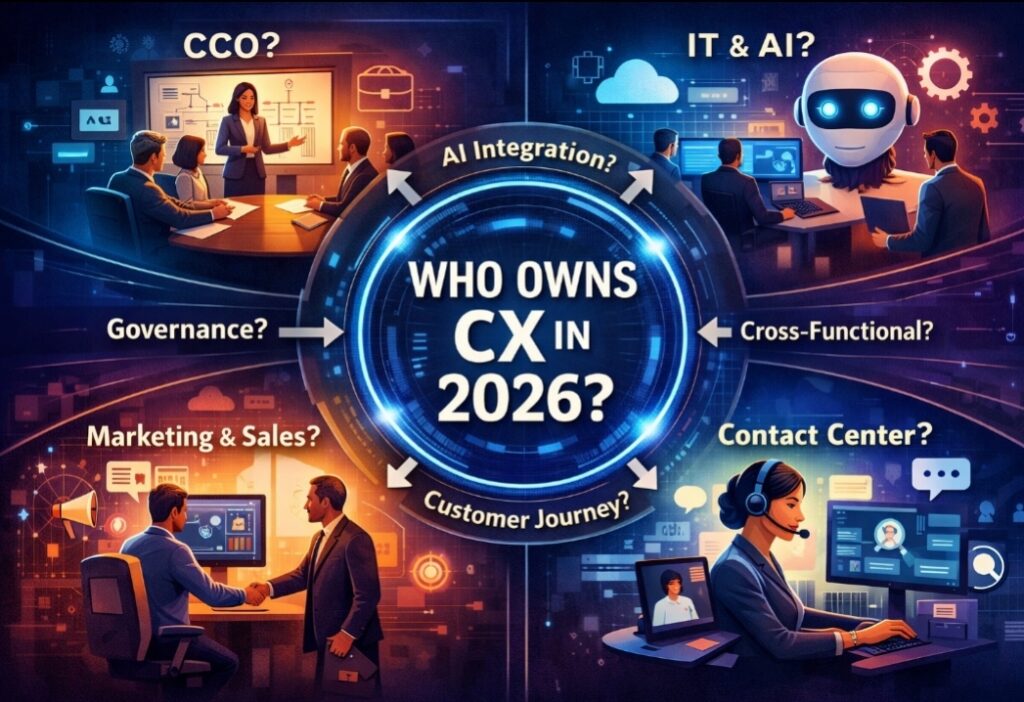
Who Owns CX in 2026? Governance Models, AI Gaps, and Cross-Functional Strategy
Who Owns CX in 2026? Why “It Depends” Is the Only Honest Answer
Picture this.
Your marketing team just launched a bold campaign.
Sales celebrates a spike in conversions.
Product ships a long-awaited feature.
The contact center rolls out a new AI bot.
Yet NPS drops.
Customers complain about repeating themselves.
Journey analytics show abandoned carts and stalled onboarding.
Everyone touches CX.
No one owns it.
That tension sits at the heart of a new report from Forrester Research.The firm concludes that many organizations still struggle with one core question:
Who Owns CX in 2026: Where should CX live?
The answer, according to Forrester analyst Judy Weader, is deceptively simple: It depends.
For CX and EX leaders facing siloed teams, AI gaps, and journey fragmentation, that answer feels unsatisfying. But it is also strategically correct.
Let’s unpack why.
What Is the Real Question Behind “Where Does CX Sit?”
Short answer: The real issue is not org charts. It is accountability, alignment, and shared outcomes.
When leaders debate ownership, they are really asking:
- Who sets CX standards?
- Who funds transformation?
- Who gets credit or blame?
- Who breaks silos?
CX fails when it becomes a department instead of a discipline.
As Clint Riley, COO of Globe Midwest Adjusters International, explains, experience is a collective effort. Marketing sets expectations. Sales personalizes. Operations delivers. Finance and IT influence trust through billing and systems.
No function operates in a CX vacuum.
Who Owns CX in 2026: Why Doesn’t Single-Department Ownership Work?
Short answer: Because no department sees the full journey.
When one team “owns” CX, it often becomes siloed. Metrics optimize locally, not holistically.
Paula Mantle of Branch puts it clearly:
- Marketing shapes the promise.
- Sales reinforces trust.
- Product determines usability.
- Customer success defines recovery.
- Legal and finance influence friction.
If only one team governs CX, context gets lost in handoffs.
And brand, as Mantle notes, is not what companies say.
It is what customers experience repeatedly.
What Happens When CX Is “Shared”?
Short answer: Shared ownership works only when data, insights, and decision rights are democratized.
Jonathan Moran at SAS warns that CX breaks down when one team claims full control.
Why?
Because no function has a 360-degree view of:
- Preferences
- Frustrations
- Behavioral history
- Cross-channel context
This is where most AI initiatives fail.
Chatbots live in one system.
Contact center logs sit elsewhere.
Marketing automation runs separately.
Rishi Rana of Cyara hears it often: one team owns bots, another owns voice, another owns analytics.
Fragmented tools create fragmented trust.
Should a Chief Customer Officer Own CX?
Short answer: A CCO can elevate CX, but cannot centralize execution.
The rise of the chief customer officer reflects the SaaS shift.
Lyndsey Valin of SugarCRM notes that CX evolved alongside subscription models. Recurring revenue demands recurring value.
But even here, CX is not just customer success.
It is:
- Sales interactions
- Product usability
- Onboarding clarity
- Support responsiveness
- Commercial transparency
A CCO can orchestrate alignment.
They cannot deliver experience alone.
Is Marketing and Sales Co-Ownership the Answer?
Short answer: Only if they share data and eliminate friction.
Sandeep Menon, CEO of Auxia, argues that the journey is one continuous arc.
Customers do not see funnel stages.
They see one relationship.
Yet marketing stacks often contain a dozen disconnected tools.
Sales works from another system.
Agentic AI can unify behavior signals.
But governance must align incentives.
If marketing optimizes MQLs and sales optimizes quota, the customer absorbs the friction.
Does IT Actually Own Modern CX?
Short answer: Technology now defines the interface, but tech ownership without business alignment fails.
Cyndee Harrison of Synaptic argues that CX is fundamentally digital.
From coffee orders to enterprise e-commerce, the interface is the experience.
Technology determines:
- Speed
- Security
- Personalization
- Integration
If systems lag or data breaches occur, brand trust collapses.
Yet IT cannot own CX alone.
It enables it.
What About the Contact Center?
Short answer: The contact center owns emotional moments of truth.
Jeff Palmer at Upstream Works highlights a hard truth:
Customers judge brands most intensely when something goes wrong.
AI-powered efficiency plus empathetic human support can convert detractors into advocates.
But long hold times or repeated explanations erode loyalty instantly.
When AI deployments fail, CIOs may be blamed.
When agents underperform, operations take the hit.
Ownership shifts based on failure points.
So What Does It Depend On?
Short answer: Strategy, culture, executive sponsorship, and maturity.
Forrester identifies several determining factors:
- CEO commitment
Direct reporting sounds powerful. It fails without executive bandwidth. - Political capital of the CX leader
Influence often matters more than hierarchy. - Organizational maturity
Early-stage firms may centralize. Mature firms often federate. - Business model
SaaS differs from retail. Insurance differs from telecom. - Technology architecture
Fragmented stacks demand integration leadership.
A Practical Framework: The CX Governance Matrix
For CXQuest readers navigating real-world complexity, consider this structured model.
| Dimension | Centralized Model | Federated Model | Embedded Model |
|---|---|---|---|
| Strategy | Owned by CCO | Shared with business heads | Integrated into BU strategy |
| Data | Central CX analytics | Shared data lake | BU-level dashboards |
| Budget | CX transformation fund | Joint funding | Departmental |
| Accountability | Single executive | Shared OKRs | Function-specific KPIs |
No model is universally superior.
The key is clarity.
Key Insights for CX/EX Leaders
- CX is a system, not a function.
- AI amplifies silos if governance lags.
- Shared metrics prevent handoff friction.
- Executive alignment matters more than reporting lines.
- Customer memory ignores org charts.
Common Pitfalls to Avoid
- Treating CX as a survey program.
- Launching AI without cross-functional governance.
- Optimizing channel KPIs instead of journey KPIs.
- Creating a CCO role without authority.
- Ignoring EX while chasing CX gains.
Remember: employee experience fuels customer experience.
Who Owns CX in 2026: How Should CX Leaders Decide Where CX Lives?
Short answer: Start with outcomes, then design governance backward.
Ask:
- What business outcome are we optimizing?
Retention? Revenue? Cost-to-serve? - Where does breakdown occur most often?
Handoffs? Data gaps? Emotional moments? - Who controls the biggest friction lever?
Then design decision rights accordingly.
This shifts the debate from “who owns CX?” to
“Who can remove the most friction?”
FAQ: Advanced CX Governance Questions
Does reporting to the CEO guarantee CX success?
No. Without sustained executive sponsorship, visibility becomes symbolic.
Can AI replace cross-functional alignment?
No. AI magnifies structural clarity or chaos. It cannot fix governance gaps.
Should CX sit in marketing for digital-first brands?
Sometimes. But only if marketing controls end-to-end data and post-sale experience.
Is a CCO necessary in mid-sized firms?
Not always. Influence networks may outperform formal hierarchy.
How often should CX governance be reassessed?
Annually at minimum. Strategy shifts demand structural flexibility.
Actionable Takeaways for CX Leaders
- Map ownership against the customer journey.
Identify where friction concentrates. - Create shared cross-functional KPIs.
Tie bonuses to retention or lifetime value. - Centralize data before centralizing authority.
- Clarify decision rights for AI deployments.
- Build executive coalition, not just executive sponsorship.
- Audit handoffs quarterly.
Focus on moments where trust erodes. - Invest equally in EX alignment.
Empower frontline teams with authority. - Review governance annually.
CX location should evolve with strategy.
At CXQuest, we often say:
Customers experience one company, not many departments.
The question is not where CX sits or Who Owns CX in 2026.
The question is whether your structure reflects the reality your customers already live.
In 2026, the winners will not be those who solve the org chart debate.
They will be those who design systems where accountability flows as seamlessly as the customer journey itself.
The post Who Owns CX in 2026? Governance Models, AI Gaps, and Cross-Functional Strategy appeared first on CX Quest.


You May Also Like
Ripple XRP Deep Dive: Is This Payments Token Still a Smart Long-Term Investment?

The Next Crypto Breakout Below $1 Investors Are Preparing For