

What Building a Simple Age Calculator Taught Me About Time, Technology, and Small Tools
⏳ A Friend’s Question That Sparked an Idea
One evening, a friend casually asked me: \n “Can you tell me exactly how old I am — in days?”
I laughed, but then realized something funny: I didn’t actually know. I could tell him his age in years, sure. But days? Weeks? Hours? Even heartbeats? I had no clue.
That single question got stuck in my head. As a developer, I enjoy problems that look simple on the surface but hide a lot of complexity underneath. So I decided to build a free Online Age Calculator for my site.
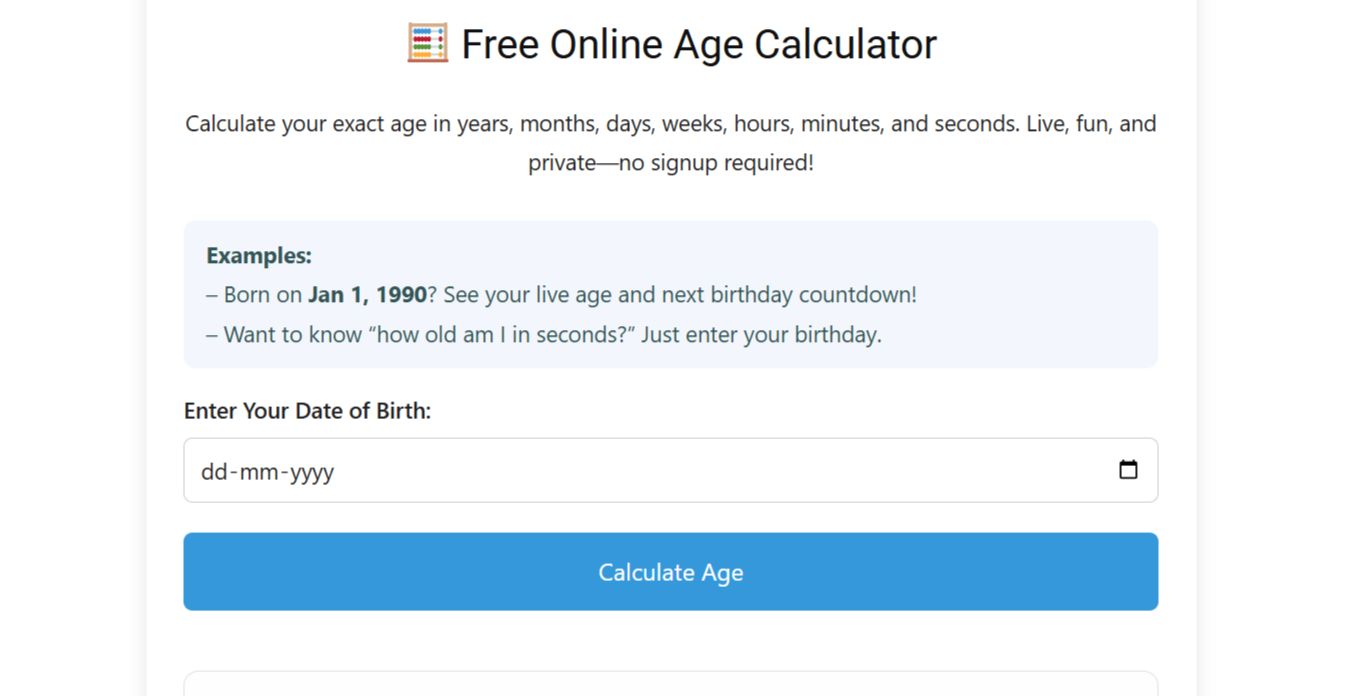
I figured it would be a quick weekend project. Instead, it turned into something much bigger — a little side project that ended up teaching me about tricky coding problems, why people love small tools, and even how we think about time itself.
🧮 The Hidden Math of Time
At first, I thought calculating age would be trivial: \n Current year – birth year = age. Done.
But time doesn’t play that nicely.
- Leap years sneak in an extra day.
- Months vary (28, 29, 30, or 31 days).
- If your birthday hasn’t happened yet this year, you subtract one.
Suddenly, what looked like a middle-school math problem became a puzzle full of edge cases. I leaned on JavaScript’s Date() object, but even that wasn’t enough — I had to carefully adjust for months, days, and special cases like February 29 birthdays.
When I finally got it working, it felt less like writing a calculator and more like uncovering the hidden rules of time itself.
🌍 Why Exact Age Matters More Than You Think
At first I assumed people would only use the calculator out of curiosity. But the more feedback I got, the more I realized how practical it actually was.
- A student told me they used it to fill out an admission form.
- Someone in finance said they checked pension eligibility with it.
- A coach said the birthday countdown became a fun motivator for their team.
It turns out, age precision matters in more places than I’d ever thought:
- Legal documents — Birth certificates, passports, IDs.
- Banking and pensions — Eligibility often depends on exact dates.
- Sports — Age cutoffs can be strict to the very day.
- Healthcare — Vaccines, screenings, and treatments tied to exact age.
- Education — Admissions and exams with strict limits.
In all of these, “I’m about 30” isn’t good enough. Precision matters.
🎯 What Makes This Tool Different
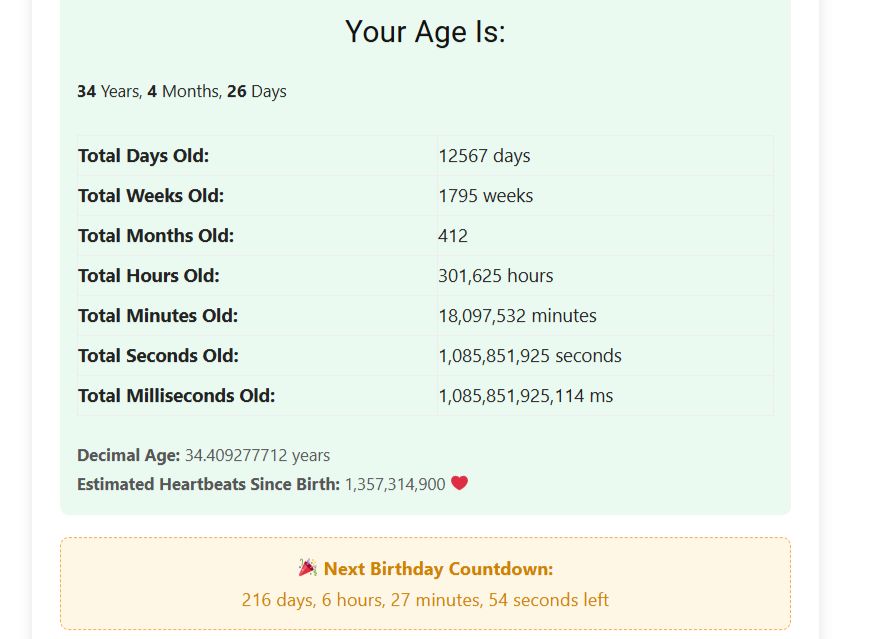
The first version only returned years. Useful, but honestly, boring. So I started adding extra stats — partly out of curiosity, partly because it was fun to see what else I could calculate.
- Total Days Lived → Staring at a five-digit number is surreal.
- Weeks & Months Old → Neat milestones most people never think about.
- Hours, Minutes, Seconds, Milliseconds → Every tick of your life, counted.
- Decimal Age → Not just “34 years,” but 34.40 years.
- Estimated Heartbeats ❤️ → Billions of beats, which suddenly makes you think about health.
- Next Birthday Countdown 🎉 → Exact days, hours, minutes until the next cake.
When I tested it on myself, I was stunned: \n Over 12,000 days lived, 1.3 billion heartbeats, and still counting.
It was the first time I’d looked at my life in those numbers, and it somehow made time feel both longer and shorter at the same moment.
📊 Why People Love Simple Tools
I kept wondering: why was this little calculator getting so much attention? So I started digging into user behavior and UX psychology.
The answer was simple:
- People love tools that do one thing well.
- They love instant results without logins, ads, or distractions.
- And they love fun facts they can share.
One student wrote to me saying they’d shown their “days lived” number to their whole class. Another person told me they used the heartbeat counter as an icebreaker in a workshop. That’s when I realized: these weren’t just stats. They were conversation starters.
The internet is full of massive apps and platforms, but sometimes the magic is in doing one small thing in a way that feels fresh, personal, and fun.
🛠️ Lessons I Learned as a Developer
This project wasn’t about chasing some big idea. But it ended up reshaping how I think about side projects:
- Small doesn’t mean trivial. Even a calculator can touch law, finance, health, and daily life.
- Edge cases are everything. Leap years, negative days, decimal precision — the details are where trust is won.
- Users surprise you. I never thought the heartbeat counter would be popular, but it turned out to be the feature people loved most.
💬 Final Thoughts
When my friend asked me how old he was in days, I thought it was a silly question. Now I see it was the spark for one of the most interesting side projects I’ve ever worked on.
Watching him laugh at his “1.3 billion heartbeats” stat reminded me that even the tiniest tools can create real, human moments. And that, to me, is more valuable than any flashy app or framework.
👉 If you’re curious, you can try the tool here: Free Online Age Calculator.
And if you’re a developer: don’t underestimate the small stuff. Sometimes, it’s those simple little projects that end up leaving the biggest impact.


You May Also Like

Senate moves on coinbase CLARITY Act as stablecoin

Lovable AI’s Astonishing Rise: Anton Osika Reveals Startup Secrets at Bitcoin World Disrupt 2025




