Bitcoin heads into the final days of August with choppy, two-way trade and a familiar seasonal question hanging over it: will September once again be a drag—or a reset into Q4 strength? As of Wednesday, August 28, BTC hovers near $112,900 after a stop-start month that has bulls and bears circling the same range rather than breaking conviction. Macro expectations, market positioning and Bitcoin’s own statistical quirks now converge in a narrow window before the Federal Reserve’s September policy meeting, making the next few weeks unusually consequential. The Fed’s rate-setting FOMC convenes September 16–17, and futures markets currently price a high probability of a cut, though officials continue to emphasize data-dependence. Bitcoin’s September Seasonality Seasonality is the first prism through which traders are reading the tape. Daan Crypto Trades captured the prevailing mood on X, noting a “choppy August” and pointing to a historical oddity: “During BTC’s history it has never closed both August & September in the green.” He added a pragmatic caveat about why this matters at all: “Whether you believe in seasonality or not, the thing that matters is if a lot of others do. And if enough people do, it can work as a self-fulfilling prophecy.” Related Reading: Bitcoin Selloff: $2.2 Billion In BTC Floods Exchanges Independent datasets support the caution around September. CoinGlass-based compilations show that across the past 12 years, September has delivered an average negative return for BTC of roughly 3.8%, making it the worst month on the calendar. By contrast, Q4—and especially October and November—has historically outperformed on average, a profile that helps explain why traders often look to buy late-Q3 weakness. However, there is a silver lining. Across Bitcoin’s history, September has closed in the green on four occasions—most notably in 2015 and 2016, and again in recent years. In 2023, BTC gained 3.9%, followed by a 7.3% rise in 2024. Anthony Pompliano offered a broader framing this week, starting with the simple, if stubborn, statistics: “September is actually the only month of the year that historically is negative.” He attributes the late-summer doldrums in part to investor behavior—“Everyone is on vacation… not in front of their screens”—and in part to unresolved macro questions from traditional finance. “There’s a lot of uncertainty still,” he said, even as “Jerome Powell has come out and said that he’s going to likely cut rates in September.” While markets have swiftly moved to price that outcome after the Jackson Hole speech, Fed officials have been careful to say the decision remains data-driven; major brokerages nonetheless shifted their base cases to a September cut following Powell’s labor-market warnings. Pompliano’s second theme is about the path higher. A straight line from last November’s ~$69,000 to six-figure prices, he argued, would risk a “very big dump on the other side.” Instead, the market “wants… some sort of correction and resetting,” flushing leverage and “setting a foundation of the price.” He sketched a broad consolidation band—“call it $125,00 to maybe $110,000”—before buyers return. Why is Bitcoin’s price going down? The answer is simpler than you think. pic.twitter.com/lYqbqQJO9R — Anthony Pompliano 🌪 (@APompliano) August 27, 2025 That sequencing rhymes with the way many systematic funds and discretionary crypto desks treat September: as a month to reduce risk into thin liquidity, then rebuild as Q4 flows approach. It also resonates with Daan Crypto Trades’ tactical lens: “Probably any larger dip in the next 1–2 weeks is the one to bid for the EOY bounce/rally to new all time highs in my opinion. We will see.” All Eyes On The Fed Macro timing could be the deciding factor. The FOMC’s September 16–17 meeting is now the key waypoint, with rate futures implying an ~85–90% chance of a cut and some odds of a second move by year-end. Related Reading: Bitcoin MVRV Compression Signals Pause – Market Digests Recent Volatility Chair Powell signaled at Jackson Hole that labor-market risks have risen even as inflation risks linger, a balance that has pushed several Wall Street houses to bring forward their easing timelines. At the same time, senior Fed officials have stressed that every meeting is “live” and contingent on incoming data—an important caveat for risk assets that have already leaned into the dovish narrative. If a cut materializes, the question for BTC will be whether it validates the existing bid or merely meets expectations and fades. This week’s immediate focus will fall on Friday’s release of the Personal Consumption Expenditures (PCE) price index—the Federal Reserve’s preferred gauge of inflation. The July PCE data will be published on August 29, providing policymakers and markets alike with a crucial read on both headline and core consumer price pressures. From there, attention will pivot to the next major cluster of inflation releases landing just days before the September FOMC. On Thursday, September 11, the Bureau of Labor Statistics will publish the Consumer Price Index (CPI) and the Producer Price Index (PPI) for August. These will represent the final inflation checkpoints before the Fed convenes on September 16–17, meaning they could decisively shape the tone of the meeting. At press time, BTC traded at $113,049. Featured image created with DALL.E, chart from TradingView.comBitcoin heads into the final days of August with choppy, two-way trade and a familiar seasonal question hanging over it: will September once again be a drag—or a reset into Q4 strength? As of Wednesday, August 28, BTC hovers near $112,900 after a stop-start month that has bulls and bears circling the same range rather than breaking conviction. Macro expectations, market positioning and Bitcoin’s own statistical quirks now converge in a narrow window before the Federal Reserve’s September policy meeting, making the next few weeks unusually consequential. The Fed’s rate-setting FOMC convenes September 16–17, and futures markets currently price a high probability of a cut, though officials continue to emphasize data-dependence. Bitcoin’s September Seasonality Seasonality is the first prism through which traders are reading the tape. Daan Crypto Trades captured the prevailing mood on X, noting a “choppy August” and pointing to a historical oddity: “During BTC’s history it has never closed both August & September in the green.” He added a pragmatic caveat about why this matters at all: “Whether you believe in seasonality or not, the thing that matters is if a lot of others do. And if enough people do, it can work as a self-fulfilling prophecy.” Related Reading: Bitcoin Selloff: $2.2 Billion In BTC Floods Exchanges Independent datasets support the caution around September. CoinGlass-based compilations show that across the past 12 years, September has delivered an average negative return for BTC of roughly 3.8%, making it the worst month on the calendar. By contrast, Q4—and especially October and November—has historically outperformed on average, a profile that helps explain why traders often look to buy late-Q3 weakness. However, there is a silver lining. Across Bitcoin’s history, September has closed in the green on four occasions—most notably in 2015 and 2016, and again in recent years. In 2023, BTC gained 3.9%, followed by a 7.3% rise in 2024. Anthony Pompliano offered a broader framing this week, starting with the simple, if stubborn, statistics: “September is actually the only month of the year that historically is negative.” He attributes the late-summer doldrums in part to investor behavior—“Everyone is on vacation… not in front of their screens”—and in part to unresolved macro questions from traditional finance. “There’s a lot of uncertainty still,” he said, even as “Jerome Powell has come out and said that he’s going to likely cut rates in September.” While markets have swiftly moved to price that outcome after the Jackson Hole speech, Fed officials have been careful to say the decision remains data-driven; major brokerages nonetheless shifted their base cases to a September cut following Powell’s labor-market warnings. Pompliano’s second theme is about the path higher. A straight line from last November’s ~$69,000 to six-figure prices, he argued, would risk a “very big dump on the other side.” Instead, the market “wants… some sort of correction and resetting,” flushing leverage and “setting a foundation of the price.” He sketched a broad consolidation band—“call it $125,00 to maybe $110,000”—before buyers return. Why is Bitcoin’s price going down? The answer is simpler than you think. pic.twitter.com/lYqbqQJO9R — Anthony Pompliano 🌪 (@APompliano) August 27, 2025 That sequencing rhymes with the way many systematic funds and discretionary crypto desks treat September: as a month to reduce risk into thin liquidity, then rebuild as Q4 flows approach. It also resonates with Daan Crypto Trades’ tactical lens: “Probably any larger dip in the next 1–2 weeks is the one to bid for the EOY bounce/rally to new all time highs in my opinion. We will see.” All Eyes On The Fed Macro timing could be the deciding factor. The FOMC’s September 16–17 meeting is now the key waypoint, with rate futures implying an ~85–90% chance of a cut and some odds of a second move by year-end. Related Reading: Bitcoin MVRV Compression Signals Pause – Market Digests Recent Volatility Chair Powell signaled at Jackson Hole that labor-market risks have risen even as inflation risks linger, a balance that has pushed several Wall Street houses to bring forward their easing timelines. At the same time, senior Fed officials have stressed that every meeting is “live” and contingent on incoming data—an important caveat for risk assets that have already leaned into the dovish narrative. If a cut materializes, the question for BTC will be whether it validates the existing bid or merely meets expectations and fades. This week’s immediate focus will fall on Friday’s release of the Personal Consumption Expenditures (PCE) price index—the Federal Reserve’s preferred gauge of inflation. The July PCE data will be published on August 29, providing policymakers and markets alike with a crucial read on both headline and core consumer price pressures. From there, attention will pivot to the next major cluster of inflation releases landing just days before the September FOMC. On Thursday, September 11, the Bureau of Labor Statistics will publish the Consumer Price Index (CPI) and the Producer Price Index (PPI) for August. These will represent the final inflation checkpoints before the Fed convenes on September 16–17, meaning they could decisively shape the tone of the meeting. At press time, BTC traded at $113,049. Featured image created with DALL.E, chart from TradingView.com

Bitcoin And The September Curse: Can This Time Be Different?

2025/08/28 19:00
5 min read
For feedback or concerns regarding this content, please contact us at crypto.news@mexc.com

Bitcoin heads into the final days of August with choppy, two-way trade and a familiar seasonal question hanging over it: will September once again be a drag—or a reset into Q4 strength? As of Wednesday, August 28, BTC hovers near $112,900 after a stop-start month that has bulls and bears circling the same range rather than breaking conviction.

Macro expectations, market positioning and Bitcoin’s own statistical quirks now converge in a narrow window before the Federal Reserve’s September policy meeting, making the next few weeks unusually consequential. The Fed’s rate-setting FOMC convenes September 16–17, and futures markets currently price a high probability of a cut, though officials continue to emphasize data-dependence.

Bitcoin’s September Seasonality

Seasonality is the first prism through which traders are reading the tape. Daan Crypto Trades captured the prevailing mood on X, noting a “choppy August” and pointing to a historical oddity: “During BTC’s history it has never closed both August & September in the green.” He added a pragmatic caveat about why this matters at all: “Whether you believe in seasonality or not, the thing that matters is if a lot of others do. And if enough people do, it can work as a self-fulfilling prophecy.”

Independent datasets support the caution around September. CoinGlass-based compilations show that across the past 12 years, September has delivered an average negative return for BTC of roughly 3.8%, making it the worst month on the calendar. By contrast, Q4—and especially October and November—has historically outperformed on average, a profile that helps explain why traders often look to buy late-Q3 weakness.

However, there is a silver lining. Across Bitcoin’s history, September has closed in the green on four occasions—most notably in 2015 and 2016, and again in recent years. In 2023, BTC gained 3.9%, followed by a 7.3% rise in 2024.
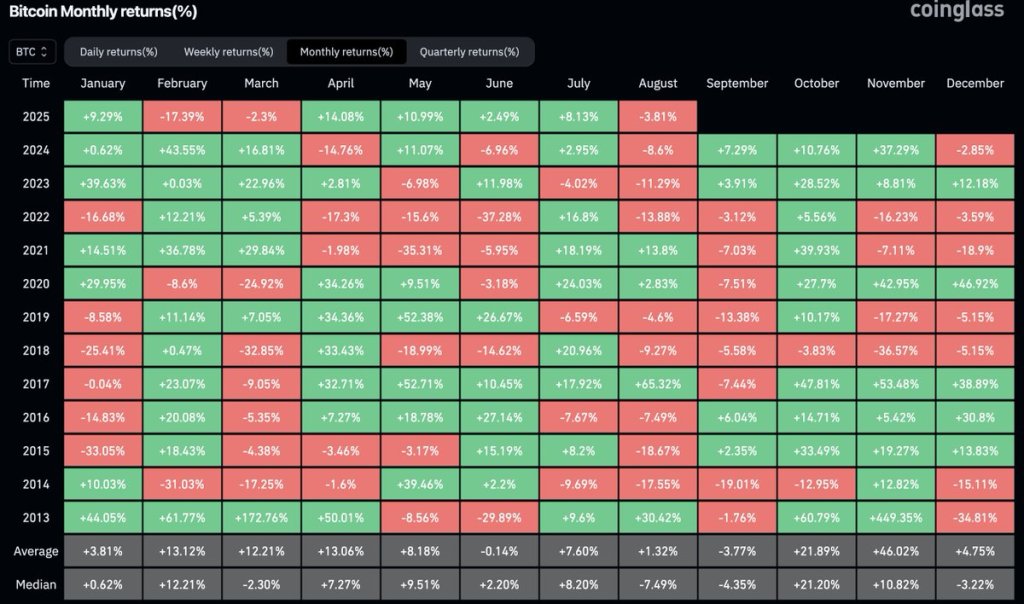
Bitcoin Seasonality

Anthony Pompliano offered a broader framing this week, starting with the simple, if stubborn, statistics: “September is actually the only month of the year that historically is negative.” He attributes the late-summer doldrums in part to investor behavior—“Everyone is on vacation… not in front of their screens”—and in part to unresolved macro questions from traditional finance.

“There’s a lot of uncertainty still,” he said, even as “Jerome Powell has come out and said that he’s going to likely cut rates in September.” While markets have swiftly moved to price that outcome after the Jackson Hole speech, Fed officials have been careful to say the decision remains data-driven; major brokerages nonetheless shifted their base cases to a September cut following Powell’s labor-market warnings.

Pompliano’s second theme is about the path higher. A straight line from last November’s ~$69,000 to six-figure prices, he argued, would risk a “very big dump on the other side.” Instead, the market “wants… some sort of correction and resetting,” flushing leverage and “setting a foundation of the price.” He sketched a broad consolidation band—“call it $125,00 to maybe $110,000”—before buyers return.

That sequencing rhymes with the way many systematic funds and discretionary crypto desks treat September: as a month to reduce risk into thin liquidity, then rebuild as Q4 flows approach. It also resonates with Daan Crypto Trades’ tactical lens: “Probably any larger dip in the next 1–2 weeks is the one to bid for the EOY bounce/rally to new all time highs in my opinion. We will see.”

All Eyes On The Fed

Macro timing could be the deciding factor. The FOMC’s September 16–17 meeting is now the key waypoint, with rate futures implying an ~85–90% chance of a cut and some odds of a second move by year-end.

Chair Powell signaled at Jackson Hole that labor-market risks have risen even as inflation risks linger, a balance that has pushed several Wall Street houses to bring forward their easing timelines. At the same time, senior Fed officials have stressed that every meeting is “live” and contingent on incoming data—an important caveat for risk assets that have already leaned into the dovish narrative. If a cut materializes, the question for BTC will be whether it validates the existing bid or merely meets expectations and fades.

This week’s immediate focus will fall on Friday’s release of the Personal Consumption Expenditures (PCE) price index—the Federal Reserve’s preferred gauge of inflation. The July PCE data will be published on August 29, providing policymakers and markets alike with a crucial read on both headline and core consumer price pressures.

From there, attention will pivot to the next major cluster of inflation releases landing just days before the September FOMC. On Thursday, September 11, the Bureau of Labor Statistics will publish the Consumer Price Index (CPI) and the Producer Price Index (PPI) for August. These will represent the final inflation checkpoints before the Fed convenes on September 16–17, meaning they could decisively shape the tone of the meeting.

At press time, BTC traded at $113,049.
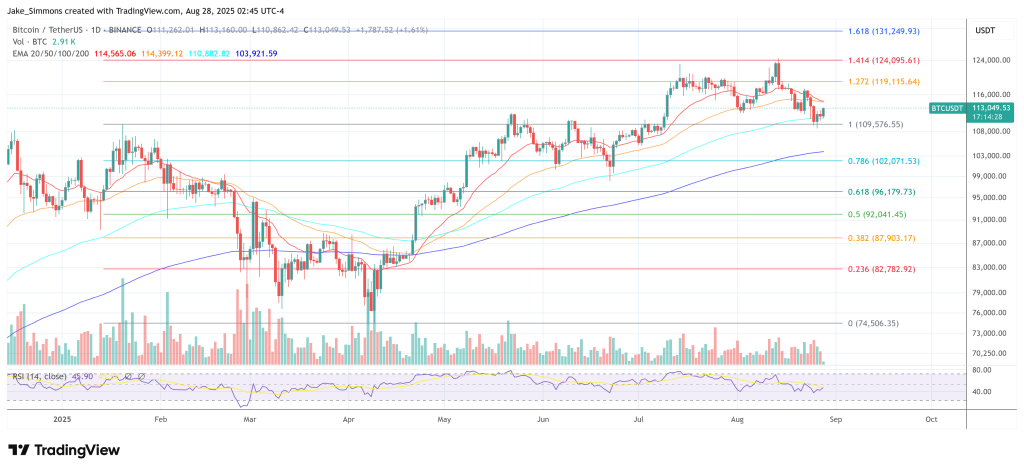
Bitcoin price
Market Opportunity
NEAR Logo
NEAR Price(NEAR)
$1.2364
$1.2364$1.2364
-3.35%
USD
NEAR (NEAR) Live Price Chart
Disclaimer: The articles reposted on this site are sourced from public platforms and are provided for informational purposes only. They do not necessarily reflect the views of MEXC. All rights remain with the original authors. If you believe any content infringes on third-party rights, please contact crypto.news@mexc.com for removal. MEXC makes no guarantees regarding the accuracy, completeness, or timeliness of the content and is not responsible for any actions taken based on the information provided. The content does not constitute financial, legal, or other professional advice, nor should it be considered a recommendation or endorsement by MEXC.

You May Also Like

Edges higher ahead of BoC-Fed policy outcome

Edges higher ahead of BoC-Fed policy outcome

The post Edges higher ahead of BoC-Fed policy outcome appeared on BitcoinEthereumNews.com. USD/CAD gains marginally to near 1.3760 ahead of monetary policy announcements by the Fed and the BoC. Both the Fed and the BoC are expected to lower interest rates. USD/CAD forms a Head and Shoulder chart pattern. The USD/CAD pair ticks up to near 1.3760 during the late European session on Wednesday. The Loonie pair gains marginally ahead of monetary policy outcomes by the Bank of Canada (BoC) and the Federal Reserve (Fed) during New York trading hours. Both the BoC and the Fed are expected to cut interest rates amid mounting labor market conditions in their respective economies. Inflationary pressures in the Canadian economy have cooled down, emerging as another reason behind the BoC’s dovish expectations. However, the Fed is expected to start the monetary-easing campaign despite the United States (US) inflation remaining higher. Investors will closely monitor press conferences from both Fed Chair Jerome Powell and BoC Governor Tiff Macklem to get cues about whether there will be more interest rate cuts in the remainder of the year. According to analysts from Barclays, the Fed’s latest median projections for interest rates are likely to call for three interest rate cuts by 2025. Ahead of the Fed’s monetary policy, the US Dollar Index (DXY), which tracks the Greenback’s value against six major currencies, holds onto Tuesday’s losses near 96.60. USD/CAD forms a Head and Shoulder chart pattern, which indicates a bearish reversal. The neckline of the above-mentioned chart pattern is plotted near 1.3715. The near-term trend of the pair remains bearish as it stays below the 20-day Exponential Moving Average (EMA), which trades around 1.3800. The 14-day Relative Strength Index (RSI) slides to near 40.00. A fresh bearish momentum would emerge if the RSI falls below that level. Going forward, the asset could slide towards the round level of…
Share
BitcoinEthereumNews2025/09/18 01:23
Crypto Supercycle in 2025? DeepSeek Ranks the Best Altcoins to Buy Right Now
Crypto Supercycle in 2025? DeepSeek Ranks the Best Altcoins to Buy Right Now

The post Crypto Supercycle in 2025? DeepSeek Ranks the Best Altcoins to Buy Right Now appeared on BitcoinEthereumNews.com. Crypto Supercycle in 2025? DeepSeek Ranks the Best Altcoins to Buy Right Now Sign Up for Our Newsletter! For updates and exclusive offers enter your email. As a crypto writer, Krishi splits his time between decoding the chaos of the markets and writing about it in a way that doesn’t put you to sleep. He’s been at it for nearly two years in the crypto trenches. Yes, he regrets missing the magnificent rallies that came before that (who doesn’t!), but he’s more than ready to put his money where his words are. Before diving headfirst into crypto, Krishi spent over five years writing for some of the biggest names in tech, including TechRadar, Tom’s Guide, and PC Gaming, covering everything from gadgets and cybersecurity to gaming and software. When he’s not scouring and writing about the latest happenings in crypto, Krishi trades the forex market while keeping crypto in his long-term HODL plans. He’s a Bitcoin believer, though he never lets that bias creep into his writing. This website uses cookies. By continuing to use this website you are giving consent to cookies being used. Visit our Privacy Center or Cookie Policy. I Agree Source: https://bitcoinist.com/crypto-supercycle-2025-best-altcoins-to-buy-now-deepseek/


Share
BitcoinEthereumNews2025/09/18 01:45
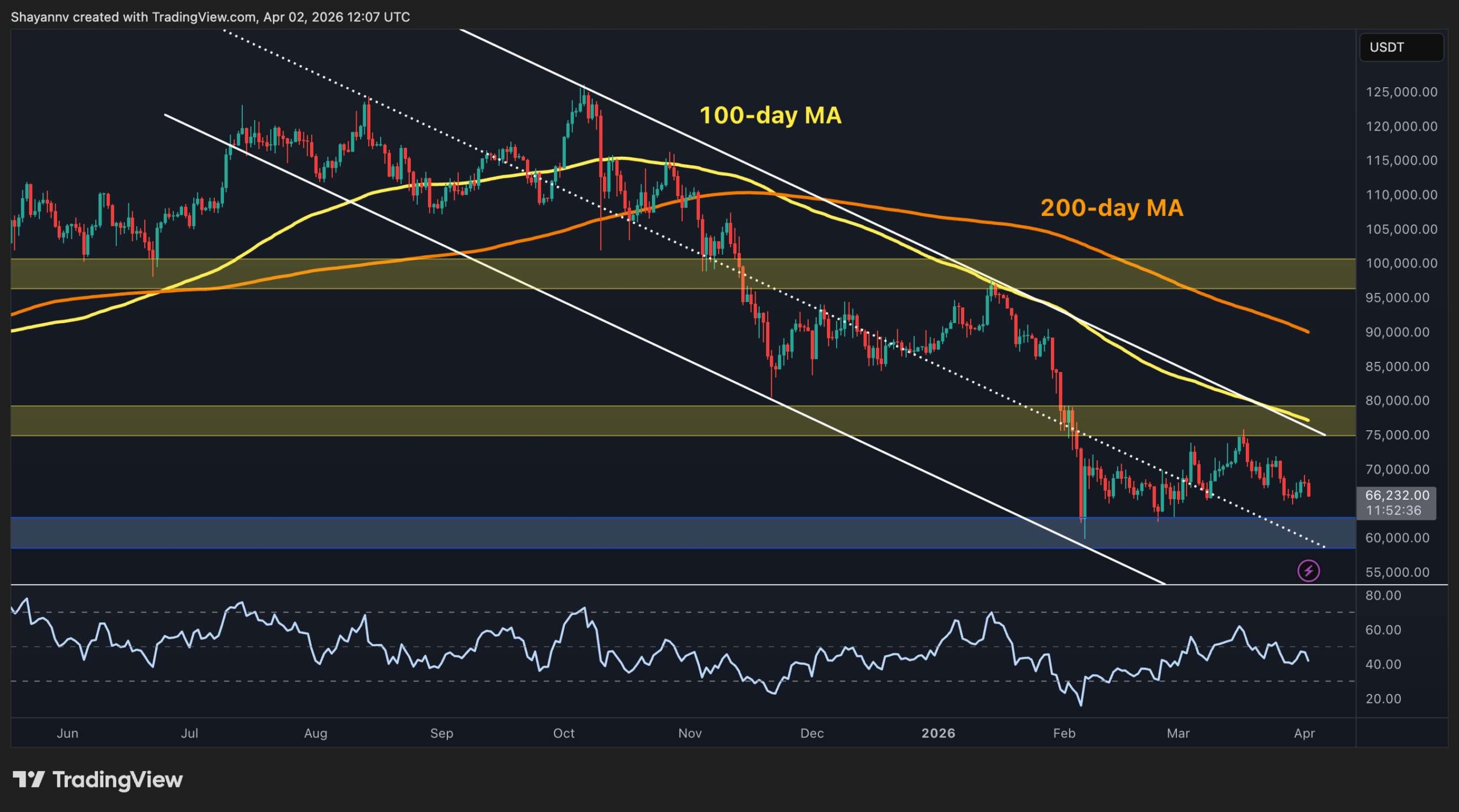
Bitcoin Price Analysis: What’s Next for BTC After Tanking to $66K?

Bitcoin Price Analysis: What’s Next for BTC After Tanking to $66K?

BTC has entered a phase of consolidation after a sharp decline from January highs near $100k. The price action shows that BTC has been respecting a broad ascending
Share
CryptoPotato2026/04/02 22:27

$30,000 in PRL + 15,000 USDT

$30,000 in PRL + 15,000 USDT$30,000 in PRL + 15,000 USDT

Deposit & trade PRL to boost your rewards!


