The solution integrates fair auctions, automata‑based route planning, and rebalancing, ensuring fairer request assignment without degrading efficiency.The solution integrates fair auctions, automata‑based route planning, and rebalancing, ensuring fairer request assignment without degrading efficiency.

Fair Auctions, Automata Routing, and Rebalancing for Distributed Mobility‑On‑Demand Assignment

:::info Authors:

(1) Kaier Liang, with the Mechanical Engineering and Mechanics Department at Lehigh University, PA, USA;

(2) Cristian-Ioan Vasile, with the Mechanical Engineering and Mechanics Department at Lehigh University, PA, USA.

:::

Abstract and I. Introduction

II. Preliminaries

III. Problem Formulation

IV. Solution

V. Simulation

VI. Conclusions and References

IV. SOLUTION

A. Fair Auction Based Assignment Scheme

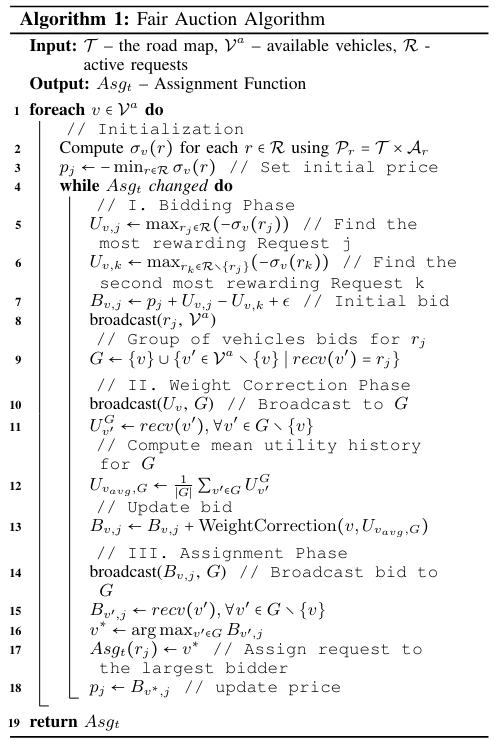
The auction algorithm is a widely used approach for solving assignment problems in a distributed manner. The algorithm consists of two phases: the bidding phase and the assignment phase. During the bidding phase, each agent (in our case, each vehicle) makes a bid for each item (i.e., request). Then, during the assignment phase, the item is assigned to the agent with the highest bid. This process is repeated iteratively until there is no change in the assignment. The auction algorithm is known to be optimal and has a polynomial runtime for assignment problems [29].

\ We modify the standard algorithm to account for fair allocation in addition to optimizing an objective function. In our specific setting, the objective is to minimize the total traveling time, as defined by equation (2), with the requests as the items for auction and the vehicles as the bidders. To consider fairness, we add an intermediate Weight Correction Phase between bidding and assignment. The auction algorithm we use for our vehicle assignment problem is outlined in Alg. 1. In the algorithm, we use two communication primitives: (a) broadcasting function broadcast (msg, V) that sends message msg to all vehicles in V, and (b) receive function recv(v′) that returns the message sent by agent v′. We assume that no packages are lost, and they are received in the same order they are sent. Thus, the receive function recv() is used in blocking mode.

\ To find the minimum of the objective function, the auction algorithm is used in reverse. We use the travel time with opposite sign to compute the first and second most rewarding requests in lines 5-6 based on the utility value defined in equation (3). Specifically, the vehicles prefer requests that induce lower travel times. During the bidding phase, each available vehicle places a bid for the most desirable request. This utility value takes into account the constraints of maximum waiting time and the delay time for the request. The bid amount is calculated in line 7 and is the sum of the request’s price, the difference between the first and second most desirable request’s utility difference, and a slack constant variable ϵ. This constant is typically set as 1 N , where N is the number of bidders. The price of a request is initialized with the negative of the smallest travel time of any request for the vehicle at line 3. Agents broadcast their preferred request (line 8) to the fleet, and construct the bidding group G of other agents interested in the same request (line 9).

\ After the bidding phase, a weight correction phase is added to promote fairness. The weight correction is computed using equation (4), which adjusts the original travel utility based on the difference between the vehicle utility and the average utility of all vehicles in the same bidding group G. This allows vehicles with low history utility to increase their bids beyond their actual bidding capability, giving them a greater chance of winning the auction. The weight correction phase aims to balance the auction and prevent vehicles from continuously dominating the auction process.

\
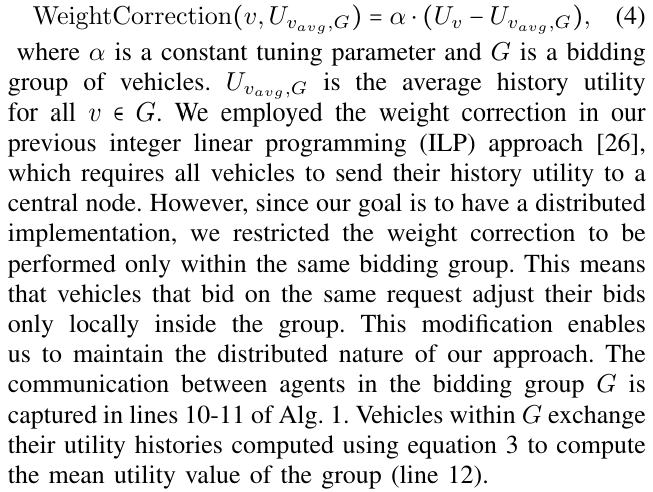
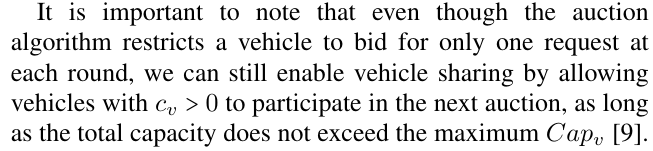
\ Finally, during the assignment phase, the request is allocated to the vehicle that offers the highest bid (lines 14- 17), and the auction is executed iteratively. In the subsequent rounds, other vehicles can increase their bids until the highest bid and bidder remain the same. Note that the price of the request is also updated at the end of each round at line 18.

\
\

B. Automata-based Route Planning

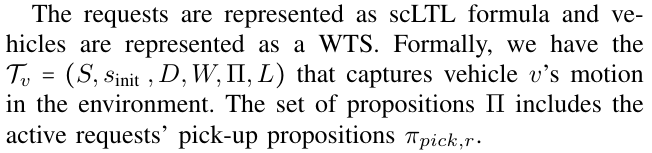
To conduct an auction in the bidding phase, we need to determine which vehicles are eligible to bid for which requests and what the utility (essentially the route) is for each request. We obtain this information through the construction of product automata.

\
\
\
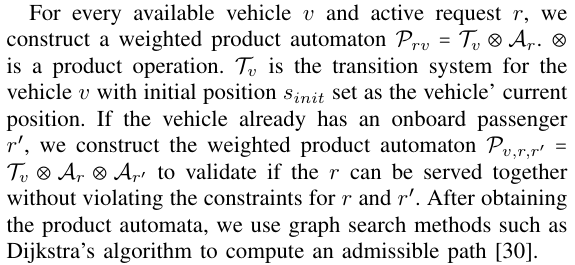
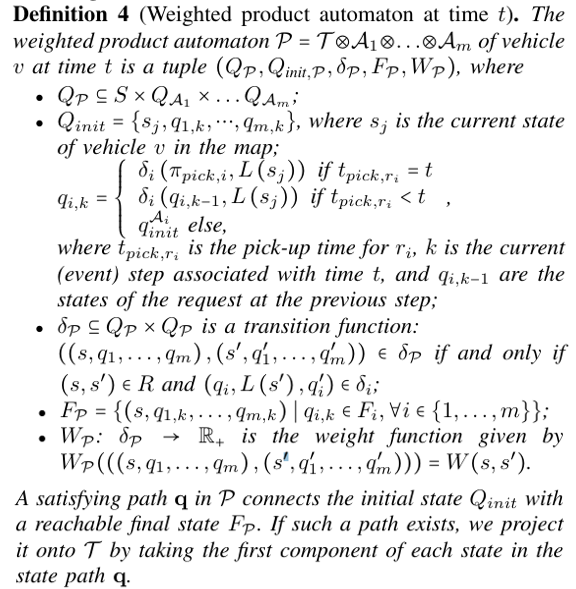
\ The formal definition of the product automaton is the following.

\
\

C. Fair Rebalancing
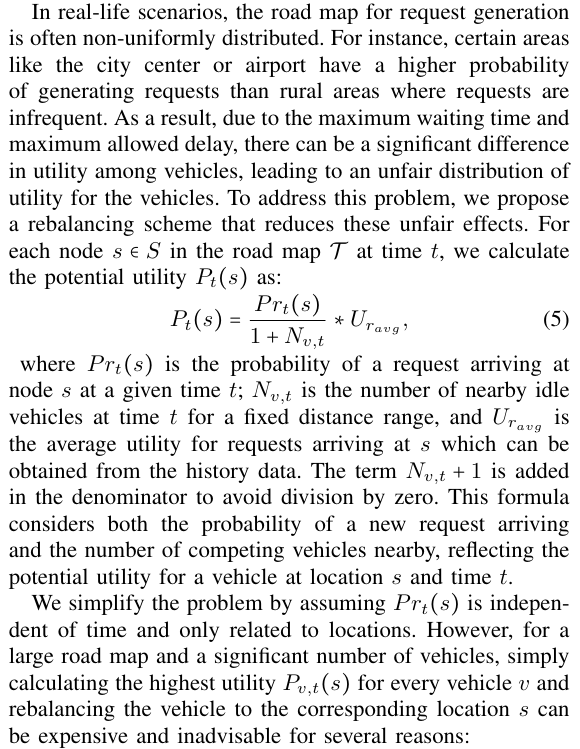
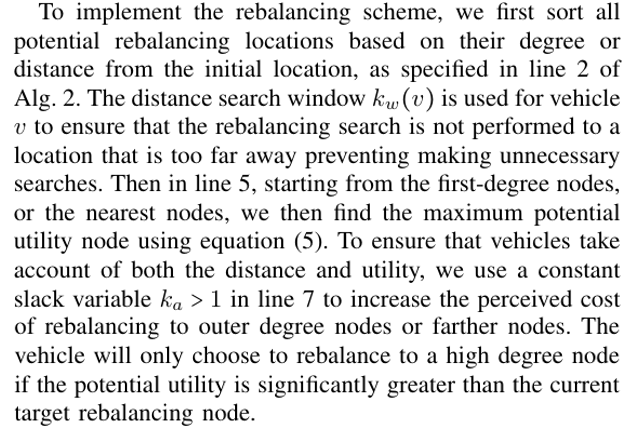
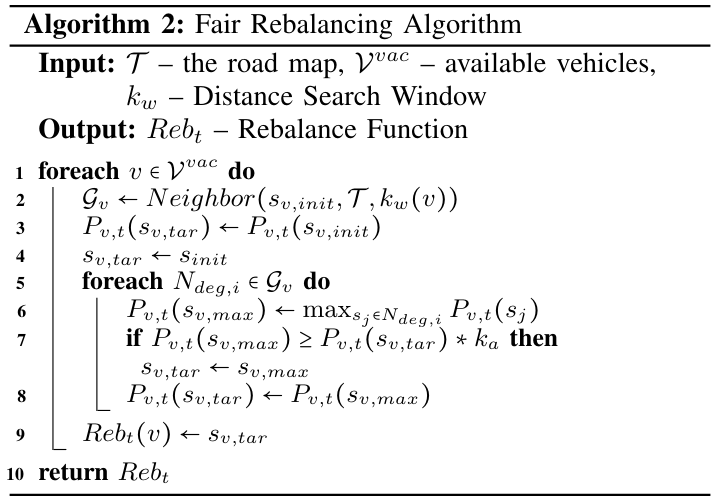
\ (1) The highest location can be the same for all vehicles, which can be seen from the independence with respect to a specific vehicle in equation (5).

\ (2) Rebalancing itself will require some cost as it will require idle vehicles to move to another location. Therefore the highest potential location that is far away may be less attractive than a location with a smaller value but close.

\ To deal with these problems, we use a slack parameter and a distance search window. The rebalancing target location is calculated in Alg. 2:

\
\
\ The auction and rebalancing are implemented sequentially. At a given time sample frequency, an auction is conducted to assign available vehicles to every unassigned request. Then the rebalancing is conducted to move idle vehicles to move to better locations. Therefore, vehicles are either in progress to serve requests or in rebalancing to move to another location.

:::info This paper is available on arxiv under CC by 4.0 Deed (Attribution 4.0 International) license.

:::

\

Market Opportunity
Router Protocol Logo
Router Protocol Price(ROUTE)
$0.002641
$0.002641$0.002641
+0.76%
USD
Router Protocol (ROUTE) Live Price Chart
Disclaimer: The articles reposted on this site are sourced from public platforms and are provided for informational purposes only. They do not necessarily reflect the views of MEXC. All rights remain with the original authors. If you believe any content infringes on third-party rights, please contact service@support.mexc.com for removal. MEXC makes no guarantees regarding the accuracy, completeness, or timeliness of the content and is not responsible for any actions taken based on the information provided. The content does not constitute financial, legal, or other professional advice, nor should it be considered a recommendation or endorsement by MEXC.

You May Also Like

Tokyo’s Metaplanet Launches Miami Subsidiary to Amplify Bitcoin Income

Tokyo’s Metaplanet Launches Miami Subsidiary to Amplify Bitcoin Income

Metaplanet Inc., the Japanese public company known for its bitcoin treasury, is launching a Miami subsidiary to run a dedicated derivatives and income strategy aimed at turning holdings into steady, U.S.-based cash flow. Japanese Bitcoin Treasury Player Metaplanet Opens Miami Outpost The new entity, Metaplanet Income Corp., sits under Metaplanet Holdings, Inc. and is based […]
Share
Coinstats2025/09/18 00:32
How A 130-Year-Old Course Reimagined The Golf Experience

How A 130-Year-Old Course Reimagined The Golf Experience

The post How A 130-Year-Old Course Reimagined The Golf Experience appeared on BitcoinEthereumNews.com. An aerial view of Storm King Golf Club, a reimagined golf experience that’s scheduled to open in 2026. Erik Matuszewski In the rolling hills of New York’s Hudson Valley, just 56 miles from Manhattan and minutes from West Point, a revolutionary new golf course is reimagining how golf can be played, experienced, and shared. Named after the nearby mountain that overlooks the property, Storm King Golf Club packs more variety and possibility in 63 acres than many courses four times its size, offering 40 distinct hole configurations, five different 9-hole routing options, and a 19-hole par 3 layout. “The idea was to create a unique place where people could experience golf in a way that’s fun and interesting to them,” said founder David Gang, a software executive who purchased the course about five years ago with a vision to reimagine golf and challenge convention along the way. Storm King is a far cry from the original facility that opened in 1894; today, it’s a wild looking, choose-your-own-adventure playground where golfers can craft their journey based on skill level, mood, or simple curiosity about what lies around the next bend. The facility boasts 12 green complexes totaling 225,000 square feet of putting surface, nearly four times that of an iconic property like Pebble Beach Golf Links, which has 63,000 square feet across all 18 holes. “Our brains have been wired for golf in a very traditional way forever,” says Gang, an avid golfer who co-founded Brightspot, a leading content management system. There are unusual design shapes and unique routing options at Storm King, which was built to focus on versatility, playability and sustainability. Erik Matuszewski “We think about 9 holes, 18 holes, par 3s, par 4s, and par 5s. They’re very set in our minds,” he added. “So, when you come…
Share
BitcoinEthereumNews2025/09/18 18:44
IP Hits $11.75, HYPE Climbs to $55, BlockDAG Surpasses Both with $407M Presale Surge!

IP Hits $11.75, HYPE Climbs to $55, BlockDAG Surpasses Both with $407M Presale Surge!

The post IP Hits $11.75, HYPE Climbs to $55, BlockDAG Surpasses Both with $407M Presale Surge! appeared on BitcoinEthereumNews.com. Crypto News 17 September 2025 | 18:00 Discover why BlockDAG’s upcoming Awakening Testnet launch makes it the best crypto to buy today as Story (IP) price jumps to $11.75 and Hyperliquid hits new highs. Recent crypto market numbers show strength but also some limits. The Story (IP) price jump has been sharp, fueled by big buybacks and speculation, yet critics point out that revenue still lags far behind its valuation. The Hyperliquid (HYPE) price looks solid around the mid-$50s after a new all-time high, but questions remain about sustainability once the hype around USDH proposals cools down. So the obvious question is: why chase coins that are either stretched thin or at risk of retracing when you could back a network that’s already proving itself on the ground? That’s where BlockDAG comes in. While other chains are stuck dealing with validator congestion or outages, BlockDAG’s upcoming Awakening Testnet will be stress-testing its EVM-compatible smart chain with real miners before listing. For anyone looking for the best crypto coin to buy, the choice between waiting on fixes or joining live progress feels like an easy one. BlockDAG: Smart Chain Running Before Launch Ethereum continues to wrestle with gas congestion, and Solana is still known for network freezes, yet BlockDAG is already showing a different picture. Its upcoming Awakening Testnet, set to launch on September 25, isn’t just a demo; it’s a live rollout where the chain’s base protocols are being stress-tested with miners connected globally. EVM compatibility is active, account abstraction is built in, and tools like updated vesting contracts and Stratum integration are already functional. Instead of waiting for fixes like other networks, BlockDAG is proving its infrastructure in real time. What makes this even more important is that the technology is operational before the coin even hits exchanges. That…
Share
BitcoinEthereumNews2025/09/18 00:32