Dogecoin is flashing a rare weekly “bearish cross” just as traders debate whether last week’s $0.08 washout was the cycle’s reset or merely the first leg lower.Dogecoin is flashing a rare weekly “bearish cross” just as traders debate whether last week’s $0.08 washout was the cycle’s reset or merely the first leg lower.

Dogecoin Sees Weekly Bearish Cross: Bottom Or Breakdown Next?

2026/02/17 13:30
3 min read

Dogecoin is flashing a rare weekly “bearish cross” just as traders debate whether last week’s $0.08 washout was the cycle’s reset or merely the first leg lower. The setup matters beyond DOGE itself because memecoin flows are increasingly being treated as a proxy for risk appetite across crypto.

Is The Dogecoin Bottom In?

A chart shared by Charting Guy shows the 20-week EMA crossing below the 200-week EMA, a technical event he argues has historically aligned with DOGE capitulation. “DOGE typically bottoms around when the 20 weekly EMA crosses below the 200 weekly EMA. That happened last week” he wrote, adding that he “increased my position by 50% at the lows” and that his community received buy alerts.
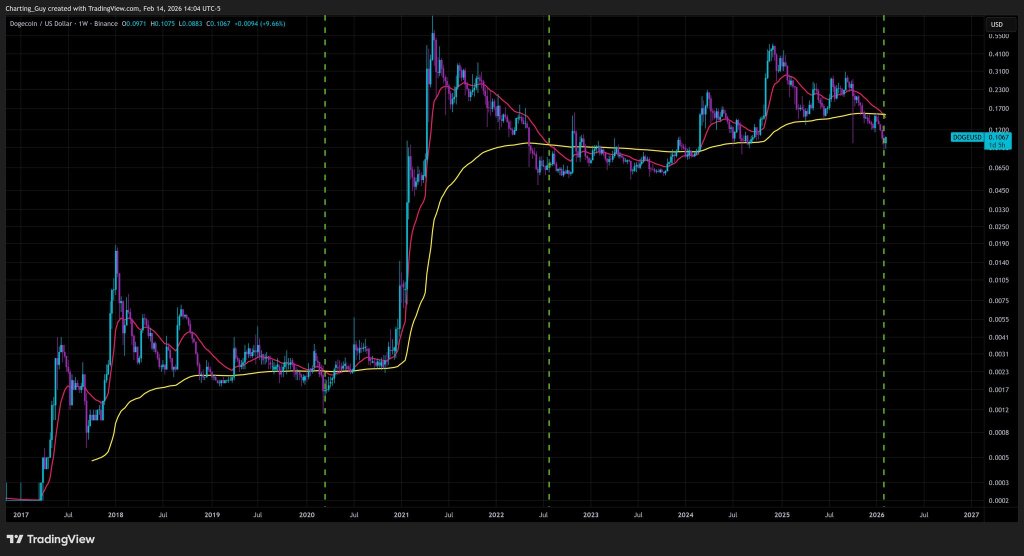
Dogecoin weekly bearish cross

That framing is colliding with more cautious range-based reads from other analysts watching spot structure instead of the moving-average signal alone.

Daan Crypto Trades described the post-dip bounce as constructive, but explicitly framed it as range trade rather than trend confirmation. “DOGE Decent price action here over the past few days after the big $0.08 test last week. Currently seeing this $0.08-$0.13 area as a large range,” he posted.

“Anything above that point would make me confident in a further move towards the Daily 200MA/EMA. Currently near the middle so hard to really assume a direction here the way it’s trading.”
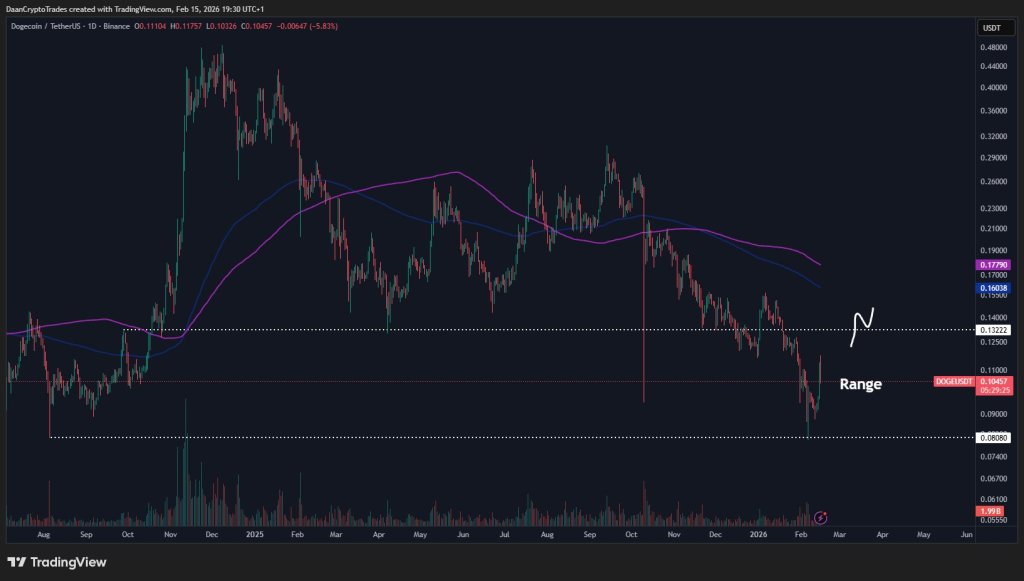
Dogecoin price analysis

On his chart, DOGE/USDT was sitting around the middle of that band near $0.10–$0.11, with the upper range marker around $0.132 and the lower boundary near $0.088. In other words: not a clean trend, not a clean mean reversion, just a market waiting for a push.

That “waiting” can be expensive in a leverage-heavy coin. CEO of Aphractal João Wedson struck a stark tone, warning: “If you are long on Doge, you will likely be liquidated soon!”

An aggregated liquidation heatmap shared by Alphractal highlights why this warning resonates with derivatives traders: thick bands of potential liquidation levels sit below current price over the past three days, suggesting stop-driven moves could cascade if DOGE starts trending instead of chopping.
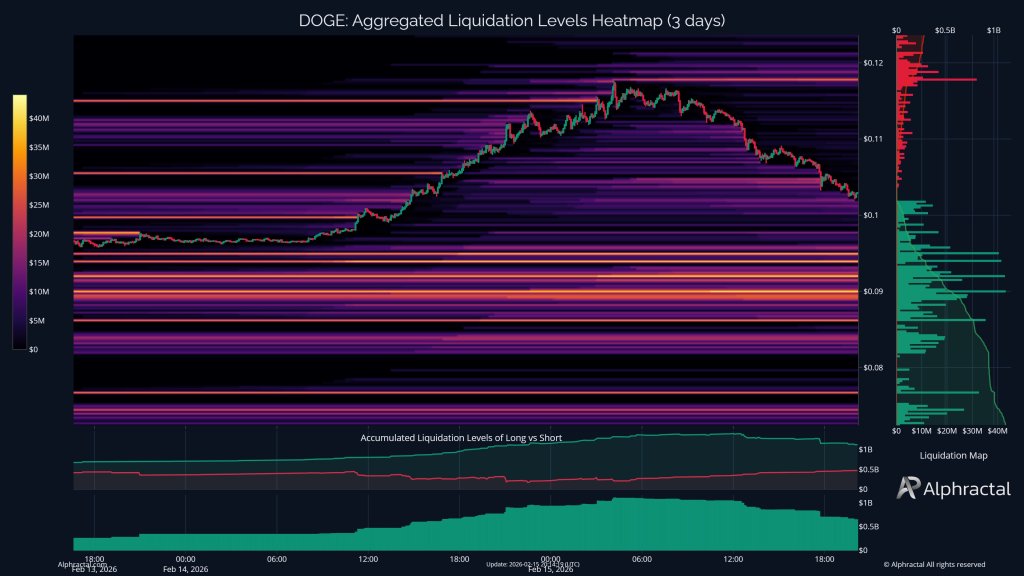
Dogecoin liquidation heatmap

Wedson also argued that DOGE rallies can function as a broader volatility tell for Bitcoin, calling them “a risk signal for Bitcoin” and saying it “usually happens when Bitcoin is moving sideways.”

Alphractal echoed the rotation narrative in a longer note on flows. “Over the past few days, memecoins have significantly outperformed BTC and other altcoins. What stood out the most was Dogecoin, where the number of trades surpassed all others in its category,” the account wrote. “However, in the last few hours, memecoins have started to correct while BTC remains relatively stable.”

The near-term map is clean even if the conviction isn’t. Bulls need a decisive reclaim of the top of the $0.08–$0.13 range to credibly reopen the path toward the daily 200 MA/EMA that Daan flagged. Bears, meanwhile, will focus on whether the market revisits the $0.08 area and whether that level holds on a second test with liquidation clusters in play.

At press time, Dogecoin traded at $0.10.

Dogecoin price chart
Market Opportunity
DOGE Logo
DOGE Price(DOGE)
$0.09882
$0.09882$0.09882
-0.76%
USD
DOGE (DOGE) Live Price Chart
Disclaimer: The articles reposted on this site are sourced from public platforms and are provided for informational purposes only. They do not necessarily reflect the views of MEXC. All rights remain with the original authors. If you believe any content infringes on third-party rights, please contact service@support.mexc.com for removal. MEXC makes no guarantees regarding the accuracy, completeness, or timeliness of the content and is not responsible for any actions taken based on the information provided. The content does not constitute financial, legal, or other professional advice, nor should it be considered a recommendation or endorsement by MEXC.

You May Also Like

SEC Clears the Way for Spot Crypto ETFs with New Generic Rules

SEC Clears the Way for Spot Crypto ETFs with New Generic Rules

The post SEC Clears the Way for Spot Crypto ETFs with New Generic Rules appeared first on Coinpedia Fintech News The U.S. SEC has approved new listing standards that simplify the process for launching spot crypto ETFs under the ’33 Act. Cryptocurrencies with listed futures on Coinbase, currently about 12 to 15 coins, will now qualify automatically, removing the need for separate case-by-case approvals. This change streamlines regulatory procedures, cutting delays and hurdles, while opening …
Share
CoinPedia2025/09/18 14:35
Raydium’s 200% volume spike tests RAY’s breakout strength – Here’s why

Raydium’s 200% volume spike tests RAY’s breakout strength – Here’s why

The post Raydium’s 200% volume spike tests RAY’s breakout strength – Here’s why appeared on BitcoinEthereumNews.com. RAY surged over 11% in 24 hours to $0.69 as
Share
BitcoinEthereumNews2026/02/17 18:10
Bitcoin devs cheer block reconstruction stats, ignore security budget concerns

Bitcoin devs cheer block reconstruction stats, ignore security budget concerns

The post Bitcoin devs cheer block reconstruction stats, ignore security budget concerns appeared on BitcoinEthereumNews.com. This morning, Bitcoin Core developers celebrated improved block reconstruction statistics for node operators while conveniently ignoring the reason for these statistics — the downward trend in fees for Bitcoin’s security budget. Reacting with heart emojis and thumbs up to a green chart showing over 80% “successful compact block reconstructions without any requested transactions,” they conveniently omitted red trend lines of the fees that Bitcoin users pay for mining security which powered those green statistics. Block reconstructions occur when a node requests additional information about transactions within a compact block. Although compact blocks allow nodes to quickly relay valid bundles of transactions across the internet, the more frequently that nodes can reconstruct without extra, cumbersome transaction requests from their peers is a positive trend. Because so many nodes switched over in August to relay transactions bidding 0.1 sat/vB across their mempools, nodes now have to request less transaction data to reconstruct blocks containing sub-1 sat/vB transactions. After nodes switched over in August to accept and relay pending transactions bidding less than 1 sat/vB, disparate mempools became harmonized as most nodes had a better view of which transactions would likely join upcoming blocks. As a result, block reconstruction times improved, as nodes needed less information about these sub-1 sat/vB transactions. In July, several miners admitted that user demand for Bitcoin blockspace had persisted at such a low that they were willing to accept transaction fees of just 0.1 satoshi per virtual byte — 90% lower than their prior 1 sat/vB minimum. With so many blocks partially empty, they succumbed to the temptation to accept at least something — even 1 billionth of one bitcoin (BTC) — rather than $0 to fill up some of the excess blockspace. Read more: Bitcoin’s transaction fees have fallen to a multi-year low Green stats for block reconstruction after transaction fees crash After…
Share
BitcoinEthereumNews2025/09/18 04:07