Is Solayer’s popularity a result of the market’s new expectations for the SVM track or does the project itself have the potential to be a dark horse?Is Solayer’s popularity a result of the market’s new expectations for the SVM track or does the project itself have the potential to be a dark horse?

The first community sale exceeded expectations by 15 times and was forced to be postponed. Will Solayer, which has a few more narratives, become a dark horse?

2025/01/14 11:42
7 min read
For feedback or concerns regarding this content, please contact us at crypto.news@mexc.com

Author: Frank, PANews

At the beginning of 2025, the new issuance activities of Solana's SVM track frequently set off various hair-pulling groups. First, the Sonic SVM airdrop triggered discussions on social media, and then another Solana ecological project Solayer announced that it would soon launch a community sale, which once again triggered the market's fanatical imagination of the code of wealth.

According to many social media accounts, due to Solayer's KYC rules, accounts that resell overseas KYC information in the market have increased their prices, and many bloggers have jokingly posted pictures of collecting KYC information in African countries. Faced with such popularity, Buidlpad, the partner of Solayer in this sale, urgently announced on January 13 that the Solayer community sale would be postponed for 3 days to January 16 to ensure fair distribution because the number of registrations far exceeded expectations.

Is Solayer’s popularity a result of the market’s new expectations for the SVM track or does the project itself have the potential to be a dark horse?

From re-staking to hardware acceleration, three narrative updates in one year

Solayer is a relatively young project, founded in 2024. In less than a year since its creation, Solayer has completed multiple narrative transformations, and it seems that it has hit the mark every time.

At the beginning of its creation, Solayer was positioned as a re-pledge protocol. After the mainnet was launched in August, it became a hot re-pledge protocol on the Solana chain. It successfully completed a $12 million seed round of financing that month. This round of financing was led by Polychain Capital, with Binance Labs and Arthur Hayes' family office Maelstrom participating in the investment. The post-investment valuation reached $80 million. Previously, Solayer also completed a round of Pre-Seed financing of an undisclosed size, with investors including Solana co-founder Anatoly Yakovenko and Polygon co-founder Sandeep Nailwal.
The first community sale exceeded expectations by 15 times and was forced to be postponed. Will Solayer, which has a few more narratives, become a dark horse?

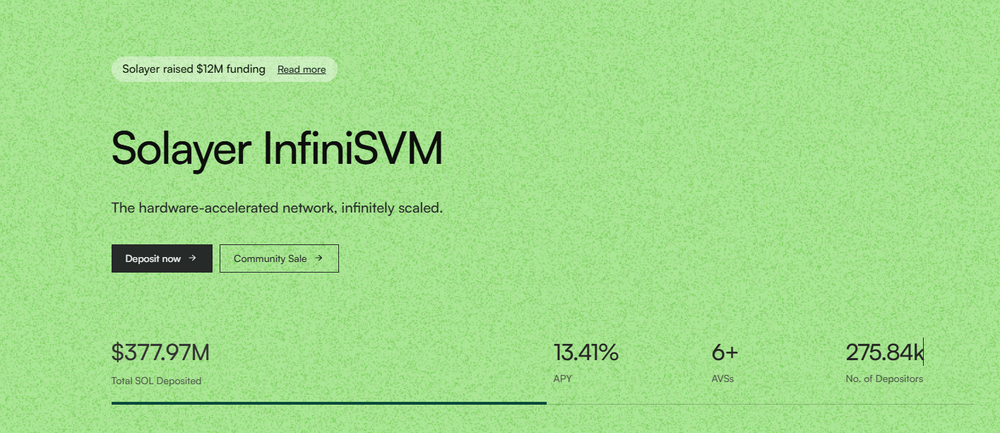
In the field of re-staking, Solayer has also achieved impressive results. As of January 13, its official data showed that the current TVL amount has reached 370 million US dollars, the number of depositors is about 275,000, and the average annualized rate of return has reached 13.41%. It ranks ninth among Solana's TVL and sixth among all re-staking protocols.

However, re-staking does not seem to be Solayer's ultimate goal. In October, Solayer launched the RWA narrative and launched the synthetic stablecoin Solayer USD, which is also a stablecoin asset based on government bonds. It is similar to the USD0 launched by Usual some time ago. The current market value of this stablecoin is about 30 million US dollars, ranking sixth in the Solana ecosystem. Of course, this volume is still relatively small in the entire network, ranking only 46th.

In December, Solayer quietly updated an article titled "Software Expansion Has Reached Its Limit - The Future Lies in Hardware Expansion" in his blog. The article pointed out that with the problems of state fragmentation, throughput limitation, delay and cost, system complexity, etc., the software upgrade of Ethereum EVM Layer 2 network has reached a bottleneck period, and the high performance of Solana and Sui also comes from the characteristics of software simplification and hardware acceleration. However, in this article, Solayer did not disclose his next plan to become the fastest network in the entire network by upgrading hardware.

Millions of TPS, 100Gbps, technical narratives are still effective

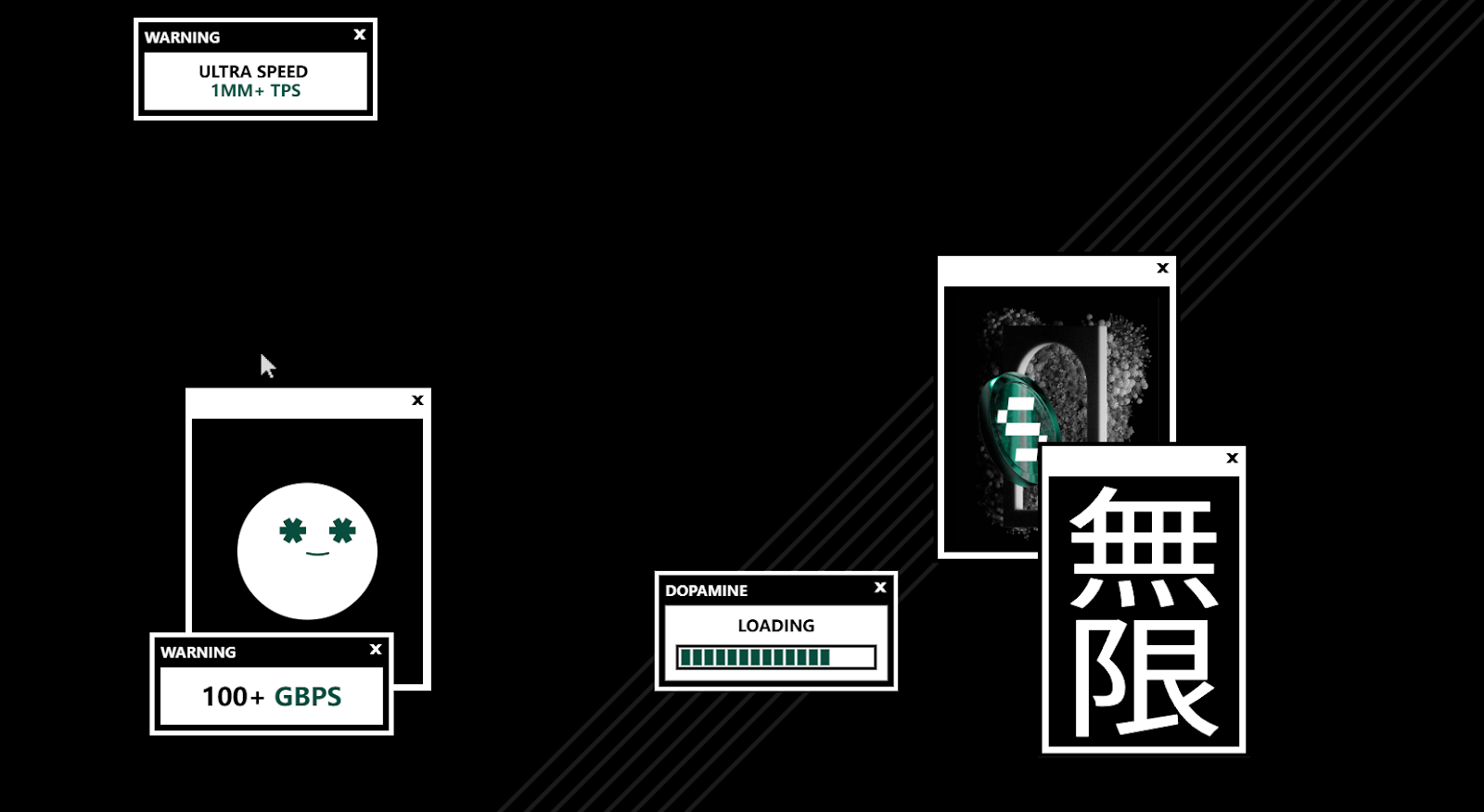
Until January 7, Solayer released its 2025 roadmap. Through hardware expansion, Solayer will launch the first novel hardware expansion SVM, which can achieve 1M TPS and 100Gbps. PANews learned from the white paper that Solayer proposed the technical principle of achieving millions of TPS and 100Gbps bandwidth. The core of the technology comes from a hardware acceleration technology called Infiniband RDMA, which can achieve microsecond-level cross-node communication. This technology can be divided into two parts. One part is Infiniband (wireless bandwidth), which is a high-performance network architecture used to efficiently connect computing nodes, storage systems and other devices, and is widely used in supercomputers and data centers.
The first community sale exceeded expectations by 15 times and was forced to be postponed. Will Solayer, which has a few more narratives, become a dark horse?

Another core technology is RDMA (Remote Direct Memory Access), which allows devices to directly access the memory of remote nodes without the intervention of the operating system. This "zero-copy" communication method greatly reduces the CPU load and communication latency. It is understood that these two technologies are currently mainly used in high-performance computing (HPC), artificial intelligence and machine learning, finance and distributed storage. Solayer should be the first to be adopted in blockchain networks. At present, it is not certain whether this technology can be realized.

From the team's experience, Solayer's founder Rachel Chu was a core developer of Sushiswap, and another co-founder Jason Li graduated from Berkeley University with a degree in computer science and previously created the non-custodial Web3 wallet MPCVault. In addition, on January 8, Solayer also announced the acquisition of Fuzzland, a smart contract hybrid fuzzer company. It is reported that one of the tasks of this acquisition is to focus on building a hardware-accelerated SVM chain.

Community sales spark participation boom

On January 9, Solayer announced the first community sale in cooperation with Builder. According to the information released, the total issuance of LAYER tokens is 1 billion, and this sale is 30 million, with a total fundraising of US$10.5 million. The average price of the token is about US$0.35, which is a token valuation of US$350 million. 100% of the LAYER tokens in the community sale will be unlocked on the day of the Token Generation Event (TGE).
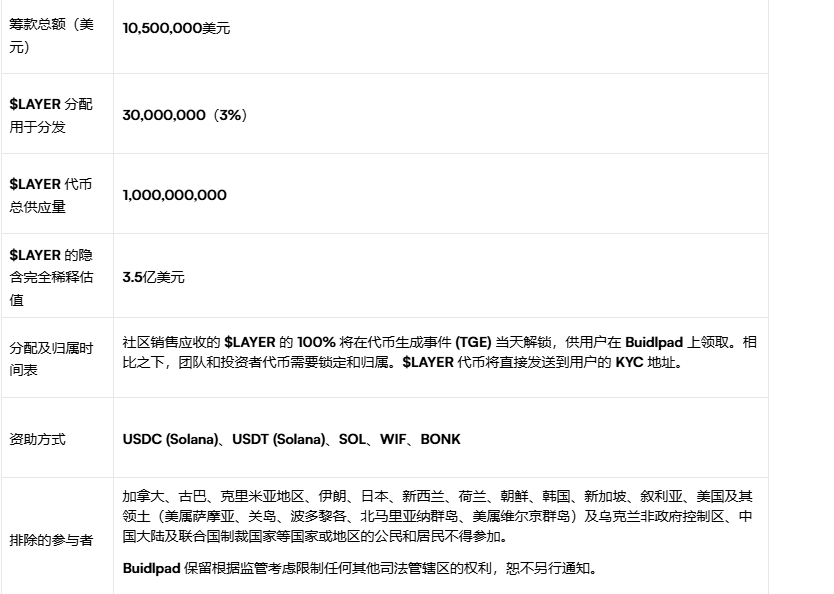
The first community sale exceeded expectations by 15 times and was forced to be postponed. Will Solayer, which has a few more narratives, become a dark horse?

In addition to the token sale, Solayer also released a debit card called the Solayer Emerald Metal Card, a virtual + physical debit card in partnership with Visa that can be used online and offline for export and legal spending. The exact timeline for this product will be announced separately by Solayer. Users who participate in this sale have the opportunity to receive the Solayer Emerald Metal Card. Previously, it was often seen that token sales would issue whitelists to users who own certain hardware or products, but Solayer's model of buying coins and giving cards is relatively rare.

Regardless of the reasons, various bot studios and many crypto KOLs have posted KYC registration tweets on social media. Taking the newly launched Sonic SVM as an analogy, the current market value of SONIC tokens is about $240 million, and the fully diluted market value is about $1.6 billion. In addition, the market seems to have higher expectations for Solayer. Even at the $1.6 billion market value expectation, LAYER's expected appreciation seems to have 4 to 5 times the space.

As expected, the KYC subscription of LAYER was extremely popular. According to Buidlpad, the current number of registered people is more than 15 times the expected number, and they also noticed a large number of robots and furry studios. Therefore, they had to suspend registration and postpone the sale to January 16.

Of course, we cannot predict the performance of LAYER after it goes online. From the development history of Solayer in just one year, from re-staking to RWA, to hardware acceleration and encrypted payment cards, at least in terms of narrative and rhythm control, we can see that this team has a lot of experience, and has taken a route similar to Hyperliquid, which is to deliver products first and then deliver technology. If the technical strength and operational strength behind it can be matched synchronously, the goal of millions of TPS can be achieved, and the new technological milestone of millisecond-level transaction speed can be achieved, Solayer will truly become the next rising star that cannot be ignored. The result of all this depends on when Solayer can bring its products to market.


Market Opportunity
Moonveil Logo
Moonveil Price(MORE)
$0.0005044
$0.0005044$0.0005044
-4.03%
USD
Moonveil (MORE) Live Price Chart
Disclaimer: The articles reposted on this site are sourced from public platforms and are provided for informational purposes only. They do not necessarily reflect the views of MEXC. All rights remain with the original authors. If you believe any content infringes on third-party rights, please contact crypto.news@mexc.com for removal. MEXC makes no guarantees regarding the accuracy, completeness, or timeliness of the content and is not responsible for any actions taken based on the information provided. The content does not constitute financial, legal, or other professional advice, nor should it be considered a recommendation or endorsement by MEXC.

You May Also Like

Ethereum’s Fusaka Upgrade Poised to Enhance Scalability

Ethereum’s Fusaka Upgrade Poised to Enhance Scalability

The post Ethereum’s Fusaka Upgrade Poised to Enhance Scalability appeared on BitcoinEthereumNews.com. Key Points: Ethereum’s Fusaka upgrade enhancing blockchain scalability. Expected institutional adoption increase. Dilution risk for unstaked ETH holders grows. VanEck announced on October 4 that Ethereum’s Fusaka upgrade, scheduled for December 3, 2025, will ease data burdens on validators and enhance scalability for Layer-2 solutions. This upgrade aims to attract more institutional investors by reducing Layer-2 costs, potentially increasing ETH holdings and staking activities, while posing dilution risks for unstaked holders. Fusaka to Reduce Costs and Boost Adoption Ethereum’s Fusaka upgrade aims to boost scalability by increasing blob capacity, reducing validator data burdens, and lowering Layer-2 costs. VanEck addressed its potential for attracting institutional adoption. Observers note the risk of dilution for unstaked ETH holders as institutional participants take positions. Scalability improvements and decreased transaction costs are key changes expected from the upgrade. Additionally, heightened appeal to institutional investors suggests increased staking and liquidity within the Ethereum network. This leads to broader implications, including potentially greater network security and improved transaction speeds. “Both the blob capacity hard forks will more than double the current blob capacity.” – Christine D. Kim, Ethereum Researcher, Ethereum Foundation Market reactions have been notable, with observers pointing to past Ethereum upgrades that fueled increased Layer-2 activity and enhanced validator participation. As outlined by industry experts, the potential for network growth through these improvements suggests that Ethereum’s stature as a major blockchain could be further solidified. Ethereum Price Data and Future Implications Did you know? The upcoming Fusaka upgrade reflects a similar approach to Ethereum’s previous Dencun upgrade, which initially introduced blobs, reducing rollup costs and boosting Layer-2 expansion. Historical patterns indicate such upgrades induce spikes in Layer-2 usage. As of October 4, 2025, Ethereum (ETH) was priced at $4,486.13 with a market cap of $541,490,696,840 and a trading volume of $42,766,570,071, according to CoinMarketCap. ETH…
Share
BitcoinEthereumNews2025/10/04 19:06
JPMorgan Chase plans to accept Bitcoin as loan collateral. What's the underlying reason?

JPMorgan Chase plans to accept Bitcoin as loan collateral. What's the underlying reason?

After years of tension between cryptocurrencies and traditional finance, a symbolic shift is taking place inside the world’s largest bank. JPMorgan Chase & Co. is reportedly preparing to allow institutional clients to use Bitcoin and Ethereum as collateral for cash loans. This means that the bank's borrowers can pledge the two largest cryptocurrencies by market capitalization, and the relevant assets will be held by approved third-party custodians such as Coinbase. The program is expected to be launched by the end of 2025. The move is ironic given that the financial giant's CEO, Jamie Dimon, is a well-known cryptocurrency critic who has previously described Bitcoin as a "scam." But growing demand in the nascent cryptocurrency industry forced him to back the company's product launches. A new chapter in digital collateral JPMorgan's move could quietly rewrite the boundaries between digital assets and regulated credit markets. According to Galaxy Research data, as of June 30, the total amount of outstanding loans in centralized finance reached US$17.78 billion, a month-on-month increase of 15% and a year-on-year increase of 147%. If decentralized loans are included, the total balance of cryptocurrency-collateralized credit reached US$53.09 billion in the second quarter of 2025, setting the third highest record in history. These data reflect a structural shift: as digital asset prices rise, lending activity increases in tandem. The trend has narrowed credit spreads, making loans more attractive to traders and corporate treasuries. In addition, businesses have also begun to use cryptocurrency-collateralized lending to finance operations, replacing equity issuance with debt secured by digital assets. In this context, JPMorgan Chase’s entry is less an experiment than a decisive move by the institution to “catch up with its peers” in the emerging industry. In response, cryptocurrency researcher Shanaka Anslem Perera estimates that the model could unlock $10 billion to $20 billion in instant lending capacity for hedge funds, corporate treasuries, and large asset managers. These institutions want to access U.S. dollar liquidity without having to sell their cryptocurrency tokens. In practical terms, this means that companies can now raise funds using digital assets, using the same process as borrowing against U.S. Treasuries or blue-chip stocks. The significance of JPMorgan's move While cryptocurrency-collateralized lending is already common among decentralized finance (DeFi) protocols and small centralized finance lenders, JPMorgan’s involvement institutionalizes the model. The bank’s entry signals that digital assets are mature enough to meet the global financial industry’s standards for compliance, custody and risk management. Matt Sheffield, CIO of SharpLink, an Ethereum-focused finance firm, believes the development could reshape how asset managers and funds manage their balance sheets. “Until now, many traditional financial institutions that rely on bank transactions have had to choose between holding Ethereum spot and other positions,” he said. "The world's largest investment bank is working to change that. By borrowing against positions held by third-party custodians, institutions can build more profitable portfolios and increase the value of their collateral." At the same time, this decision also strengthens JPMorgan's overall layout in the cryptocurrency field. Over the past two years, the bank has built Onyx, a blockchain-based settlement network, processed billions of dollars in tokenized payments, and explored digital asset repo transactions. Accepting Bitcoin and Ethereum as loan collateral completes the closed loop of "issuance-settlement-credit", and all three links rely on blockchain infrastructure. Based on this, Sheffield predicts that this move will trigger a "competitive chain reaction" among large banks. He pointed out: “This will set off a wave. For large institutions, the deterrent of ‘being the first to act’ is huge. Once the risks are reduced, other banks will follow suit, and if they don’t act, they will lose their competitiveness.” Currently, competitors such as Citigroup and Goldman Sachs have expanded their digital asset custody and repurchase businesses; BlackRock has incorporated tokenized Treasury bonds (BUIDL) into its fund ecosystem; and Fidelity has doubled the number of employees in its institutional cryptocurrency department this year. Opportunities and challenges coexist Despite growing acceptance of digital assets on Wall Street, challenges remain. Banks involved in this market must deal with the inherent volatility of cryptocurrencies, uncertainty about regulatory capital treatment, and ongoing counterparty risk, all of which have limited their efforts to expand their cryptocurrency-backed lending businesses. US regulators have yet to issue clear capital weighting guidelines for digital collateral, forcing institutions to rely on conservative internal models. Even if custody risk is managed by a third-party custodian, regulatory oversight is expected to remain strict. Nonetheless, the trajectory of the industry is unmistakable, with digital assets becoming increasingly integrated into the fabric of global credit markets. Bitcoin analyst Joe Consoerti said the moves suggest that “the global financial system is slowly reallocating collateral around the highest-quality assets known to mankind.”
Share
PANews2025/10/27 13:00
PBOC Sets Strongest Fix In 34 Months, Signaling Strategic Shift

PBOC Sets Strongest Fix In 34 Months, Signaling Strategic Shift

The post PBOC Sets Strongest Fix In 34 Months, Signaling Strategic Shift appeared on BitcoinEthereumNews.com. Yuan Mid-Point Soars: PBOC Sets Strongest Fix In 34
Share
BitcoinEthereumNews2026/03/05 11:45