Charles Hoskinson Touts Cardano’s 2025 Wins in Governance and Scaling
TLDR
- Cardano implemented a large-scale on-chain governance system that enabled community-led decision-making in 2025.
- The community successfully passed a $150 million annual budget through the new governance structure.
- Charles Hoskinson confirmed that he no longer controls Cardano’s strategic decisions or funding priorities.
- A global constitutional convention involving over 50 countries helped establish Cardano’s formal constitution.
- Hydra was launched to improve scalability and prepare the network for increased transaction demand.
Cardano achieved several key milestones in 2025, including a functioning on-chain governance system, a $150 million budget vote, and major upgrades. Founder Charles Hoskinson described the year as a breakthrough for decentralized coordination, highlighting governance over hype as the network’s core success. He also pointed to infrastructure progress, including Hydra, Midnight, and the upcoming launch of Ouroboros Leios.
Governance as Cardano’s Defining Achievement
Charles Hoskinson described Cardano’s governance as its most impactful achievement throughout 2025. He explained that many networks lack real decentralized governance, relying instead on insider decision-making.
In contrast, Cardano implemented a large-scale governance system supported by a formal constitution. The community passed a $150 million budget and debated several key amendments.
Hoskinson said, “For the first time, roadmaps and funding priorities are no longer set by me or the Foundation.” He emphasized that community-driven decisions now shape Cardano’s future strategy.
The system also facilitated transparent debates and created channels for scalable consensus. This governance framework is designed to remain efficient as Cardano grows.
Cardano hosted a global constitutional convention involving members from over 50 countries. Hoskinson described the multi-year process as difficult but transformative.
He added that true decentralization requires time, coordination, and resilience. The 2025 developments proved Cardano could govern at scale without losing efficiency.
Infrastructure, Privacy, and Scalability Milestones
Cardano introduced major technical advancements in 2025, including the Hydra scaling protocol. Hoskinson confirmed that Ouroboros Leios will follow in 2026.
Hydra aims to handle more users while maintaining low latency. It helps the network meet demand from millions of users and applications.
Cardano also launched Midnight, a chain designed to support private, cross-chain transactions. Hoskinson described it as critical to future blockchain infrastructure.
Midnight protects user strategies by obscuring intent in a multi-chain environment. It enables secure, programmable privacy across decentralized apps.
The project aligns with a broader shift to intent-based systems. In this model, users define outcomes while platforms manage execution behind the scenes.
Hoskinson warned that exposed intent could invite attacks. He said Midnight prevents this by embedding privacy into execution layers.
He also revealed that Cardano advanced plans for Bitcoin DeFi bridges. The network worked on infrastructure to support stablecoins and commercial integrations.
Decentralization Beyond Voting and Future Plans
Hoskinson criticized networks that claim decentralization while relying on large token holders. He stated that Cardano avoids this by building consensus openly.
He explained that Cardano’s system moves past simple voting. It uses formal processes to reach agreement across a diverse user base.
As complexity grows, disagreements increase. Cardano aims to resolve these without delays that affect upgrades or security.
The governance model has already handled real budgets, proposals, and accountability. It stands out in an industry where control is often concentrated.
Cardano integrated projects like Pyth and plans further network expansions. Hoskinson said more technical rollouts are scheduled for 2026.
Leios will focus on improved efficiency, while Midnight will handle privacy-critical functions. Both are expected to scale Cardano’s reach.
The platform is preparing for a new phase centered on user intent and abstraction. Hoskinson said these trends will shape blockchain use in 2026.
He stated that Cardano must compete by being faster and more adaptive. According to him, the community now drives that progress.
The post Charles Hoskinson Touts Cardano’s 2025 Wins in Governance and Scaling appeared first on CoinCentral.


You May Also Like
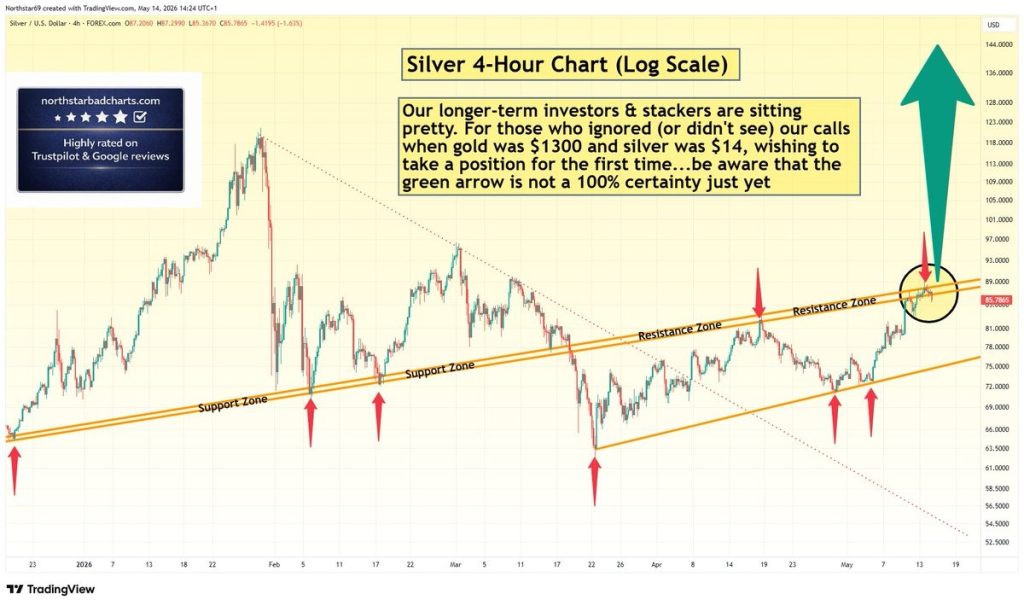
Silver Price Warning: Green Arrow Setup Is Not Confirmed – Wait for Clear Signal

Facebook spotlights African cinema in 6th ‘Made by Africa, loved by the world’ campaign