Bitcoin is pushing above the $95,000 level as selling pressure across the market continues to ease, offering a renewed sense of short-term stability after weeksBitcoin is pushing above the $95,000 level as selling pressure across the market continues to ease, offering a renewed sense of short-term stability after weeks

Bitcoin Bulls Take Control: Futures Positioning Turns Bullish for First Time Since October

2026/01/15 13:00

Bitcoin is pushing above the $95,000 level as selling pressure across the market continues to ease, offering a renewed sense of short-term stability after weeks of choppy consolidation. Following a volatile end to last year, price action has gradually improved, with buyers regaining control and forcing Bitcoin back into a range that had previously acted as resistance. While skepticism remains high and many analysts continue to warn of a broader corrective phase, recent derivatives and positioning data suggest that market behavior may be shifting beneath the surface.

According to an analysis shared by Axel Adler, Bitcoin’s Positioning Index SMA-30d has climbed to 3.5, marking the first sustained breakout above the 3.0 level since October 6, 2025. That previous breakout occurred during the rally that ultimately carried BTC toward the $125,000 peak, making the current move particularly notable from a historical perspective.

Bitcoin Positioning Index | Source: CryptoQuant

The positioning index reflects aggregated futures market dynamics, including open interest, funding behavior, and long-short activity, and is often used to identify regime changes in trader sentiment.

This renewed strength in positioning does not guarantee immediate upside continuation, but it does indicate that futures traders are once again willing to take directional exposure after months of defensive positioning. As Bitcoin holds above $95K, the coming sessions will be critical in determining whether this move develops into a broader trend or remains a temporary relief rally.

Futures Positioning Signals a Shift Toward a Bullish Regime

According to Axel Adler Jr., the recent breakout of the Positioning Index SMA-30d above the 3.0 level marks an important local shift in Bitcoin’s futures market structure. After spending nearly three months oscillating within the 0 ± 2 range, this move signals that traders are transitioning from neutral or defensive positioning into a more directional stance.

Adler notes that confirmation now depends on persistence rather than speed. The key continuation trigger is the SMA holding above the 2.0 level for at least one week, which would validate that the shift is not a short-lived reaction.

This view is reinforced by developments in the Bitcoin Advanced Sentiment Index. While sentiment briefly peaked at 93.15% when BTC traded near $95,061, it has since cooled to roughly 70%. Importantly, this pullback has occurred without a breakdown in price structure. The index remains well above the neutral 50% threshold and above its 30-day average near 62.9%, indicating that bullish conditions still dominate the futures market.

Bitcoin Advanced Sentiment Index | Source: CryptoQuant

Adler interprets the roughly 23-percentage-point decline in sentiment as a healthy release of short-term overheating rather than a trend reversal. Historically, such resets often strengthen trend durability. Risk emerges if sentiment falls below 50% alongside a price drop under $92,000. Conversely, holding sentiment above 60% during short consolidation phases would support further upside continuation.

Bitcoin Price Action Details

Bitcoin price action on the daily chart shows a clear attempt to regain control after a prolonged consolidation phase. Following the sharp November sell-off that pushed BTC into the low $80K region, price has gradually formed a higher-low structure, signaling stabilization rather than continued capitulation. The recent push above $95,000 marks the highest daily close since mid-November and places Bitcoin back above its short-term moving average, a level that had capped upside throughout December.
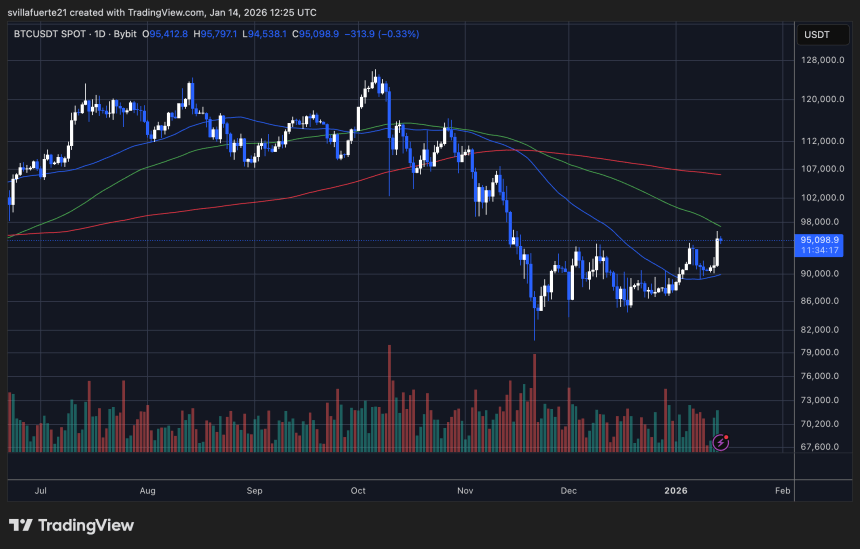
BTC testing critical resistance | Source: BTCUSDT chart on TradingView

However, the broader trend remains mixed. The 50-day moving average is still sloping downward and sits above the current price, acting as near-term dynamic resistance. Meanwhile, the 200-day moving average continues to trend higher well below price, confirming that the broader market structure remains intact despite recent volatility. This positioning reflects a market transitioning from corrective pressure into a potential recovery phase, rather than a clean trend reversal.

The recent advance toward $95K occurred without a significant volume spike, suggesting reduced selling pressure rather than aggressive new demand. This is consistent with a relief-driven move fueled by short covering and position rebalancing.

For bulls, holding above the $93K–$95K range is critical to maintain momentum and build a base for continuation. Failure to consolidate above this zone would increase the risk of renewed range-bound trading or a pullback toward the $90K support area.

Featured image from ChatGPT, chart from TradingView.com 

Market Opportunity
BULLS Logo
BULLS Price(BULLS)
$404.52
$404.52$404.52
-0.73%
USD
BULLS (BULLS) Live Price Chart
Disclaimer: The articles reposted on this site are sourced from public platforms and are provided for informational purposes only. They do not necessarily reflect the views of MEXC. All rights remain with the original authors. If you believe any content infringes on third-party rights, please contact service@support.mexc.com for removal. MEXC makes no guarantees regarding the accuracy, completeness, or timeliness of the content and is not responsible for any actions taken based on the information provided. The content does not constitute financial, legal, or other professional advice, nor should it be considered a recommendation or endorsement by MEXC.

You May Also Like

Saudi Awwal Bank Adopts Chainlink Tools, LINK Near $23

Saudi Awwal Bank Adopts Chainlink Tools, LINK Near $23

The post Saudi Awwal Bank Adopts Chainlink Tools, LINK Near $23 appeared on BitcoinEthereumNews.com. SAB adopts Chainlink’s CCIP and CRE to expand tokenization and cross-border finance tools. SAB and Wamid target $2.32T Saudi capital markets with blockchain-based tokenization plans. LINK price falls 2.43% to $22.99 despite higher trading volume and steady liquidity ratios. Saudi Awwal Bank has added Chainlink’s Cross-Chain Interoperability Protocol (CCIP) and the Chainlink Runtime Environment (CRE) to its digital strategy. CCIP links assets and data across multiple blockchains, while CRE provides banks with a controlled framework to test and deploy new financial applications. The lender, with more than $100 billion in assets, is applying the tools to tokenized assets, cross-border settlement, and automated credit platforms. The move signals that Chainlink’s infrastructure is being adopted at scale inside regulated finance. Related: Chainlink’s Deal with SBI Is a Major Win, But Chart Shows LINK’s Battle at $27 Resistance Wamid Partnership Aims at $2.32 Trillion Markets In parallel, SAB signed an agreement with Wamid, a subsidiary of the Saudi Tadawul Group, to pilot tokenization of the Saudi Exchange’s $2.32 trillion capital markets. The focus is on equities and debt products, opening the door for blockchain-based issuance and settlement. SAB has already executed the world’s first Islamic repo on distributed ledger technology, in collaboration with Oumla earlier this year. That transaction gave regulators a template for compliant on-chain contracts. The Wamid deal builds directly on that precedent, shifting from single-instrument pilots toward broader capital markets integration. Saudi Blockchain Buildout Gains Pace Saudi institutions are building multiple layers of digital infrastructure. Oumla is working with Avalanche to develop the Kingdom’s first domestically hosted Layer 1 blockchain. SAB’s Chainlink adoption adds an interoperability and execution layer on top. Together, these projects are shaping a domestic framework for tokenization, with global connectivity added only where liquidity requires it. LINK Price and Liquidity Snapshot While institutional adoption progresses, Chainlink’s…
Share
BitcoinEthereumNews2025/09/18 08:49
Pump.fun CEO to Call Low-Cap Gem to Test New ‘Callouts’ Feature — Is a 100x Incoming?

Pump.fun CEO to Call Low-Cap Gem to Test New ‘Callouts’ Feature — Is a 100x Incoming?

Pump.fun has rolled out a new social feature that is already stirring debate across Solana’s meme coin scene, after founder Alon Cohen said he would personally
Share
CryptoNews2026/01/16 06:26
New York Regulators Push Banks to Adopt Blockchain Analytics

New York Regulators Push Banks to Adopt Blockchain Analytics

New York’s top financial regulator urged banks to adopt blockchain analytics, signaling tighter oversight of crypto-linked risks. The move reflects regulators’ concern that traditional institutions face rising exposure to digital assets. While crypto-native firms already rely on monitoring tools, the Department of Financial Services now expects banks to use them to detect illicit activity. NYDFS Outlines Compliance Expectations The notice, issued on Wednesday by Superintendent Adrienne Harris, applies to all state-chartered banks and foreign branches. In its industry letter, the New York State Department of Financial Services (NYDFS) emphasized that blockchain analytics should be integrated into compliance programs according to each bank’s size, operations, and risk appetite. The regulator cautioned that crypto markets evolve quickly, requiring institutions to update frameworks regularly. “Emerging technologies introduce evolving threats that require enhanced monitoring tools,” the notice stated. It stressed the need for banks to prevent money laundering, sanctions violations, and other illicit finance linked to virtual currency transactions. To that end, the Department listed specific areas where blockchain analytics can be applied: Screening customer wallets with crypto exposure to assess risks. Verifying the origin of funds from virtual asset service providers (VASPs). Monitoring the ecosystem holistically to detect money laundering or sanctions exposure. Identifying and assessing counterparties, such as third-party VASPs. Evaluating expected versus actual transaction activity, including dollar thresholds. Weighing risks tied to new digital asset products before rollout. These examples highlight how institutions can tailor monitoring tools to strengthen their risk management frameworks. The guidance expands on NYDFS’s Virtual Currency-Related Activities (VCRA) framework, which has governed crypto oversight in the state since 2022. Regulators Signal Broader Impact Market observers say the notice is less about new rules and more about clarifying expectations. By formalizing the role of blockchain analytics in traditional finance, New York is reinforcing the idea that banks cannot treat crypto exposure as a niche concern. Analysts also believe the approach could ripple beyond New York. Federal agencies and regulators in other states may view the guidance as a blueprint for aligning banking oversight with the realities of digital asset adoption. For institutions, failure to adopt blockchain intelligence tools may invite regulatory scrutiny and undermine their ability to safeguard customer trust. With crypto now firmly embedded in global finance, New York’s stance suggests that blockchain analytics are no longer optional for banks — they are essential to protecting the financial system’s integrity.
Share
Coinstats2025/09/18 08:49