

AI Tokens: The Next Bitcoin? What Will Happen in the Market in 2 Years
Welcome to 2025–2026 — where the only thing growing faster than coffee prices is AI tokens. Just yesterday we were arguing about whether ChatGPT could write a university thesis (spoiler: it could). Today, we’re buying digital assets that literally power an entire army of those same “writers.”
I’m not a fan of clichés, so let me be blunt: we’re entering an era where your crypto wallet is no longer just a vault for “digital gold,” but a fuel tank for a future global neural network. And trust me, this isn’t just another “cat-themed shitcoin.”
Take $FET, for example. It’s building an economy of autonomous agents and already sits at a market capitalization of $548.77M. Not convincing enough? Look at NEAR. In 2025, NEAR is actively positioning itself as a foundation for AI-powered applications — and it’s doing just fine with a market cap of $2.06B. AI is much closer to us than most people think!
Why AI Tokens Go Beyond The Meme Narrative
AI tokens are cryptocurrencies tied to projects where artificial intelligence plays a core role. In simple terms, they act as fuel, governance rights, or a share in the value of decentralized AI ecosystems. And most importantly, they address one of the biggest problems of modern AI: centralization.
Today, giants like Google, Meta, and OpenAI control the data, the compute power, and the rules of the game. AI tokens offer a different model. They make it possible to:
- Decentralize computation
You can rent out your idle GPU power and get paid in tokens. Your graphics card stops collecting dust and starts earning.
2. Monetize data
Your unique datasets or trained models become assets that can be traded on open markets.
3. Democratize governance
Token holders vote on how AI projects evolve through DAOs, instead of decisions being made behind closed doors.
The Crypto Catalyst: Infrastructure, Metaverses, and Durov
The current surge in AI tokens isn’t random. It’s the result of a perfect storm.
- Overheated startups: After the breakout success of models like GPT-4, AI startups need fast, global capital and strong user engagement. Tokens are an almost perfect tool for that.
- Gaming and metaverse integration: In metaverses and GameFi, AI tokens aren’t just “assets.” They’re payment methods for generating unique NFTs, powering AI-driven NPC behavior, or creating content on demand. Your digital alter ego can now pay for AI services.
- Liquidity as a growth engine (Market Making): New AI tokens, especially from ambitious projects, rely on market-making programs. This isn’t about “painting a price.” It’s about ensuring constant activity, healthy liquidity, and real tradability. Think of it as giving a newborn token a head start in the listing marathon.
A quick note on scale and ambition: When someone like Pavel Durov talks about launching an AI lab — say, in Kazakhstan — he’s not just looking for engineers. He’s signaling the next phase of the race. AI projects are becoming global by default, and they need something more flexible and borderless than traditional equity. That “something” is tokens.
Top 3 AI Tokens Poised to Outperform the Classics
The crypto market has always lived by shifting narratives, but the foundational pillars remain. Altcoin giants like $XRP constantly stay in the spotlight, never disappearing from the conversation regardless of market cycles, with a market capitalization of $119.3B. Promising altcoins, such as WhiteBIT Coin, show steady growth without extreme volatility, and if current trends continue, this coin could reach a $20B market cap next year.
Against this backdrop, AI tokens don’t yet have the same market dominance, but their long-term potential outweighs short-term speculation. Here are the top 3 AI tokens to watch:
1. AI token: Bittensor ($TAO)
$TAO is the embodiment of Proof-of-Contribution (PoC), where the token acts as both incentive and payment for providing high-quality AI models. It’s a decentralized marketplace for exchanging intelligence, turning AI research into a race with direct monetary rewards.
By the end of 2025, its market cap stabilized around $2.5-$3B, highlighting its leadership in the sector. Its price remains highly volatile, reflecting both speculative and fundamental interest.
2. AI token: NEAR Protocol ($NEAR)
While $NEAR is a general Layer-1 blockchain, it has effectively become the preferred “hub” for AI startups thanks to its Nightshade architecture, which offers incredible scalability and low fees. Unlike $Solana, which focuses on pure transaction speed, $NEAR provides an ideal environment for resource-intensive neural networks.
Its market cap hovers around $2–2.5B, and the number of AI projects on its platform has exceeded expectations, showing outstanding growth.
3. AI token: Chainlink ($LINK)
$LINK — it’s a critical decentralized oracle network bridging AI models on the blockchain with real-world data (prices, events, weather). It ensures AI algorithms operate on verified, trustworthy data, making it essential for enterprise integration.
With a market cap between $9-$15B, $LINK is the “mature player” in this list, serving not just AI but the entire DeFi and RWA ecosystem. Its Total Value Secured (TVS), reflecting the crypto market’s reliance on its data, consistently exceeds $75B.
The Next 2 Years: Where AI Tokens Grow Up
2024 was the year of meme coins. 2025 belongs to Bitcoin. But from behind Bitcoin, AI tokens are already stepping into the spotlight. The next two years in the AI-token sector won’t be about rockets and moonshots. They’ll be about utility. We’re entering a phase where AI tokens stop being purely speculative assets and start functioning as units of account and access rights to real resources.
Market Evolution: From Speculation to Infrastructure
We’re moving from Proof-of-Hype to Proof-of-Contribution (PoC) 2.0. Your $TAO or $NEAR won’t rise just because “AI is trending.” It will rise only if it’s actually used:
1. Buying Compute Power
Tokens will become fuel for decentralized compute clusters, gradually replacing fiat-based subscriptions like AWS or Azure. Token price will correlate directly with real demand for AI training and inference.
2. Securing and Exchanging Data
Tokens (think $LINK-style models) will act as collateral, guaranteeing the authenticity and integrity of training data. This is critical for enterprise adoption — FinTech, Pharma, and other regulated sectors.
🛑 Risks: Underestimating Centralization
The main risk: Google, Microsoft, and OpenAI are not standing still. They can launch their own “blockchain-light” solutions. If they manage to make their AI platforms sufficiently decentralized and user-friendly, the hype around pure AI tokens could fade.
Your 2027 Strategy:
Look for projects that don’t just talk about AI, but actually make it work. Focus on fundamental usage, not price pumps driven by Elon Musk’s tweets. AI tokens are not the end product — they’re the pipes through which data flows. Invest in the data.
AI Tokens: The Next Bitcoin? What Will Happen in the Market in 2 Years was originally published in Coinmonks on Medium, where people are continuing the conversation by highlighting and responding to this story.
You May Also Like

Stellar (XLM) Eyes $0.28 After Roadmap Signals Stablecoin and Lending Growth
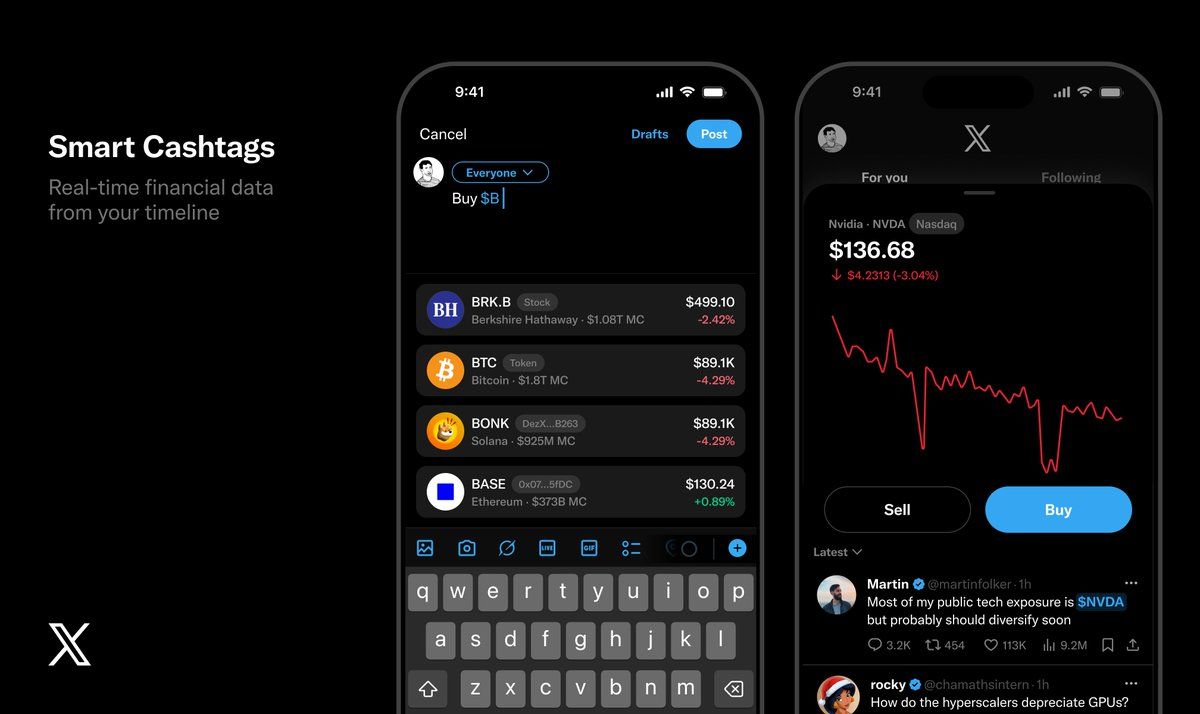
X Smart Cashtags: Elon Musk’s Platform Eyes Crypto and Stock Trading Integration
