

Best Crypto to Buy Now – Solana Price Prediction, Next 1000x Crypto

Solana’s ecosystem now shows a clear gap between strong institutional growth and weak short-term price action. Large institutions continue to build on Solana at a fast pace.
Visa has enabled USDC settlements for U.S. banks on Solana, and CME Group has expanded its Solana futures offerings. These steps support the move toward a future $10 trillion tokenized asset market.
At the same time, Solana has pulled in more than $670 million in net ETF inflows this month, helping form a strong long-term base for SOL.
In the short term, the price chart looks weaker. Many long-term investors still see Solana as a fast leader in DeFi, but technical signals point to risk.
This update looks closely at Solana’s current position. It covers price structure, on-chain data, and Solana’s link to Bitcoin. It also lays out the most likely paths for the next major move and compares them with earlier forecasts to help manage risk.
While Solana leads the conversation around high-speed Layer-1 networks, best crypto to buy now discussions increasingly focus on a new idea: bringing that same speed to Bitcoin.
Bitcoin Hyper (HYPER) drives this shift by using the Solana Virtual Machine (SVM) to tackle Bitcoin’s long-standing scaling limits.
Source – Cilinix Crypto YouTube Channel
Visa’s USDC Shift to Solana Highlights Growing Institutional Adoption
A stablecoin is a crypto token that follows the value of a real asset, most often the U.S. dollar. It works like a digital casino chip that always equals $1 when cashed out.
USDC, created by Circle, is one of the largest stablecoins. It stays near $1 because Circle holds real assets to back it, and users can usually swap it 1:1 for dollars.
Visa now lets select partner banks and fintech firms settle payments with USDC instead of using traditional bank transfers. Settlement means clearing balances between banks, card issuers, and Visa at the end of the day.
Rather than waiting on slow and costly wire transfers, these firms can send USDC on-chain. They now do this on Solana, a fast blockchain with low fees that handles large volumes of transactions.
Visa reports that its stablecoin settlement volume already reaches about $3.5 billion per year, with plans to support more stablecoins and blockchains, including the euro-based EURC.
Cross River Bank and Lead Bank have already settled with Visa in USDC on Solana. This shows that regulated banks now use public blockchains in everyday operations.
This trend fits into the broader Solana story. Large financial institutions continue to test Solana for payments and real-world assets. J.P. Morgan has even issued tokenized commercial paper on Solana using USDC, according to Reuters. This step shows that Solana supports serious institutional use, not just meme coins.
The shift to Solana goes beyond speed. It focuses on cutting transaction costs. Ethereum’s high gas fees have pushed firms to look for cheaper options, a problem Vitalik Buterin has openly discussed. Solana offers transaction costs that drop to fractions of a cent, something older systems like SWIFT cannot match.
Solana Shows Strong ETF Demand
Solana’s on-chain data points to stability but fails to signal strong upside momentum. DEX trading volumes increased earlier, then turned lower, while the stablecoin market cap on Solana keeps growing. Total value locked stays flat.
These signals show steady network use, but they do not provide enough force to break current resistance. At the same time, Solana ETF flows remain strong. Solana spot ETFs recorded steady buying throughout December, with positive net inflows on almost every day since December 4.
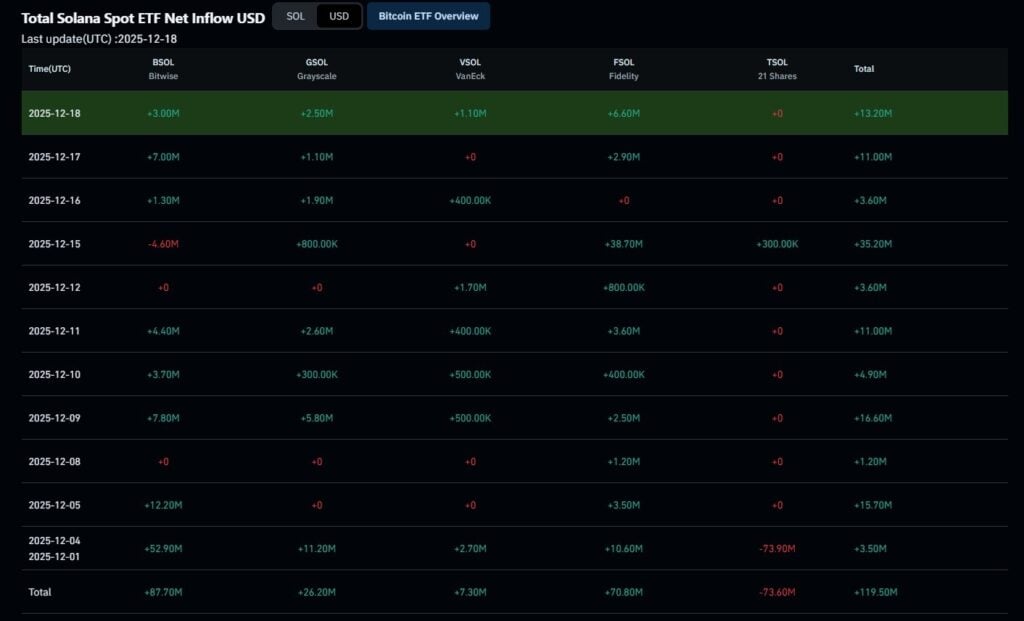
Several sessions exceeded $10 million in inflows. Bitwise, Grayscale, VanEck, and Fidelity account for most of the demand, while 21Shares posted one large outflow early on that no longer shapes the trend.
Recent sessions added more strength, including over $13 million on December 18 and $11 million the day before. In total, Solana spot ETFs have drawn about $120 million in net inflows, showing strong institutional interest even as SOL’s price stays muted.
Solana Price Prediction
Solana has broken below the $125–$126 value-area-low zone, a move anticipated in earlier updates due to Bitcoin’s ongoing weakness and Solana’s lack of independent momentum.
After testing this support for several days, the loss of $125 opened a clean liquidity gap below. This area, which once acted as support, has now flipped into strong overhead resistance.
The key question now is whether Solana can reclaim the $125–$126 range. A clear move back above this zone would signal a reclaim setup and give bulls a path toward short-term relief.
A rejection, however, would confirm that the breakdown is holding and increase the chance of another move lower to fill the liquidity gap.
Upcoming U.S. inflation data will likely decide the next move. While Solana’s internal fundamentals remain stable, price action currently tracks broader market conditions and Bitcoin’s performance.
If inflation prints below expectations, improved sentiment could provide enough momentum to reclaim $125, alongside a short-term bounce in Bitcoin. If inflation meets or exceeds expectations, buyers may struggle to clear the $126 resistance, especially if Bitcoin fails to break its own overhead levels.

This setup points to two main outcomes. Positive macro data could push price back above $125–$126, invalidate the breakdown, and create a high-value long setup. Failure to reclaim resistance could lead to a move toward the next major support near $115, which marks last year’s value-area low.
Bitcoin Hyper Combines Solana Speed With Bitcoin Security as a New Layer-2 Opportunity
A new Bitcoin Layer-2 coin has entered the market, and it stands out as the only project of its kind. The Layer-2 narrative continues to grow, and many major crypto projects now come from this space.
Layer-2 networks help large blockchains run faster and cheaper by handling transactions off-chain. They act like flyovers built above a busy Layer-1 highway. Before Bitcoin Hyper, Bitcoin lacked a fast Layer-2 solution, even though the network clearly needs one.
Bitcoin Hyper brings a new approach to a crowded market. It positions itself as the first mover building real infrastructure for a Bitcoin Layer-2 network that allows faster and low-cost Bitcoin transactions.
This setup gives it strong upside potential and places it among the best crypto to buy this festive weekend, according to the Cryptonews YouTube channel.
Bitcoin Hyper also offers a 39% APY staking reward, which adds extra appeal for early supporters. Its ICO has already climbed to just under $30 million and could move higher as market sentiment improves.
Investors who want early access can visit the Bitcoin Hyper website and buy $HYPER using SOL, ETH, USDT, USDC, BNB, or a credit card. The project also recommends using Best Wallet, a popular option for crypto and Bitcoin storage.
HYPER already appears in Best Wallet’s “Upcoming Tokens” section, which allows users to buy, track, and claim tokens easily once trading begins.
Visit Bitcoin Hyper
This article has been provided by one of our commercial partners and does not reflect Cryptonomist’s opinion. Please be aware our commercial partners may use affiliate programs to generate revenues through the links on this article.


You May Also Like

Paradigm Develops Prediction Markets Trading Terminal

Crypto Will Never Die As Iran Signals De-Escalation and Whales Are Quietly Buying Pepeto While Retail Panics



