New York Attorney General Letitia James has raised serious concerns over the recently passed GENIUS Act, warning Congress that the bill, in its current form, could leave investors and the U.S. financial system vulnerable. In a letter sent Monday to congressional leaders, James urged lawmakers to slow down the legislative process and implement stronger guardrails before finalizing any stablecoin regulations. Attorney General Calls GENIUS Act “A Danger to Investors, Economy, and National Security” The U.S. Senate approved the “Guiding and Establishing National Innovation for U.S. Stablecoins Act” last month in a 68-30 vote . It marked the first time the chamber passed a comprehensive bill focused solely on stablecoins. The legislation proposes strict rules for issuers, including full dollar backing and monthly disclosures of reserves. The bill is now headed to the House of Representatives, where lawmakers are preparing for a potential vote in the coming days. Source: NYAG But Attorney General James says the GENIUS Act does not go far enough to protect the public. “Many people across the country invest millions of dollars in cryptocurrencies, yet our laws fail to protect them and their money from fraud,” James said in the letter. “Unregulated cryptocurrency transactions are a danger to investors, the economy, and national security.” James expressed concern that legalizing stablecoin issuance without stronger oversight will open the door to financial abuse. She warned that the current bill lacks key protections and could allow stablecoin issuers to operate with less accountability than banks. Her letter calls on Congress to treat stablecoin issuers like traditional banks. That would include stronger regulatory supervision, capital requirements, and FDIC-backed insurance on stablecoin deposits. She also recommended digital identity verification for stablecoin users to reduce fraud, prevent money laundering, and limit the ability of bad actors to hide behind anonymity. James warned that stablecoins are often used in anonymous transactions, which can be exploited by criminal networks and terrorist groups. Without stricter measures, she argued, the GENIUS Act could compromise national security and leave the economy exposed. The letter also emphasized the need to keep stablecoin issuers within U.S. jurisdiction. Offshore platforms, James said, pose enforcement challenges and make it harder to maintain regulatory standards. She also urged lawmakers not to undercut community banks, which she said remain essential to rural and underserved communities. GENIUS and CLARITY Crypto Bills Favor Industry Over Investors James is not only targeting the GENIUS Act; She has also submitted a statement to the House Financial Services Committee regarding the Digital Asset Market Clarity Act ( CLARITY ), another crypto bill under review. In that statement, James criticized the bill for shielding bad actors, allowing market manipulation, and failing to give regulators the tools to stop fraud. She warned that both the GENIUS and CLARITY Acts, if passed without key revisions, would create a weak regulatory framework that prioritizes industry growth over consumer protection. In her latest letter, James told Congress: “Take the time necessary to draft legislation that will enhance innovation while protecting our banking system that is the envy of the world.” The GENIUS Act, while receiving bipartisan support in the Senate , has drawn divided reactions from regulators and state officials. It would limit stablecoin issuance to licensed institutions and impose requirements around asset backing and public disclosures. ⚠️ The GENIUS Act has been passed — but experts say stablecoins have the potential to damage the global economy #Crypto #Tether #Circle #USDT #USDC https://t.co/NWGB63iV2M — Cryptonews.com (@cryptonews) June 19, 2025 Under the bill, stablecoins must be backed by U.S. dollars or equivalent liquid assets, and consumer protections are included in the event of issuer bankruptcy. President Donald Trump has publicly endorsed the bill. “Get it to my desk, ASAP—NO DELAYS, NO ADD ONS,” he wrote on Truth Social. Still, James insists the bill needs deeper scrutiny. She warned that pushing stablecoin legislation forward without additional safeguards will leave American investors at risk. The House of Representatives is expected to hold procedural votes on the GENIUS and CLARITY Acts as early as the week of July 7 . 🏛️ The GENIUS Act and the CLARITY Act slated to be voted on by the House of Representatives as early as next week. #GENIUSAct #CLARITYAct https://t.co/5sxdIu420J — Cryptonews.com (@cryptonews) June 30, 2025 Should either bill pass both chambers, it would represent a major shift in how digital assets are regulated in the U.S. This isn’t James’ first warning to Congress. In April, she sent letters urging lawmakers to include “common sense principles” in any crypto bill, such as requiring stablecoin issuers to operate onshore and barring cryptocurrencies from retirement accounts. With momentum building in Washington to establish clear crypto laws, James is pressing for balance. She says investor protection and financial stability must not be traded for speed. “Congress must pass legislation that strengthens oversight of cryptocurrency to help stop fraud and criminal activity and protect the American public,” she said.New York Attorney General Letitia James has raised serious concerns over the recently passed GENIUS Act, warning Congress that the bill, in its current form, could leave investors and the U.S. financial system vulnerable. In a letter sent Monday to congressional leaders, James urged lawmakers to slow down the legislative process and implement stronger guardrails before finalizing any stablecoin regulations. Attorney General Calls GENIUS Act “A Danger to Investors, Economy, and National Security” The U.S. Senate approved the “Guiding and Establishing National Innovation for U.S. Stablecoins Act” last month in a 68-30 vote . It marked the first time the chamber passed a comprehensive bill focused solely on stablecoins. The legislation proposes strict rules for issuers, including full dollar backing and monthly disclosures of reserves. The bill is now headed to the House of Representatives, where lawmakers are preparing for a potential vote in the coming days. Source: NYAG But Attorney General James says the GENIUS Act does not go far enough to protect the public. “Many people across the country invest millions of dollars in cryptocurrencies, yet our laws fail to protect them and their money from fraud,” James said in the letter. “Unregulated cryptocurrency transactions are a danger to investors, the economy, and national security.” James expressed concern that legalizing stablecoin issuance without stronger oversight will open the door to financial abuse. She warned that the current bill lacks key protections and could allow stablecoin issuers to operate with less accountability than banks. Her letter calls on Congress to treat stablecoin issuers like traditional banks. That would include stronger regulatory supervision, capital requirements, and FDIC-backed insurance on stablecoin deposits. She also recommended digital identity verification for stablecoin users to reduce fraud, prevent money laundering, and limit the ability of bad actors to hide behind anonymity. James warned that stablecoins are often used in anonymous transactions, which can be exploited by criminal networks and terrorist groups. Without stricter measures, she argued, the GENIUS Act could compromise national security and leave the economy exposed. The letter also emphasized the need to keep stablecoin issuers within U.S. jurisdiction. Offshore platforms, James said, pose enforcement challenges and make it harder to maintain regulatory standards. She also urged lawmakers not to undercut community banks, which she said remain essential to rural and underserved communities. GENIUS and CLARITY Crypto Bills Favor Industry Over Investors James is not only targeting the GENIUS Act; She has also submitted a statement to the House Financial Services Committee regarding the Digital Asset Market Clarity Act ( CLARITY ), another crypto bill under review. In that statement, James criticized the bill for shielding bad actors, allowing market manipulation, and failing to give regulators the tools to stop fraud. She warned that both the GENIUS and CLARITY Acts, if passed without key revisions, would create a weak regulatory framework that prioritizes industry growth over consumer protection. In her latest letter, James told Congress: “Take the time necessary to draft legislation that will enhance innovation while protecting our banking system that is the envy of the world.” The GENIUS Act, while receiving bipartisan support in the Senate , has drawn divided reactions from regulators and state officials. It would limit stablecoin issuance to licensed institutions and impose requirements around asset backing and public disclosures. ⚠️ The GENIUS Act has been passed — but experts say stablecoins have the potential to damage the global economy #Crypto #Tether #Circle #USDT #USDC https://t.co/NWGB63iV2M — Cryptonews.com (@cryptonews) June 19, 2025 Under the bill, stablecoins must be backed by U.S. dollars or equivalent liquid assets, and consumer protections are included in the event of issuer bankruptcy. President Donald Trump has publicly endorsed the bill. “Get it to my desk, ASAP—NO DELAYS, NO ADD ONS,” he wrote on Truth Social. Still, James insists the bill needs deeper scrutiny. She warned that pushing stablecoin legislation forward without additional safeguards will leave American investors at risk. The House of Representatives is expected to hold procedural votes on the GENIUS and CLARITY Acts as early as the week of July 7 . 🏛️ The GENIUS Act and the CLARITY Act slated to be voted on by the House of Representatives as early as next week. #GENIUSAct #CLARITYAct https://t.co/5sxdIu420J — Cryptonews.com (@cryptonews) June 30, 2025 Should either bill pass both chambers, it would represent a major shift in how digital assets are regulated in the U.S. This isn’t James’ first warning to Congress. In April, she sent letters urging lawmakers to include “common sense principles” in any crypto bill, such as requiring stablecoin issuers to operate onshore and barring cryptocurrencies from retirement accounts. With momentum building in Washington to establish clear crypto laws, James is pressing for balance. She says investor protection and financial stability must not be traded for speed. “Congress must pass legislation that strengthens oversight of cryptocurrency to help stop fraud and criminal activity and protect the American public,” she said.

Trump-Backed GENIUS Act Under Fire: NYAG Urges Tougher Stablecoin Rules Before July Vote

New York Attorney General Letitia James has raised serious concerns over the recently passed GENIUS Act, warning Congress that the bill, in its current form, could leave investors and the U.S. financial system vulnerable.

In a letter sent Monday to congressional leaders, James urged lawmakers to slow down the legislative process and implement stronger guardrails before finalizing any stablecoin regulations.

Attorney General Calls GENIUS Act “A Danger to Investors, Economy, and National Security”

The U.S. Senate approved the “Guiding and Establishing National Innovation for U.S. Stablecoins Act” last month in a 68-30 vote. It marked the first time the chamber passed a comprehensive bill focused solely on stablecoins.

The legislation proposes strict rules for issuers, including full dollar backing and monthly disclosures of reserves. The bill is now headed to the House of Representatives, where lawmakers are preparing for a potential vote in the coming days.
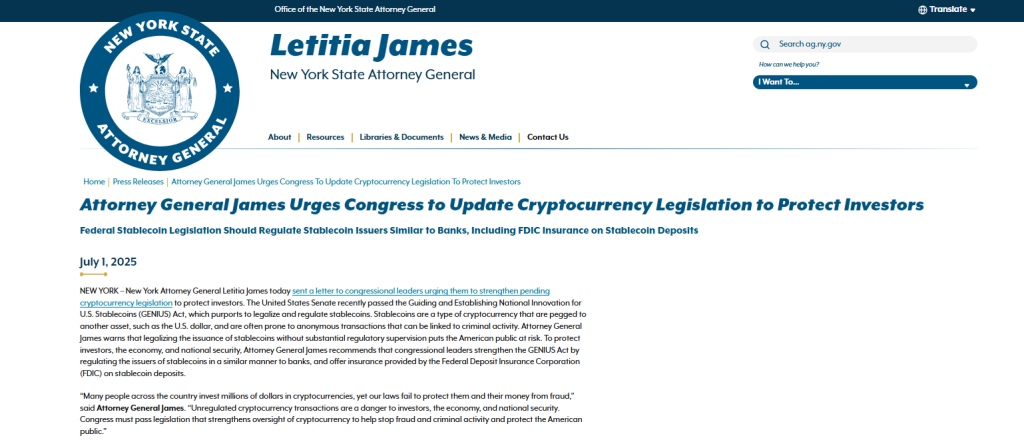
Source: NYAG

But Attorney General James says the GENIUS Act does not go far enough to protect the public.

“Many people across the country invest millions of dollars in cryptocurrencies, yet our laws fail to protect them and their money from fraud,” James said in the letter.

“Unregulated cryptocurrency transactions are a danger to investors, the economy, and national security.”

James expressed concern that legalizing stablecoin issuance without stronger oversight will open the door to financial abuse.

She warned that the current bill lacks key protections and could allow stablecoin issuers to operate with less accountability than banks.

Her letter calls on Congress to treat stablecoin issuers like traditional banks. That would include stronger regulatory supervision, capital requirements, and FDIC-backed insurance on stablecoin deposits.

She also recommended digital identity verification for stablecoin users to reduce fraud, prevent money laundering, and limit the ability of bad actors to hide behind anonymity.

James warned that stablecoins are often used in anonymous transactions, which can be exploited by criminal networks and terrorist groups. Without stricter measures, she argued, the GENIUS Act could compromise national security and leave the economy exposed.

The letter also emphasized the need to keep stablecoin issuers within U.S. jurisdiction. Offshore platforms, James said, pose enforcement challenges and make it harder to maintain regulatory standards.

She also urged lawmakers not to undercut community banks, which she said remain essential to rural and underserved communities.

GENIUS and CLARITY Crypto Bills Favor Industry Over Investors

James is not only targeting the GENIUS Act; She has also submitted a statement to the House Financial Services Committee regarding the Digital Asset Market Clarity Act (CLARITY), another crypto bill under review.

In that statement, James criticized the bill for shielding bad actors, allowing market manipulation, and failing to give regulators the tools to stop fraud.

She warned that both the GENIUS and CLARITY Acts, if passed without key revisions, would create a weak regulatory framework that prioritizes industry growth over consumer protection.

In her latest letter, James told Congress: “Take the time necessary to draft legislation that will enhance innovation while protecting our banking system that is the envy of the world.”

The GENIUS Act, while receiving bipartisan support in the Senate, has drawn divided reactions from regulators and state officials. It would limit stablecoin issuance to licensed institutions and impose requirements around asset backing and public disclosures.

Under the bill, stablecoins must be backed by U.S. dollars or equivalent liquid assets, and consumer protections are included in the event of issuer bankruptcy.

President Donald Trump has publicly endorsed the bill. “Get it to my desk, ASAP—NO DELAYS, NO ADD ONS,” he wrote on Truth Social.

Still, James insists the bill needs deeper scrutiny. She warned that pushing stablecoin legislation forward without additional safeguards will leave American investors at risk.

The House of Representatives is expected to hold procedural votes on the GENIUS and CLARITY Acts as early as the week of July 7.

Should either bill pass both chambers, it would represent a major shift in how digital assets are regulated in the U.S.

This isn’t James’ first warning to Congress. In April, she sent letters urging lawmakers to include “common sense principles” in any crypto bill, such as requiring stablecoin issuers to operate onshore and barring cryptocurrencies from retirement accounts.

With momentum building in Washington to establish clear crypto laws, James is pressing for balance. She says investor protection and financial stability must not be traded for speed.

“Congress must pass legislation that strengthens oversight of cryptocurrency to help stop fraud and criminal activity and protect the American public,” she said.


Market Opportunity
LETSTOP Logo
LETSTOP Price(STOP)
$0.0161
$0.0161$0.0161
-4.22%
USD
LETSTOP (STOP) Live Price Chart
Disclaimer: The articles reposted on this site are sourced from public platforms and are provided for informational purposes only. They do not necessarily reflect the views of MEXC. All rights remain with the original authors. If you believe any content infringes on third-party rights, please contact service@support.mexc.com for removal. MEXC makes no guarantees regarding the accuracy, completeness, or timeliness of the content and is not responsible for any actions taken based on the information provided. The content does not constitute financial, legal, or other professional advice, nor should it be considered a recommendation or endorsement by MEXC.

You May Also Like

Vitalik Buterin Reaffirms Original 2014 Ethereum Vision With Modern Web3 Technology Stack

Vitalik Buterin Reaffirms Original 2014 Ethereum Vision With Modern Web3 Technology Stack

TLDR: Ethereum proof-of-stake transition and ZK-EVM scaling solutions effectively realize the 2014 sharding vision. Waku evolved from Whisper to power decentralized
Share
Blockonomi2026/01/14 17:17
Fed Decides On Interest Rates Today—Here’s What To Watch For

Fed Decides On Interest Rates Today—Here’s What To Watch For

The post Fed Decides On Interest Rates Today—Here’s What To Watch For appeared on BitcoinEthereumNews.com. Topline The Federal Reserve on Wednesday will conclude a two-day policymaking meeting and release a decision on whether to lower interest rates—following months of pressure and criticism from President Donald Trump—and potentially signal whether additional cuts are on the way. President Donald Trump has urged the central bank to “CUT INTEREST RATES, NOW, AND BIGGER” than they might plan to. Getty Images Key Facts The central bank is poised to cut interest rates by at least a quarter-point, down from the 4.25% to 4.5% range where they have been held since December to between 4% and 4.25%, as Wall Street has placed 100% odds of a rate cut, according to CME’s FedWatch, with higher odds (94%) on a quarter-point cut than a half-point (6%) reduction. Fed governors Christopher Waller and Michelle Bowman, both Trump appointees, voted in July for a quarter-point reduction to rates, and they may dissent again in favor of a large cut alongside Stephen Miran, Trump’s Council of Economic Advisers’ chair, who was sworn in at the meeting’s start on Tuesday. It’s unclear whether other policymakers, including Kansas City Fed President Jeffrey Schmid and St. Louis Fed President Alberto Musalem, will favor larger cuts or opt for no reduction. Fed Chair Jerome Powell said in his Jackson Hole, Wyoming, address last month the central bank would likely consider a looser monetary policy, noting the “shifting balance of risks” on the U.S. economy “may warrant adjusting our policy stance.” David Mericle, an economist for Goldman Sachs, wrote in a note the “key question” for the Fed’s meeting is whether policymakers signal “this is likely the first in a series of consecutive cuts” as the central bank is anticipated to “acknowledge the softening in the labor market,” though they may not “nod to an October cut.” Mericle said he…
Share
BitcoinEthereumNews2025/09/18 00:23
CME Group to Launch Solana and XRP Futures Options

CME Group to Launch Solana and XRP Futures Options

The post CME Group to Launch Solana and XRP Futures Options appeared on BitcoinEthereumNews.com. An announcement was made by CME Group, the largest derivatives exchanger worldwide, revealed that it would introduce options for Solana and XRP futures. It is the latest addition to CME crypto derivatives as institutions and retail investors increase their demand for Solana and XRP. CME Expands Crypto Offerings With Solana and XRP Options Launch According to a press release, the launch is scheduled for October 13, 2025, pending regulatory approval. The new products will allow traders to access options on Solana, Micro Solana, XRP, and Micro XRP futures. Expiries will be offered on business days on a monthly, and quarterly basis to provide more flexibility to market players. CME Group said the contracts are designed to meet demand from institutions, hedge funds, and active retail traders. According to Giovanni Vicioso, the launch reflects high liquidity in Solana and XRP futures. Vicioso is the Global Head of Cryptocurrency Products for the CME Group. He noted that the new contracts will provide additional tools for risk management and exposure strategies. Recently, CME XRP futures registered record open interest amid ETF approval optimism, reinforcing confidence in contract demand. Cumberland, one of the leading liquidity providers, welcomed the development and said it highlights the shift beyond Bitcoin and Ethereum. FalconX, another trading firm, added that rising digital asset treasuries are increasing the need for hedging tools on alternative tokens like Solana and XRP. High Record Trading Volumes Demand Solana and XRP Futures Solana futures and XRP continue to gain popularity since their launch earlier this year. According to CME official records, many have bought and sold more than 540,000 Solana futures contracts since March. A value that amounts to over $22 billion dollars. Solana contracts hit a record 9,000 contracts in August, worth $437 million. Open interest also set a record at 12,500 contracts.…
Share
BitcoinEthereumNews2025/09/18 01:39