

ABB's Rajesh Ramachandran on why AI won't replace humans but will make them better at their jobs
When three captains can oversee 6,000 marine vessels across the globe, or two operators can manage 3.8 million solar panels generating 2 billion watts of clean power, something fundamental has shifted in how industries operate. But, contrary to dystopian predictions about AI replacing workers, this transformation isn't about eliminating humans from the equation. It's about amplifying their expertise to unprecedented levels.
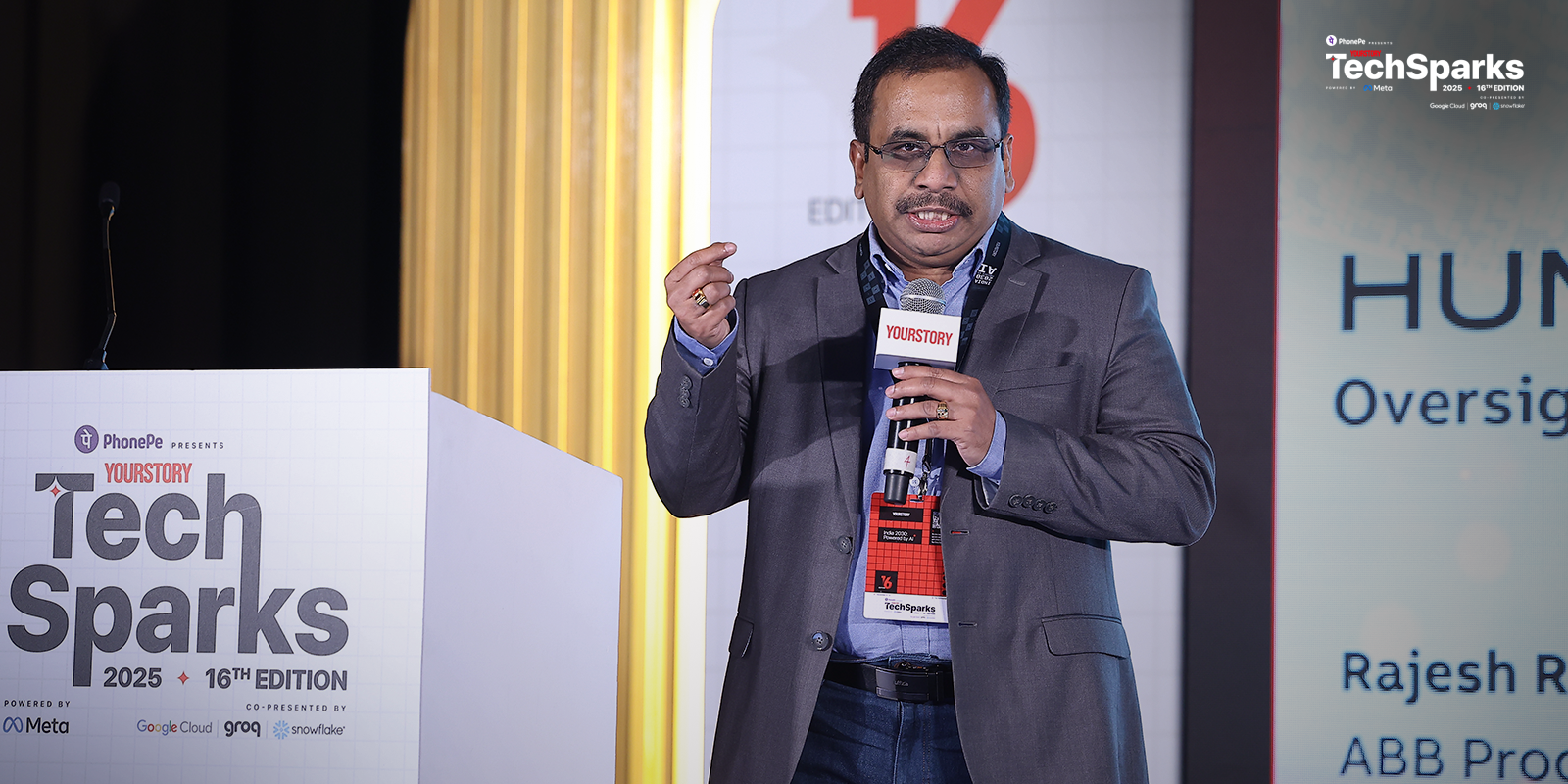
At YourStory's TechSparks 2025, Rajesh Ramachandran, Global Chief Digital Officer at ABB, delivered a keynote on ‘Human-Centered AI: Oversight without bottlenecks in the autonomous industry,’ outlining how the $40 billion industrial technology giant is navigating the complex transition from automation to autonomous operations while keeping humans firmly in the loop.
"If automation helps machines to get better, AI will make humans get better," Ramachandran told the audience. "It's not about replacing humans. Humans using AI will be replacing humans who are not using AI."
The anatomy of industrial AI
ABB's approach to autonomous operations rests on what Ramachandran calls "level four automation", a framework that maintains human supervision while allowing machines to execute tasks autonomously. This isn't a theoretical model. The company already operates a fleet operations center in Stockholm, Sweden, where a handful of experts provide insights for over 6,000 vessels, managing everything from voyage planning to fuel optimization and asset maintenance.
Similarly, ABB's control systems power the world's largest single-site solar plant in Abu Dhabi, where just two operators manage the entire facility using the company's Genix platform, which was developed in Bangalore. These aren't incremental improvements. They represent a
"We are responsible as one of the leaders to solve industrial problems, complex problems with AI," Ramachandran said. "We're fundamental reimagining of industrial operations.
not just doing pilots. This needs to be applied at scale for problems that need solving."
Beyond data crunching
What distinguishes ABB's industrial AI from consumer-facing applications is the integration of domain expertise with data science. Ramachandran explained that solving industrial problems requires combining first-principle models with data-driven approaches, which the company calls "ensemble learning".
Take precision cooling systems in data centers, which currently consume 10% of global electricity and are projected to reach 15% by 2030. ABB's solution doesn't rely solely on machine learning models crunching massive datasets. Instead, it combines thermodynamic and other physics-based models with data-driven approaches, requiring electrical engineers, chemical engineers, and data scientists to collaborate.
"It's just not about getting the data to solve problems," Ramachandran emphasized. "It's a combination of data and domain expertise."
This philosophy extends to ABB's Genix Copilot, an AI-powered platform that integrates analytical and generative AI. The copilot has transformed how field engineers work, providing 24/7 expertise through 25 different AI agents that analyze error codes and provide recommendations, reducing troubleshooting time by 80%.
The human element
Throughout his keynote, Ramachandran pushed back against the narrative that AI will eliminate programming jobs, citing Bill Gates' recent statement that programming is one profession that won't disappear due to AI. His own career trajectory supports this view. After 33 years across Siemens, Oracle, eBay, PayPal, and SAP, he joined ABB seven years ago, drawn by the opportunity to make a tangible societal impact through efficiency, reliability, and sustainability.
"When you connect technology with a purpose, then you make a really transformative impact," he said.
ABB's operations span 15 industries, from energy and manufacturing to transportation and space exploration. The company works on carbon footprint reduction through electrification, uses AI to monitor industrial emissions via satellite, and deploys drones for gas pipeline leakage detection using spectrographic and chromatographic technologies combined with cloud-based AI analysis.
In underground mines in South America, ABB manages operations remotely from 1,000 km away, controlling millions of signals and enabling autonomous operations across most of the value chain. What was once the domain of on-site operators has evolved into consultant roles where human expertise guides AI-powered decision-making systems.
The road ahead
With 40% of ABB's $36 billion revenue coming from services, the productivity gains from AI have massive implications. Ramachandran noted that the company has identified 200 use cases for AI applications, with 50 currently deployed at scale and 150 in development.
ABB is actively seeking partnerships with startups and technology providers. The company runs programs like Sinne Link, which funds emerging startups to tackle industrial challenges. Two weeks before TechSparks, ABB selected 10 startups through a challenge program to work on specific problems.
"The automation to autonomous journey is such a massive opportunity for industries, technology providers, and people who would like to define problem statements and build solutions," said Ramachandran, inviting collaboration across the ecosystem.
ABB's approach to AI offers a blueprint for how industries can embrace autonomy without losing sight of human judgment, accountability, and expertise. In this vision, the future isn't about choosing between humans and machines. It's about designing systems where both operate at their highest potential.



You May Also Like

Scotland Predicted Lineup vs Haiti: Starting XI, Team News & Tactical Analysis

Binance TR’s Pizza-Themed Social Media Event: Opportunity to Win a Domino’s Gift Voucher Worth 800 TL

Türkiye Predicted Lineup vs Australia: Starting XI, Team News & Tactical Analysis



