The Czech National Bank (CNB) has purchased Bitcoin and other digital assets worth $1 million, calling it a “test portfolio,” its first direct exposure to cryptocurrencies. The move, announced on Thursday, marks a cautious step toward understanding how blockchain-based assets could fit into future financial systems. According to the CNB, the portfolio includes Bitcoin (BTC), a U.S. dollar–pegged stablecoin, and a tokenized bank deposit.Source: CNB Made outside the bank’s international reserves, the purchase provides practical experience in handling digital assets rather than indicating a shift in policy or reserve. CNB’s Bitcoin Pilot Seeks to Prepare for the Future of Money Governor Aleš Michl said the initiative began in early 2025 to explore how decentralized assets might complement traditional holdings. The project, approved by the Bank Board on October 30, followed an internal review concluding that digital assets are becoming a growing feature of institutional portfolios worldwide. “The goal is to test every process involved in managing digital assets, from custody and key management to security and AML compliance,” Michl said. “We plan to share our findings over the next two to three years.” Officials said the purchase will not affect the bank’s €140 billion in foreign reserves. The small allocation, they said, shields the bank from Bitcoin’s price volatility.Source: Czech National Bank Through the program, the CNB will study how blockchain technology could influence payments, settlement, and accountability. Technical teams will test wallet operations, multi-signature controls, and audit procedures for on-chain transactions. Each asset in the portfolio serves a distinct purpose: Bitcoin represents decentralized money; the stablecoin, fiat-backed stability; and the tokenized deposit, a bridge to regulated finance. Michl called it a part of a long-term modernization effort. “The koruna will always remain our legal tender, but new forms of money and investment are emerging, and we want to be ready,” he said. Czech Central Bank Dips Into Bitcoin for Research, Not Reserves The decision follows nearly a year of internal debate over Bitcoin’s role in the Czech Republic’s reserves. Michl first floated the idea in January 2025, suggesting a small Bitcoin purchase for diversification. By February, he argued that central banks should study Bitcoin’s underlying technology rather than ignore it. Not all board members agreed. Jan Kubicek, another member of the Bank Board, warned that Bitcoin’s volatility and legal uncertainties made it unsuitable for reserve holdings. His caution led to a compromise: a limited pilot program instead of a formal reserve allocation. Michl had initially proposed investing up to 5% of the country’s reserves in Bitcoin, a move that would have made the Czech Republic the first Western central bank to publicly hold the asset. That plan was rejected, but the $1 million test portfolio serves as a practical middle ground, allowing the CNB to gain operational experience without altering its balance sheet. Alongside the test portfolio, the CNB launched the CNB Lab, a hub focused on emerging financial technologies. The Lab will research AI applications, instant payments, and tokenized instruments, expanding the bank’s technical capacity for future digital finance. The Czech initiative comes as European regulators cautiously explore blockchain’s potential. No EU central bank currently holds Bitcoin in its reserves, but discussions around tokenized bonds, regulated stablecoins, and a digital euro have accelerated. In October, nine European banks revealed plans for a G7-backed stablecoin, while the European Central Bank continues to test digital euro prototypes. Against that backdrop, the CNB’s step, small but tangible, distinguishes it as one of the few Western monetary authorities directly engaging with crypto assets. “Bitcoin’s past performance is impressive,” the CNB noted, “but its volatility remains incomparable to conventional assets. This project is about learning, not investing.”The Czech National Bank (CNB) has purchased Bitcoin and other digital assets worth $1 million, calling it a “test portfolio,” its first direct exposure to cryptocurrencies. The move, announced on Thursday, marks a cautious step toward understanding how blockchain-based assets could fit into future financial systems. According to the CNB, the portfolio includes Bitcoin (BTC), a U.S. dollar–pegged stablecoin, and a tokenized bank deposit.Source: CNB Made outside the bank’s international reserves, the purchase provides practical experience in handling digital assets rather than indicating a shift in policy or reserve. CNB’s Bitcoin Pilot Seeks to Prepare for the Future of Money Governor Aleš Michl said the initiative began in early 2025 to explore how decentralized assets might complement traditional holdings. The project, approved by the Bank Board on October 30, followed an internal review concluding that digital assets are becoming a growing feature of institutional portfolios worldwide. “The goal is to test every process involved in managing digital assets, from custody and key management to security and AML compliance,” Michl said. “We plan to share our findings over the next two to three years.” Officials said the purchase will not affect the bank’s €140 billion in foreign reserves. The small allocation, they said, shields the bank from Bitcoin’s price volatility.Source: Czech National Bank Through the program, the CNB will study how blockchain technology could influence payments, settlement, and accountability. Technical teams will test wallet operations, multi-signature controls, and audit procedures for on-chain transactions. Each asset in the portfolio serves a distinct purpose: Bitcoin represents decentralized money; the stablecoin, fiat-backed stability; and the tokenized deposit, a bridge to regulated finance. Michl called it a part of a long-term modernization effort. “The koruna will always remain our legal tender, but new forms of money and investment are emerging, and we want to be ready,” he said. Czech Central Bank Dips Into Bitcoin for Research, Not Reserves The decision follows nearly a year of internal debate over Bitcoin’s role in the Czech Republic’s reserves. Michl first floated the idea in January 2025, suggesting a small Bitcoin purchase for diversification. By February, he argued that central banks should study Bitcoin’s underlying technology rather than ignore it. Not all board members agreed. Jan Kubicek, another member of the Bank Board, warned that Bitcoin’s volatility and legal uncertainties made it unsuitable for reserve holdings. His caution led to a compromise: a limited pilot program instead of a formal reserve allocation. Michl had initially proposed investing up to 5% of the country’s reserves in Bitcoin, a move that would have made the Czech Republic the first Western central bank to publicly hold the asset. That plan was rejected, but the $1 million test portfolio serves as a practical middle ground, allowing the CNB to gain operational experience without altering its balance sheet. Alongside the test portfolio, the CNB launched the CNB Lab, a hub focused on emerging financial technologies. The Lab will research AI applications, instant payments, and tokenized instruments, expanding the bank’s technical capacity for future digital finance. The Czech initiative comes as European regulators cautiously explore blockchain’s potential. No EU central bank currently holds Bitcoin in its reserves, but discussions around tokenized bonds, regulated stablecoins, and a digital euro have accelerated. In October, nine European banks revealed plans for a G7-backed stablecoin, while the European Central Bank continues to test digital euro prototypes. Against that backdrop, the CNB’s step, small but tangible, distinguishes it as one of the few Western monetary authorities directly engaging with crypto assets. “Bitcoin’s past performance is impressive,” the CNB noted, “but its volatility remains incomparable to conventional assets. This project is about learning, not investing.”

Czech Central Bank Dips Into Bitcoin With $1M ‘Test Portfolio’ – A Shift in Strategy?

2025/11/14 06:20
4 min read
For feedback or concerns regarding this content, please contact us at crypto.news@mexc.com

The Czech National Bank (CNB) has purchased Bitcoin and other digital assets worth $1 million, calling it a “test portfolio,” its first direct exposure to cryptocurrencies.

The move, announced on Thursday, marks a cautious step toward understanding how blockchain-based assets could fit into future financial systems.

According to the CNB, the portfolio includes Bitcoin (BTC), a U.S. dollar–pegged stablecoin, and a tokenized bank deposit.
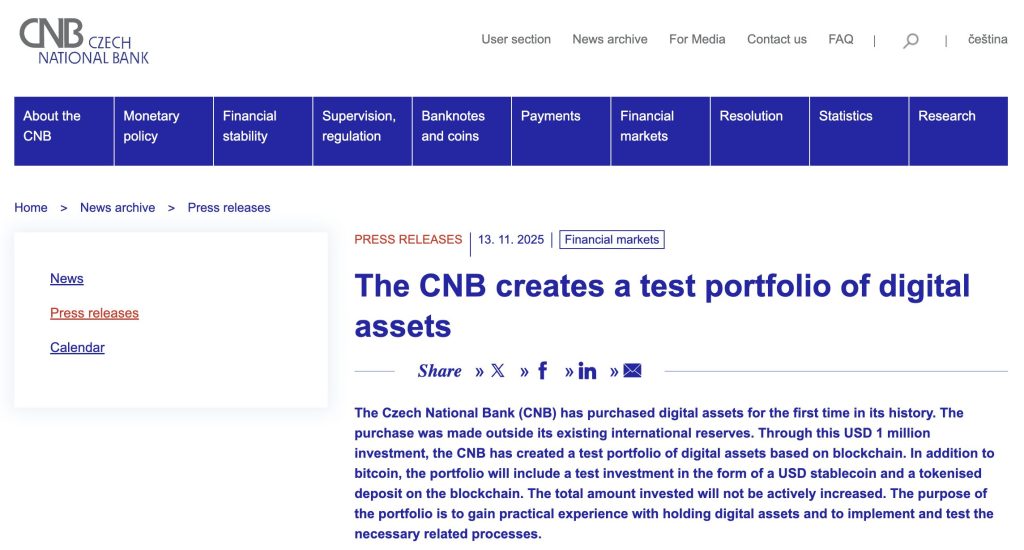
Source: CNB

Made outside the bank’s international reserves, the purchase provides practical experience in handling digital assets rather than indicating a shift in policy or reserve.

CNB’s Bitcoin Pilot Seeks to Prepare for the Future of Money

Governor Aleš Michl said the initiative began in early 2025 to explore how decentralized assets might complement traditional holdings.

The project, approved by the Bank Board on October 30, followed an internal review concluding that digital assets are becoming a growing feature of institutional portfolios worldwide.

“The goal is to test every process involved in managing digital assets, from custody and key management to security and AML compliance,” Michl said. “We plan to share our findings over the next two to three years.”

Officials said the purchase will not affect the bank’s €140 billion in foreign reserves. The small allocation, they said, shields the bank from Bitcoin’s price volatility.

Source: Czech National Bank

Through the program, the CNB will study how blockchain technology could influence payments, settlement, and accountability.

Technical teams will test wallet operations, multi-signature controls, and audit procedures for on-chain transactions.

Each asset in the portfolio serves a distinct purpose: Bitcoin represents decentralized money; the stablecoin, fiat-backed stability; and the tokenized deposit, a bridge to regulated finance.

Michl called it a part of a long-term modernization effort. “The koruna will always remain our legal tender, but new forms of money and investment are emerging, and we want to be ready,” he said.

Czech Central Bank Dips Into Bitcoin for Research, Not Reserves

The decision follows nearly a year of internal debate over Bitcoin’s role in the Czech Republic’s reserves. Michl first floated the idea in January 2025, suggesting a small Bitcoin purchase for diversification.

By February, he argued that central banks should study Bitcoin’s underlying technology rather than ignore it.

Not all board members agreed. Jan Kubicek, another member of the Bank Board, warned that Bitcoin’s volatility and legal uncertainties made it unsuitable for reserve holdings. His caution led to a compromise: a limited pilot program instead of a formal reserve allocation.

Michl had initially proposed investing up to 5% of the country’s reserves in Bitcoin, a move that would have made the Czech Republic the first Western central bank to publicly hold the asset.

That plan was rejected, but the $1 million test portfolio serves as a practical middle ground, allowing the CNB to gain operational experience without altering its balance sheet.

Alongside the test portfolio, the CNB launched the CNB Lab, a hub focused on emerging financial technologies. The Lab will research AI applications, instant payments, and tokenized instruments, expanding the bank’s technical capacity for future digital finance.

The Czech initiative comes as European regulators cautiously explore blockchain’s potential. No EU central bank currently holds Bitcoin in its reserves, but discussions around tokenized bonds, regulated stablecoins, and a digital euro have accelerated.

In October, nine European banks revealed plans for a G7-backed stablecoin, while the European Central Bank continues to test digital euro prototypes.

Against that backdrop, the CNB’s step, small but tangible, distinguishes it as one of the few Western monetary authorities directly engaging with crypto assets.

“Bitcoin’s past performance is impressive,” the CNB noted, “but its volatility remains incomparable to conventional assets. This project is about learning, not investing.”


Market Opportunity
Lorenzo Protocol Logo
Lorenzo Protocol Price(BANK)
$0.04052
$0.04052$0.04052
-0.39%
USD
Lorenzo Protocol (BANK) Live Price Chart
Disclaimer: The articles reposted on this site are sourced from public platforms and are provided for informational purposes only. They do not necessarily reflect the views of MEXC. All rights remain with the original authors. If you believe any content infringes on third-party rights, please contact crypto.news@mexc.com for removal. MEXC makes no guarantees regarding the accuracy, completeness, or timeliness of the content and is not responsible for any actions taken based on the information provided. The content does not constitute financial, legal, or other professional advice, nor should it be considered a recommendation or endorsement by MEXC.

You May Also Like

XRP Price Prediction: XRP Trapped At $1.37 As Breakout Setup Tightens

XRP Price Prediction: XRP Trapped At $1.37 As Breakout Setup Tightens

The post XRP Price Prediction: XRP Trapped At $1.37 As Breakout Setup Tightens appeared on BitcoinEthereumNews.com. XRP trades at $1.3771, down 0.53%, pressing
Share
BitcoinEthereumNews2026/03/24 01:08
Why Digital Banks Are Growing 3x Faster Than Traditional Banks

Why Digital Banks Are Growing 3x Faster Than Traditional Banks

The Growth Gap Between Digital and Traditional Banking Digital banks are acquiring customers at approximately three times the rate of their traditional counterparts
Share
Techbullion2026/03/24 00:50
Analyst Predicts ‘Uptober’ Rally for BTC Regardless of FOMC Decision

Analyst Predicts ‘Uptober’ Rally for BTC Regardless of FOMC Decision

The post Analyst Predicts ‘Uptober’ Rally for BTC Regardless of FOMC Decision appeared on BitcoinEthereumNews.com. Bitcoin traded at $116,236 as of 14:04 UTC on Sept. 17, up about 1% in the past 24 hours, holding above a key level as markets await the Federal Reserve’s policy announcement. Analysts’ comments Dean Crypto Trades noted on X that bitcoin is only about 7% above its post-election local peak, while the S&P 500 has risen 9% and gold has surged 36% during the same period. He said bitcoin has compressed more than those assets, making it likely to lead the next larger move, though it could form a “lower high” before extending further. He added that ether could join in once it breaks $5,000 and enters price discovery. Lark Davis pointed to bitcoin’s history around September FOMC meetings, saying every September decision since 2020 — except during the 2022 bear market — has preceded a strong rally. He stressed that the pattern is less about the Fed’s rate choice itself and more about seasonal dynamics, arguing that bitcoin tends to thrive in this period heading into “Uptober.” CoinDesk Research’s technical analysis According to CoinDesk Research’s technical analysis data model, bitcoin rose about 0.9% during the Sept. 16–17 analysis window, climbing from $115,461 to $116,520. BTC reached a session high of $117,317 at 07:00 UTC on Sept. 17 before consolidating. Following that peak, bitcoin tested the $116,400–$116,600 range multiple times, confirming it as a short-term support zone. In the final hour of the session, between 11:39 and 12:38 UTC, BTC attempted a breakout: prices moved narrowly between $116,351 and $116,376 before spiking to $116,551 at 12:34 on higher volume. This confirmed a consolidation-breakout pattern, though the gains were modest. Overall, bitcoin remains firm above $116,000, with support around $116,400 and resistance near $117,300. Latest 24-hour and one-month chart analysis The latest 24-hour CoinDesk Data chart, ending 14:04 UTC on…
Share
BitcoinEthereumNews2025/09/18 12:42