

Looming AI bubble could bite deep into Bitcoin and crypto markets
Is the AI bubble quietly building a fault line that could shake Bitcoin and crypto the way dot-com fever once did?
- The AI bubble is inflating fast, with valuations soaring as speculation outpaces real profits, productivity, and measurable business performance.
- Reports reveal heavy AI sector cross-investing and record losses, prompting fears of inflated metrics and government-backed corporate dependence.
- Analysts and institutions compare today’s AI boom with the dot-com era, warning that over-financing could trigger a global correction.
- Crypto mirrors market anxiety as Bitcoin falls sharply amid fears that an AI-led downturn could deepen risk across digital assets.
Table of Contents
- The AI bubble and its money loop
- Circular cashflows, not real growth
- Lessons from the dot-com bubble
- Bitcoin feels the ripple effects
The AI bubble and its money loop
Artificial intelligence is fueling a modern gold rush across technology and finance. The boom has reshaped industries from chipmaking to software, sending company valuations to record levels.
Yet many economists and investors warn that excitement may have surpassed the underlying fundamentals. They describe the surge as an “AI bubble,” recalling the late 1990s dot-com era when innovation collided with speculation and markets eventually crashed.
The concern lies in how capital moves through the sector. AI firms are investing heavily in each other’s infrastructure, cloud services, and hardware, creating a circular flow of money that inflates valuations based more on future expectations than on actual profit.
Reports show that OpenAI, one of the central players in this wave, is seeking U.S. federal loan guarantees to support infrastructure projects.
Chief Financial Officer Sarah Friar confirmed the effort at a Wall Street Journal event, explaining that such guarantees could lower borrowing costs given the vast scale of planned data centers and a $300 billion partnership with Oracle.
Once a nonprofit research lab, OpenAI now operates as a for-profit company that needs tens of billions in annual revenue just to cover computing and energy costs.
Its model increasingly resembles capital-intensive sectors such as semiconductor manufacturing, where governments often intervene with subsidies or credit support to keep early growth stable.
Skeptics question whether the numbers truly add up. Julian Brigden, co-founder of Macro Intelligence 2 Partners, asked on X why a firm expected to earn “hundreds of billions of dollars” would still require taxpayer guarantees, calling it a possible warning sign of liquidity pressure.
Meanwhile, Michael Burry, the hedge-fund manager known for predicting the 2008 housing collapse, has made a large short bet against the AI sector.
According to filings with the U.S. Securities and Exchange Commission, his firm Scion Asset Management purchased about $187.6 million in put options on Nvidia and $912 million on Palantir, signaling his view that leading AI firms could face sharp valuation declines.
The mood around these moves has spilled into other speculative markets. Crypto, which often mirrors technology stock behavior, has seen steep losses in recent weeks.
The total market cap fell from around $4.2 trillion on Oct. 6 to $3.43 trillion a month later, an 18% decline. Bitcoin (BTC) alone dropped nearly 19% in the same period, from $126,000 to roughly $103,000 as of Nov. 6, marking one of its steepest monthly declines in years.
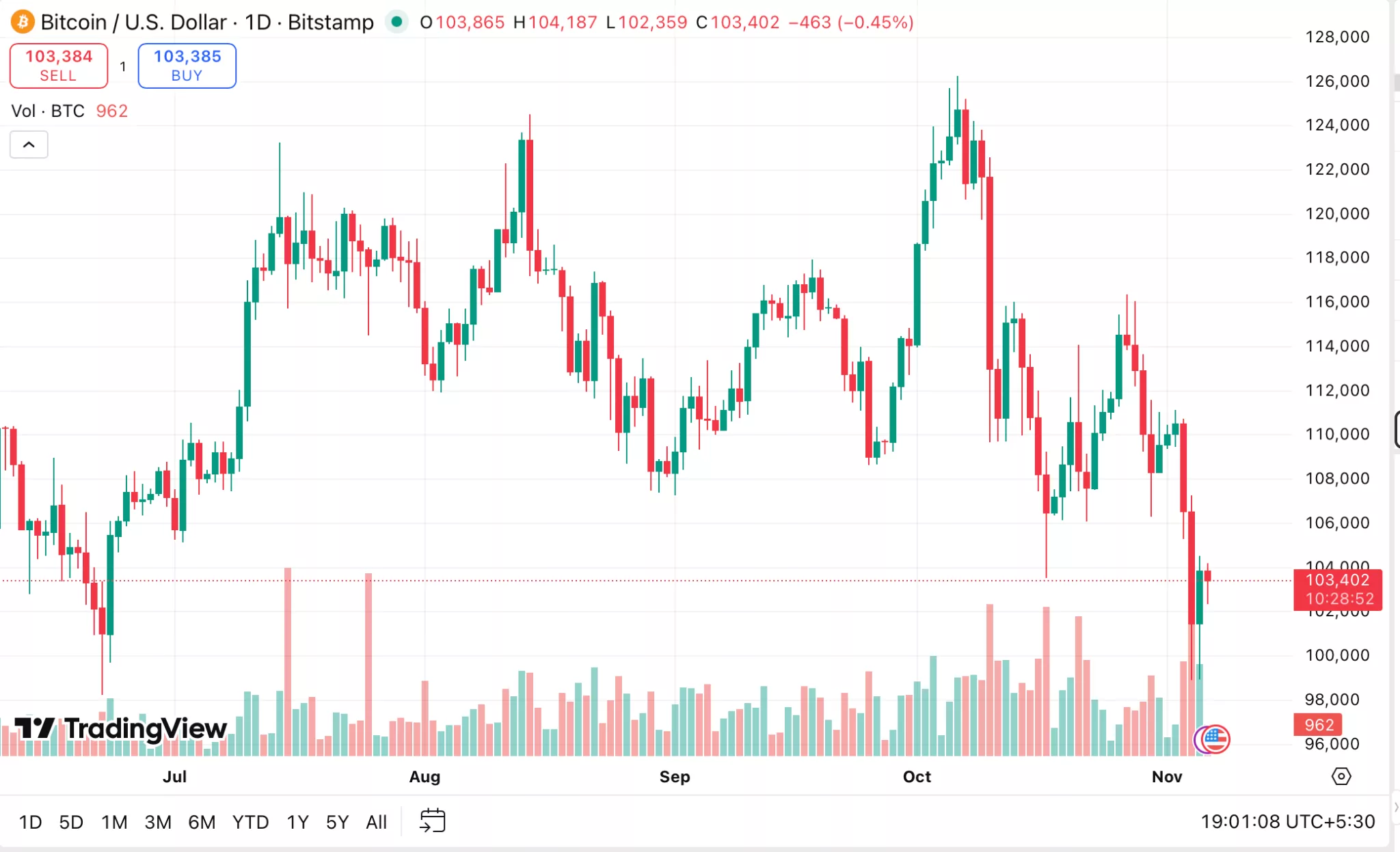
Let’s understand what is developing beneath the surface, what warning signals are emerging, and how a potential correction in AI markets could spill over into crypto will be crucial in the weeks to come.
Circular cashflows, not real growth
The first real stress test of the AI boom came in early 2025. In January, DeepSeek, a Chinese-developed chatbot, gained unexpected global traction after outperforming its rivals across several benchmarks.
The surprise sent markets reeling and triggered a sharp correction in leading AI stocks. Nvidia, which had been the centerpiece of the AI surge, fell 17% in a single trading session before recovering 8.8% the following day.
Concerns deepened as actual performance data started emerging later in the year. A Massachusetts Institute of Technology study found that despite $30 to $40 billion in enterprise spending on generative AI, 95% of companies reported no measurable return.
Crypto analyst Hedgie noted that OpenAI lost $13.5 billion on $4.3 billion in revenue during the first half of 2025, meaning ChatGPT continues to operate at a loss nearly every time it is used.
Yet the company is reportedly seeking a $1 trillion IPO, a valuation critics describe as driven more by hype than by business fundamentals.
Market analyst Hedgie described what he called “circular financing,” where companies like Nvidia invest heavily in AI startups that then spend most of that money buying Nvidia hardware. He likened it to giving a lemonade stand $10 to buy $10 worth of lemons and then counting it as $20 of economic growth.
In the first half of 2025, data center spending emerged as one of the largest contributors to U.S. GDP growth, surpassing consumer spending. That growth, however, came largely from corporate expenditure rather than actual revenue generation.
Meanwhile, spending forecasts vary widely, but analysts agree that AI infrastructure spending is set to surge through the decade. Citigroup estimates that major U.S. technology companies could collectively spend more than $2.8 trillion on AI infrastructure by 2029.
Nvidia’s valuation becomes the clearest symbol of this exuberance. In July 2025, it had become the world’s most valuable company, reaching a $4 trillion market cap, four times its 2023 level. The company alone represented about 7.3% of the S&P 500 index, which also hit record highs during the same period.
Three months later, Nvidia’s valuation surpassed $5 trillion, a figure larger than the GDP of any country except the U.S. and China, based on World Bank data.
Moreover, AI-related firms have been largely responsible for roughly 80% of all U.S. stock market gains throughout 2025, prompting analysts to question whether the rally stemmed more from concentrated financial exposure than from real productivity growth.
Lessons from the dot-com bubble
The debate around a potential AI bubble has grown unusually self-aware. Even Sam Altman, CEO of OpenAI and the public face of the current AI boom, admitted in 2025 that an investment bubble is forming.
His acknowledgment carried weight, as OpenAI’s valuation surged from $157 billion in late 2024 to about $500 billion within a year. The company’s rapid growth has come with record infrastructure spending and projections that depend more on sustained investor enthusiasm than on consistent profits.
Several prominent investors have drawn parallels between today’s AI market and earlier speculative eras. Ray Dalio, co-chief investment officer of Bridgewater Associates, said in early 2025 that the scale of AI investment looks “very similar” to what he witnessed during the dot-com boom.
In October, JPMorgan CEO Jamie Dimon remarked that while AI is a genuine and transformative technology, a large portion of the capital pouring into it may eventually be lost. He warned that markets could be underestimating the chance of a major stock correction within the next two years.
The Bank of England also cautioned that valuations of leading AI firms, including OpenAI, could prove unsustainable if infrastructure needs exceed what can be financed or managed efficiently. Its report said investors were not sufficiently warned about the risk of a sharp downturn if AI fails to deliver expected performance and profitability.
The International Monetary Fund echoed that concern. Managing director Kristalina Georgieva drew a clear link to the 2001 dot-com collapse, warning that a sudden AI market correction could slow global growth and hit developing economies hardest, especially those dependent on foreign investment and technology imports.
Goldman Sachs, however, offered a more optimistic interpretation. The firm argued that the surge in U.S. technology stocks might be supported by durable profit growth, noting that current valuations remain moderate compared with the late 1990s.
Meanwhile, Federal Reserve Chair Jerome Powell recently mentioned that AI differs from earlier bubbles because many of the companies driving the current cycle already generate real revenue. He pointed to data center construction and related infrastructure spending as tangible sources of economic activity.
Bitcoin feels the ripple effects
Bitcoin remains under pressure as investor sentiment weakens and economic uncertainty rises. Data from CoinGlass shows the asset has already fallen nearly 11% this quarter, making it the second-worst Q4 since 2020. October alone saw a 3.85% decline, marking the weakest October performance since 2018.
Alex Thorn, Head of Firmwide Research at Galaxy, has lowered his year-end Bitcoin target from $185,000 to $120,000. In a note to clients, he said large holders are offloading coins, corporations are showing reduced interest in holding Bitcoin in their treasuries, and investors are diversifying into other assets.
Thorn remains optimistic about Bitcoin’s long-term outlook but expects short-term performance to stay weak due to tightening liquidity and a slowdown in institutional demand.
On-chain data supports that caution. Analyst Maartunn observed that long-term holders currently control about 73.6% of Bitcoin’s total supply, near record highs.
However, in the past month, roughly 363,000 Bitcoins have moved from long-term wallets into short-term hands, indicating active profit-taking as seasoned holders sell and newer investors absorb the coins.
Older wallets are also becoming active again. Over the past year, more than 1.17 million Bitcoins that had been untouched for three to five years have been spent, alongside several hundred thousand from even older addresses.
Maartunn noted that the market now stands at a crossroads. If short-term holders remain calm, prices could stabilize. If they begin selling aggressively, the next leg down could be steeper.
Combined with a global environment that is already under pressure from slowing growth, rising costs, and fears of an AI-driven market correction, crypto investors are facing multiple risks at once. Investors should remain careful, manage exposure sensibly, and never commit more than they can afford to lose.
Disclosure: This article does not represent investment advice. The content and materials featured on this page are for educational purposes only.



You May Also Like

What Does ETH Need to Break Out of Consolidation?

Aave CEO Reveals Upcoming Protocol Upgrades Set for Q4 2025 Launch



