This article introduces Decision Boundary-Aware Distillation, a novel method for Instance-Incremental Learning that preserves and extends the decision boundary using fused labels.This article introduces Decision Boundary-Aware Distillation, a novel method for Instance-Incremental Learning that preserves and extends the decision boundary using fused labels.

Optimizing SAGE Net: Achieving High Performance with Shorter Input Sequences for Online Inference

2025/11/06 00:00
3 min read
For feedback or concerns regarding this content, please contact us at crypto.news@mexc.com

Abstract and 1 Introduction

  1. Related works

  2. Problem setting

  3. Methodology

    4.1. Decision boundary-aware distillation

    4.2. Knowledge consolidation

  4. Experimental results and 5.1. Experiment Setup

    5.2. Comparison with SOTA methods

    5.3. Ablation study

  5. Conclusion and future work and References

    \

Supplementary Material

  1. Details of the theoretical analysis on KCEMA mechanism in IIL
  2. Algorithm overview
  3. Dataset details
  4. Implementation details
  5. Visualization of dusted input images
  6. More experimental results

4.1. Decision boundary-aware distillation

Decision boundary (DB) which reflects the inter-class relationship and intra-class distribution is one of the most valuable knowledge stored in a well-trained model. It can be defined by distinguishing between inner samples (correctly classified) and outer samples (misclassified), as illustrated in Fig. 2 (a). In new IIL, promoting the model’s performance on new data without forgetting equals to extend the existing DB to enclose those new outer samples while retain the DB in other locations. However, to learn from new data, existing methods take the annotated one-hot labels as the optimal learning target for granted. We argue that one-hot labels ignore the relationship between target class and other classes. Naively learning with one-hot labels tends to push outer samples towards the DB center, which can potentially interfere with the learning of other classes, especially when the data is insufficient to rectify such interference in IIL.

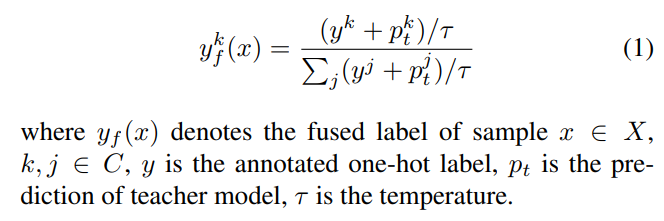
\ To address the inter-class interference, we propose to learn the new data by fusing annotated one-hot labels with predictions of existing model, as show in Eq. (1). For new outer samples, learning with fused labels retains the knowledge on none-target classes and extends the decision boundary more moderately to enclose them. Knowledge of nonetarget classes is crucial for retain learned knowledge, which also reported by Mittal et al. [18] in using super-class labels. For new inner samples, keeping the DB around it is a safer choice, i.e. using existing predicted scores as the learning target. However, we propose to push the DB away from the new peripheral inner samples by sharpening the teacher’s prediction score with the one-hot label, which in essence enlarges the inter-class distance while retaining the DB. Hence, although with different motivation, training on new outer samples and new inner samples are unified through the fused label.

\
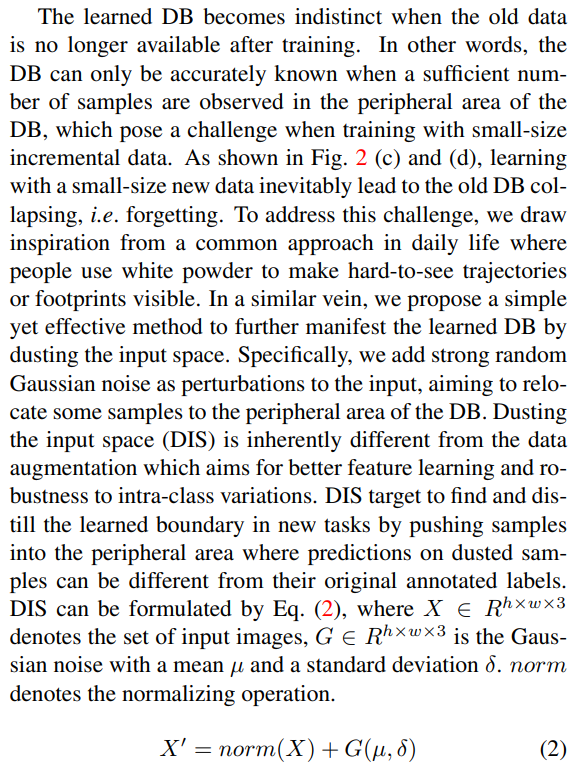
\ Alternating the learning target with fused labels unifies the knowledge learning and retaining on new samples in a simple manner. Although this manner helps retain some learned knowledge, preservation of DB in other directions that only supported by the old data is not addressed.

\
\
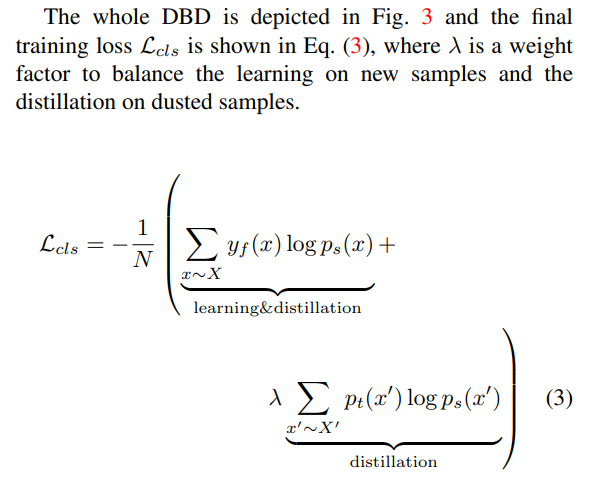
\ Decision boundary-aware distillation enables the student network to learning new knowledge with awareness of the existing knowledge.

\

:::info Authors:

(1) Qiang Nie, Hong Kong University of Science and Technology (Guangzhou);

(2) Weifu Fu, Tencent Youtu Lab;

(3) Yuhuan Lin, Tencent Youtu Lab;

(4) Jialin Li, Tencent Youtu Lab;

(5) Yifeng Zhou, Tencent Youtu Lab;

(6) Yong Liu, Tencent Youtu Lab;

(7) Qiang Nie, Hong Kong University of Science and Technology (Guangzhou);

(8) Chengjie Wang, Tencent Youtu Lab.

:::


:::info This paper is available on arxiv under CC BY-NC-ND 4.0 Deed (Attribution-Noncommercial-Noderivs 4.0 International) license.

:::

\

Disclaimer: The articles reposted on this site are sourced from public platforms and are provided for informational purposes only. They do not necessarily reflect the views of MEXC. All rights remain with the original authors. If you believe any content infringes on third-party rights, please contact crypto.news@mexc.com for removal. MEXC makes no guarantees regarding the accuracy, completeness, or timeliness of the content and is not responsible for any actions taken based on the information provided. The content does not constitute financial, legal, or other professional advice, nor should it be considered a recommendation or endorsement by MEXC.
Tags:

You May Also Like

The Evolution of AI+Crypto: DePIN solves computing power, Bittensor drives intelligence, AI Agents change interaction...

The Evolution of AI+Crypto: DePIN solves computing power, Bittensor drives intelligence, AI Agents change interaction...

Author: Go2Mars' Web3 Research Institute The Symbiosis of Algorithms and Ledgers: A Major Shift in the Global Technology Paradigm In the third decade of the 21st
Share
PANews2026/03/17 11:55
The 15th Five-Year Plan outlines the implementation of a national blockchain network construction project and active participation in international governance in areas such as digital currency.

The 15th Five-Year Plan outlines the implementation of a national blockchain network construction project and active participation in international governance in areas such as digital currency.

PANews reported on March 17th, citing Xinhua News Agency, that the full text of the 15th Five-Year Plan for National Economic and Social Development of the People
Share
PANews2026/03/17 12:19
US SEC approves universal listing standards to expedite cryptocurrency ETF approvals

US SEC approves universal listing standards to expedite cryptocurrency ETF approvals

PANews reported on September 18th that, according to Cointelegraph, the U.S. Securities and Exchange Commission (SEC) has approved a set of listing standards for commodity-based trust units, opening the door to digital asset listings without requiring individual approval. The decision, detailed in SEC filings from Nasdaq, NYSE Arca, and Cboe BZX on Wednesday, will streamline the process under Rule 6c-11, significantly reducing the approval process, which previously took several months. SEC Chairman Paul Atkins stated that this move ensures that the U.S. capital market is the best place for cutting-edge innovation in digital assets, streamlining processes, lowering barriers to entry, maximizing investor choice, and promoting innovation. The US SEC stated that to be eligible for listing, a cryptocurrency spot ETF must hold a commodity that is either traded on a market that belongs to a cross-market monitoring organization and has monitoring authority, or is the subject of a futures contract that has been listed on a designated contract market for at least six months and has a monitoring sharing agreement; in addition, if the cryptocurrency has been tracked by an ETF listed on a national securities exchange with an investment account of at least 40%, then the cryptocurrency spot ETF may also be eligible for listing; when an exchange seeks to list and trade cryptocurrency trading products that do not meet the approved general listing standards, it must submit a rule application to the US SEC.
Share
PANews2025/09/18 07:10