The 3DIML approach uses a three-step pipeline to convert erratic 2D instance masks into logical 3D instance segmentations. To ensure consistent object classification in spite of segmentation noise, InstanceMap uses a scalable mask association graph based on extended hLoc to associate masks across pictures in the first stage. After resolving ambiguities with a label NeRF, InstanceLift refines these pseudolabels. A quick post-processing step then effectively combines labels that are in disagreement.The 3DIML approach uses a three-step pipeline to convert erratic 2D instance masks into logical 3D instance segmentations. To ensure consistent object classification in spite of segmentation noise, InstanceMap uses a scalable mask association graph based on extended hLoc to associate masks across pictures in the first stage. After resolving ambiguities with a label NeRF, InstanceLift refines these pseudolabels. A quick post-processing step then effectively combines labels that are in disagreement.

Consistent 3D Mask Labeling Made Simple

2025/10/24 23:34
3 min read
For feedback or concerns regarding this content, please contact us at crypto.news@mexc.com

Abstract and I. Introduction

II. Background

III. Method

IV. Experiments

V. Conclusion and References

\

III. METHOD

Given a sequence of N posed RGB images, (Ii , Ti) where I denotes the image and T pose, we first extract viewinconsistent instance masks Mi using a generic instance segmentation model such as Mask2Former or SAM.

\ A. Mask Association

\ We first generate pseudolabel masks with InstanceMap. Formally, define ϕ(M, r) to map a mask M and region r to a consistent label for the same 3D object across different masks and regions. We extend the popular hLoc [16] framework for scalable 3D reconstruction to mask association as follows:

\
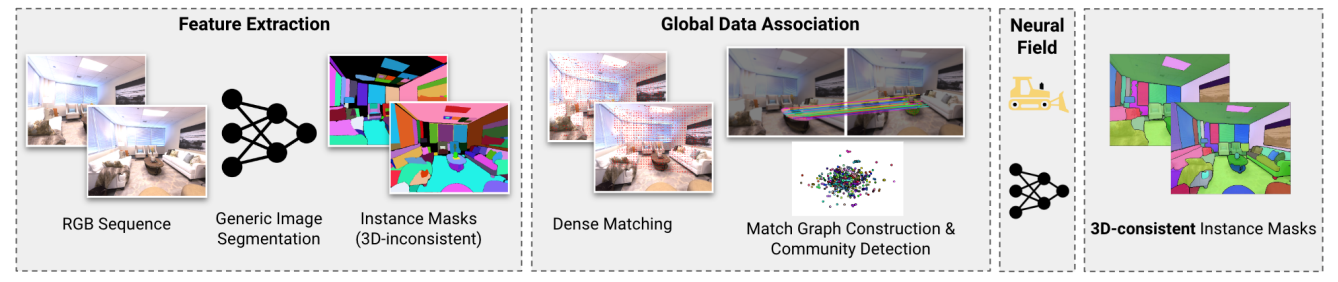
\ Fig. 2: Overview of 3DIML. A sequence of color images is segmented into object instances by an image segmentation backbone. The resulting masks produced are fed into InstanceMap, which produces instance masks consistent over all frames. These pseudo instance masks and their respective camera poses are used to supervise an instance label NeRF, which further improves consistency and resolves ambiguity present in the InstanceMap outputs. The feature extraction and global data association blocks together form InstanceMap.
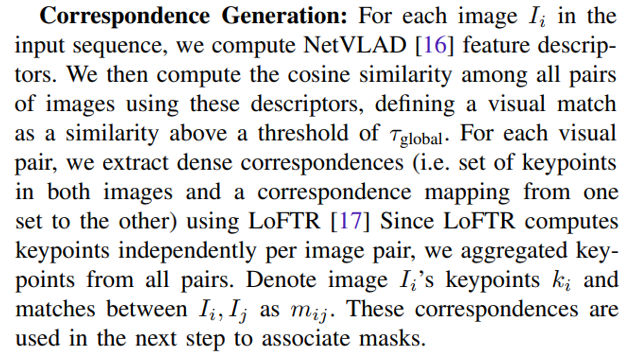
\ Since NetVLAD and LoFTR don’t have 3D information, 3DIML only performs well if each image in the scan sequence contains enough context for these models. We observe empirically a good rule of thumb is to have at least one other recognizable landmark for frames containing near-identical objects.

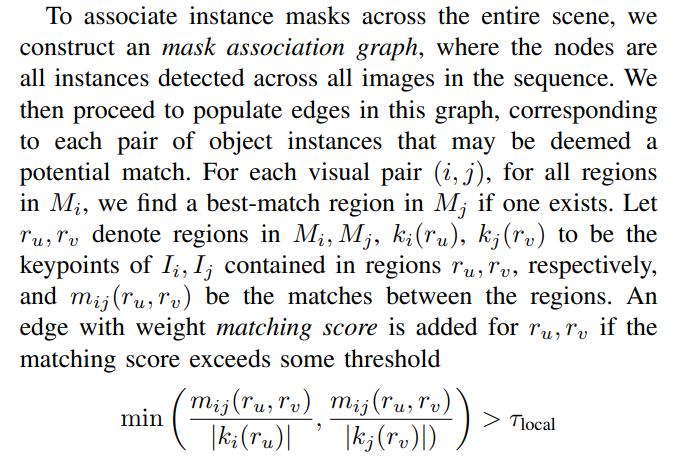
\ Mask Association Graph: Insofar, our approach produces instance masks and dense pixel correspondences among images that share a visual overlap. However, segmentation models such as SAM [2] suffer multiple issues: (a) segmentations of the same object need not be consistent across images, owing to viewpoint and appearance variations; and (b) owing to over-segmentation of objects, there isn’t usually a one-one correspondence among masks.

\
\
\ B. Mask Refinement

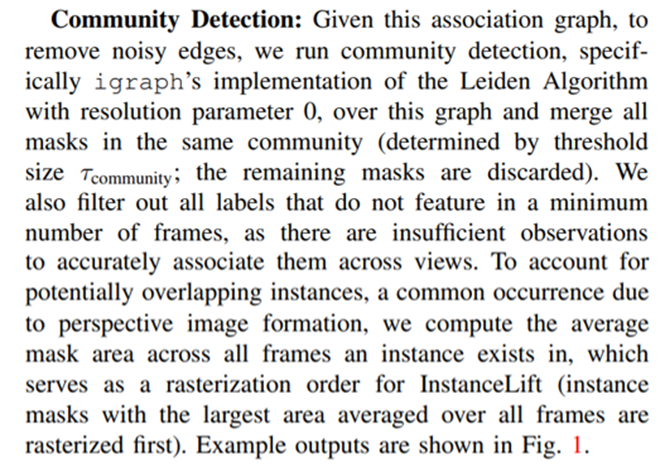
\ ϕ(M, r) is inherently noisy due to varying segmentation hierarchies for different instance masks due to differing viewpoints as well as design specifics. To address this, in InstanceLift we feed the pseudolabel masks to a label NeRF, which resolves some ambiguities. Still, NeRF cannot handle extreme cases of label ambiguity, to which we devise a fast post-processing method that determines and merges colliding labels based on random renders from the label NeRF. The few remaining, if any, ambiguities can be corrected via sparse human annotation.

\
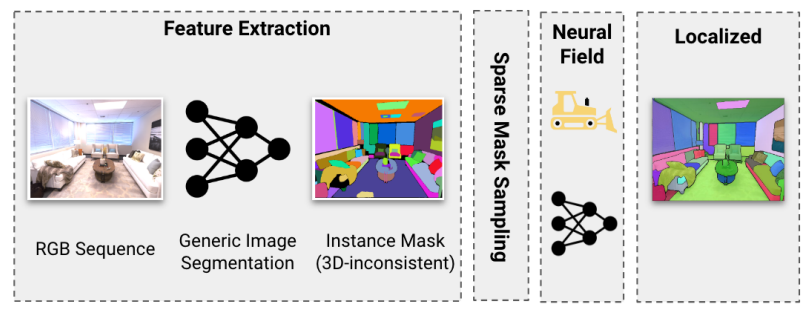
\ Fig. 3: InstanceLoc enables 3D-consistent instance segmentation for novel views of the scene unobserved by the InstanceMap pipeline. We leverage off-the-shelf instance segmentation models to first produce 3D-inconsistent instance labels for a new input image. We then query the label field over a sparse set of points on the image and use this to localize each 2D instance mask i.e., assign a 3Dconsistent label to each mask.
\ Post graph construction, we merge labels a, b if

\

\ Since we only need coarse information i.e. instance mask noise, we render images downsampled by a factor of 2.

\ C. Fast Instance Localization and Rendering

\ Training a label field enables us to predict 3D-consistent instance labels for novel viewpoints without rerunning 3DIML. However, rendering every pixel is slow, and rendering from a novel viewpoint is often noisy. We propose a fast localization approach that instead precomputes instance masks for the input image using an instance segmentation model (here FastSAM [8]). Given this instance mask, for each instance region, we sample the corresponding pixelwise 3D object labels from the label NeRF and take the majority label. Another benefit is that the input instance masks can be constructed using prompts and edited before localization.

\

:::info Authors:

(1) George Tang, Massachusetts Institute of Technology;

(2) Krishna Murthy Jatavallabhula, Massachusetts Institute of Technology;

(3) Antonio Torralba, Massachusetts Institute of Technology.

:::


:::info This paper is available on arxiv under CC by 4.0 Deed (Attribution 4.0 International) license.

:::

\

Market Opportunity
Mask Network Logo
Mask Network Price(MASK)
$0.528
$0.528$0.528
-0.11%
USD
Mask Network (MASK) Live Price Chart
Disclaimer: The articles reposted on this site are sourced from public platforms and are provided for informational purposes only. They do not necessarily reflect the views of MEXC. All rights remain with the original authors. If you believe any content infringes on third-party rights, please contact crypto.news@mexc.com for removal. MEXC makes no guarantees regarding the accuracy, completeness, or timeliness of the content and is not responsible for any actions taken based on the information provided. The content does not constitute financial, legal, or other professional advice, nor should it be considered a recommendation or endorsement by MEXC.

You May Also Like

Why Most Crypto Press Releases Get Ignored — and What Editors Actually Read in 2026

Why Most Crypto Press Releases Get Ignored — and What Editors Actually Read in 2026

Crypto editors receive hundreds of pitches a day and reject most within five seconds. Here's how the editor's desk works in 2026 and what founders need to change
Share
Cryptodaily2026/05/09 21:20
One Of Frank Sinatra’s Most Famous Albums Is Back In The Spotlight

One Of Frank Sinatra’s Most Famous Albums Is Back In The Spotlight

The post One Of Frank Sinatra’s Most Famous Albums Is Back In The Spotlight appeared on BitcoinEthereumNews.com. Frank Sinatra’s The World We Knew returns to the Jazz Albums and Traditional Jazz Albums charts, showing continued demand for his timeless music. Frank Sinatra performs on his TV special Frank Sinatra: A Man and his Music Bettmann Archive These days on the Billboard charts, Frank Sinatra’s music can always be found on the jazz-specific rankings. While the art he created when he was still working was pop at the time, and later classified as traditional pop, there is no such list for the latter format in America, and so his throwback projects and cuts appear on jazz lists instead. It’s on those charts where Sinatra rebounds this week, and one of his popular projects returns not to one, but two tallies at the same time, helping him increase the total amount of real estate he owns at the moment. Frank Sinatra’s The World We Knew Returns Sinatra’s The World We Knew is a top performer again, if only on the jazz lists. That set rebounds to No. 15 on the Traditional Jazz Albums chart and comes in at No. 20 on the all-encompassing Jazz Albums ranking after not appearing on either roster just last frame. The World We Knew’s All-Time Highs The World We Knew returns close to its all-time peak on both of those rosters. Sinatra’s classic has peaked at No. 11 on the Traditional Jazz Albums chart, just missing out on becoming another top 10 for the crooner. The set climbed all the way to No. 15 on the Jazz Albums tally and has now spent just under two months on the rosters. Frank Sinatra’s Album With Classic Hits Sinatra released The World We Knew in the summer of 1967. The title track, which on the album is actually known as “The World We Knew (Over and…
Share
BitcoinEthereumNews2025/09/18 00:02
Strategic Move: ZeroStax’s $107M 0G Token Acquisition Accelerates Decentralized AI Infrastructure Race

Strategic Move: ZeroStax’s $107M 0G Token Acquisition Accelerates Decentralized AI Infrastructure Race

BitcoinWorld Strategic Move: ZeroStax’s $107M 0G Token Acquisition Accelerates Decentralized AI Infrastructure Race In a landmark corporate move that signals growing
Share
bitcoinworld2026/04/02 20:05

KAIO Global Debut

KAIO Global DebutKAIO Global Debut

Enjoy 0-fee KAIO trading and tap into the RWA boom