By Eric, Foresight News Yesterday morning Beijing time, Ethereum co-founder Vitalik Buterin posted a screenshot of an article written by Peter Thiel in 2009 on X, with the caption: "Reminder that Peter Thiel is, to put it mildly, not a cypherpunk." If Vitalik's concerns two months ago about the risks of over-leverage in Ethereum DATs were merely a "friendly reminder," then this time, his direct criticism of Peter Thiel, a backer of BitMine and ETHZilla, two publicly traded Ethereum DATs, can be seen as a "direct challenge." However, this challenge doesn't appear to be solely directed at DAT companies. Vitalik's real concerns may be related to Peter Thiel's extreme political views, which are precisely the opposite of the cypherpunk ideologies that uphold decentralization. Peter Thiel: I no longer believe freedom and democracy are compatible Last October, Polymarket refuted the New York Times' report that it had political leanings. In its response, it stated that although Peter Thiel is the founder of Founders Fund, an investor in Polymarket, his political leanings will not affect the operation of the platform. Peter Thiel’s extreme political leanings are no longer news, but this seems to be the first time it has been widely discussed in the Web3 world. The screenshot Vitalik posted is from Peter Thiel’s 2009 article “The Education of a Libertarian”. In the article, Peter Thiel expressed his extreme disappointment with politics and believed that liberals at the time should find a way out of all forms of politics. He said, “Since there is no longer any truly free place in our world, I suspect that the way to escape must involve some new and hitherto untried method, leading us to some unknown country; for this reason, I am committed to studying new technologies that may create new spaces for freedom.” The new technologies mentioned by Peter Thiel include three possible areas: cyberspace, space and oceans. This article was published shortly after Bitcoin's launch, against the backdrop of a global financial crisis unleashed by Wall Street's greed. Peter Thiel advocates for using technology to bypass politics and create an absolute libertarian utopia. However, he rejects the "techno-utopianism" that assumes technology possesses its own power and will. Instead, he believes technology should confront politics, creating a new world free from political control. In this description, it seems that Peter Thiel's propositions are similar to those of the early cypherpunks. They believe that technology can create a better world, and they also believe that the development of technology will one day break the constraints of politics and give birth to a truly free country. Founders Fund, of which Peter Thiel serves as managing partner, has invested in a wide range of Web3 projects, including in recent years Polymarket, Avail, Igloo (the parent company of Pudgy Penguins), and Caldera, a Rollup-as-a-Service platform. While Peter Thiel shares the same belief in "technology changing the world" as crypto fundamentalists, his approach to achieving this goal has been quite different. In "The Education of a Libertarian," Peter Thiel's disillusionment with democracy is actually a disappointment with egalitarianism. Since the expansion of universal suffrage (especially women's suffrage) and the expansion of the welfare state in the United States in the 20th century, "capitalist democracy" has become a self-contradictory fantasy. In his view, the egalitarian tendencies of the general electorate hinder a truly free market, and therefore liberals should "escape politics" rather than try to convince the majority of voters. Peter Thiel and his followers, known for their superior understanding of technology and their foresight into future development, place greater trust in the "best minds"—technological and capital elites—to govern society, rather than relying on democratic procedures based on one person, one vote. Companies he has invested in, such as Palantir and Anduril, have undertaken numerous government surveillance and border enforcement projects, drawing criticism for "using algorithms and big data to replace democratic decision-making," essentially outsourcing public power to opaque private high-tech companies. Frankfurt-born Peter Thiel's reading list includes works by Nazi jurist Carl Schmitt, civilizational decline theorist Oswald Spengler, and The Sovereign Individual. These ideologies share a disdain for universal suffrage, a reverence for power, and a belief in historical cycles and a "state of exception." Peter Thiel combines Schmitt's "friend-and-enemy" political perspective and Spengler's "good times-bad times" authoritarian fatalism with Silicon Valley's "technological acceleration" discourse, creating a hybrid ideology of "hyper-neoliberalism + anti-democracy" that scholars have called fascist inflection. Renowned American journalist and historian Eoin Higgins, in his book "Owned: How Tech Billionaires on the Right Bought the Loudest Voice on the Left," published in February of this year, describes how tech leaders flocked to Trump after his 2016 election victory. On December 14, 2016, Thiel attended a Trump campaign meeting. The billionaire investor also brought along allies Elon Musk and Alex Karp, even though their respective companies, Tesla and Palantir, were not on the same level as companies like Google, Microsoft, and Apple at the time. During Trump's second term, Peter Thiel was behind Vice President Vance and David Sacks, the White House director of cryptocurrency and artificial intelligence and the so-called "Crypto Czar." Elon Musk, his protégé brought to the White House during Trump's first term, has become another symbol of Silicon Valley elitism. The world's richest man, even considering the noise of rocket launches, has developed a near-insane hatred of the government, or more precisely, bureaucracy. This hatred has manifested in DOGE's frantic purge of certain government departments. Clearly, this extreme ideological confrontation has left Vitalik feeling a sense of unease. Whose freedom is true freedom? While both advocated for using technology to change the world, Peter Thiel chose to allow the elite to master technology and rule over the "mortals." Satoshi Nakamoto and Vitalik, on the other hand, were more committed to equal rights in technology, creating a stark ideological opposition. Vitalik's real concern was that a group of tech elites, armed with vast amounts of capital, would exploit their power and influence to transform Ethereum into a decentralized network controlled by extreme totalitarians. While Ethereum might still be the world's computer and handle the majority of transactions for stablecoins and tokenized RWAs, it would no longer be the Ethereum that cypherpunks envisioned. Vitalik's direct motivation for developing Ethereum came from Blizzard nerfing his favorite World of Warcraft character. However, Vitalik isn't opposed to nerfs; he simply believes the decision should be made in a more democratic manner, and even if the final vote still results in a nerf, he's still okay with it. Peter Thiel, on the other hand, would arbitrarily choose not to nerf a character. This is perhaps the biggest difference between the two. In the comments section of the tweet, Vitalik agreed with the view that "Ethereum needs to be like Bitcoin eventually, where development should stop/shut down at some point, or maintenance should be minimized." He supports gradual rigidification and a more cautious approach to major changes to the protocol after short-term expansion, streamlining of Ethereum, and clearing of technical debt. This view actually corresponds to the "technological utopianism" mentioned by Peter Thiel. However, for Peter Thiel, who combines the denial of democracy, technological authoritarianism, and capital seizure of power, and goes beyond the boundaries of conventional conservatism or libertarianism, his view of freedom seems to be to restrict the freedom of the majority for the sake of absolute freedom for a few. This proposition with absolute "right" and "wrong" seems to bring "absolute political rule" to the other extreme of "absolute technological elite rule." Interestingly, Vitalik received $100,000 in funding from Peter Thiel in 2014 to develop Ethereum. Eleven years later, while the then-innocent teenager has shed his crypto fundamentalism and become a leading figure in the decentralized world, Peter Thiel still clings to his extreme ideology, which I struggle to find the right words to describe. In the next ten years, will Ethereum become a weapon of absolute freedom for a small number of people, or a tool of relative freedom for the majority?By Eric, Foresight News Yesterday morning Beijing time, Ethereum co-founder Vitalik Buterin posted a screenshot of an article written by Peter Thiel in 2009 on X, with the caption: "Reminder that Peter Thiel is, to put it mildly, not a cypherpunk." If Vitalik's concerns two months ago about the risks of over-leverage in Ethereum DATs were merely a "friendly reminder," then this time, his direct criticism of Peter Thiel, a backer of BitMine and ETHZilla, two publicly traded Ethereum DATs, can be seen as a "direct challenge." However, this challenge doesn't appear to be solely directed at DAT companies. Vitalik's real concerns may be related to Peter Thiel's extreme political views, which are precisely the opposite of the cypherpunk ideologies that uphold decentralization. Peter Thiel: I no longer believe freedom and democracy are compatible Last October, Polymarket refuted the New York Times' report that it had political leanings. In its response, it stated that although Peter Thiel is the founder of Founders Fund, an investor in Polymarket, his political leanings will not affect the operation of the platform. Peter Thiel’s extreme political leanings are no longer news, but this seems to be the first time it has been widely discussed in the Web3 world. The screenshot Vitalik posted is from Peter Thiel’s 2009 article “The Education of a Libertarian”. In the article, Peter Thiel expressed his extreme disappointment with politics and believed that liberals at the time should find a way out of all forms of politics. He said, “Since there is no longer any truly free place in our world, I suspect that the way to escape must involve some new and hitherto untried method, leading us to some unknown country; for this reason, I am committed to studying new technologies that may create new spaces for freedom.” The new technologies mentioned by Peter Thiel include three possible areas: cyberspace, space and oceans. This article was published shortly after Bitcoin's launch, against the backdrop of a global financial crisis unleashed by Wall Street's greed. Peter Thiel advocates for using technology to bypass politics and create an absolute libertarian utopia. However, he rejects the "techno-utopianism" that assumes technology possesses its own power and will. Instead, he believes technology should confront politics, creating a new world free from political control. In this description, it seems that Peter Thiel's propositions are similar to those of the early cypherpunks. They believe that technology can create a better world, and they also believe that the development of technology will one day break the constraints of politics and give birth to a truly free country. Founders Fund, of which Peter Thiel serves as managing partner, has invested in a wide range of Web3 projects, including in recent years Polymarket, Avail, Igloo (the parent company of Pudgy Penguins), and Caldera, a Rollup-as-a-Service platform. While Peter Thiel shares the same belief in "technology changing the world" as crypto fundamentalists, his approach to achieving this goal has been quite different. In "The Education of a Libertarian," Peter Thiel's disillusionment with democracy is actually a disappointment with egalitarianism. Since the expansion of universal suffrage (especially women's suffrage) and the expansion of the welfare state in the United States in the 20th century, "capitalist democracy" has become a self-contradictory fantasy. In his view, the egalitarian tendencies of the general electorate hinder a truly free market, and therefore liberals should "escape politics" rather than try to convince the majority of voters. Peter Thiel and his followers, known for their superior understanding of technology and their foresight into future development, place greater trust in the "best minds"—technological and capital elites—to govern society, rather than relying on democratic procedures based on one person, one vote. Companies he has invested in, such as Palantir and Anduril, have undertaken numerous government surveillance and border enforcement projects, drawing criticism for "using algorithms and big data to replace democratic decision-making," essentially outsourcing public power to opaque private high-tech companies. Frankfurt-born Peter Thiel's reading list includes works by Nazi jurist Carl Schmitt, civilizational decline theorist Oswald Spengler, and The Sovereign Individual. These ideologies share a disdain for universal suffrage, a reverence for power, and a belief in historical cycles and a "state of exception." Peter Thiel combines Schmitt's "friend-and-enemy" political perspective and Spengler's "good times-bad times" authoritarian fatalism with Silicon Valley's "technological acceleration" discourse, creating a hybrid ideology of "hyper-neoliberalism + anti-democracy" that scholars have called fascist inflection. Renowned American journalist and historian Eoin Higgins, in his book "Owned: How Tech Billionaires on the Right Bought the Loudest Voice on the Left," published in February of this year, describes how tech leaders flocked to Trump after his 2016 election victory. On December 14, 2016, Thiel attended a Trump campaign meeting. The billionaire investor also brought along allies Elon Musk and Alex Karp, even though their respective companies, Tesla and Palantir, were not on the same level as companies like Google, Microsoft, and Apple at the time. During Trump's second term, Peter Thiel was behind Vice President Vance and David Sacks, the White House director of cryptocurrency and artificial intelligence and the so-called "Crypto Czar." Elon Musk, his protégé brought to the White House during Trump's first term, has become another symbol of Silicon Valley elitism. The world's richest man, even considering the noise of rocket launches, has developed a near-insane hatred of the government, or more precisely, bureaucracy. This hatred has manifested in DOGE's frantic purge of certain government departments. Clearly, this extreme ideological confrontation has left Vitalik feeling a sense of unease. Whose freedom is true freedom? While both advocated for using technology to change the world, Peter Thiel chose to allow the elite to master technology and rule over the "mortals." Satoshi Nakamoto and Vitalik, on the other hand, were more committed to equal rights in technology, creating a stark ideological opposition. Vitalik's real concern was that a group of tech elites, armed with vast amounts of capital, would exploit their power and influence to transform Ethereum into a decentralized network controlled by extreme totalitarians. While Ethereum might still be the world's computer and handle the majority of transactions for stablecoins and tokenized RWAs, it would no longer be the Ethereum that cypherpunks envisioned. Vitalik's direct motivation for developing Ethereum came from Blizzard nerfing his favorite World of Warcraft character. However, Vitalik isn't opposed to nerfs; he simply believes the decision should be made in a more democratic manner, and even if the final vote still results in a nerf, he's still okay with it. Peter Thiel, on the other hand, would arbitrarily choose not to nerf a character. This is perhaps the biggest difference between the two. In the comments section of the tweet, Vitalik agreed with the view that "Ethereum needs to be like Bitcoin eventually, where development should stop/shut down at some point, or maintenance should be minimized." He supports gradual rigidification and a more cautious approach to major changes to the protocol after short-term expansion, streamlining of Ethereum, and clearing of technical debt. This view actually corresponds to the "technological utopianism" mentioned by Peter Thiel. However, for Peter Thiel, who combines the denial of democracy, technological authoritarianism, and capital seizure of power, and goes beyond the boundaries of conventional conservatism or libertarianism, his view of freedom seems to be to restrict the freedom of the majority for the sake of absolute freedom for a few. This proposition with absolute "right" and "wrong" seems to bring "absolute political rule" to the other extreme of "absolute technological elite rule." Interestingly, Vitalik received $100,000 in funding from Peter Thiel in 2014 to develop Ethereum. Eleven years later, while the then-innocent teenager has shed his crypto fundamentalism and become a leading figure in the decentralized world, Peter Thiel still clings to his extreme ideology, which I struggle to find the right words to describe. In the next ten years, will Ethereum become a weapon of absolute freedom for a small number of people, or a tool of relative freedom for the majority?

Vitalik publicly questioned Peter Thiel's "non-cyberpunk" stance, which is a factional struggle in technological thought.

2025/10/04 19:57

By Eric, Foresight News

Yesterday morning Beijing time, Ethereum co-founder Vitalik Buterin posted a screenshot of an article written by Peter Thiel in 2009 on X, with the caption: "Reminder that Peter Thiel is, to put it mildly, not a cypherpunk."
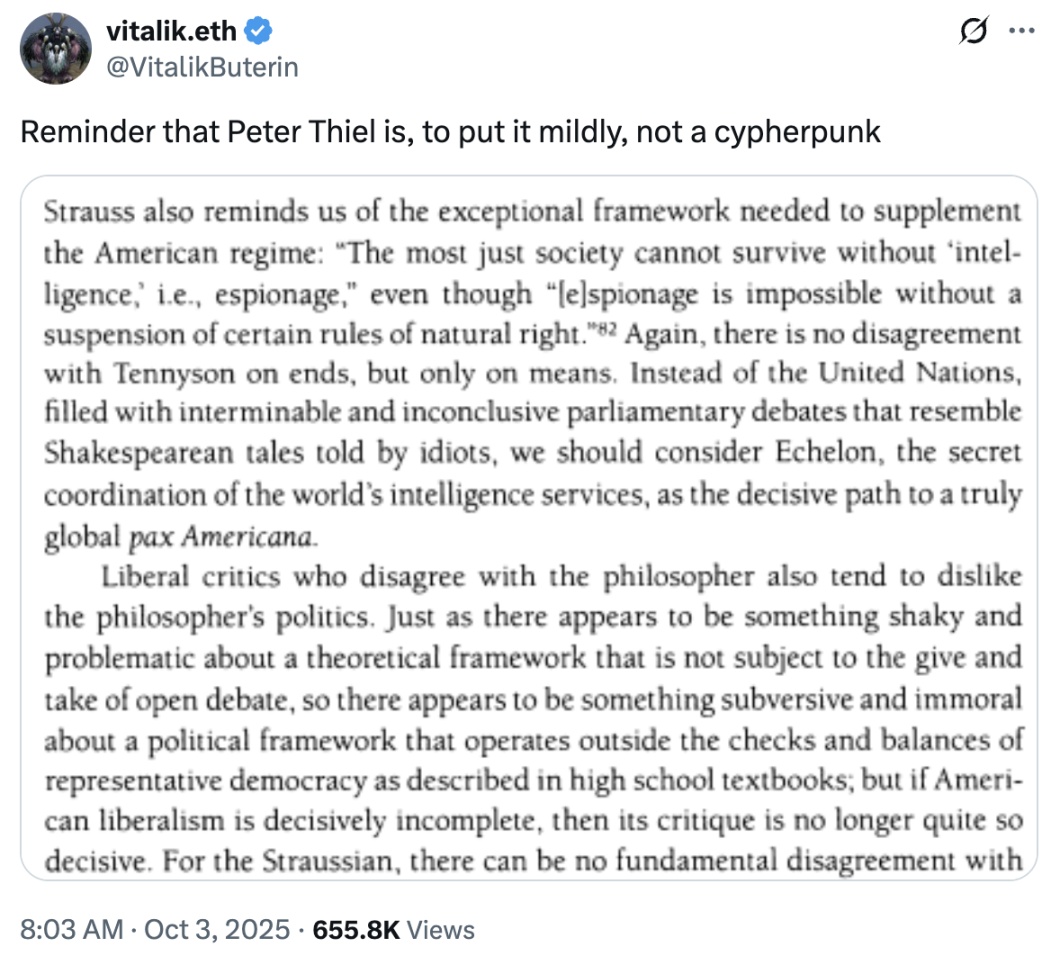
If Vitalik's concerns two months ago about the risks of over-leverage in Ethereum DATs were merely a "friendly reminder," then this time, his direct criticism of Peter Thiel, a backer of BitMine and ETHZilla, two publicly traded Ethereum DATs, can be seen as a "direct challenge." However, this challenge doesn't appear to be solely directed at DAT companies. Vitalik's real concerns may be related to Peter Thiel's extreme political views, which are precisely the opposite of the cypherpunk ideologies that uphold decentralization.

Peter Thiel: I no longer believe freedom and democracy are compatible

Last October, Polymarket refuted the New York Times' report that it had political leanings. In its response, it stated that although Peter Thiel is the founder of Founders Fund, an investor in Polymarket, his political leanings will not affect the operation of the platform.

Peter Thiel’s extreme political leanings are no longer news, but this seems to be the first time it has been widely discussed in the Web3 world.

The screenshot Vitalik posted is from Peter Thiel’s 2009 article “The Education of a Libertarian”. In the article, Peter Thiel expressed his extreme disappointment with politics and believed that liberals at the time should find a way out of all forms of politics. He said, “Since there is no longer any truly free place in our world, I suspect that the way to escape must involve some new and hitherto untried method, leading us to some unknown country; for this reason, I am committed to studying new technologies that may create new spaces for freedom.”

The new technologies mentioned by Peter Thiel include three possible areas: cyberspace, space and oceans.

This article was published shortly after Bitcoin's launch, against the backdrop of a global financial crisis unleashed by Wall Street's greed. Peter Thiel advocates for using technology to bypass politics and create an absolute libertarian utopia. However, he rejects the "techno-utopianism" that assumes technology possesses its own power and will. Instead, he believes technology should confront politics, creating a new world free from political control.

In this description, it seems that Peter Thiel's propositions are similar to those of the early cypherpunks. They believe that technology can create a better world, and they also believe that the development of technology will one day break the constraints of politics and give birth to a truly free country.

Founders Fund, of which Peter Thiel serves as managing partner, has invested in a wide range of Web3 projects, including in recent years Polymarket, Avail, Igloo (the parent company of Pudgy Penguins), and Caldera, a Rollup-as-a-Service platform. While Peter Thiel shares the same belief in "technology changing the world" as crypto fundamentalists, his approach to achieving this goal has been quite different.

In "The Education of a Libertarian," Peter Thiel's disillusionment with democracy is actually a disappointment with egalitarianism. Since the expansion of universal suffrage (especially women's suffrage) and the expansion of the welfare state in the United States in the 20th century, "capitalist democracy" has become a self-contradictory fantasy. In his view, the egalitarian tendencies of the general electorate hinder a truly free market, and therefore liberals should "escape politics" rather than try to convince the majority of voters.

Peter Thiel and his followers, known for their superior understanding of technology and their foresight into future development, place greater trust in the "best minds"—technological and capital elites—to govern society, rather than relying on democratic procedures based on one person, one vote. Companies he has invested in, such as Palantir and Anduril, have undertaken numerous government surveillance and border enforcement projects, drawing criticism for "using algorithms and big data to replace democratic decision-making," essentially outsourcing public power to opaque private high-tech companies.

Frankfurt-born Peter Thiel's reading list includes works by Nazi jurist Carl Schmitt, civilizational decline theorist Oswald Spengler, and The Sovereign Individual. These ideologies share a disdain for universal suffrage, a reverence for power, and a belief in historical cycles and a "state of exception." Peter Thiel combines Schmitt's "friend-and-enemy" political perspective and Spengler's "good times-bad times" authoritarian fatalism with Silicon Valley's "technological acceleration" discourse, creating a hybrid ideology of "hyper-neoliberalism + anti-democracy" that scholars have called fascist inflection.

Renowned American journalist and historian Eoin Higgins, in his book "Owned: How Tech Billionaires on the Right Bought the Loudest Voice on the Left," published in February of this year, describes how tech leaders flocked to Trump after his 2016 election victory. On December 14, 2016, Thiel attended a Trump campaign meeting. The billionaire investor also brought along allies Elon Musk and Alex Karp, even though their respective companies, Tesla and Palantir, were not on the same level as companies like Google, Microsoft, and Apple at the time.

During Trump's second term, Peter Thiel was behind Vice President Vance and David Sacks, the White House director of cryptocurrency and artificial intelligence and the so-called "Crypto Czar." Elon Musk, his protégé brought to the White House during Trump's first term, has become another symbol of Silicon Valley elitism. The world's richest man, even considering the noise of rocket launches, has developed a near-insane hatred of the government, or more precisely, bureaucracy. This hatred has manifested in DOGE's frantic purge of certain government departments. Clearly, this extreme ideological confrontation has left Vitalik feeling a sense of unease.

Whose freedom is true freedom?

While both advocated for using technology to change the world, Peter Thiel chose to allow the elite to master technology and rule over the "mortals." Satoshi Nakamoto and Vitalik, on the other hand, were more committed to equal rights in technology, creating a stark ideological opposition. Vitalik's real concern was that a group of tech elites, armed with vast amounts of capital, would exploit their power and influence to transform Ethereum into a decentralized network controlled by extreme totalitarians. While Ethereum might still be the world's computer and handle the majority of transactions for stablecoins and tokenized RWAs, it would no longer be the Ethereum that cypherpunks envisioned.

Vitalik's direct motivation for developing Ethereum came from Blizzard nerfing his favorite World of Warcraft character. However, Vitalik isn't opposed to nerfs; he simply believes the decision should be made in a more democratic manner, and even if the final vote still results in a nerf, he's still okay with it. Peter Thiel, on the other hand, would arbitrarily choose not to nerf a character. This is perhaps the biggest difference between the two.

In the comments section of the tweet, Vitalik agreed with the view that "Ethereum needs to be like Bitcoin eventually, where development should stop/shut down at some point, or maintenance should be minimized." He supports gradual rigidification and a more cautious approach to major changes to the protocol after short-term expansion, streamlining of Ethereum, and clearing of technical debt.

This view actually corresponds to the "technological utopianism" mentioned by Peter Thiel. However, for Peter Thiel, who combines the denial of democracy, technological authoritarianism, and capital seizure of power, and goes beyond the boundaries of conventional conservatism or libertarianism, his view of freedom seems to be to restrict the freedom of the majority for the sake of absolute freedom for a few. This proposition with absolute "right" and "wrong" seems to bring "absolute political rule" to the other extreme of "absolute technological elite rule."
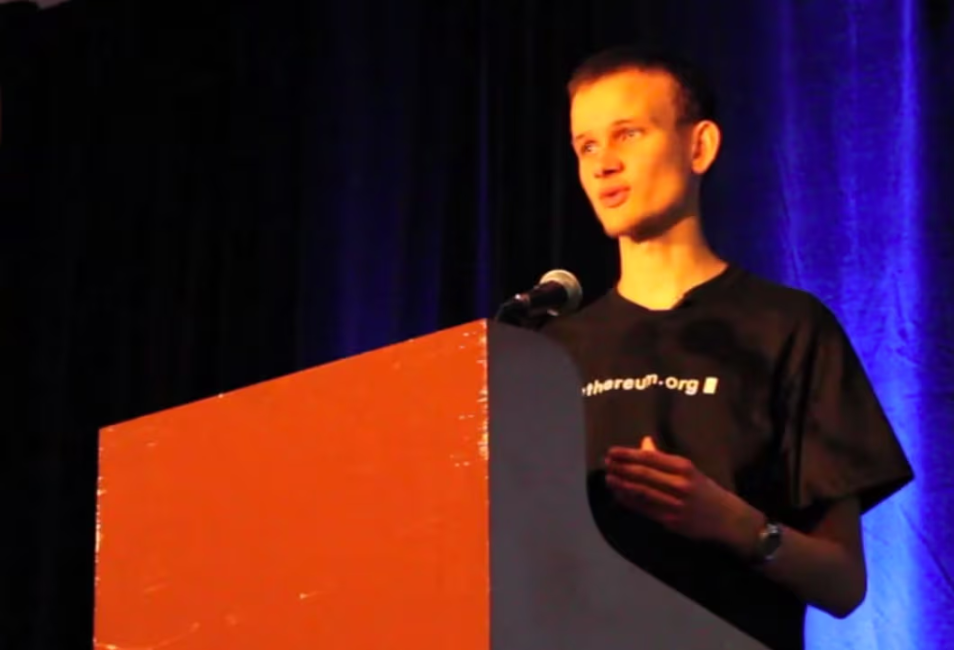
Interestingly, Vitalik received $100,000 in funding from Peter Thiel in 2014 to develop Ethereum. Eleven years later, while the then-innocent teenager has shed his crypto fundamentalism and become a leading figure in the decentralized world, Peter Thiel still clings to his extreme ideology, which I struggle to find the right words to describe.

In the next ten years, will Ethereum become a weapon of absolute freedom for a small number of people, or a tool of relative freedom for the majority?

Market Opportunity
Notcoin Logo
Notcoin Price(NOT)
$0.0005284
$0.0005284$0.0005284
+1.09%
USD
Notcoin (NOT) Live Price Chart
Disclaimer: The articles reposted on this site are sourced from public platforms and are provided for informational purposes only. They do not necessarily reflect the views of MEXC. All rights remain with the original authors. If you believe any content infringes on third-party rights, please contact service@support.mexc.com for removal. MEXC makes no guarantees regarding the accuracy, completeness, or timeliness of the content and is not responsible for any actions taken based on the information provided. The content does not constitute financial, legal, or other professional advice, nor should it be considered a recommendation or endorsement by MEXC.

You May Also Like

Atlassian’s Monumental DX Acquisition: Revolutionizing Developer Productivity for a Billion-Dollar Future

Atlassian’s Monumental DX Acquisition: Revolutionizing Developer Productivity for a Billion-Dollar Future

BitcoinWorld Atlassian’s Monumental DX Acquisition: Revolutionizing Developer Productivity for a Billion-Dollar Future In a move that sends ripples across the tech industry, impacting everything from foundational infrastructure to the cutting-edge innovations seen in blockchain and cryptocurrency development, productivity software giant Atlassian has made its largest acquisition to date. This isn’t just another corporate buyout; it’s a strategic investment in the very fabric of how software is built. The Atlassian acquisition of DX, a pioneering developer productivity platform, for a staggering $1 billion, signals a profound commitment to optimizing engineering workflows and understanding the true pulse of development teams. For those invested in the efficiency and scalability of digital ecosystems, this development underscores the growing importance of robust tooling at every layer. Unpacking the Monumental Atlassian Acquisition: A Billion-Dollar Bet on Developer Efficiency On a recent Thursday, Atlassian officially announced its agreement to acquire DX for $1 billion, a sum comprising both cash and restricted stock. This substantial investment highlights Atlassian’s belief in the critical role of developer insights in today’s fast-paced tech landscape. For years, Atlassian has been synonymous with collaboration and project management tools, powering teams worldwide with products like Jira, Confluence, and Trello. However, recognizing a growing need, the company has now decisively moved to integrate a dedicated developer productivity insight platform into its formidable product suite. This acquisition isn’t merely about expanding market share; it’s about deepening Atlassian’s value proposition by providing comprehensive visibility into the health and efficiency of engineering operations. The strategic rationale behind this billion-dollar move is multifaceted. Atlassian co-founder and CEO Mike Cannon-Brookes shared with Bitcoin World that after a three-year attempt to build an in-house developer productivity insight tool, his Sydney-based company realized the immense value of an external, existing solution. This candid admission speaks volumes about the complexity and specialized nature of developer productivity measurement. DX emerged as the natural choice, not least because an impressive 90% of DX’s existing customers were already leveraging Atlassian’s project management and collaboration tools. This pre-existing synergy promises a smoother integration and immediate value for a significant portion of the combined customer base. What is the DX Platform and Why is it a Game-Changer? At its core, DX is designed to empower enterprises by providing deep analytics into how productive their engineering teams truly are. More importantly, it helps identify and unblock bottlenecks that can significantly slow down development cycles. Launched five years ago by Abi Noda and Greyson Junggren, DX emerged from a fundamental challenge: the lack of accurate and non-intrusive metrics to understand developer friction. Abi Noda, in a 2022 interview with Bitcoin World, articulated his founding vision: to move beyond superficial metrics that often failed to capture the full picture of engineering challenges. His experience as a product manager at GitHub revealed that traditional measures often felt like surveillance rather than support, leading to skewed perceptions of productivity. DX was built on a different philosophy, focusing on qualitative and quantitative insights that truly reflect what hinders teams, without making developers feel scrutinized. Noda noted, “The assumptions we had about what we needed to help ship products faster were quite different than what the teams and developers were saying was getting in their way.” Since emerging from stealth in 2022, the DX platform has demonstrated remarkable growth, tripling its customer base every year. It now serves over 350 enterprise customers, including industry giants like ADP, Adyen, and GitHub. What makes DX’s success even more impressive is its lean operational model; the company achieved this rapid expansion while raising less than $5 million in venture funding. This efficiency underscores the inherent value and strong market demand for its solution, making it an exceptionally attractive target for Atlassian. Boosting Developer Productivity: Atlassian’s Strategic Vision The acquisition of DX is a clear signal of Atlassian’s strategic intent to not just manage tasks, but to optimize the entire software development lifecycle. By integrating DX’s capabilities, Atlassian aims to offer an end-to-end “flywheel” for engineering teams. This means providing tools that not only facilitate collaboration and project tracking but also offer actionable insights into where processes are breaking down and how they can be improved. Mike Cannon-Brookes elaborated on this synergy, stating, “DX has done an amazing job [of] understanding the qualitative and quantitative aspects of developer productivity and turning that into actions that can improve those companies and give them insights and comparisons to others in their industry, others at their size, etc.” This capability to benchmark and identify specific areas for improvement is invaluable for organizations striving for continuous enhancement. Abi Noda echoed this sentiment, telling Bitcoin World that the combined entities are “better together than apart.” He emphasized how Atlassian’s extensive suite of tools complements the data and information gathered by DX. “We are able to provide customers with that full flywheel to get the data and understand where we are unhealthy,” Noda explained. “They can plug in Atlassian’s tools and solutions to go address those bottlenecks. An end-to-end flywheel that is ultimately what customers want.” This integration promises to create a seamless experience, allowing teams to move from identifying an issue to implementing a solution within a unified ecosystem. The Intersection of Enterprise Software and Emerging Tech Trends This landmark acquisition also highlights a significant trend in the broader enterprise software landscape: a shift towards more intelligent, data-driven solutions that directly impact operational efficiency and competitive advantage. As companies continue to invest heavily in digital transformation, the ability to measure and optimize the output of their most valuable asset — their engineering talent — becomes paramount. DX’s impressive roster of over 350 enterprise customers, including some of the largest and most technologically advanced organizations, is a testament to the universal need for such a platform. These companies recognize that merely tracking tasks isn’t enough; they need to understand the underlying dynamics of their engineering teams to truly unlock their potential. The integration of DX into Atlassian’s ecosystem will likely set a new standard for what enterprise software can offer, pushing competitors to enhance their own productivity insights. Moreover, this move by Atlassian, a global leader in enterprise collaboration, underscores a broader investment thesis in foundational tooling. Just as robust blockchain infrastructure is critical for the future of decentralized finance, powerful and insightful developer tools are essential for the evolution of all software, including the complex applications underpinning Web3. The success of companies like DX, which scale without massive external funding, also resonates with the lean, efficient ethos often celebrated in the crypto space. Navigating the Era of AI Tools: Measuring Impact and ROI Perhaps one of the most compelling aspects of this acquisition, as highlighted by Atlassian’s CEO, is its timely relevance in the era of rapidly advancing AI tools. Mike Cannon-Brookes noted that the rise of AI has created a new imperative for companies to measure its usage and effectiveness. “You suddenly have these budgets that are going up. Is that a good thing? Is that not a good thing? Am I spending the money in the right ways? It’s really, really important and critical.” With AI-powered coding assistants and other generative AI solutions becoming increasingly prevalent in development workflows, organizations are grappling with how to quantify the return on investment (ROI) of these new technologies. DX’s platform can provide the necessary insights to understand if AI tools are genuinely boosting productivity, reducing bottlenecks, or simply adding to complexity. By offering clear data on how AI impacts developer efficiency, DX will help enterprises make smarter, data-driven decisions about their AI investments. This foresight positions Atlassian not just as a provider of developer tools, but as a strategic partner in navigating the complexities of modern software development, particularly as AI integrates more deeply into every facet of the engineering process. It’s about empowering organizations to leverage AI effectively, ensuring that these powerful new tools translate into tangible improvements in output and innovation. The Atlassian acquisition of DX represents a significant milestone for both companies and the broader tech industry. It’s a testament to the growing recognition that developer productivity is not just a buzzword, but a measurable and critical factor in an organization’s success. By combining DX’s powerful insights with Atlassian’s extensive suite of collaboration and project management tools, the merged entity is poised to offer an unparalleled, end-to-end solution for optimizing software development. This strategic move, valued at a billion dollars, underscores Atlassian’s commitment to innovation and its vision for a future where engineering teams are not only efficient but also deeply understood and supported, paving the way for a more productive and insightful era in enterprise software. To learn more about the latest AI market trends, explore our article on key developments shaping AI features. This post Atlassian’s Monumental DX Acquisition: Revolutionizing Developer Productivity for a Billion-Dollar Future first appeared on BitcoinWorld.
Share
Coinstats2025/09/18 21:40
China Bans Nvidia’s RTX Pro 6000D Chip Amid AI Hardware Push

China Bans Nvidia’s RTX Pro 6000D Chip Amid AI Hardware Push

TLDR China instructs major firms to cancel orders for Nvidia’s RTX Pro 6000D chip. Nvidia shares drop 1.5% after China’s ban on key AI hardware. China accelerates development of domestic AI chips, reducing U.S. tech reliance. Crypto and AI sectors may seek alternatives due to limited Nvidia access in China. China has taken a bold [...] The post China Bans Nvidia’s RTX Pro 6000D Chip Amid AI Hardware Push appeared first on CoinCentral.
Share
Coincentral2025/09/18 01:09
UWRO President Nail Saifutdinov: Digital Solutions for Faith Communities and Remembrance Services—Under One International Foundation

UWRO President Nail Saifutdinov: Digital Solutions for Faith Communities and Remembrance Services—Under One International Foundation

UWRO (United World Religions Organization) is an international faith tech foundation working at the intersection of technology, media, and social impact. It creates
Share
Techbullion2025/12/26 20:19