TLDR Walmart cuts synthetic dyes & additives from 1,000 private-label foods. Reformulated Walmart foods target transparency, full rollout by 2027. Walmart bans 30+ additives, aiming for cleaner Great Value & Bettergoods. Customers drive Walmart’s push for dye-free, simpler food ingredients. Walmart’s additive-free shift sparks supply chain, cost considerations. Walmart Inc. (WMT) saw its stock price [...] The post Walmart (WMT) stock: Slips 1.24% as Retail Giant Moves to Remove Dyes and 30 Additives From Store Brands appeared first on CoinCentral.TLDR Walmart cuts synthetic dyes & additives from 1,000 private-label foods. Reformulated Walmart foods target transparency, full rollout by 2027. Walmart bans 30+ additives, aiming for cleaner Great Value & Bettergoods. Customers drive Walmart’s push for dye-free, simpler food ingredients. Walmart’s additive-free shift sparks supply chain, cost considerations. Walmart Inc. (WMT) saw its stock price [...] The post Walmart (WMT) stock: Slips 1.24% as Retail Giant Moves to Remove Dyes and 30 Additives From Store Brands appeared first on CoinCentral.

Walmart (WMT) stock: Slips 1.24% as Retail Giant Moves to Remove Dyes and 30 Additives From Store Brands

TLDR

  • Walmart cuts synthetic dyes & additives from 1,000 private-label foods.
  • Reformulated Walmart foods target transparency, full rollout by 2027.
  • Walmart bans 30+ additives, aiming for cleaner Great Value & Bettergoods.
  • Customers drive Walmart’s push for dye-free, simpler food ingredients.
  • Walmart’s additive-free shift sparks supply chain, cost considerations.

Walmart Inc. (WMT) saw its stock price fall by 1.24% on October 1st, closing at $101.79 by 3:34 PM EDT.
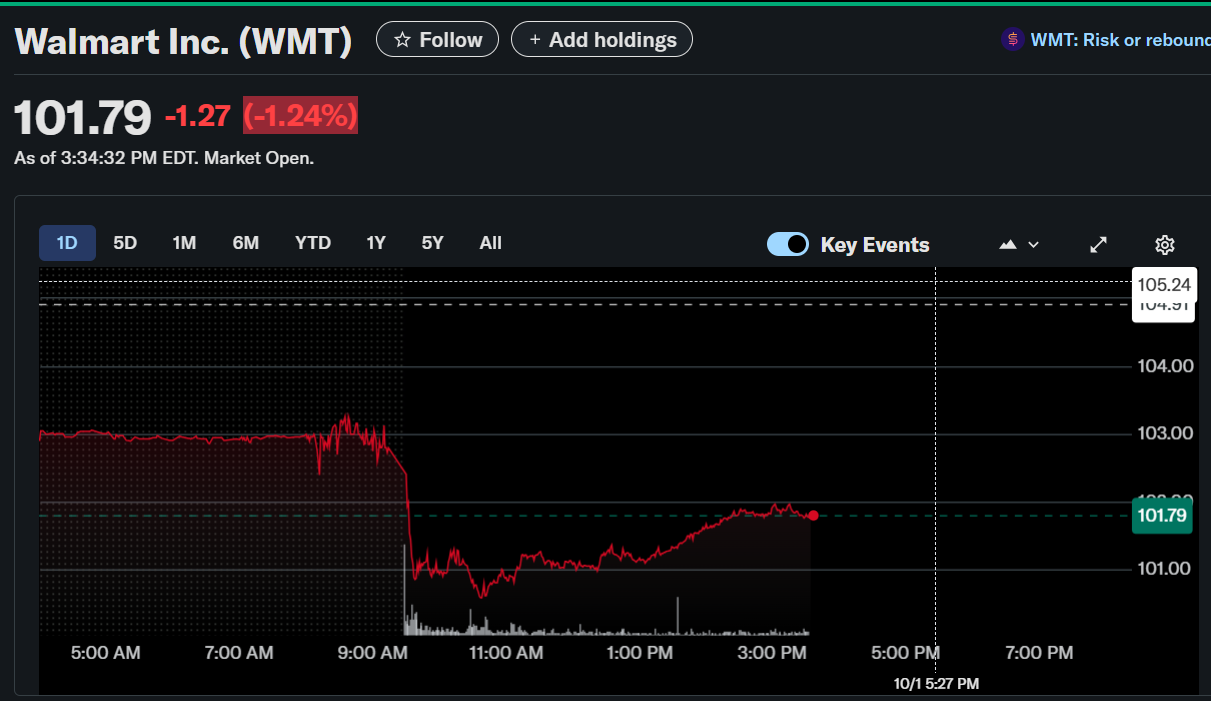
Walmart Inc. (WMT)

This decline followed the company’s major announcement regarding changes to its private-label food products. Investors reacted with caution to the news, as the move could impact operational costs in the near term.

The company declared it would eliminate synthetic dyes and over 30 additional additives from its private brand food items. The transition will affect about 1,000 products including snacks, drinks, baked goods, and condiments. Reformulated items will gradually appear on shelves over the coming months, with the full rollout expected by January 2027.

While this initiative supports evolving customer demands, it also brings immediate logistical and supply chain considerations. Walmart plans to maintain product taste consistency while sourcing alternative ingredients. As the leading U.S. grocer, the company’s decisions often influence wider retail and consumer trends.

Reformulation Targets Transparency and Quality

Walmart is advancing its private brand strategy by targeting simpler and more familiar ingredients in its food portfolio. This initiative covers all major private labels such as Great Value, Marketside, Freshness Guaranteed, and Bettergoods. The goal is to align product content with increasing customer interest in ingredient transparency.

Currently, 90% of Walmart’s private brand products are free from synthetic dyes. The company aims to extend this standard across its entire food range. Ingredients like potassium nitrate, potassium bisulfite, and phthalates are among those being removed from items like meats and beverages.

Customer research guided the decision, with 62% seeking more transparency and 54% actively checking ingredient labels. These insights reinforced Walmart’s commitment to improving product integrity. The Bettergoods brand, launched earlier, already emphasizes plant-based and “made without” options under $5.

Industry and Regulatory Context Supports the Shift

Walmart’s announcement follows increasing regulatory pressure and industry shifts regarding artificial additives in food products. The Department of Health and Human Services recently urged companies to phase out remaining synthetic dyes. The FDA has also begun working with manufacturers to reduce such ingredients.

Other food companies, including Kraft Heinz and General Mills, have also started removing synthetic dyes from their products. Walmart’s scale means its reformulation strategy could influence industry norms and consumer expectations. Food policy advocates recognize the retailer’s move as a market-leading step.

Walmart began promoting healthier choices as early as 2012 with its “Great For You” labeling initiative. The current reformulation builds on that legacy, reinforcing Walmart’s market position. While short-term costs may rise, the company aims to strengthen brand trust and long-term customer loyalty.


The post Walmart (WMT) stock: Slips 1.24% as Retail Giant Moves to Remove Dyes and 30 Additives From Store Brands appeared first on CoinCentral.

Market Opportunity
EPNS Logo
EPNS Price(PUSH)
$0.0104
$0.0104$0.0104
+0.09%
USD
EPNS (PUSH) Live Price Chart
Disclaimer: The articles reposted on this site are sourced from public platforms and are provided for informational purposes only. They do not necessarily reflect the views of MEXC. All rights remain with the original authors. If you believe any content infringes on third-party rights, please contact service@support.mexc.com for removal. MEXC makes no guarantees regarding the accuracy, completeness, or timeliness of the content and is not responsible for any actions taken based on the information provided. The content does not constitute financial, legal, or other professional advice, nor should it be considered a recommendation or endorsement by MEXC.

You May Also Like

Digitap Raises Over $4M: A Comparison with DeepSnitch AI

Digitap Raises Over $4M: A Comparison with DeepSnitch AI

Both DeepSnitch AI and Digitap ($TAP) have been highlighted within some crypto communities for their distinct approaches. Although the two coins take a very different
Share
Crypto Ninjas2026/01/18 23:42
China Blocks Nvidia’s RTX Pro 6000D as Local Chips Rise

China Blocks Nvidia’s RTX Pro 6000D as Local Chips Rise

The post China Blocks Nvidia’s RTX Pro 6000D as Local Chips Rise appeared on BitcoinEthereumNews.com. China Blocks Nvidia’s RTX Pro 6000D as Local Chips Rise China’s internet regulator has ordered the country’s biggest technology firms, including Alibaba and ByteDance, to stop purchasing Nvidia’s RTX Pro 6000D GPUs. According to the Financial Times, the move shuts down the last major channel for mass supplies of American chips to the Chinese market. Why Beijing Halted Nvidia Purchases Chinese companies had planned to buy tens of thousands of RTX Pro 6000D accelerators and had already begun testing them in servers. But regulators intervened, halting the purchases and signaling stricter controls than earlier measures placed on Nvidia’s H20 chip. Image: Nvidia An audit compared Huawei and Cambricon processors, along with chips developed by Alibaba and Baidu, against Nvidia’s export-approved products. Regulators concluded that Chinese chips had reached performance levels comparable to the restricted U.S. models. This assessment pushed authorities to advise firms to rely more heavily on domestic processors, further tightening Nvidia’s already limited position in China. China’s Drive Toward Tech Independence The decision highlights Beijing’s focus on import substitution — developing self-sufficient chip production to reduce reliance on U.S. supplies. “The signal is now clear: all attention is focused on building a domestic ecosystem,” said a representative of a leading Chinese tech company. Nvidia had unveiled the RTX Pro 6000D in July 2025 during CEO Jensen Huang’s visit to Beijing, in an attempt to keep a foothold in China after Washington restricted exports of its most advanced chips. But momentum is shifting. Industry sources told the Financial Times that Chinese manufacturers plan to triple AI chip production next year to meet growing demand. They believe “domestic supply will now be sufficient without Nvidia.” What It Means for the Future With Huawei, Cambricon, Alibaba, and Baidu stepping up, China is positioning itself for long-term technological independence. Nvidia, meanwhile, faces…
Share
BitcoinEthereumNews2025/09/18 01:37
The Economics of Self-Isolation: A Game-Theoretic Analysis of Contagion in a Free Economy

The Economics of Self-Isolation: A Game-Theoretic Analysis of Contagion in a Free Economy

Exploring how the costs of a pandemic can lead to a self-enforcing lockdown in a networked economy, analyzing the resulting changes in network structure and the existence of stable equilibria.
Share
Hackernoon2025/09/17 23:00