

Despite Wall Street Sounding the Alarm, SpaceX Doubles Down on $135 IPO Price
Key highlights:
- Critics are poking holes in SpaceX’s $1.7 trillion valuation ahead of IPO
- Morningstar says a fair value estimate is $63 per share rather than SpaceX’s peg of $135.
- Despite the wave of critics, investors are highly anticipating the IPO scheduled for June 12.
SpaceX is forging ahead with its planned $135 IPO share price despite mounting criticism that the company’s valuation has become disconnected from its fundamentals. The aerospace giant is seeking a valuation of $1.75 trillion, a figure that would make it one of the most valuable companies in the world.
Analysts see nearly $1 trillion valuation gap in SpaceX
One of the strongest challenges to SpaceX’s valuation came from US-based financial services firm Morningstar, which recently estimated the company’s fair value at around $780 billion. The figure is less than half of the valuation implied by SpaceX’s IPO price, with Morningstar analysts arguing that investors may be placing overly optimistic expectations on the company’s future growth prospects.
While Morningstar noted that the incoming IPO does not offer the best entry point for retail traders, it predicted that buyers could find better entry points once the initial excitement surrounding the IPO fades. In its final fair value estimate, Morningstar valued SpaceX at $63 per share, hinged on whether the company releases a minimum viable product with its orbital data centers and commercializes a slice of its AI computational capacity.
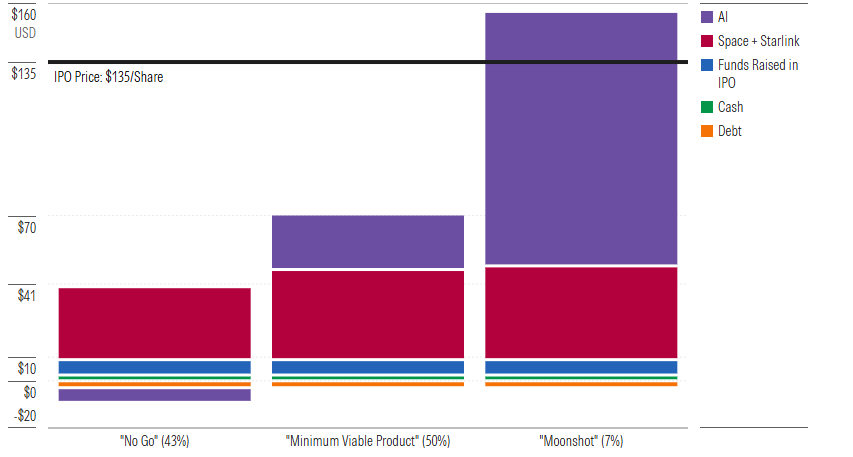
Source: Morningstar
“We think the company has been significantly overvalued and investors will have opportunities to buy the stock at more attractive levels after the IPO,” wrote Morningstar analysts.
Meanwhile, analysts are poking holes in SpaceX’s profitability. While the company has generated billions of dollars in revenue through launch services and Starlink, reports indicate that heavy investments continue to weigh on earnings.The company logged net losses of $4.28 billion in Q1 2026, with the space business and AI arm losing $619 million and $2.5 billion, respectively. Critics are pointing to the company’s S-1 filing and its acknowledgement of a history of net losses and the possibility that it may never achieve profitability.
SpaceX will go public on June 12 on the Nasdaq Exchange under the ticker SPCX, with Goldman Sachs predicting an AI revenue boom. The company ditched the traditional pricing range and set a fixed price of $135 per share, with up to 30% of shares earmarked for individual retail investors.
Investors continue to bet on Musk
Despite mounting criticisms, investor demand remains strong for the SpaceX IPO. Proponents are backing the company given its dominance in commercial launches and the continued expansion of the Starlink satellite network.Meanwhile, others are pointing to Elon Musk’s track record of building high-growth companies.
The success of Tesla and the rapid rise of xAI have convinced many investors that traditional valuation models may underestimate the potential of Musk-led ventures.Furthermore, concerns around forced index buying and “FOMO” have seen investors jostling for position ahead of the IPO. CNBC’s Jim Cramer has previously warned of an imminent artificial supply squeeze given the stock’s tiny public float, with investors keen on leveraging the structural quirk to their advantage.
If the offering succeeds, it could validate the market’s willingness to pay a significant premium for growth and innovation. While there is a possibility that the offering may struggle, SpaceX is unwilling to blink as the IPO inches closer.


You May Also Like
India’s Central Bank Issues Detailed Guidelines for Forex Swap Facility
Trump’s presidency is finished: political analyst
UK FCA Proposes Letting Authorized Funds Hold Crypto ETNs Under Strict Limits



