

SK Hynix Stock Is Up 240% This Year — And It Just Hit $1 Trillion
TLDR
- SK Hynix hit a $1 trillion market cap this week, becoming only the second South Korean company in history to reach the milestone.
- The stock is up 240% year-to-date and over 80% in May alone.
- SK Hynix Q1 revenue nearly tripled year-over-year to 52.6 trillion won ($34.8bn), with operating profit up fivefold.
- The company holds a 57% share of the high-bandwidth memory (HBM) market and has locked in ~70% of Nvidia’s Vera Rubin HBM orders.
- US investors can’t buy the stock directly yet, but the Roundhill Memory ETF (DRAM) — currently trading around $60 — holds SK Hynix as its second-largest position at 27%.
SK Hynix joined one of the most exclusive clubs in global finance this week, crossing the $1 trillion market cap threshold on the back of explosive AI-driven demand for memory chips.
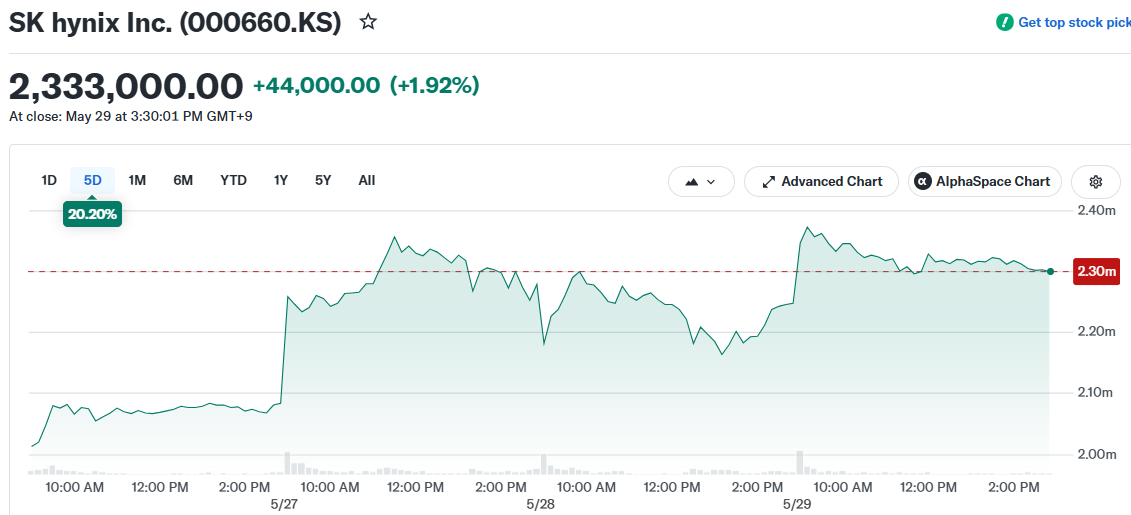 SK hynix Inc. (000660.KS)
The South Korean chipmaker’s stock price has surged 240% since January 1, and more than 80% in May alone — one of the most dramatic single-month runs for any company of its size. On Friday, its market cap stood at 1.66 quadrillion won, or roughly $1.10 trillion.
It’s the third chip company to hit the milestone this month, following US-based Micron and fellow South Korean heavyweight Samsung Electronics. The three companies together account for nearly all of the world’s memory chip production.
The trigger is simple: AI infrastructure requires enormous amounts of memory. As demand for GPUs and AI accelerators has exploded, so has the need for the high-bandwidth memory (HBM) that powers them — and SK Hynix has been the clearest beneficiary.
SK Hynix’s Numbers Are Hard to Ignore
Q1 revenue came in at 52.6 trillion won ($34.8bn), up threefold year-over-year. Operating profit surged fivefold to 37.6 trillion won ($24.9bn). Operating margins hit an all-time high of 72%.
Those aren’t just good numbers — they’re historic. The company’s financials have been reshaped entirely by HBM, the product it pioneered and still dominates.
SK Hynix held a 57% share of the global HBM market in Q4 2025, and expects to retain over 50% share for the next-generation HBM4 in 2026. It has also secured approximately 70% of HBM orders for Nvidia’s Vera Rubin platform, tying its fortunes closely to the world’s largest chipmaker.
The company is also signing three-to-five year long-term supply deals with customers — a structural shift that should reduce the wild cyclical swings the memory market has historically been prone to.
How US Investors Can Get Exposure
SK Hynix does not yet trade in the US market. The company has filed for American depositary receipts (ADRs), which could begin trading later this year, but nothing is confirmed.
In the meantime, the Roundhill Memory ETF (DRAM), currently trading at around $60–$63 per share, offers the clearest path in. SK Hynix makes up 27% of the fund’s portfolio. Micron sits at the top at just over 29%, with Samsung at 19%.
The ETF also includes NAND exposure through Kioxia and Sandisk, plus hard-disk-drive names like Seagate and Western Digital.
On valuation, SK Hynix is trading at a forward P/E of under 7 — unusually low for a company putting up these numbers, though partly a reflection of the currency and access barriers for most investors.
SK Hynix believes DRAM will remain supply-constrained through 2030, and is investing 19 trillion won ($13bn) in a new fabrication plant dedicated to advanced packaging to keep pace with demand.
Only 17 companies in history have ever reached a $1 trillion valuation. SK Hynix is now one of just four non-US companies on that list, alongside Samsung, TSMC, and Saudi Aramco.
The post SK Hynix Stock Is Up 240% This Year — And It Just Hit $1 Trillion appeared first on CoinCentral.


You May Also Like

MAGA pundit humiliated after drawing a blank on Trump accomplishments

Metaplanet buys 5,075 Bitcoin in Q1 to become 3rd-largest treasury

BTC Price Shaky Near $67K While Oil Surges on Middle East Tensions: What's Next? (April 2 Update)



