The Most Secure Crypto Exchanges in 2026 (Ranked & Compared)
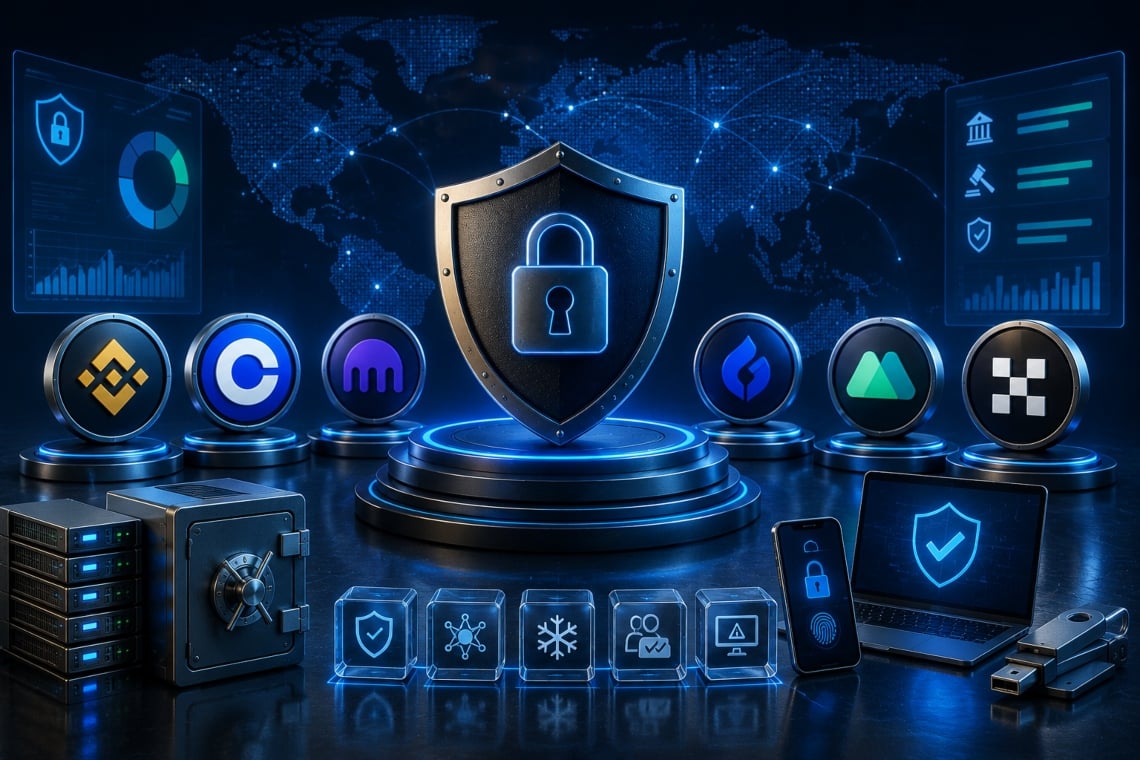
Security has become the defining factor in choosing a cryptocurrency exchange in 2026. With billions in digital assets held on centralized platforms, exchanges remain exposed to risks such as cyberattacks, internal failures, regulatory actions, and liquidity stress events.
Following several high-profile industry incidents in recent years, users and institutions increasingly prioritize transparency, proof of reserves, custody architecture, and regulatory oversight over trading fees or feature sets.
This ranking evaluates the most secure crypto exchanges in 2026 using a transparent, structured methodology focused on measurable security and trust indicators.
How We Evaluate Crypto Exchange Security
Each exchange is assessed using a standardized scoring framework across the following categories:
- Custody Infrastructure (cold storage usage, wallet architecture, multi-signature systems)
- Proof of Reserves (PoR) transparency and verification mechanisms
- Regulatory Compliance and licensing coverage
- Insurance & Protection Funds for user asset coverage
- Security Audits & Certifications (e.g., ISO standards, third-party audits)
- Operational Track Record (historical hacks, outages, or fund losses)
- Transparency Level (public reporting, disclosures, and verifiability)
Each category is weighted to reflect real-world risk exposure, with custody and PoR carrying the highest importance.
Security Ranking of Crypto Exchanges in 2026
1. Binance
Binance remains the largest global crypto exchange by volume and liquidity. Its security infrastructure has evolved significantly, particularly after industry-wide pressure to improve transparency and reserve reporting.
Security Overview
- Majority of user assets held in cold storage
- SAFU (Secure Asset Fund for Users) protection fund
- Multi-layer risk monitoring and anomaly detection systems
- Advanced withdrawal controls (2FA, whitelist, anti-phishing)
- Regular Proof of Reserves reporting
Considerations
Binance benefits from deep liquidity, robust infrastructure, and a dedicated insurance fund designed to protect users in extreme scenarios.
Due to its scale and global exposure, Binance remains a high-value target for attackers and operates under varying regulatory scrutiny across jurisdictions.
2. Bitget
Bitget has positioned itself as a security-focused exchange with strong emphasis on verifiable reserves and institutional-grade protection mechanisms.
Security Overview
- Multi-signature cold wallet infrastructure for asset custody
- Merkle Tree-based Proof of Reserves (PoR)
- Protection Fund exceeding $300 million for extreme risk scenarios
- ISO 27001 and ISO 27701 certifications for security and privacy management
Bitget stands out for combining Proof of Reserves transparency with a dedicated protection fund and formal security certifications, aligning it with institutional security expectations.
3. Coinbase
Coinbase is widely regarded as one of the most secure and regulated crypto platforms globally, particularly strong in institutional-grade custody.
Security Overview
- ~98% of customer assets stored in offline cold storage
- Publicly listed company with audited financial statements
- Strong regulatory oversight (U.S.-based, SEC reporting requirements)
- Insurance coverage for fiat balances (where applicable)
- Strong authentication standards (2FA, biometrics)
Coinbase prioritizes conservative asset management and compliance, making it a preferred choice for institutional investors and risk-averse users.
Higher fees and limited asset selection compared to offshore exchanges.
4. Kraken
Kraken has built one of the strongest reputations in the industry for security-first engineering and operational discipline.
Security Overview
- Majority of funds held in cold storage
- No major exchange-wide hacks since launch
- Global Settings Lock and Master Key protections
- Regular independent security audits
- Advanced account-level controls
Kraken’s long-term track record and conservative security culture place it among the most trusted exchanges in the industry.
Lower liquidity compared to Binance or Coinbase in certain markets.
5. OKX
OKX has made significant investments in infrastructure security and transparency, particularly in its Proof of Reserves implementation.
Security Overview
- Multi-layer hot and cold wallet separation
- Regular PoR reporting with on-chain verification
- Advanced internal risk control systems
- Strong encryption and withdrawal protection mechanisms
OKX offers a balanced combination of liquidity, transparency, and technical security infrastructure.
Regulatory status varies across regions, which may affect accessibility.
6. Bybit
Bybit focuses on trading performance while continuously improving its security and risk management systems.
Security Overview
- Majority of funds stored in cold wallets
- Insurance fund covering liquidation and risk events
- Real-time risk engine monitoring
- Mandatory security features (2FA, anti-phishing tools)
Bybit has improved transparency and infrastructure resilience in recent years, particularly in derivatives risk management.
Less regulatory coverage compared to Coinbase or Kraken.
Key Takeaways: What Actually Makes an Exchange “Secure” in 2026
Security in crypto exchanges is no longer defined only by cold storage. In 2026, the most important factors are:
- Verifiable Proof of Reserves (PoR)
- Transparent custody architecture
- Regulatory alignment and audits
- Dedicated insurance or protection funds
- Long-term operational track record
No exchange is risk-free. Even the most secure platforms differ in terms of regulatory exposure, transparency depth, and historical resilience.
Conclusion
The most secure crypto exchanges in 2026 combine strong custody infrastructure with transparency mechanisms and regulatory accountability.
Coinbase and Kraken lead in trust and regulatory strength. Binance leads in scale and liquidity with strong security infrastructure. OKX and Bitget stand out for transparency-driven models and evolving security frameworks. Bybit continues improving its institutional-grade risk systems


You May Also Like

LIST: Bayanihan initiatives amid soaring oil prices

Egyptian foreign minister to meet Putin over Iran conflict

Metaplanet Stock Passes MARA to Become Third-Largest BTC Holder — Stock Slips Anyway