This article explores how physics-informed neural networks (PINNs) can simulate shock wave generation, interactions, and entropy solutions. Using Burgers’ equation as a test case, the models accurately handle wave formation, collisions, and rarefaction without prior knowledge of origin points. The results highlight how deep learning can advance computational fluid dynamics by tackling problems once limited to traditional numerical methods.This article explores how physics-informed neural networks (PINNs) can simulate shock wave generation, interactions, and entropy solutions. Using Burgers’ equation as a test case, the models accurately handle wave formation, collisions, and rarefaction without prior knowledge of origin points. The results highlight how deep learning can advance computational fluid dynamics by tackling problems once limited to traditional numerical methods.

Shocks, Collisions, and Entropy—Neural Networks Handle It All

Abstract and 1. Introduction

1.1. Introductory remarks

1.2. Basics of neural networks

1.3. About the entropy of direct PINN methods

1.4. Organization of the paper

  1. Non-diffusive neural network solver for one dimensional scalar HCLs

    2.1. One shock wave

    2.2. Arbitrary number of shock waves

    2.3. Shock wave generation

    2.4. Shock wave interaction

    2.5. Non-diffusive neural network solver for one dimensional systems of CLs

    2.6. Efficient initial wave decomposition

  2. Gradient descent algorithm and efficient implementation

    3.1. Classical gradient descent algorithm for HCLs

    3.2. Gradient descent and domain decomposition methods

  3. Numerics

    4.1. Practical implementations

    4.2. Basic tests and convergence for 1 and 2 shock wave problems

    4.3. Shock wave generation

    4.4. Shock-Shock interaction

    4.5. Entropy solution

    4.6. Domain decomposition

    4.7. Nonlinear systems

  4. Conclusion and References

4.3. Shock wave generation

In this section, we demonstrate the potential of our algorithms to handle shock wave generation, as described in Subsection 2.3. One of the strengths of the proposed algorithm

\
\ is that it does not require to know the initial position&time of birth, in order to accurately track the DLs. Recall that the principle is to assume that in a given (sub)domain and from a smooth function a shock wave will eventually be generated. Hence we decompose the corresponding (sub)domain in two subdomains and consider three neural networks: two neural networks will approximate the solution in each subdomain, and one neural network will approximate the DL. As long as the shock wave is not generated (say for t < t∗ ), the global solution remains smooth and the Rankine-Hugoniot condition is trivially satisfied (null jump); hence the DL for t < t∗ does not have any meaning.

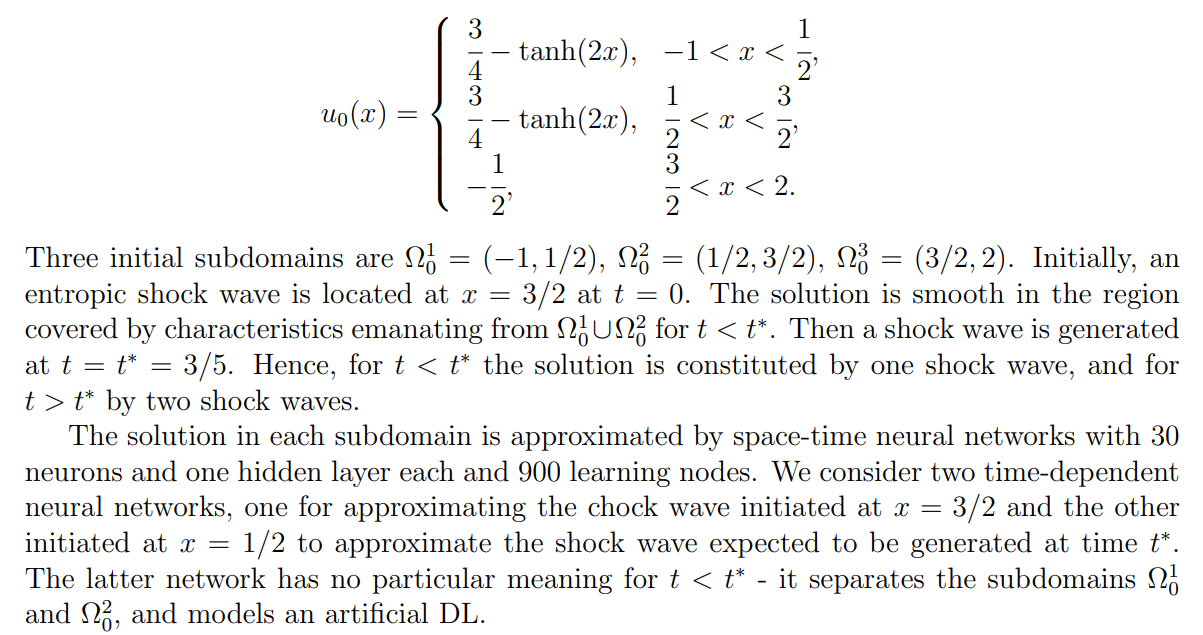
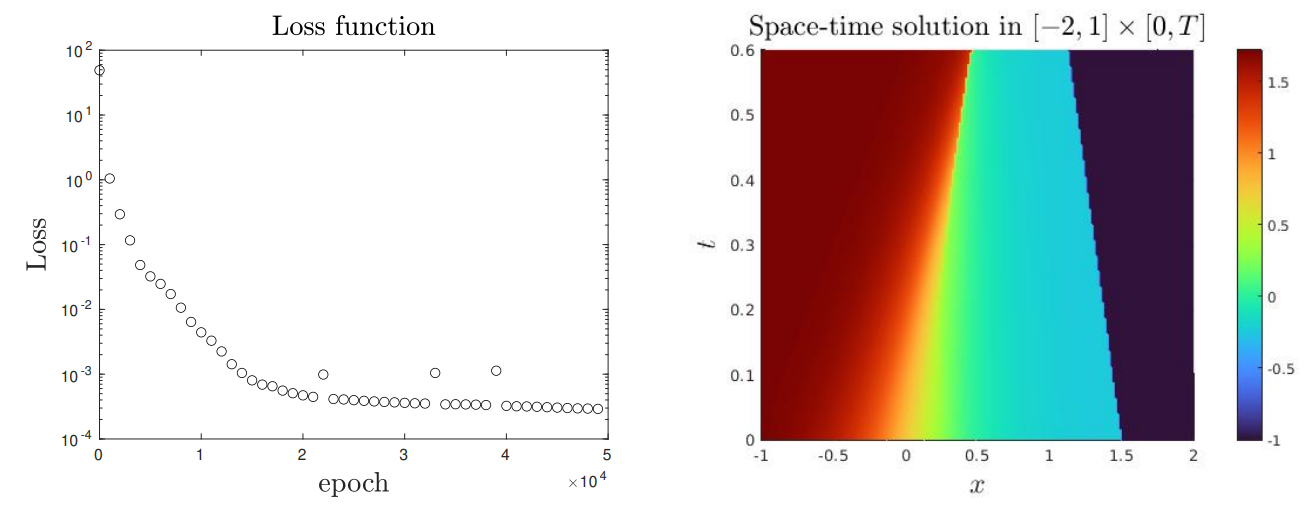
\ Experiment 4. We again consider the inviscid Burgers’ equation, Ω × [0, T] = (−1, 2) × [0, 0.5] and the initial condition

\
\
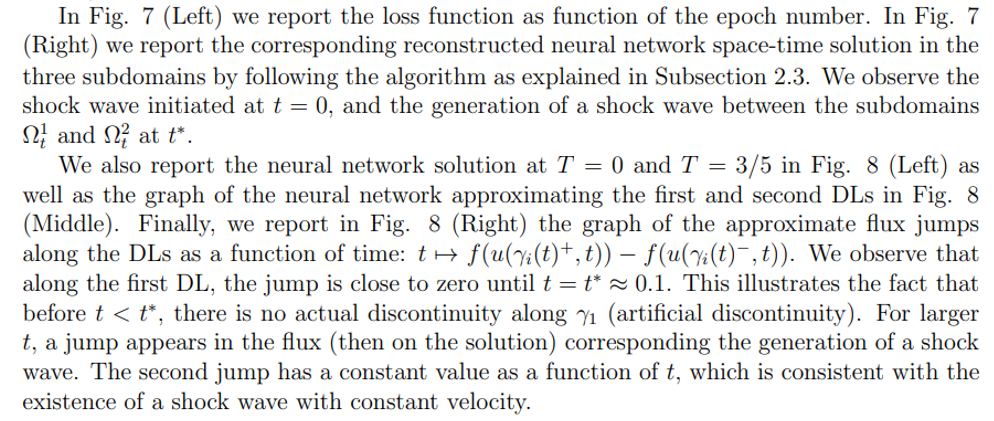
\ Figure 7: Experiment 4. (Left) Loss function. (Right) Space-time solution
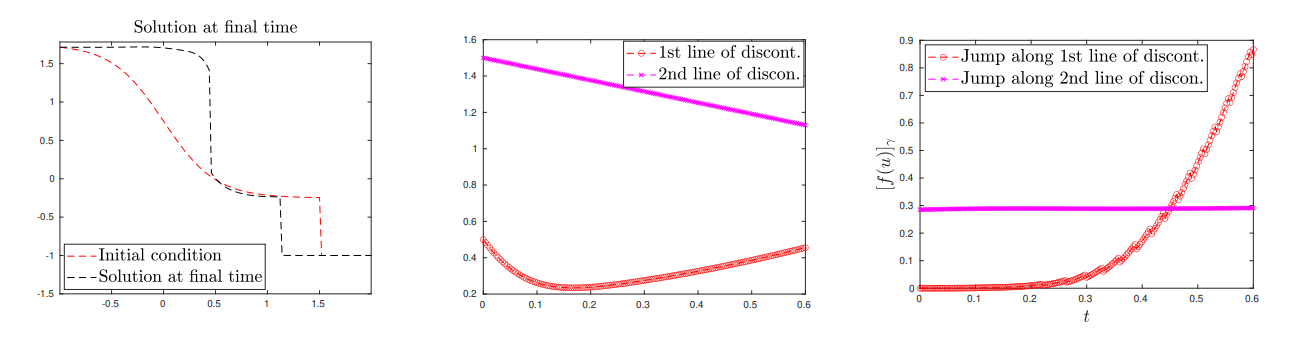
\ Figure 8: Experiment 4. (Left) Graph of the solution at T = 3/5. (Middle) Discontinuity lines. (Right) Flux jump along the DLs.

\

4.4. Shock-Shock interaction

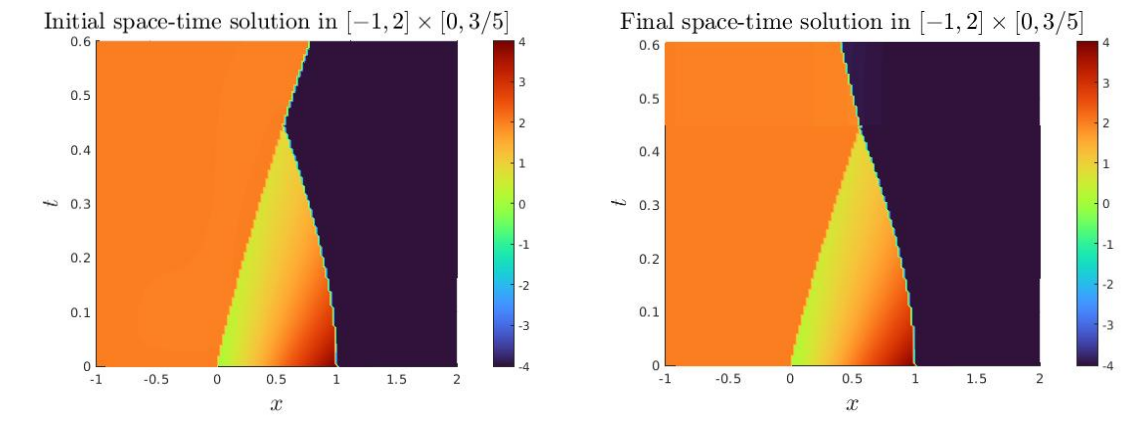
In this subsection, we are proposing a test involving the interaction of two shock waves merging to generate a third shock wave. As explained in Subsection 2.4, in this case it is necessary re-decompose the full domain once the two shock waves have interacted.

\ \
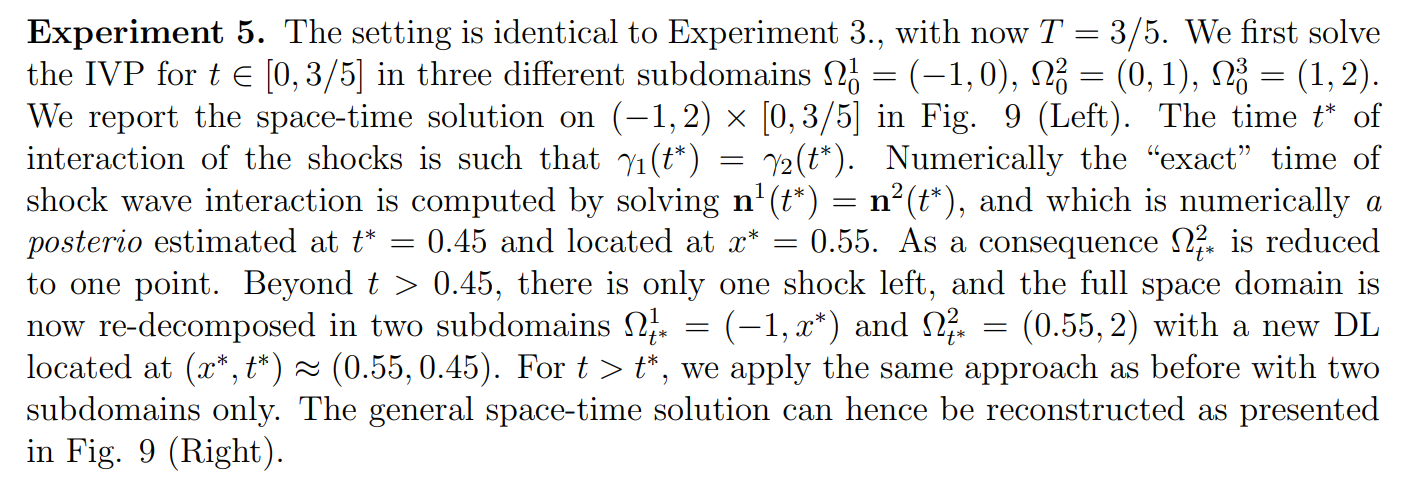
\ \ \ Figure 9: Experiment 5. (Left) Space-time solution without shock interaction (artificial for t > t∗ = 0.45. (Right) Space-time solution with shock interaction.
\

4.5. Entropy solution

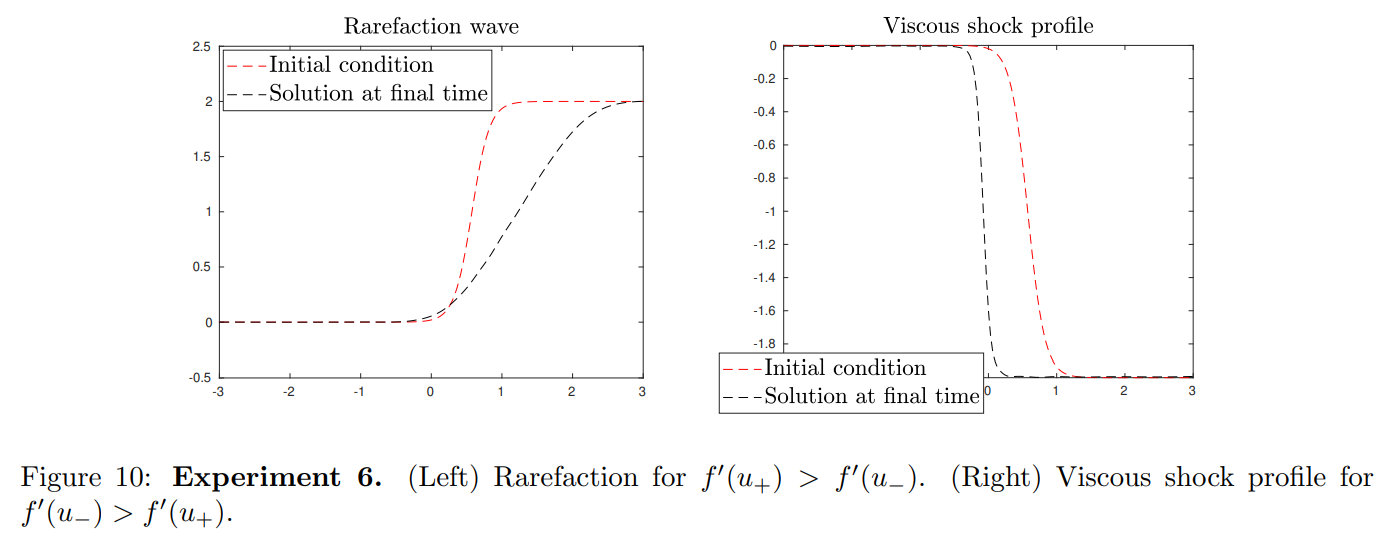
We propose here an experiment dedicated to the computation of the viscous shock profiles and rarefaction waves and illustrating the discussion from Subsection 1.3. In this example, a regularized non-entropic shock is shown to be “destabilized” into rarefaction wave by the direct PINN method.

\ \

\ \ \ \

\ \ \
\ \

:::info Authors:

(1) Emmanuel LORIN, School of Mathematics and Statistics, Carleton University, Ottawa, Canada, K1S 5B6 and Centre de Recherches Mathematiques, Universit´e de Montr´eal, Montreal, Canada, H3T 1J4 (elorin@math.carleton.ca);

(2) Arian NOVRUZI, a Corresponding Author from Department of Mathematics and Statistics, University of Ottawa, Ottawa, ON K1N 6N5, Canada (novruzi@uottawa.ca).

:::


:::info This paper is available on arxiv under CC by 4.0 Deed (Attribution 4.0 International) license.

:::

\

Market Opportunity
Instadapp Logo
Instadapp Price(FLUID)
$2.7248
$2.7248$2.7248
-2.18%
USD
Instadapp (FLUID) Live Price Chart
Disclaimer: The articles reposted on this site are sourced from public platforms and are provided for informational purposes only. They do not necessarily reflect the views of MEXC. All rights remain with the original authors. If you believe any content infringes on third-party rights, please contact service@support.mexc.com for removal. MEXC makes no guarantees regarding the accuracy, completeness, or timeliness of the content and is not responsible for any actions taken based on the information provided. The content does not constitute financial, legal, or other professional advice, nor should it be considered a recommendation or endorsement by MEXC.

You May Also Like

Woodway Assurance receives $1 million in funding for data privacy assurance solution EviData

Woodway Assurance receives $1 million in funding for data privacy assurance solution EviData

OTTAWA, ON, Dec. 17, 2025 /PRNewswire/ – New Canadian technology company Woodway Assurance is proud to announce that it has closed an oversubscribed seed funding
Share
AI Journal2025/12/17 23:16
Wormhole Unleashes W 2.0 Tokenomics for a Connected Blockchain Future

Wormhole Unleashes W 2.0 Tokenomics for a Connected Blockchain Future

TLDR Wormhole reinvents W Tokenomics with Reserve, yield, and unlock upgrades. W Tokenomics: 4% yield, bi-weekly unlocks, and a sustainable Reserve Wormhole shifts to long-term value with treasury, yield, and smoother unlocks. Stakers earn 4% base yield as Wormhole optimizes unlocks for stability. Wormhole’s new Tokenomics align growth, yield, and stability for W holders. Wormhole [...] The post Wormhole Unleashes W 2.0 Tokenomics for a Connected Blockchain Future appeared first on CoinCentral.
Share
Coincentral2025/09/18 02:07
BlackRock boosts AI and US equity exposure in $185 billion models

BlackRock boosts AI and US equity exposure in $185 billion models

The post BlackRock boosts AI and US equity exposure in $185 billion models appeared on BitcoinEthereumNews.com. BlackRock is steering $185 billion worth of model portfolios deeper into US stocks and artificial intelligence. The decision came this week as the asset manager adjusted its entire model suite, increasing its equity allocation and dumping exposure to international developed markets. The firm now sits 2% overweight on stocks, after money moved between several of its biggest exchange-traded funds. This wasn’t a slow shuffle. Billions flowed across multiple ETFs on Tuesday as BlackRock executed the realignment. The iShares S&P 100 ETF (OEF) alone brought in $3.4 billion, the largest single-day haul in its history. The iShares Core S&P 500 ETF (IVV) collected $2.3 billion, while the iShares US Equity Factor Rotation Active ETF (DYNF) added nearly $2 billion. The rebalancing triggered swift inflows and outflows that realigned investor exposure on the back of performance data and macroeconomic outlooks. BlackRock raises equities on strong US earnings The model updates come as BlackRock backs the rally in American stocks, fueled by strong earnings and optimism around rate cuts. In an investment letter obtained by Bloomberg, the firm said US companies have delivered 11% earnings growth since the third quarter of 2024. Meanwhile, earnings across other developed markets barely touched 2%. That gap helped push the decision to drop international holdings in favor of American ones. Michael Gates, lead portfolio manager for BlackRock’s Target Allocation ETF model portfolio suite, said the US market is the only one showing consistency in sales growth, profit delivery, and revisions in analyst forecasts. “The US equity market continues to stand alone in terms of earnings delivery, sales growth and sustainable trends in analyst estimates and revisions,” Michael wrote. He added that non-US developed markets lagged far behind, especially when it came to sales. This week’s changes reflect that position. The move was made ahead of the Federal…
Share
BitcoinEthereumNews2025/09/18 01:44