Polygon has restored full network stability after a software bug temporarily disrupted milestone finality and forced some nodes offline, according to an official incident report published on the project’s status page. The issue began early Wednesday when a bug affecting Bor, Polygon’s block producer, and Erigon, its data access layer, caused disruptions across parts of the ecosystem. While the blockchain itself continued to produce blocks, some Remote Procedure Call (RPC) services and validators halted, forcing providers to rewind to the last finalized block and resynchronize. Polygon Executes Emergency Hard Fork to Resolve Finality Bug Polygon engineers confirmed the bug was preventing node progress under certain configurations, though restarting affected nodes resolved the issue for several validators and RPC providers. At the time, Polygonscan, the network’s block explorer, showed no block updates for more than five hours. Polygon later explained that Polygonscan’s nodes had halted after a faulty milestone produced by Heimdall, the project’s consensus engine. A company representative said that the team was working with Polygonscan to switch to functioning nodes that had not halted, stressing that block production remained live. “Checkpoint finality is working as expected within 15 minutes,” the team said in an update at 08:52 UTC, sharing an alternative link where real-time block production could be tracked. Analysis revealed the problem stemmed from Heimdall’s finality gadget, which is responsible for producing milestones every few seconds. Although checkpoints to Ethereum were still being posted every 20 minutes, milestones, which provide faster, deterministic finality, were not being processed. This left local fast finality delayed even as the main chain continued adding blocks. To address the problem, Polygon rolled out emergency updates: Bor version 2.2.11-beta2 and Heimdall version 0.3.1, the latter requiring a hard fork. The upgrade, executed at 3 p.m. UTC, deleted the faulty milestone and purged it from node databases. Polygon confirmed soon after that the hard fork was successfully completed and that both milestones and checkpoints were once again finalizing normally.Source: Polygonscan “The hard fork has been successfully completed, and milestones are now processing normally along with state sync. Checkpoints are going through, and consensus finalization has been fully restored on Polygon PoS,” the team wrote in a statement on X. Polygon Foundation co-founder and CEO Sandeep Nailwal later explained that the disruption originated from a faulty milestone proposal that pushed some Bor nodes onto divergent forks. This triggered short-term instability not accounted for in the system. He emphasized that while checkpoint finality on Ethereum had remained active throughout, local milestone finality was delayed. “Milestones are a lightweight alternative to checkpoints, enabling faster, deterministic finality for transactions, even before a checkpoint is submitted to Ethereum,” Nailwal said. “The root cause came from a faulty milestone proposal. We rolled out fixes on both Heimdall and Bor. With these fixes now live, nodes are not stuck, and consensus is finalizing normally.” Nailwal described the event as part of the growing pains of scaling Polygon’s proof-of-stake chain but said each challenge strengthens its resilience. “There will be growing pains with any ambitious upgrade. But each one makes Polygon PoS stronger on our road to GigaGas throughput,” he said, adding that more upgrades are planned to boost capacity and reliability. Polygon engineers continue to monitor the network to ensure stability and are investigating how the faulty milestone was introduced. Despite the temporary setback, the network has resumed normal operations, with blocks, milestones, and checkpoints processing in real time Polygon’s Reliability Questioned After Finality Bug, TVL Down 87% From Peak Polygon developers have deployed a hard fork to fix a bug that temporarily halted block production on its proof-of-stake chain, restoring the network after several hours of disruption. The issue, tied to transaction finality, left exchanges and DeFi protocols unable to process deposits or withdrawals as they waited for confirmation guarantees. The outage drew criticism from Polymarket traders, who argued that a blockchain hosting one of the sector’s largest prediction markets should not face such problems. “It might have gone unnoticed because no one was using it, but this has been going on for about two hours,” one trader posted, pointing to the risk of reversals during the downtime. TokenPocket, a multichain stablecoin wallet, also paused Polygon transactions after observing that no new blocks had been finalized for over an hour. The incident comes just weeks after Polygon’s Heimdall v2 upgrade, designed to cut finality times to five seconds and improve validator coordination. That update followed the July 1 Bhilai hard fork, which raised throughput to 1,000 transactions per second and integrated Ethereum’s Pectra EIPs. Despite these efforts, network reliability remains a concern, as Polygon’s total value locked has dropped from a $9.43 billion peak in 2021 to $1.2 billion today, per DeFiLlama. The chain’s native token, POL, has fallen 3.4% on the day and is down 30% year-to-date, trading at $0.27. Meanwhile, another Ethereum Layer-2, Linea, faced a separate outage earlier today when its mainnet sequencer stalled, causing a 67-minute pause in block production. While Linea has already deployed a fix, developers are questioning whether the two disruptions are linked. Linea has not disclosed the cause of its downtime. Both events highlight the fragility of scaling networks that have become essential to Ethereum’s broader ecosystemPolygon has restored full network stability after a software bug temporarily disrupted milestone finality and forced some nodes offline, according to an official incident report published on the project’s status page. The issue began early Wednesday when a bug affecting Bor, Polygon’s block producer, and Erigon, its data access layer, caused disruptions across parts of the ecosystem. While the blockchain itself continued to produce blocks, some Remote Procedure Call (RPC) services and validators halted, forcing providers to rewind to the last finalized block and resynchronize. Polygon Executes Emergency Hard Fork to Resolve Finality Bug Polygon engineers confirmed the bug was preventing node progress under certain configurations, though restarting affected nodes resolved the issue for several validators and RPC providers. At the time, Polygonscan, the network’s block explorer, showed no block updates for more than five hours. Polygon later explained that Polygonscan’s nodes had halted after a faulty milestone produced by Heimdall, the project’s consensus engine. A company representative said that the team was working with Polygonscan to switch to functioning nodes that had not halted, stressing that block production remained live. “Checkpoint finality is working as expected within 15 minutes,” the team said in an update at 08:52 UTC, sharing an alternative link where real-time block production could be tracked. Analysis revealed the problem stemmed from Heimdall’s finality gadget, which is responsible for producing milestones every few seconds. Although checkpoints to Ethereum were still being posted every 20 minutes, milestones, which provide faster, deterministic finality, were not being processed. This left local fast finality delayed even as the main chain continued adding blocks. To address the problem, Polygon rolled out emergency updates: Bor version 2.2.11-beta2 and Heimdall version 0.3.1, the latter requiring a hard fork. The upgrade, executed at 3 p.m. UTC, deleted the faulty milestone and purged it from node databases. Polygon confirmed soon after that the hard fork was successfully completed and that both milestones and checkpoints were once again finalizing normally.Source: Polygonscan “The hard fork has been successfully completed, and milestones are now processing normally along with state sync. Checkpoints are going through, and consensus finalization has been fully restored on Polygon PoS,” the team wrote in a statement on X. Polygon Foundation co-founder and CEO Sandeep Nailwal later explained that the disruption originated from a faulty milestone proposal that pushed some Bor nodes onto divergent forks. This triggered short-term instability not accounted for in the system. He emphasized that while checkpoint finality on Ethereum had remained active throughout, local milestone finality was delayed. “Milestones are a lightweight alternative to checkpoints, enabling faster, deterministic finality for transactions, even before a checkpoint is submitted to Ethereum,” Nailwal said. “The root cause came from a faulty milestone proposal. We rolled out fixes on both Heimdall and Bor. With these fixes now live, nodes are not stuck, and consensus is finalizing normally.” Nailwal described the event as part of the growing pains of scaling Polygon’s proof-of-stake chain but said each challenge strengthens its resilience. “There will be growing pains with any ambitious upgrade. But each one makes Polygon PoS stronger on our road to GigaGas throughput,” he said, adding that more upgrades are planned to boost capacity and reliability. Polygon engineers continue to monitor the network to ensure stability and are investigating how the faulty milestone was introduced. Despite the temporary setback, the network has resumed normal operations, with blocks, milestones, and checkpoints processing in real time Polygon’s Reliability Questioned After Finality Bug, TVL Down 87% From Peak Polygon developers have deployed a hard fork to fix a bug that temporarily halted block production on its proof-of-stake chain, restoring the network after several hours of disruption. The issue, tied to transaction finality, left exchanges and DeFi protocols unable to process deposits or withdrawals as they waited for confirmation guarantees. The outage drew criticism from Polymarket traders, who argued that a blockchain hosting one of the sector’s largest prediction markets should not face such problems. “It might have gone unnoticed because no one was using it, but this has been going on for about two hours,” one trader posted, pointing to the risk of reversals during the downtime. TokenPocket, a multichain stablecoin wallet, also paused Polygon transactions after observing that no new blocks had been finalized for over an hour. The incident comes just weeks after Polygon’s Heimdall v2 upgrade, designed to cut finality times to five seconds and improve validator coordination. That update followed the July 1 Bhilai hard fork, which raised throughput to 1,000 transactions per second and integrated Ethereum’s Pectra EIPs. Despite these efforts, network reliability remains a concern, as Polygon’s total value locked has dropped from a $9.43 billion peak in 2021 to $1.2 billion today, per DeFiLlama. The chain’s native token, POL, has fallen 3.4% on the day and is down 30% year-to-date, trading at $0.27. Meanwhile, another Ethereum Layer-2, Linea, faced a separate outage earlier today when its mainnet sequencer stalled, causing a 67-minute pause in block production. While Linea has already deployed a fix, developers are questioning whether the two disruptions are linked. Linea has not disclosed the cause of its downtime. Both events highlight the fragility of scaling networks that have become essential to Ethereum’s broader ecosystem

Polygon Hard Fork Fixes Bug That Knocked Nodes Offline — Network Back Online

2025/09/11 07:59

Polygon has restored full network stability after a software bug temporarily disrupted milestone finality and forced some nodes offline, according to an official incident report published on the project’s status page.

The issue began early Wednesday when a bug affecting Bor, Polygon’s block producer, and Erigon, its data access layer, caused disruptions across parts of the ecosystem.

While the blockchain itself continued to produce blocks, some Remote Procedure Call (RPC) services and validators halted, forcing providers to rewind to the last finalized block and resynchronize.

Polygon Executes Emergency Hard Fork to Resolve Finality Bug

Polygon engineers confirmed the bug was preventing node progress under certain configurations, though restarting affected nodes resolved the issue for several validators and RPC providers.

At the time, Polygonscan, the network’s block explorer, showed no block updates for more than five hours. Polygon later explained that Polygonscan’s nodes had halted after a faulty milestone produced by Heimdall, the project’s consensus engine.

A company representative said that the team was working with Polygonscan to switch to functioning nodes that had not halted, stressing that block production remained live.

“Checkpoint finality is working as expected within 15 minutes,” the team said in an update at 08:52 UTC, sharing an alternative link where real-time block production could be tracked.

Analysis revealed the problem stemmed from Heimdall’s finality gadget, which is responsible for producing milestones every few seconds.

Although checkpoints to Ethereum were still being posted every 20 minutes, milestones, which provide faster, deterministic finality, were not being processed. This left local fast finality delayed even as the main chain continued adding blocks.

To address the problem, Polygon rolled out emergency updates: Bor version 2.2.11-beta2 and Heimdall version 0.3.1, the latter requiring a hard fork. The upgrade, executed at 3 p.m. UTC, deleted the faulty milestone and purged it from node databases.

Polygon confirmed soon after that the hard fork was successfully completed and that both milestones and checkpoints were once again finalizing normally.
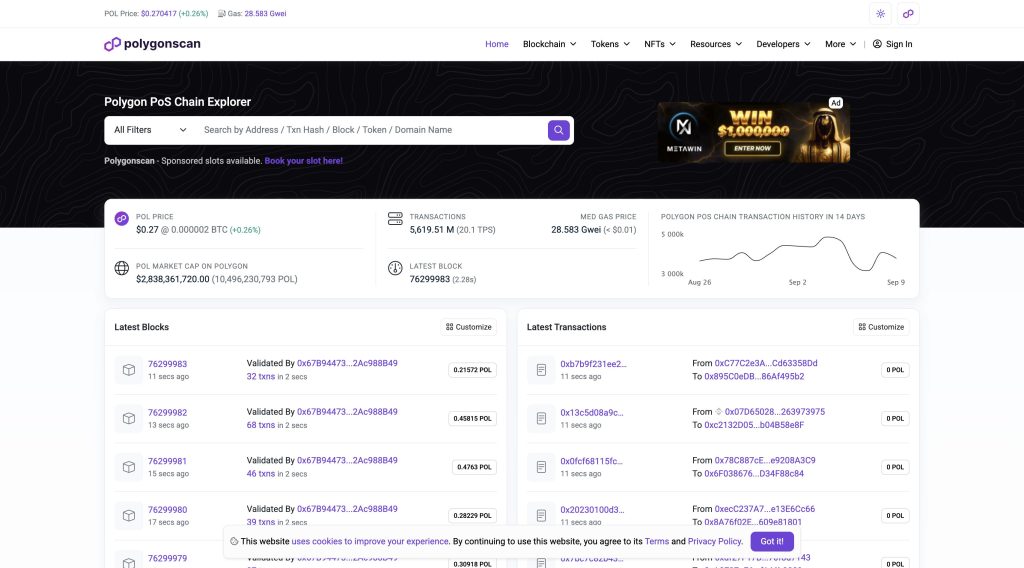
Source: Polygonscan

“The hard fork has been successfully completed, and milestones are now processing normally along with state sync. Checkpoints are going through, and consensus finalization has been fully restored on Polygon PoS,” the team wrote in a statement on X.

Polygon Foundation co-founder and CEO Sandeep Nailwal later explained that the disruption originated from a faulty milestone proposal that pushed some Bor nodes onto divergent forks. This triggered short-term instability not accounted for in the system.

He emphasized that while checkpoint finality on Ethereum had remained active throughout, local milestone finality was delayed.

“Milestones are a lightweight alternative to checkpoints, enabling faster, deterministic finality for transactions, even before a checkpoint is submitted to Ethereum,” Nailwal said. “The root cause came from a faulty milestone proposal. We rolled out fixes on both Heimdall and Bor.

With these fixes now live, nodes are not stuck, and consensus is finalizing normally.”

Nailwal described the event as part of the growing pains of scaling Polygon’s proof-of-stake chain but said each challenge strengthens its resilience. “There will be growing pains with any ambitious upgrade.

But each one makes Polygon PoS stronger on our road to GigaGas throughput,” he said, adding that more upgrades are planned to boost capacity and reliability.

Polygon engineers continue to monitor the network to ensure stability and are investigating how the faulty milestone was introduced.

Despite the temporary setback, the network has resumed normal operations, with blocks, milestones, and checkpoints processing in real time

Polygon’s Reliability Questioned After Finality Bug, TVL Down 87% From Peak

Polygon developers have deployed a hard fork to fix a bug that temporarily halted block production on its proof-of-stake chain, restoring the network after several hours of disruption.

The issue, tied to transaction finality, left exchanges and DeFi protocols unable to process deposits or withdrawals as they waited for confirmation guarantees.

The outage drew criticism from Polymarket traders, who argued that a blockchain hosting one of the sector’s largest prediction markets should not face such problems. “It might have gone unnoticed because no one was using it, but this has been going on for about two hours,” one trader posted, pointing to the risk of reversals during the downtime.

TokenPocket, a multichain stablecoin wallet, also paused Polygon transactions after observing that no new blocks had been finalized for over an hour.

The incident comes just weeks after Polygon’s Heimdall v2 upgrade, designed to cut finality times to five seconds and improve validator coordination.

That update followed the July 1 Bhilai hard fork, which raised throughput to 1,000 transactions per second and integrated Ethereum’s Pectra EIPs. Despite these efforts, network reliability remains a concern, as Polygon’s total value locked has dropped from a $9.43 billion peak in 2021 to $1.2 billion today, per DeFiLlama.

The chain’s native token, POL, has fallen 3.4% on the day and is down 30% year-to-date, trading at $0.27.

Meanwhile, another Ethereum Layer-2, Linea, faced a separate outage earlier today when its mainnet sequencer stalled, causing a 67-minute pause in block production.

While Linea has already deployed a fix, developers are questioning whether the two disruptions are linked. Linea has not disclosed the cause of its downtime.

Both events highlight the fragility of scaling networks that have become essential to Ethereum’s broader ecosystem.

Disclaimer: The articles reposted on this site are sourced from public platforms and are provided for informational purposes only. They do not necessarily reflect the views of MEXC. All rights remain with the original authors. If you believe any content infringes on third-party rights, please contact service@support.mexc.com for removal. MEXC makes no guarantees regarding the accuracy, completeness, or timeliness of the content and is not responsible for any actions taken based on the information provided. The content does not constitute financial, legal, or other professional advice, nor should it be considered a recommendation or endorsement by MEXC.

You May Also Like

Tether's value surges over 40-fold, with a $500 billion valuation hinting at both capital and narrative ambitions.

Tether's value surges over 40-fold, with a $500 billion valuation hinting at both capital and narrative ambitions.

By Nancy, PANews News that Tether is in talks to raise funds at a $500 billion valuation has propelled it to new heights. If the deal goes through, its valuation would leap to the highest of any global crypto company, rivaling even Silicon Valley unicorns like OpenAI and SpaceX. Tether, with its strong capital base, boasts profit levels that have driven its price-to-earnings ratio beyond the reach of both crypto and traditional institutions. Yet, its pursuit of a new round of capital injection at a high valuation serves not only as a powerful testament to its profitability but also as a means of shaping the market narrative through capital operations, building momentum for future business and market expansion. Net worth soared more than 40 times in a year, and well-known core investors are being evaluated. On September 24, Bloomberg reported that stablecoin giant Tether is planning to sell approximately 3% of its shares at a valuation of $15 billion to $20 billion. If the deal goes through, Tether's valuation could reach approximately $500 billion, making it one of the world's most valuable private companies and potentially setting a record for the largest single financing in the history of the crypto industry. By comparison, in November 2024, Cantor Fitzgerald, a prominent US financial services firm, acquired approximately 5% of Tether for $600 million, valuing the company at approximately $12 billion. This means Tether's value has increased more than 40-fold in less than a year. However, since Cantor Fitzgerald's former CEO, Howard Lutnick, is currently the US Secretary of Commerce, the deal was interpreted as a "friendship price" that could potentially garner more political support for Tether. Tether's rapid rise in value is largely due to its dominant market share, impressive profit margins, and solid financial position. According to Coingecko data, as of September 24th, USDT's market capitalization exceeded $172 billion, setting a new record and accounting for over 60% of the market share. Furthermore, Tether CEO Paolo Ardoino recently admitted that Tether's profit margin is as high as 99%. The second-quarter financial report further demonstrates Tether's robust financial position, with $162.5 billion in reserve assets exceeding $157.1 billion in liabilities. "Tether has about $5.5 billion in cash, Bitcoin and equity assets on its balance sheet. If calculated based on the approximately $173 billion USDT in circulation and a 4% compound yield, and if it raises funds at a valuation of $500 billion, it means that its enterprise value to annualized return (PE) multiple is about 68 times," Dragonfly investor Omar pointed out. Sources familiar with the matter revealed that the disclosed valuation represents the upper end of the target range, and the final transaction value could be significantly lower. Negotiations are at an early stage, and investment details are subject to change. The transaction involves the issuance of new shares, not the sale of shares by existing investors. Paolo Ardoino later confirmed that the company is actively evaluating the possibility of raising capital from a number of prominent core investors. Behind the high valuation of external financing, the focus is on business expansion and compliance layout Tether has always been known to be "rich." The stablecoin giant is expected to generate $13.7 billion in net profit in 2024, thanks to interest income from U.S. Treasury bonds and cash assets. For any technology or financial company, this profit level is more than enough to support continued expansion. However, Tether is now launching a highly valued external financing plan. This is not only a capital operation strategy, but also relates to business expansion and regulatory compliance. According to Paolo Ardoino, Tether plans to raise funds to expand the company's strategic scale in existing and new business lines (stablecoins, distribution coverage, artificial intelligence, commodity trading, energy, communications, and media) by several orders of magnitude. He disclosed in July this year that Tether has invested in over 120 companies to date, and this number is expected to grow significantly in the coming months and years, with a focus on key areas such as payment infrastructure, renewable energy, Bitcoin, agriculture, artificial intelligence, and tokenization. In other words, Tether is trying to transform passive income that depends on the interest rate environment into active growth in cross-industry investments. But pressure is mounting. With the increasing number of competitors and the Federal Reserve resuming its interest rate cut cycle, Tether's main source of profit faces downward risks. The company has previously emphasized that its external investments are entirely sourced from its own profits. A decline in earnings expectations would mean a shrinking pool of funds available for expansion. However, the injection of substantial financing would provide Tether with ample liquidity for its investment portfolio. What truly necessitates Tether's capital and resources is expansion into the US market. With the implementation of the US GENIUS Act, stablecoin issuance enters a new compliance framework. This presents both a challenge and an opportunity for Tether. This is especially true after competitor Circle's successful IPO and capital market recognition, with its valuation soaring to $30 billion, further magnifying Tether's compliance shortcomings. On the one hand, USDT has long been on the gray edge, walking on the edge of regulation. Tether has successfully attracted public attention through extremely small equity transactions and huge valuations, and has also used this to enhance the market narrative, thereby breaking the negative perception of the outside world and significantly enhancing its own influence. On the other hand, unlike Circle's IPO, Tether has chosen a different path to gain mainstream market acceptance. In September of this year, Tether announced that it would launch a US-native stablecoin, USAT, by the end of the year. Unlike the widely circulated USDT, USAT is designed specifically for businesses and institutions operating under US regulations. It is issued by Anchorage Digital, a licensed digital asset bank, and operates on Tether's global distribution network. This allows Tether to retain control over its core profits while meeting regulatory compliance requirements. The personnel arrangements also make this new card intriguing. USAT's CEO is Bo Hines (see also: 29-Year-Old Crypto Upstart Bo Hines: From White House Crypto Liaison to Rapid Assignment to Tether's US Stablecoin ). In August of this year, Tether appointed him as its Digital Asset and US Strategy Advisor, responsible for developing and executing Tether's US market development strategy and strengthening communication with policymakers. As previously reported by PANews, Hines previously served as the White House Digital Asset Policy Advisor, where he was responsible for promoting crypto policy and facilitating the passage of the GENIUS Act, a US stablecoin, and has accumulated extensive connections in the political and business circles. This provides USAT with an additional layer of protection when entering the US market. Cantor Fitzgerald, the advisor to this financing round, is also noteworthy. As one of the Federal Reserve's designated principal dealers, Cantor boasts extensive experience in investment banking and private equity, building close ties to Wall Street's political and business networks. Furthermore, Cantor is the primary custodian of Tether's reserve assets, providing firsthand insight into the latter's fund operations. For external investors, Cantor's involvement not only adds credibility to Tether's financing valuation but also provides added certainty for the launch of USAT in the US market.
Share
PANews2025/09/24 15:52