This section formulates the UAV‑CRN rate maximization problem and proposes a BCD‑SCA algorithm, decomposing it into convex subproblems with proven convergence.This section formulates the UAV‑CRN rate maximization problem and proposes a BCD‑SCA algorithm, decomposing it into convex subproblems with proven convergence.

BCD‑SCA Based Optimization for UAV‑CRN: Joint Trajectory, Power, and Scheduling Design

Abstract and I. Introduction

II. System Model

III. Problem Formulation

IV. Proposed Algorithm for Problem P0

V. Numerical Results

VI. Conclusion

APPENDIX A: PROOF OF LEMMA 1 and References

II. SYSTEM MODEL
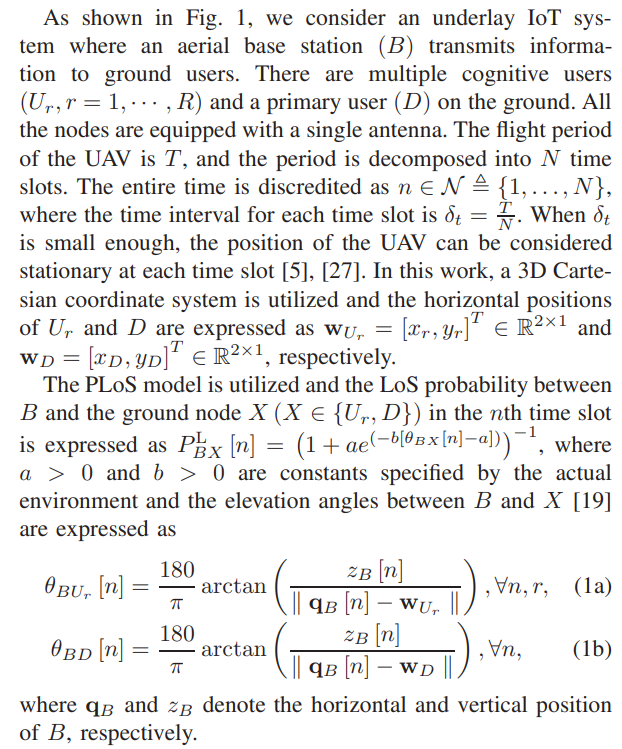
\ The channel coefficient between B and X in the nth time slot is expressed a

\
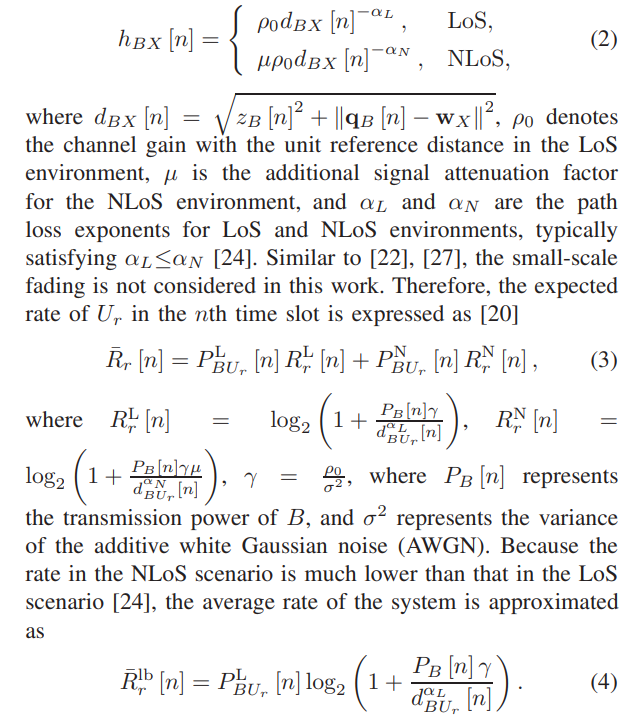
\
\ The horizontal energy consumption of B is expressed as [14]

\
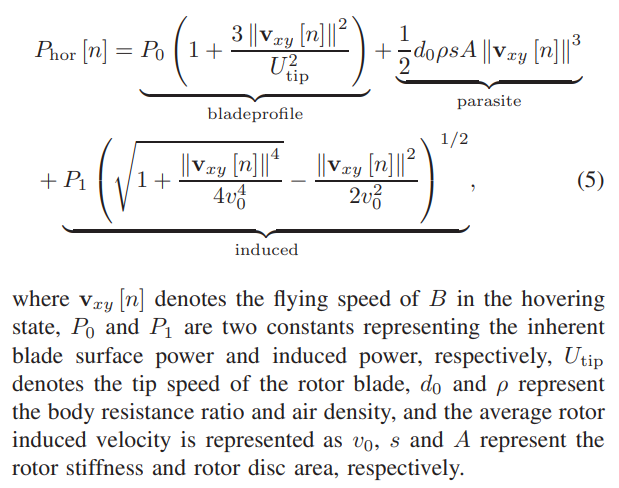
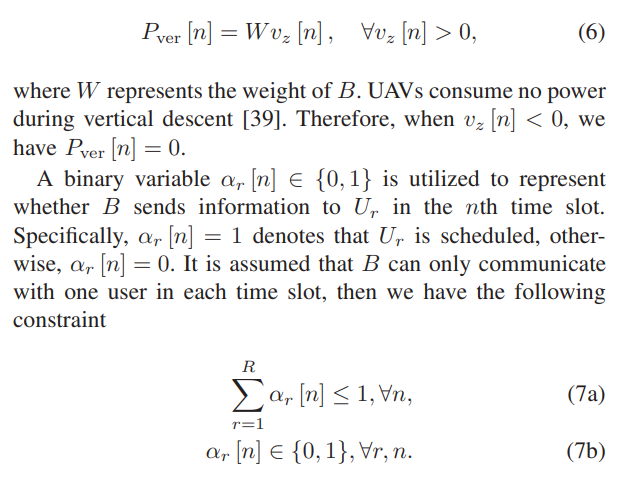
\ The energy consumption of B in the vertical direction is as expressed as [24], [39]

\
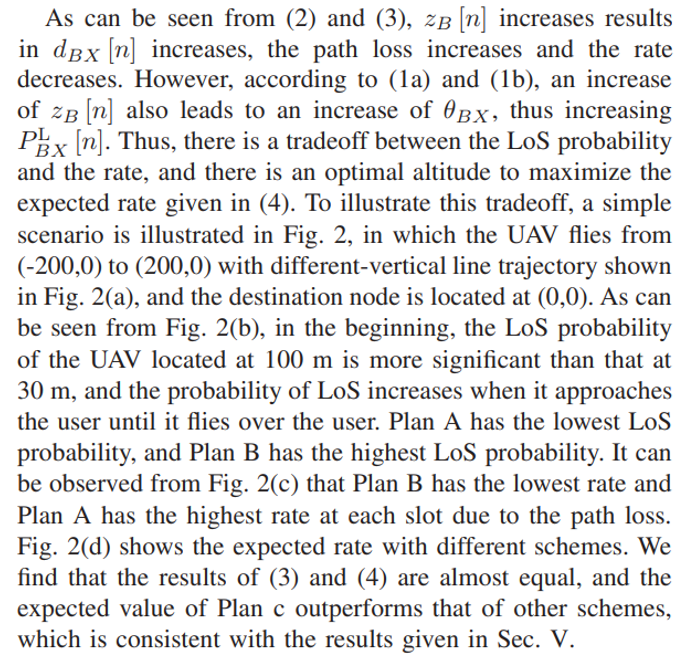
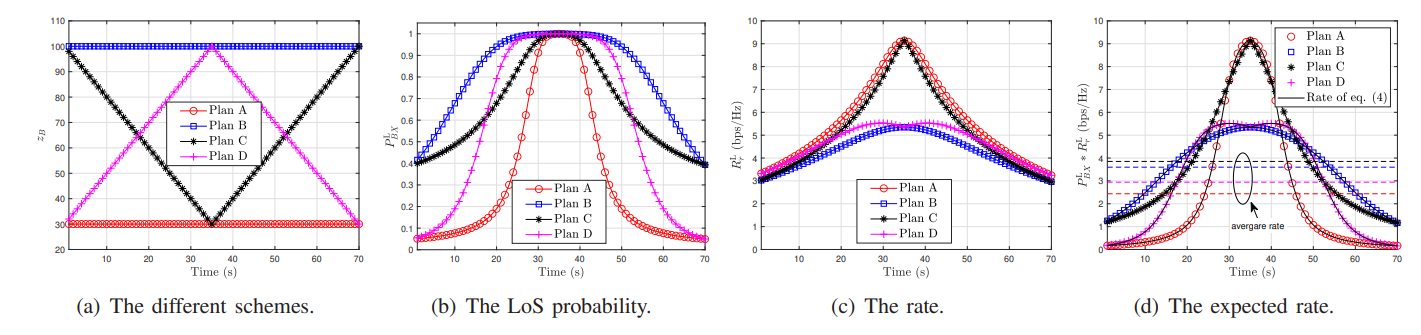
\ Fig. 2: The comparison among different schemes.
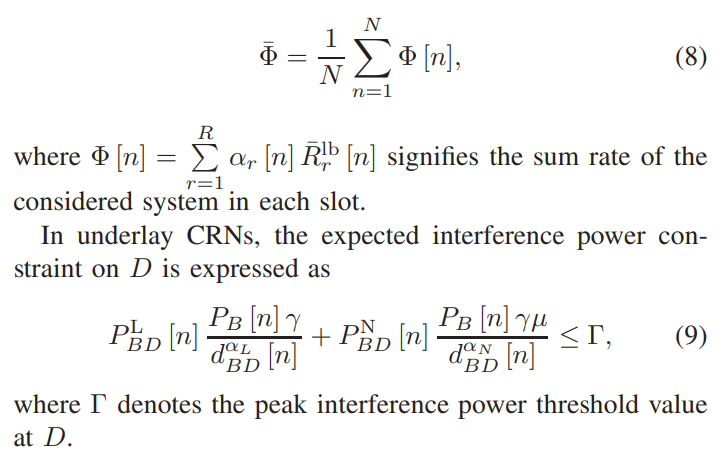
\ The average rate of the considered system is expressed as

\
\

III. PROBLEM FORMULATION

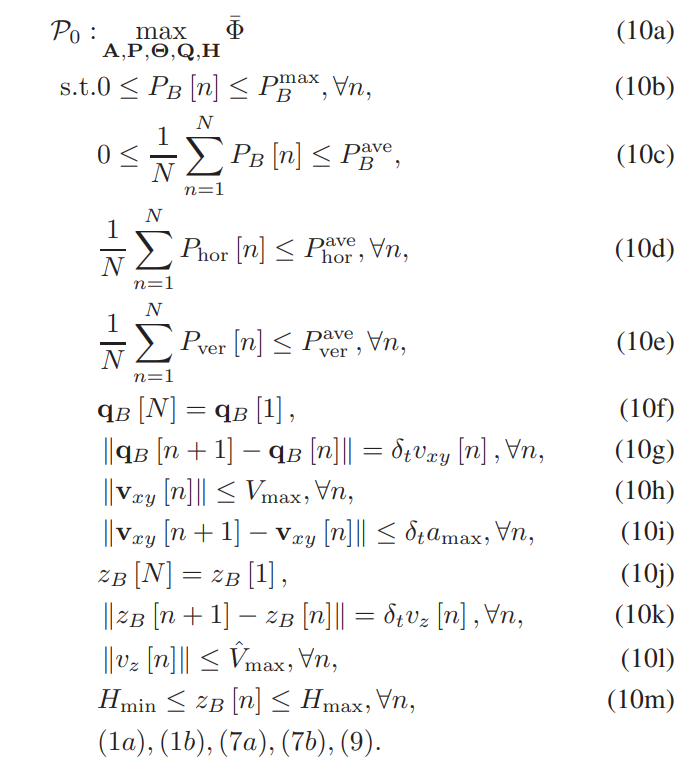
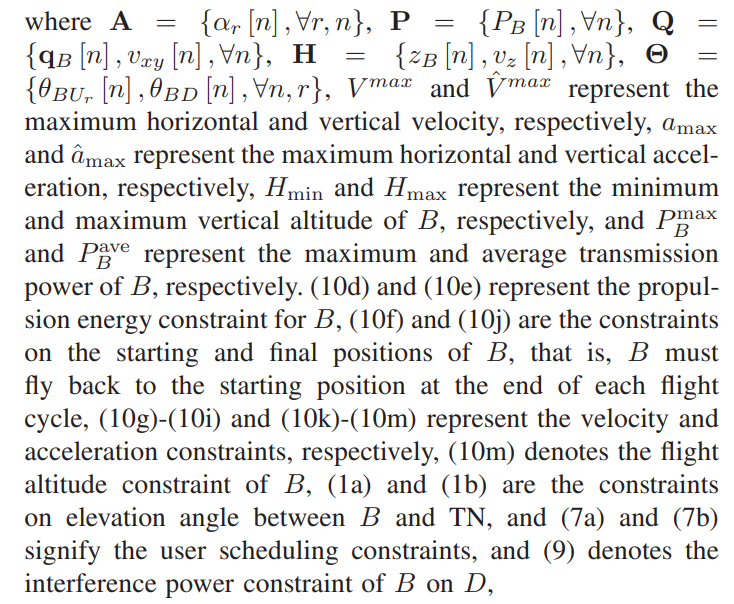
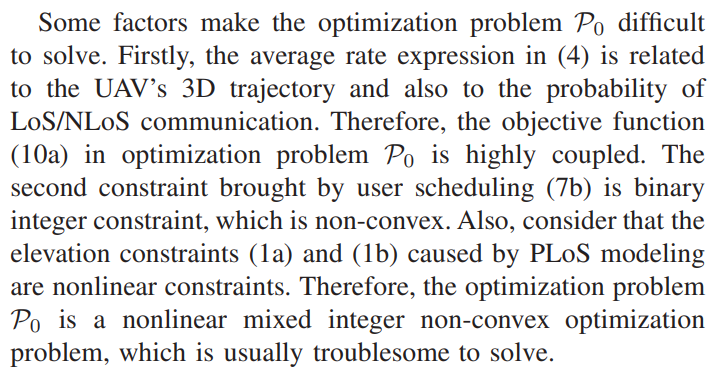
In this work, the average rate of the system is optimized, which is related to user scheduling, the transmission power and 3D trajectory, the horizontal and vertical velocities of B. Then the following optimization problem is formulated

\ \
\ \ \
\ \ \
\

IV. PROPOSED ALGORITHM FOR PROBLEM P0

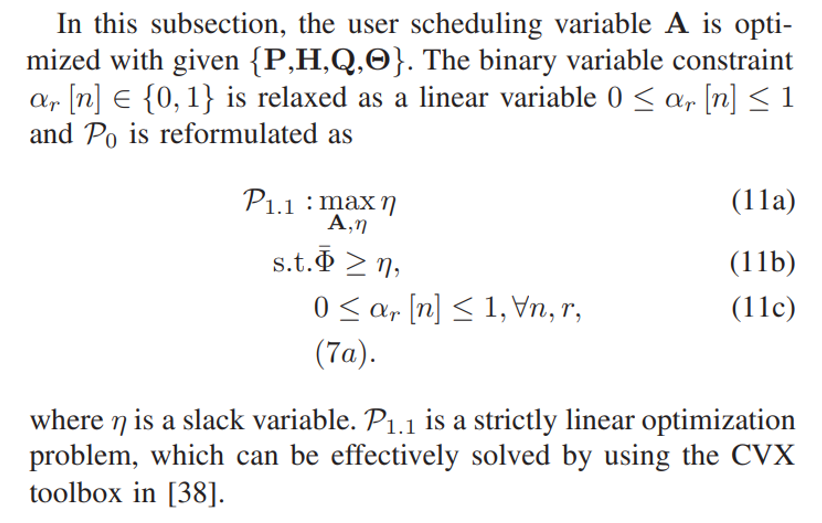
To solve P0, we utilize the BCD technology to decompose the original problem into multiple subproblems. Specifically, for the given other variables, A, P, H, and Q are optimized in each subproblem respectively. In addition, the SCA technology is utilized to transform the non-convex constraints into convex constraints.

\ A. Subproblem 1: Optimizing User Scheduling Variable

\ \
\ \ \

\ \ B. Subproblem 2: Optimizing Transmit Power of B

\ \
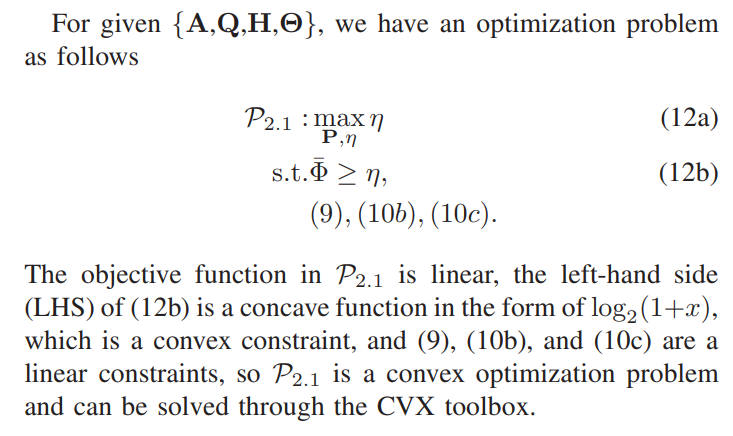
\ \ C. Subproblem 3: Optimizing Horizontal Trajectory and Velocity of B

\ In this subsection, the horizontal trajectory and velocity of B is optimized for provided {A,P,H}. The original optimization problem is rewritten as

\ \
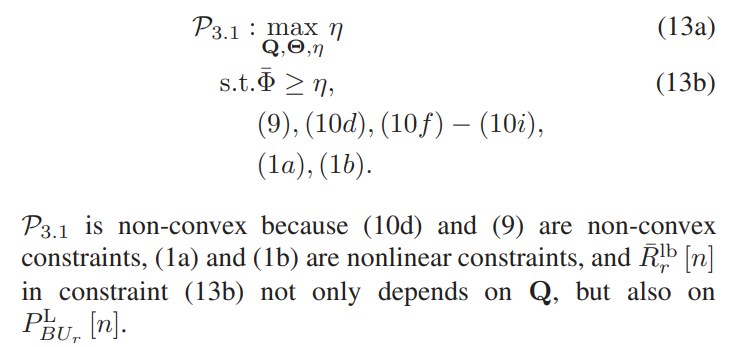
\ \ \
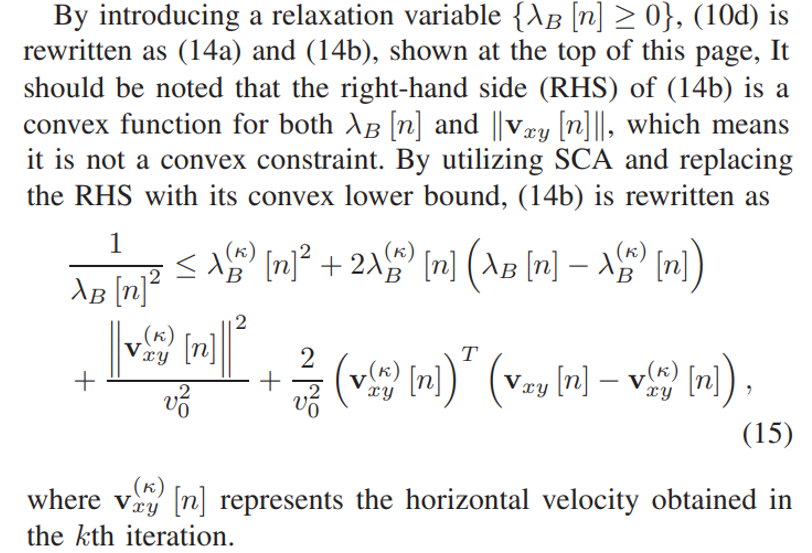
\ \ \
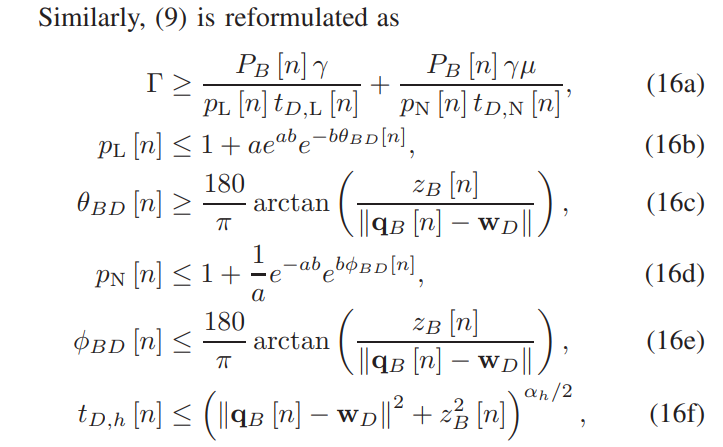
\ \ \
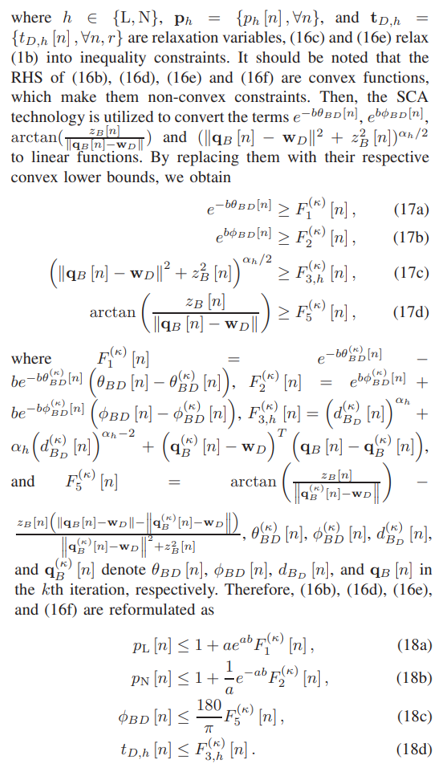
\ \ \
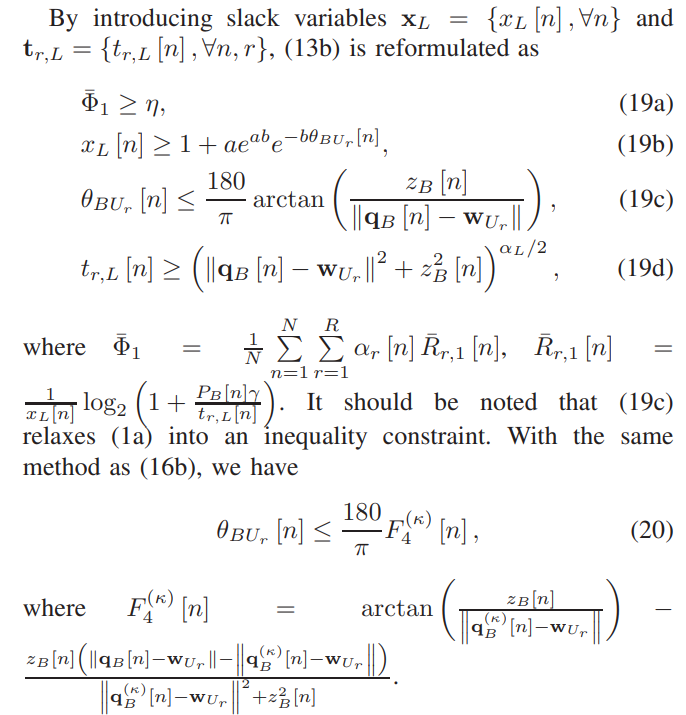
\ \ To address the non-convexity in (19a), Lemma 1 is introduced.

\ \
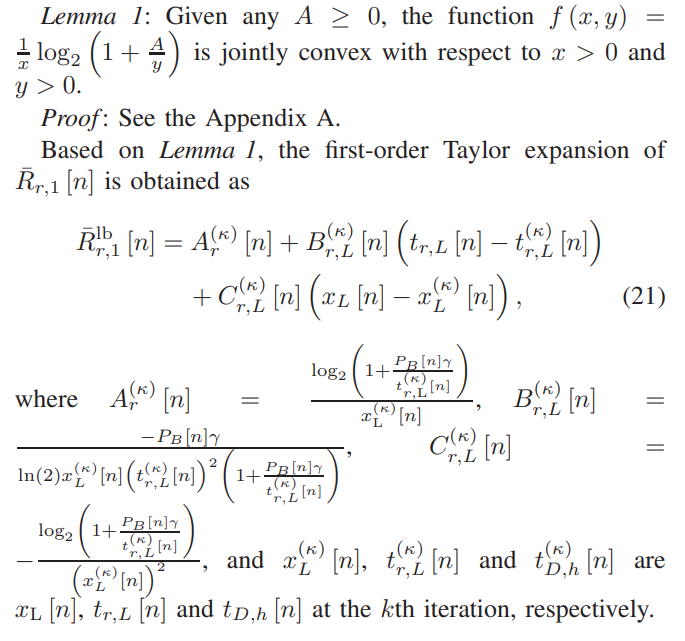
\ \ \
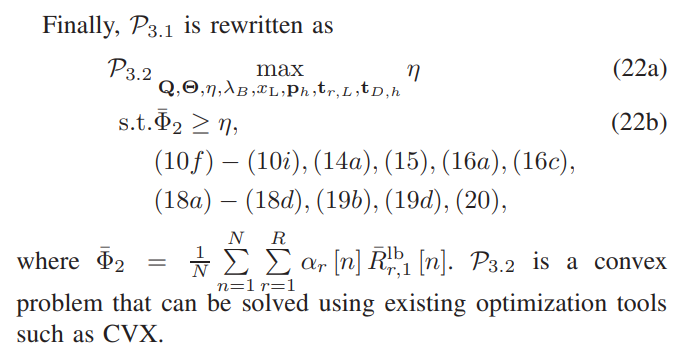
\ \ D. Subproblem 4: Optimizing Horizontal Trajectory and Velocity of B

\ In this subsection, for given {A,P,Q}, the vertical trajectory H of B is optimized. The optimization problem is expressed as

\ \
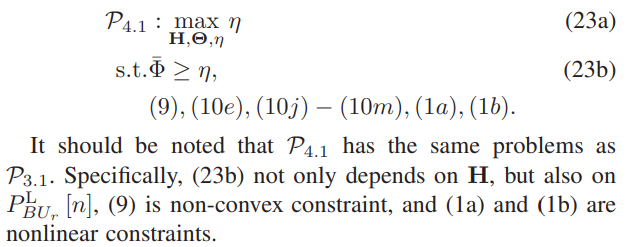
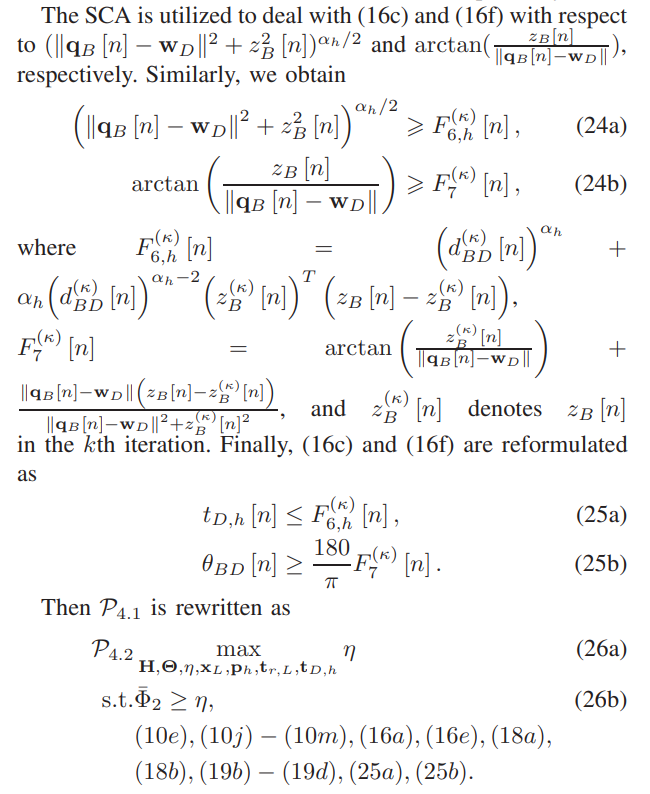
\ \ With the same method as (13b), (23b) is reformulated as (19a)-(19d) and (1a) and (1b) are reformulated as (16c), (16e), and (19c). With the same method in Subproblem 3, (9) in this subsection is reformulated as (16a)-(16f) wherein (16b) and (16d) are reformulated as (18a) and (18b), respectively.

\ \
\ \ \
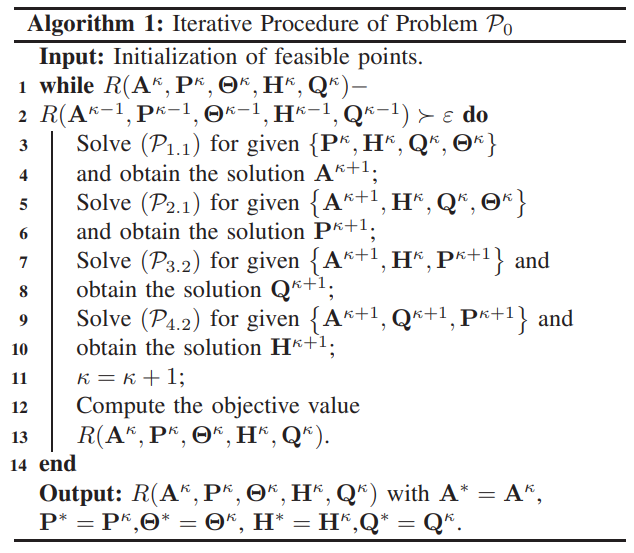
\ \ P4.2 is a convex optimization problem that can be solved using existing optimization tools such as CVX.

\ E. Convergence Analysis of Algorithm 1

\ \
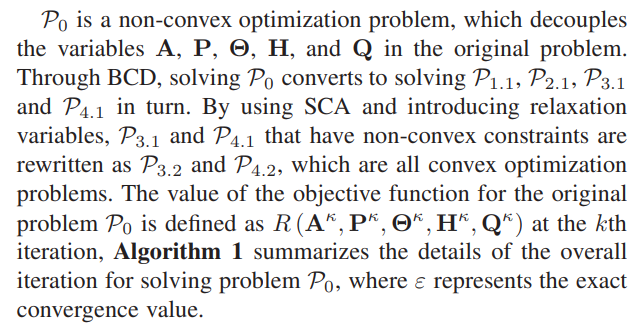
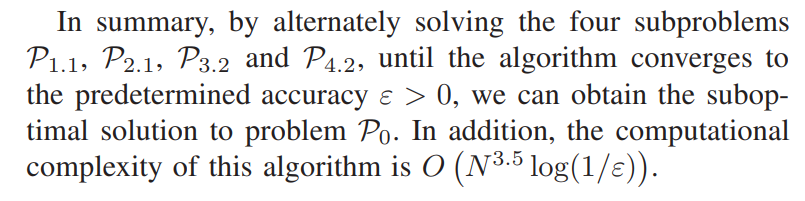
\ \ The obtained suboptimal solution of the transformed subproblem is also the suboptimal solution of the original nonconvex subproblem, and each subproblem is solved using SCA convex transformation iteration. Finally, all suboptimal solutions of the subproblems that satisfy the threshold ε constitute the suboptimal solution of the original problem. Therefore, our algorithm is to alternately solve the subproblem P1.1, P2.1, P3.2 and P4.2 to obtain the suboptimal solution of the original problem until a solution that satisfies the threshold ε is obtained.

\ It is worth noting that in the classic BCD, to ensure the convergence of the algorithm, it is necessary to accurately solve and update the subproblems of each variable block with optimality in each iteration. But when we solve P3.1 and P4.1 , we can only optimally solve their approximation problem P3.2 and P4.2. Therefore, we cannot directly apply the convergence analysis of the classical BCD, and further proof of the convergence of Algorithm 1 is needed, as shown below.

\ \
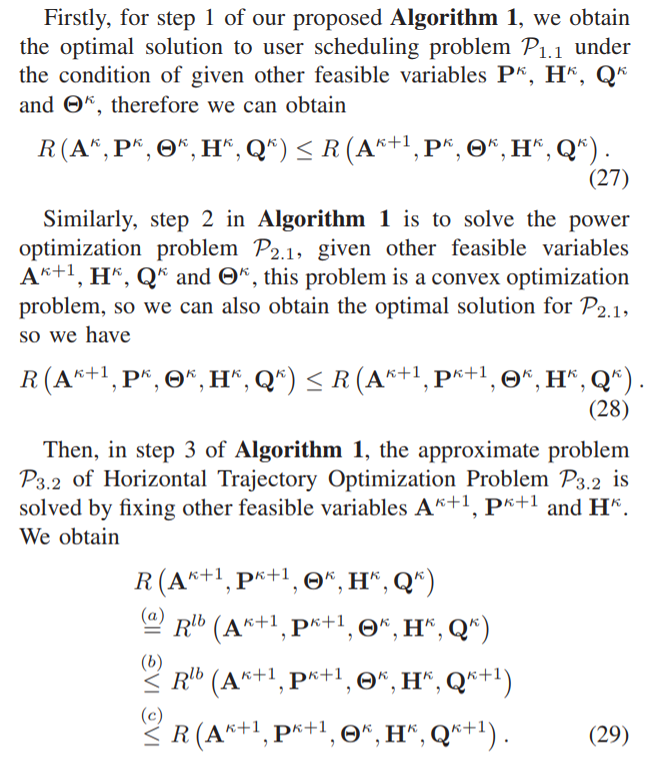
\ \ \
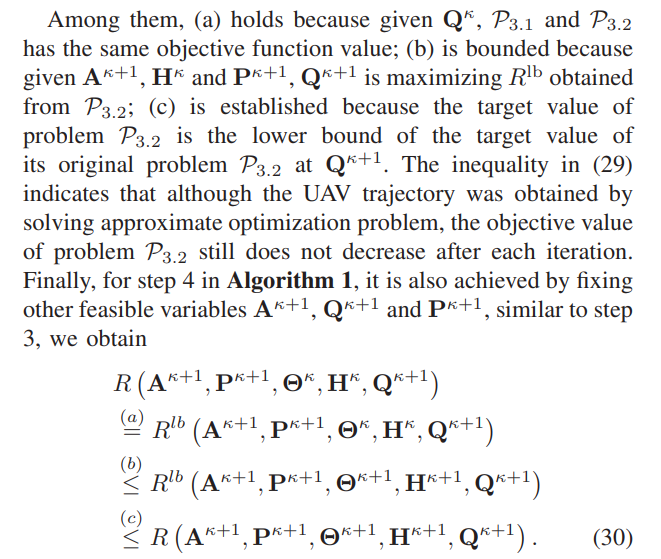
\ \ (30) This is similar to the representation in (29), and from (27) to (30), we obtain

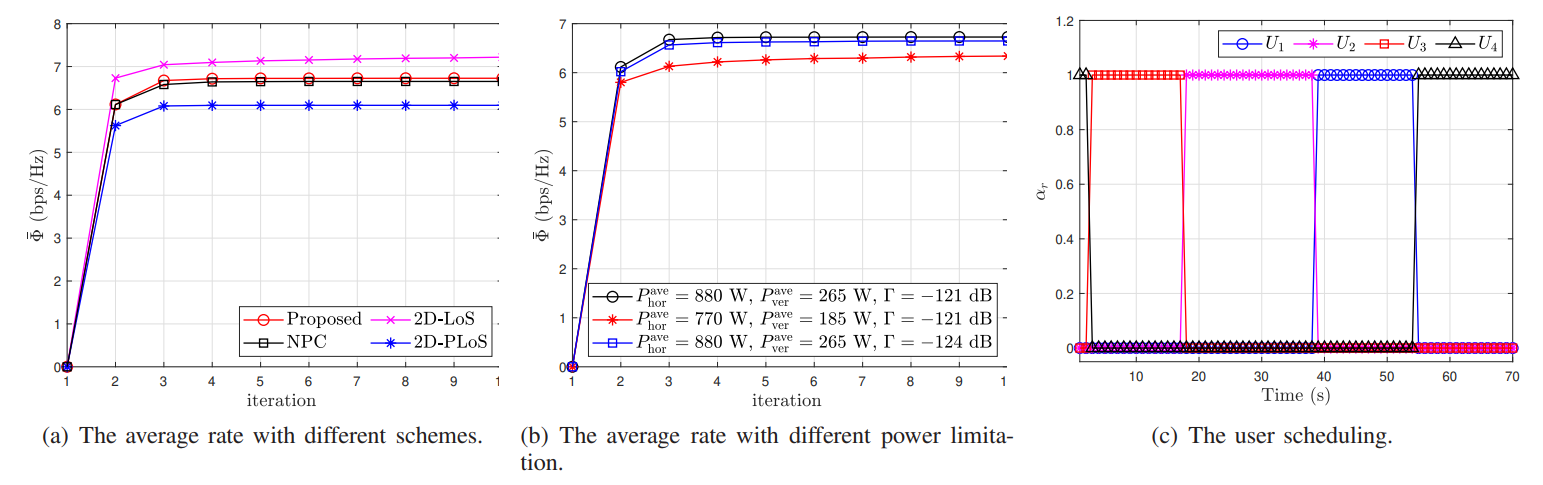
\ 1 . (31) The above analysis indicates that the target value of P0 does not decrease after each iteration of Algorithm 1. Due to the objective value of P0 is a finite upper bound, therefore the proposed Algorithm 1 ensures convergence. The simulation results in the next section indicate that the proposed BCDbased method converges rapidly for the setting we are considering. In addition, since only convex optimization problems need to be solved in each iteration of Algorithm 1, which have polynomial complexity, Algorithm 1 can actually converge

\ \ Fig. 3: The average rate and user scheduling.
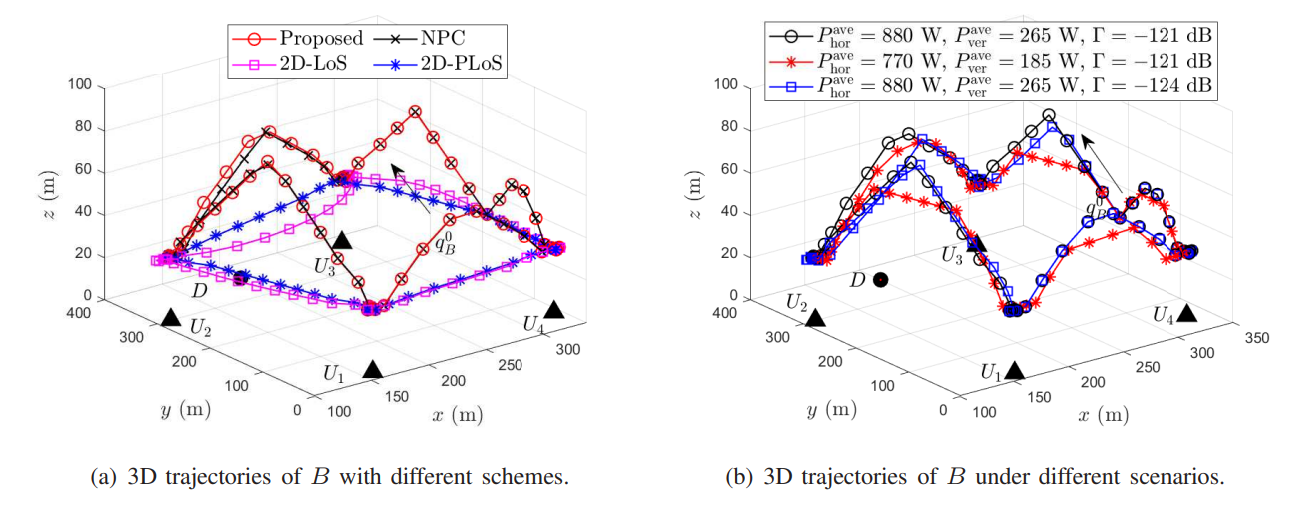
\ \ \ Fig. 4: 3D trajectories of B under different schemes and scenarios.

\ \ quickly for wireless networks with a moderate number of users.

\ \
\

:::info Authors:

(1) Hongjiang Lei, School of Communications and Information Engineering, Chongqing University of Posts and Telecommunications, Chongqing 400065, China (leihj@cqupt.edu.cn);

(2) Xiaqiu Wu, School of Communications and Information Engineering, Chongqing University of Posts and Telecommunications, Chongqing 400065, China (cquptwxq@163.com);

(3) Ki-Hong Park, CEMSE Division, King Abdullah University of Science and Technology (KAUST), Thuwal 23955-6900, Saudi Arabia (kihong.park@kaust.edu.sa);

(4) Gaofeng Pan, School of Cyberspace Science and Technology, Beijing Institute of Technology, Beijing 100081, China (gaofeng.pan.cn@ieee.org).

:::


:::info This paper is available on arxiv under CC BY 4.0 DEED license.

:::

\

Market Opportunity
Scallop Logo
Scallop Price(SCA)
$0.045
$0.045$0.045
+0.67%
USD
Scallop (SCA) Live Price Chart
Disclaimer: The articles reposted on this site are sourced from public platforms and are provided for informational purposes only. They do not necessarily reflect the views of MEXC. All rights remain with the original authors. If you believe any content infringes on third-party rights, please contact service@support.mexc.com for removal. MEXC makes no guarantees regarding the accuracy, completeness, or timeliness of the content and is not responsible for any actions taken based on the information provided. The content does not constitute financial, legal, or other professional advice, nor should it be considered a recommendation or endorsement by MEXC.

You May Also Like

Unlocking Opportunities: Coinbase Derivative Blends Crypto ETFs and Tech Giants

Unlocking Opportunities: Coinbase Derivative Blends Crypto ETFs and Tech Giants

BitcoinWorld Unlocking Opportunities: Coinbase Derivative Blends Crypto ETFs and Tech Giants The financial world is constantly evolving, and a groundbreaking development has just arrived for investors seeking diversified exposure. Coinbase, a leading cryptocurrency exchange, has introduced an innovative Coinbase derivative product that’s poised to redefine investment strategies. This new offering uniquely combines crypto exchange-traded funds (ETFs) with the stability and growth potential of major U.S. technology stocks. What is This Revolutionary Coinbase Derivative? Coinbase’s latest financial innovation is a derivative product designed to track the performance of two powerful market segments. It’s a game-changer because it offers something unprecedented in the U.S. market. It tracks the “Magnificent Seven,” a group of seven dominant U.S. tech companies known for their significant market influence. It also includes BlackRock’s spot Bitcoin and Ethereum ETFs, providing direct exposure to the two largest cryptocurrencies. Additionally, Coinbase’s own stock is part of this unique blend, adding another layer of exposure to the crypto ecosystem. This Coinbase derivative marks the first time a U.S.-listed product has offered direct spot exposure to both cryptocurrencies and major equities in a single package. This simplifies investment, bridging traditional finance and digital assets. Bridging the Gap: Benefits for Investors with Coinbase Derivative This new Coinbase derivative offers several compelling advantages for both seasoned and new investors looking to diversify their portfolios efficiently. Simplified Diversification: Instead of managing separate investments, investors gain exposure to both through a single product, streamlining the process. Enhanced Accessibility: For those hesitant to directly invest in cryptocurrencies, this derivative provides a regulated and more familiar pathway through an established exchange. Potential for Growth: By combining high-growth tech companies with the dynamic potential of cryptocurrencies, the product aims to capture upside from both sectors. Innovation in Finance: It integrates digital assets into mainstream financial products, reflecting evolving global markets. This product caters to a growing demand for integrated investment solutions that reflect the interconnectedness of today’s financial world. Understanding the Components: Tech Giants and Crypto ETFs in the Coinbase Derivative To appreciate this Coinbase derivative, understanding its core components is essential. The “Magnificent Seven” refers to tech powerhouses driving significant market growth. On the cryptocurrency side, BlackRock’s spot Bitcoin and Ethereum ETFs are crucial. These ETFs allow investors to gain exposure to the price movements of Bitcoin and Ethereum without directly owning the underlying digital assets. This eliminates some complexities associated with crypto custody and security. The inclusion of Coinbase’s own stock further aligns the derivative with the crypto industry’s performance. This combination provides a balanced, dynamic investment profile, capturing modern market trends. Navigating the Future: Challenges and Considerations for the Coinbase Derivative While the Coinbase derivative presents exciting opportunities, investors should also be aware of potential challenges and considerations. All investments carry risks. Market Volatility: Cryptocurrencies are known for their price fluctuations, which can impact the derivative’s performance. Even large-cap tech stocks can experience significant swings. Regulatory Landscape: The regulatory environment for cryptocurrencies is still evolving. Changes could influence the value and availability of such products. Concentration Risk: While diversified across two asset classes, the product is still concentrated in specific tech companies and two main cryptocurrencies. Understanding these factors is crucial for informed decisions. Thorough research and considering risk tolerance are paramount before engaging. Coinbase’s introduction of this unique derivative product marks a significant milestone in the financial industry. By ingeniously blending the world of leading technology stocks with the dynamic growth of spot crypto ETFs, it offers investors an unprecedented avenue for diversified exposure. This move not only simplifies access to complex markets but also underscores the growing convergence of traditional finance and digital assets. It’s an exciting time to witness such innovation, providing new tools for portfolio expansion and risk management in an ever-changing economic landscape. Frequently Asked Questions About the Coinbase Derivative Here are some common questions about this new investment product: Q1: What exactly is the Coinbase derivative? A1: It’s a new financial product launched by Coinbase that tracks the performance of both major U.S. technology stocks (the Magnificent Seven) and spot Bitcoin and Ethereum ETFs, along with Coinbase’s own stock. Q2: Why is this derivative considered unique? A2: It’s the first U.S.-listed derivative to offer direct spot exposure to both cryptocurrencies and major equities within a single product, simplifying diversification for investors. Q3: Which specific tech companies are included in the “Magnificent Seven”? A3: While the exact composition can vary slightly depending on the index, it generally refers to leading U.S. tech giants like Apple, Microsoft, Amazon, Google (Alphabet), Meta, Nvidia, and Tesla. Q4: How does this product provide exposure to cryptocurrencies? A4: It achieves this through BlackRock’s spot Bitcoin and Ethereum ETFs, which allow investors to gain exposure to the price movements of these cryptocurrencies without directly holding the digital assets themselves. Q5: What are the main benefits of investing in this Coinbase derivative? A5: Key benefits include simplified diversification across tech and crypto, enhanced accessibility to digital assets, and the potential for growth from two dynamic market sectors. What are your thoughts on this innovative blend of crypto and tech? Share this article with your network and join the conversation about the future of diversified investing! To learn more about the latest explore our article on key developments shaping crypto market institutional adoption. This post Unlocking Opportunities: Coinbase Derivative Blends Crypto ETFs and Tech Giants first appeared on BitcoinWorld.
Share
Coinstats2025/09/23 05:10
Crossmint Partners with MoneyGram for USDC Remittances in Colombia

Crossmint Partners with MoneyGram for USDC Remittances in Colombia

TLDR Crossmint enables MoneyGram’s new stablecoin payment app for cross-border transfers. The new app allows USDC transfers from the US to Colombia, boosting financial inclusion. MoneyGram offers USDC savings and Visa-linked spending for Colombian users. The collaboration simplifies cross-border payments with enterprise-grade blockchain tech. MoneyGram, a global leader in remittance services, launched its stablecoin-powered cross-border [...] The post Crossmint Partners with MoneyGram for USDC Remittances in Colombia appeared first on CoinCentral.
Share
Coincentral2025/09/18 21:02
Why Peter Brandt Says The US Crypto Bill Won’t Be A Game-Changer

Why Peter Brandt Says The US Crypto Bill Won’t Be A Game-Changer

The post Why Peter Brandt Says The US Crypto Bill Won’t Be A Game-Changer appeared on BitcoinEthereumNews.com. Will a landmark US crypto bill send Bitcoin soaring
Share
BitcoinEthereumNews2025/12/20 08:21