This article explores how neural networks can be combined with domain decomposition methods to solve complex nonlinear systems in fluid dynamics. Experiments on shallow water equations and Euler’s equations demonstrate that even simple neural architectures can approximate shock waves and discontinuities with surprising accuracy. While still at proof-of-concept stage, these results highlight the potential of AI-powered solvers for tackling problems that challenge traditional numerical methods.This article explores how neural networks can be combined with domain decomposition methods to solve complex nonlinear systems in fluid dynamics. Experiments on shallow water equations and Euler’s equations demonstrate that even simple neural architectures can approximate shock waves and discontinuities with surprising accuracy. While still at proof-of-concept stage, these results highlight the potential of AI-powered solvers for tackling problems that challenge traditional numerical methods.

AI Learns to Predict Shock Waves

Abstract and 1. Introduction

1.1. Introductory remarks

1.2. Basics of neural networks

1.3. About the entropy of direct PINN methods

1.4. Organization of the paper

  1. Non-diffusive neural network solver for one dimensional scalar HCLs

    2.1. One shock wave

    2.2. Arbitrary number of shock waves

    2.3. Shock wave generation

    2.4. Shock wave interaction

    2.5. Non-diffusive neural network solver for one dimensional systems of CLs

    2.6. Efficient initial wave decomposition

  2. Gradient descent algorithm and efficient implementation

    3.1. Classical gradient descent algorithm for HCLs

    3.2. Gradient descent and domain decomposition methods

  3. Numerics

    4.1. Practical implementations

    4.2. Basic tests and convergence for 1 and 2 shock wave problems

    4.3. Shock wave generation

    4.4. Shock-Shock interaction

    4.5. Entropy solution

    4.6. Domain decomposition

    4.7. Nonlinear systems

  4. Conclusion and References

4.6. Domain decomposition

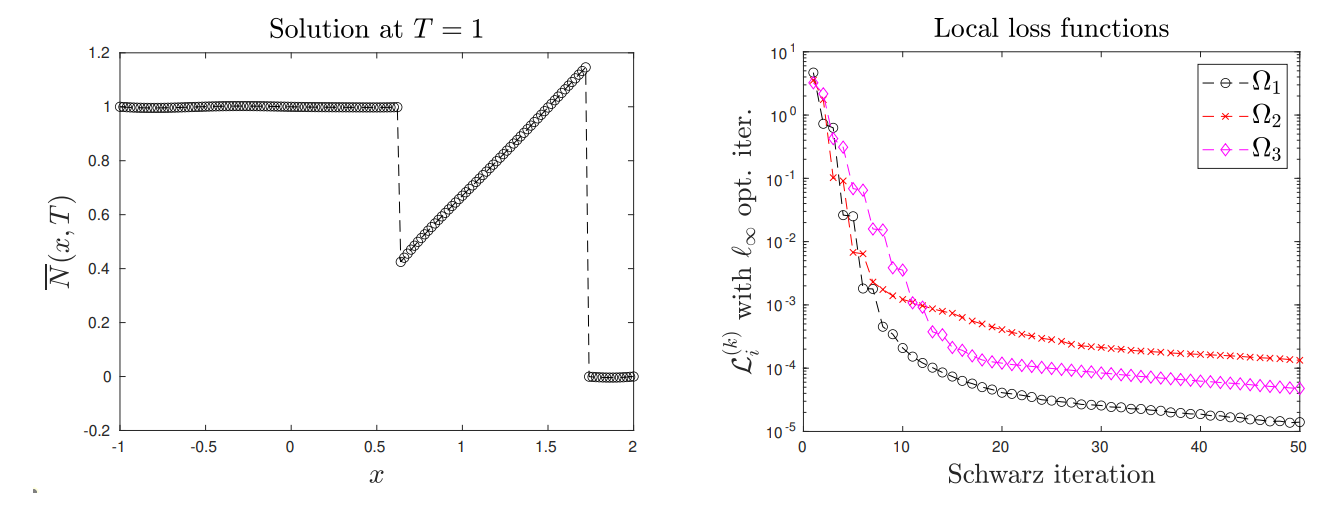
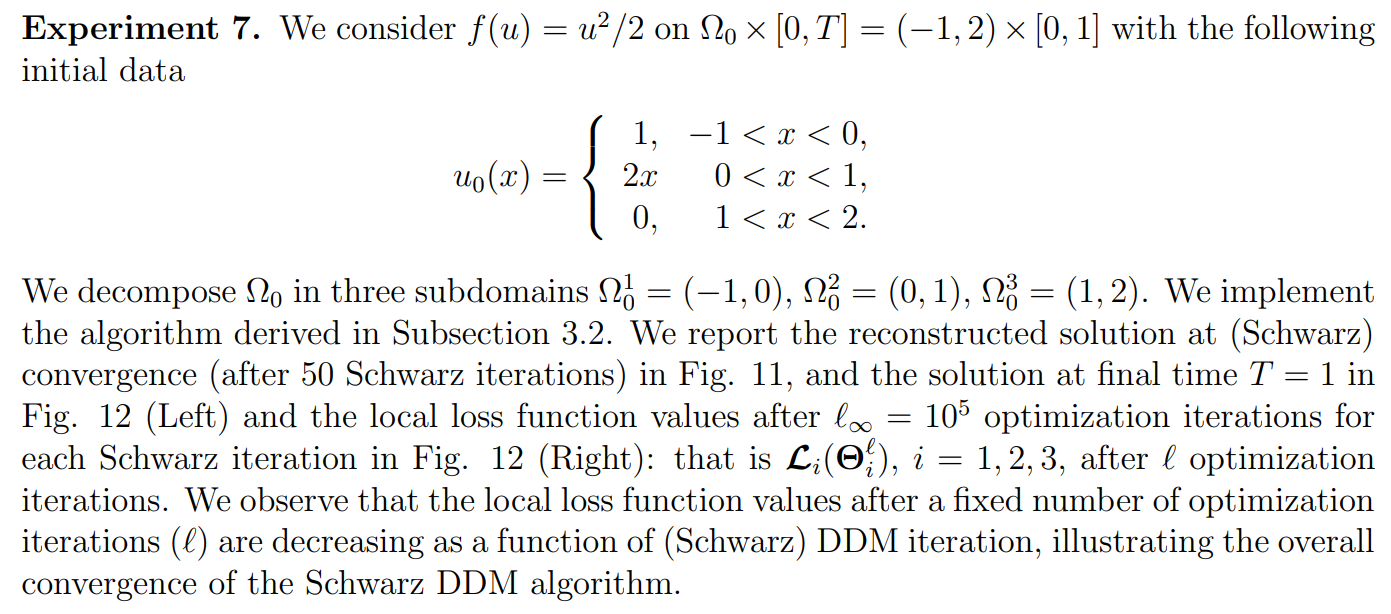
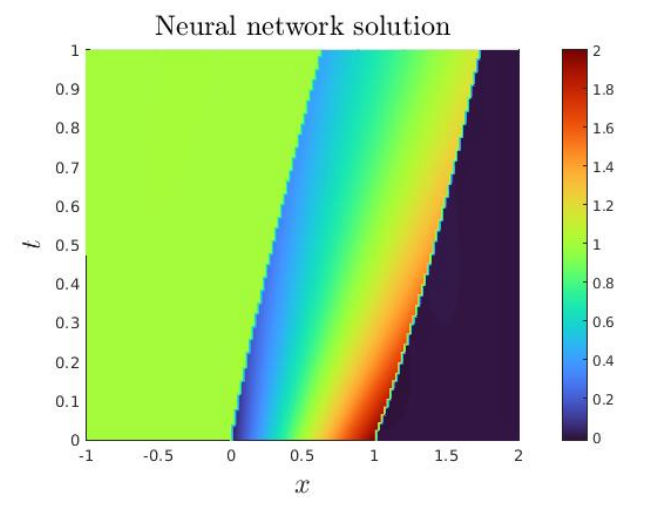
In this subsection, we propose an experiment illustrating the combination of the neural network based HCL solver developed in this paper with the domain decomposition method from Subsection 3.2. We numerically illustrate the convergence of the algorithm. The neural networks have 30 neurons and one hidden layer, and the number of learning nodes is 900 learning nodes.

\
\ Figure 11: Experiment 7. Reconstructed space-time solution.
\ Figure 12: Experiment 7. (Left) Solution at T = 1. (Right) Local loss function values after a fixed number ℓ∞ of optimization iterations.

\ The DDM naturally makes sense for much more computationally complex problems. This test however illustrates a proof-of-concept of the SWR approach.

4.7. Nonlinear systems

In this subsection, we are interested in the numerical approximation of hyperbolic systems with shock waves.

\ Experiment 8. In this experiment we focus on the initial wave decomposition for a Riemann problem. The system considered here is the Shallow water equations (m = 2).

\ \

\ \ where h is the height of a compressible fluid, u its velocity, and g is the gravitational constant taken here equal to 1. The spatial domain is (−0.1, 0.1), the final time is T = 0.0025, and we impose null Dirichlet boundary conditions.

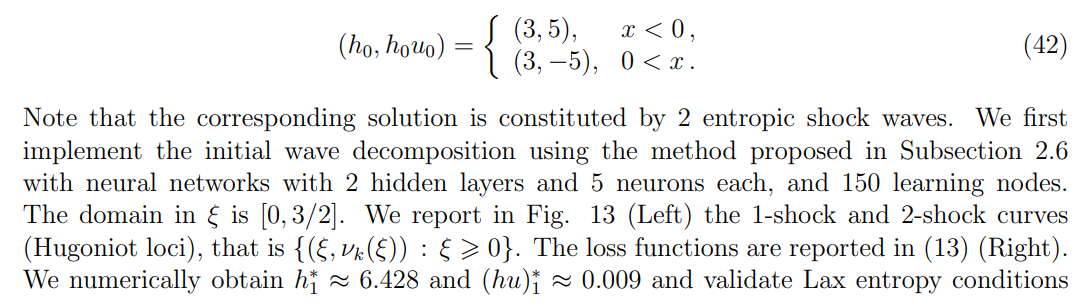
\ Experiment 8a. The initial data is given by

\ \
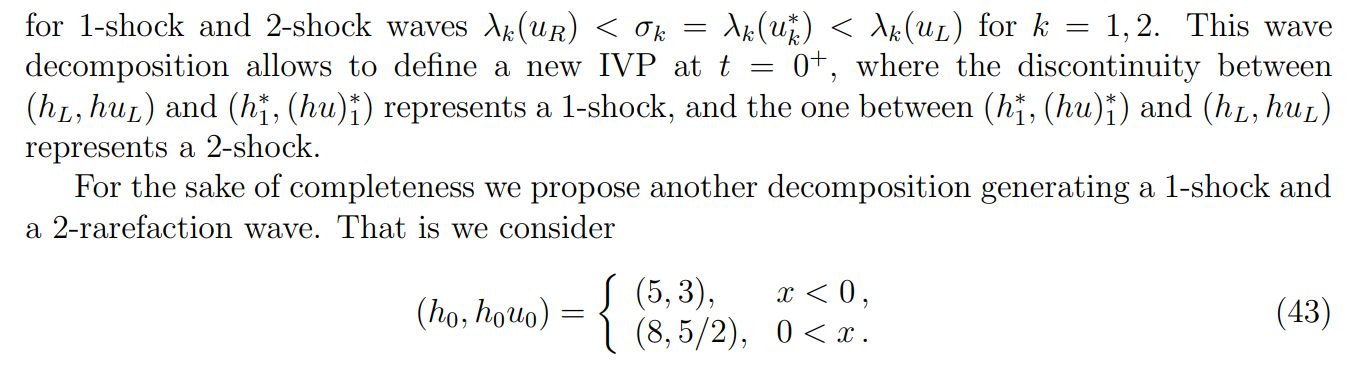
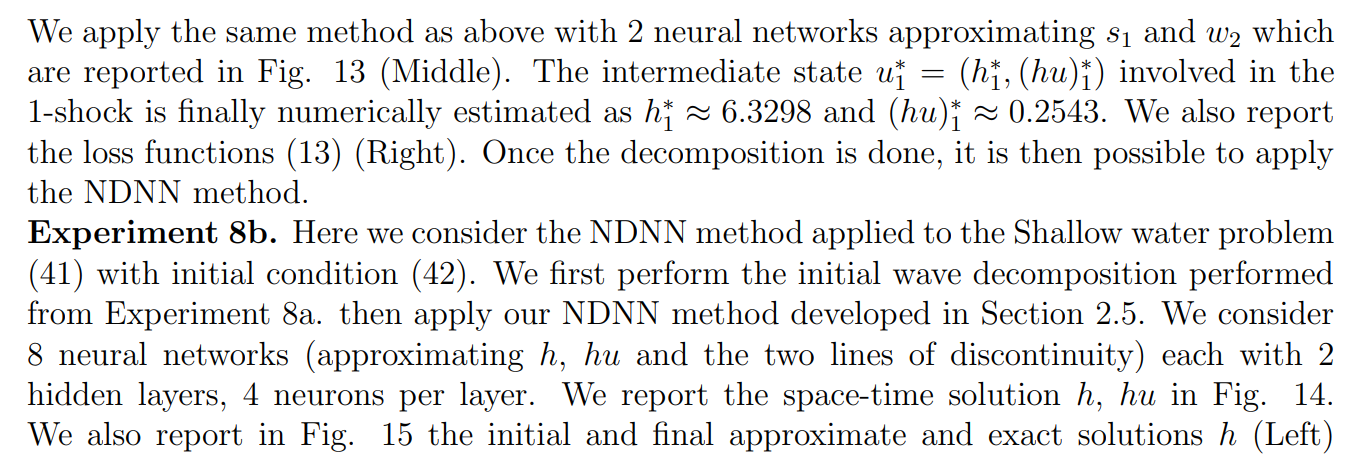
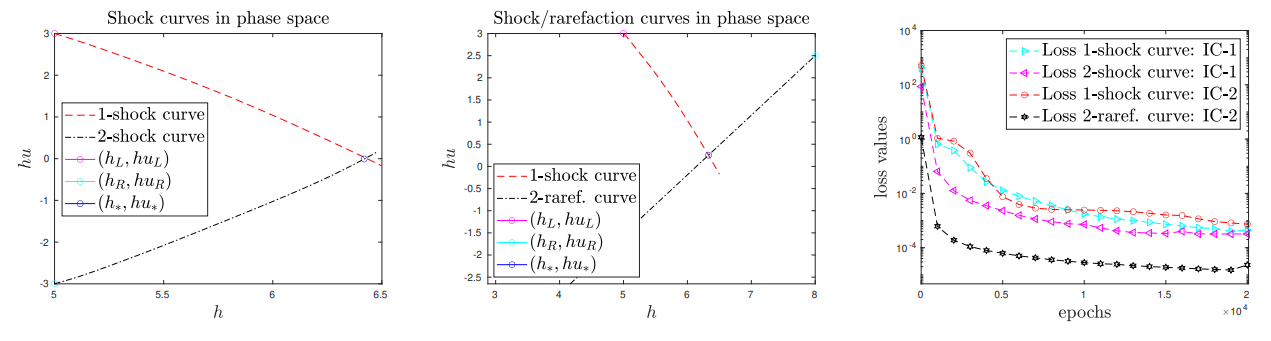
\ \ \ Figure 13: Experiment 8a. (Left) Shock curves in phase space with initial condition (42). (Middle) 1-shock curve and 2-rarefaction curve with initial condition (43). (Right) Loss functions for constructing simple waves (42) and (43)
\ \ \

\ \ \

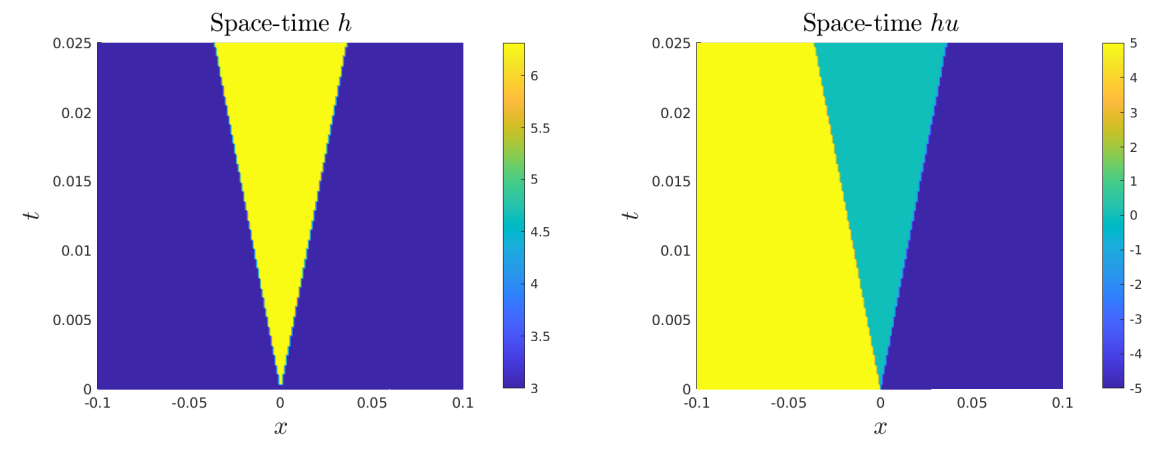
\ \ \ Figure 14: Experiment 8b. Approximate space-time solution (Left) h : (x, t) 7→ h(x, t). (Right) hu : (x, t) 7→ hu(x, t).

\ \ and hu (Middle), as well as the loss function Fig. 15 (Right). This experiment shows that

\ \ Figure 15: Experiment 8b. (Left) Approximate component x 7→ h(x, T). (Middle) Approximate component x 7→ hu(x, T). (Right) Loss function.
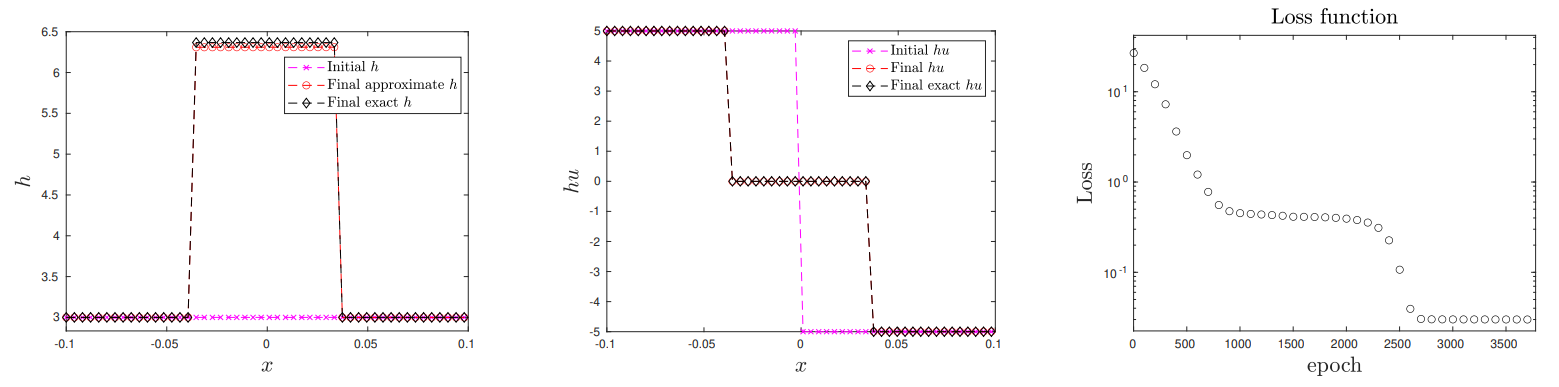
\ \ the proposed methodology allows for the computation of the solution to (at least simple) Riemann problems.

\ Experiment 9. In this last experiment, we consider Euler’s equations modeling compressible inviscid fluid flows. This is a 3-equation HCL which reads as follows (in conservative form)

\ \
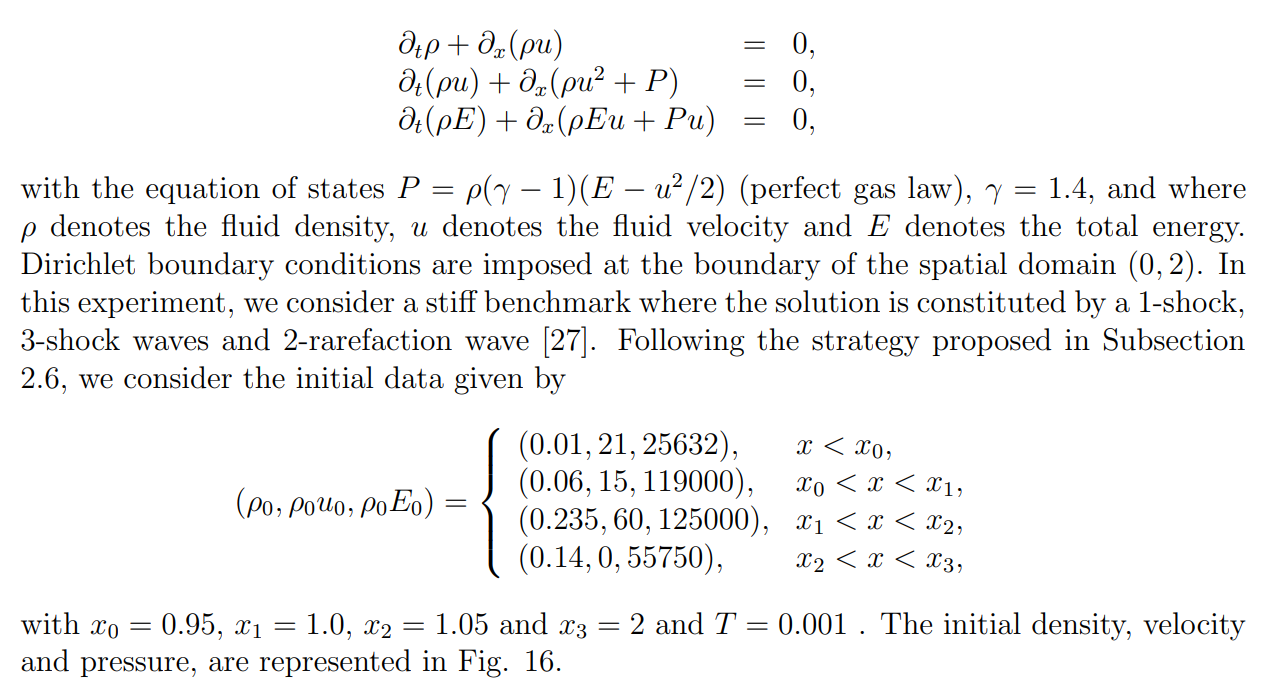
\ \ \ Figure 16: Experiment 9. Initial data (Left) Density. (Middle) Velocity (Right) Pressure.
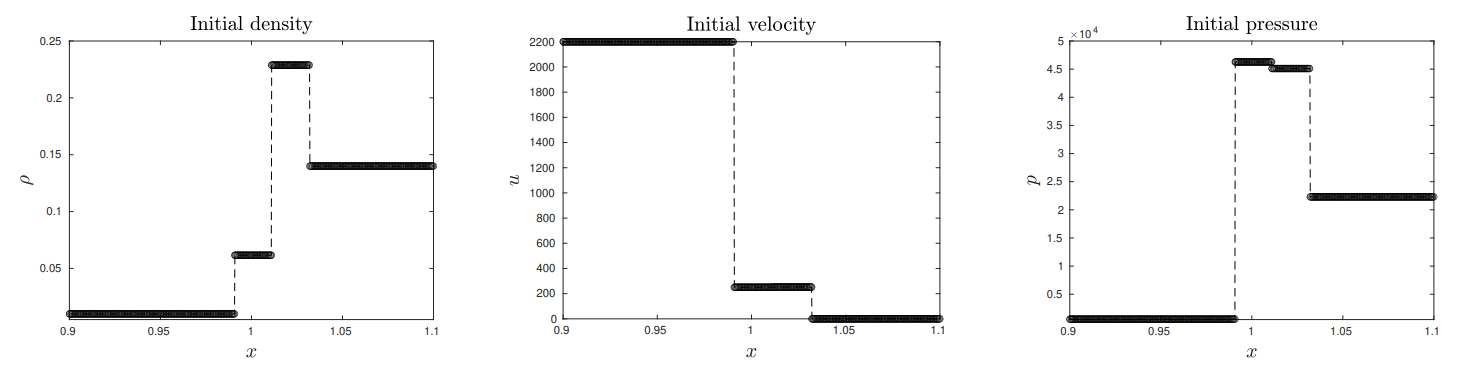
\ \ We implement the method developed in Subsection 2.5 with m = 3, 1 hidden layer and 30 neurons for each conservative component ρ, ρu, ρE and for the 3 lines of discontinuity. In Fig. 17 we report the density, velocity and pressure at initial and final times T. This test illustrates the precision of the proposed approach, with in particular an accurate approximation of the 2-contact discontinuity which is often hard to obtain with standard solvers.

\

:::info Authors:

(1) Emmanuel LORIN, School of Mathematics and Statistics, Carleton University, Ottawa, Canada, K1S 5B6 and Centre de Recherches Mathematiques, Universit´e de Montr´eal, Montreal, Canada, H3T 1J4 (elorin@math.carleton.ca);

(2) Arian NOVRUZI, a Corresponding Author from Department of Mathematics and Statistics, University of Ottawa, Ottawa, ON K1N 6N5, Canada (novruzi@uottawa.ca).

:::


:::info This paper is available on arxiv under CC by 4.0 Deed (Attribution 4.0 International) license.

:::

\

Market Opportunity
Waves Logo
Waves Price(WAVES)
$0.669
$0.669$0.669
-1.54%
USD
Waves (WAVES) Live Price Chart
Disclaimer: The articles reposted on this site are sourced from public platforms and are provided for informational purposes only. They do not necessarily reflect the views of MEXC. All rights remain with the original authors. If you believe any content infringes on third-party rights, please contact service@support.mexc.com for removal. MEXC makes no guarantees regarding the accuracy, completeness, or timeliness of the content and is not responsible for any actions taken based on the information provided. The content does not constitute financial, legal, or other professional advice, nor should it be considered a recommendation or endorsement by MEXC.

You May Also Like

CEO Sandeep Nailwal Shared Highlights About RWA on Polygon

CEO Sandeep Nailwal Shared Highlights About RWA on Polygon

The post CEO Sandeep Nailwal Shared Highlights About RWA on Polygon appeared on BitcoinEthereumNews.com. Polygon CEO Sandeep Nailwal highlighted Polygon’s lead in global bonds, Spiko US T-Bill, and Spiko Euro T-Bill. Polygon published an X post to share that its roadmap to GigaGas was still scaling. Sentiments around POL price were last seen to be bearish. Polygon CEO Sandeep Nailwal shared key pointers from the Dune and RWA.xyz report. These pertain to highlights about RWA on Polygon. Simultaneously, Polygon underlined its roadmap towards GigaGas. Sentiments around POL price were last seen fumbling under bearish emotions. Polygon CEO Sandeep Nailwal on Polygon RWA CEO Sandeep Nailwal highlighted three key points from the Dune and RWA.xyz report. The Chief Executive of Polygon maintained that Polygon PoS was hosting RWA TVL worth $1.13 billion across 269 assets plus 2,900 holders. Nailwal confirmed from the report that RWA was happening on Polygon. The Dune and https://t.co/W6WSFlHoQF report on RWA is out and it shows that RWA is happening on Polygon. Here are a few highlights: – Leading in Global Bonds: Polygon holds 62% share of tokenized global bonds (driven by Spiko’s euro MMF and Cashlink euro issues) – Spiko U.S.… — Sandeep | CEO, Polygon Foundation (※,※) (@sandeepnailwal) September 17, 2025 The X post published by Polygon CEO Sandeep Nailwal underlined that the ecosystem was leading in global bonds by holding a 62% share of tokenized global bonds. He further highlighted that Polygon was leading with Spiko US T-Bill at approximately 29% share of TVL along with Ethereum, adding that the ecosystem had more than 50% share in the number of holders. Finally, Sandeep highlighted from the report that there was a strong adoption for Spiko Euro T-Bill with 38% share of TVL. He added that 68% of returns were on Polygon across all the chains. Polygon Roadmap to GigaGas In a different update from Polygon, the community…
Share
BitcoinEthereumNews2025/09/18 01:10
YoungHoon Kim Predicts XRP Price Surge Amid Institutional Demand

YoungHoon Kim Predicts XRP Price Surge Amid Institutional Demand

The post YoungHoon Kim Predicts XRP Price Surge Amid Institutional Demand appeared first on Coinpedia Fintech News YoungHoon Kim, the world’s highest IQ holder,
Share
CoinPedia2025/12/18 20:36
Why Reference-to-Video Is the Missing Piece in AI Video — and How Wan 2.6 Solves It

Why Reference-to-Video Is the Missing Piece in AI Video — and How Wan 2.6 Solves It

AI video generation has improved rapidly.  Visual quality is higher, motion looks smoother, and demos are more impressive than ever. Yet many creators still struggle
Share
AI Journal2025/12/18 20:11