Let’s take a closer look at the new requirements of CRP-1, compare them with the regulatory policies of other countries and regions, and then discuss the impact these changes will have on us cryptocurrency players. Written by Xiao Sa Legal Team Driven by a wave of technological innovation, the global cryptoasset market has expanded rapidly. This has, however, also exposed a range of risks, including price volatility and money laundering, making the need for effective regulation even more urgent. In September 2025, the Hong Kong Monetary Authority (HKMA) issued a draft of the new module CRP-1, "Cryptoasset Classification," of the Banking Supervisory Policy Manual (SPM), to the local banking industry for public comment. This draft aims to align with international regulatory standards and establish a regulatory framework that balances innovation and risk prevention, providing clear guidance for banks involved in cryptoasset-related businesses. Next, the Sajie team will take a closer look at the new requirements of CRP-1, compare them with the regulatory policies of other countries and regions, and discuss the impact these changes will have on our cryptocurrency players. 01 Interpretation of the core content of the new Hong Kong CRP-1 regulations (I) Basic Definition: Scope of Supervision and Applicable Objects The new CRP-1 regulation clearly defines the scope of cryptoasset regulation, laying a solid foundation for subsequent implementation. Specifically, the new regulation defines cryptoassets as those primarily relying on cryptography and distributed ledger technology (DLT), or similar technologies, that can be used for payment or investment purposes, or to acquire goods or services. However, it explicitly excludes central bank-issued digital currencies from this scope. This approach provides a precise definition of cryptoassets while distinguishing them from legal tender digital currencies, preventing overly broad regulation. The new regulations will apply to all licensed financial institutions in Hong Kong, including regular banks, restricted license banks, and deposit-taking companies. These institutions are an important part of Hong Kong's financial system, and the crypto businesses they conduct directly impact financial stability. Bringing them under regulation will help control risks at the source. In terms of risk management, the new regulations adopt a comprehensive approach. Risks arising from banks' own holdings of crypto assets, the safekeeping and trading of crypto assets for clients, and indirect exposure to crypto assets through financial derivatives must all be managed. This prevents financial institutions from exploiting loopholes to evade regulation, ensuring that all crypto-related risks are rigorously managed. (2) Core categories Risk grading is the core logic of the new CRP-1 regulations. The new regulations divide crypto assets into Group 1 (low risk) and Group 2 (high risk) based on their risk mitigation capabilities. The table below provides a clear overview of these core categories. 02. Connection and Differences between CRP-1 and International Rules (BCBS Standards) (1) BCBS Standard Core Logic The Basel Committee on Banking Supervision (BCBS), as the core institution of global banking supervision, issued the "Prudent Treatment of Crypto-Asset Risk Exposures" in December 2022 and launched the "Revision of Crypto-Asset Standards" in July 2024, building a global unified crypto-asset regulatory framework. Its core logic can be summarized as "risk classification and prudent control." The BCBS standards focus on "preventing and controlling cryptoasset risks and ensuring adequate bank capitalization" to prevent the transmission of cryptoasset risks to the traditional banking system and maintain global financial stability. Within the core framework, the BCBS classifies cryptoassets into "Group 1" and "Group 2" based on risk, setting strict capital requirements for high-risk assets while also promoting global regulatory coordination to prevent regulatory arbitrage. The launch of the BCBS standard stems from the rapid development and risk accumulation of the global crypto asset market. It aims to provide a unified regulatory benchmark for internationally active banks, balance "financial stability" and "responsible innovation", and provide a reference framework for regulators in various countries. (2) Integration of CRP-1 and BCBS The new CRP-1 regulations and BCBS standards are consistent in many key areas, demonstrating Hong Kong's commitment as an international financial center to keeping pace with global regulation. In terms of asset classification, CRP-1 divides crypto assets into "Group 1" and "Group 2," while BCBS divides them into "Group 1" and "Group 2." The core criterion for both classifications is the ability of an asset to manage risk. For example, relatively low-risk and reliable assets like compliant stablecoins fall into "Group 1" under BCBS and "Group 1" under CRP-1. Both require clear legal regulations for such assets and effective risk management. For higher-risk assets, both sides implement strict regulations on the amount of capital that financial institutions must maintain to manage risk, fully embodying the principle of "the greater the risk, the stricter the management." In terms of fund supervision requirements, CRP-1 largely continues the BCBS's approach to prudent management. The BCBS stipulates that for certain high-risk crypto assets, financial institutions must maintain a reserve of funds equivalent to 1250% of the asset's value to mitigate risk. CRP-1 also applies this standard to Group 2b assets. For highly liquid crypto assets, the BCBS requires trading on regulated exchanges and achieving a certain market size. CRP-1 also imposes similar requirements on Group 2a assets, requiring trading on regulated exchanges and setting market capitalization and trading volume thresholds to ensure that the funds invested align with the asset's risk. In addition, both CRP-1 and BCBS place particular emphasis on comprehensive supervision. Whether it is the crypto assets held by the bank itself, the assets involved in providing services to customers, or even indirectly related risks, all must be included in the regulatory scope to avoid the emergence of "gray areas" where no one is in charge and to achieve the goal of global unified supervision. 03 CRP-1 Specific Impact of the New Regulations on Crypto Asset Users After the implementation of the new CRP-1 regulations, banks’ crypto business has undergone major adjustments, which directly affects our friends’ trading, custody, and use of crypto assets. Let's start with trading options. The new regulations have tightened trading restrictions on both assets and channels. High-risk Category 2b assets, like some NFTs and governance tokens, are no longer permitted by banks, forcing users to switch to other platforms, which can be less reliable. While Category 1 compliant assets are safe, the selection is narrower. Category 2a assets must be traded on licensed exchanges, which require stricter account opening procedures and higher thresholds. Regarding asset security, the new regulations do make asset custody safer, providing priority for recovering funds even if a platform fails. However, the stringent anti-money laundering requirements reduce personal privacy, and the price fluctuations of different assets vary. For those holding Category 2b NFTs and governance tokens, the Sajie team recommends prioritizing platforms regulated by the Hong Kong Monetary Authority or with international compliance qualifications, and avoiding storing all assets in one place. Those who prefer Category 1 compliant assets can seek the security of a bank, but must accept that they can purchase fewer items. For those trading Category 2a assets, remember to prepare a complete set of documents, including your ID and bank card, in advance to prepare for the exchange's rigorous review. Regardless of the type of asset you hold, you'll need to restructure your portfolio and monitor changes in bank fees. You need to balance the security provided by the new regulations with privacy protection and operational convenience. Final Thoughts In summary, the new Hong Kong CRP-1 regulation demonstrates significant foresight in the field of crypto asset regulation, providing new ideas and directions for industry development and risk prevention and control. Sister Sa recognizes that Hong Kong's cryptoasset regulation will enter a phase of dynamic optimization and deepening practice. Going forward, regulators must closely follow international trends and strengthen cross-border regulatory coordination. Industry participants should establish regular compliance communication mechanisms. I hope Hong Kong will use CRP-1 as an opportunity to improve regulatory technology, balance investor protection and innovation, and set a global regulatory precedent.Let’s take a closer look at the new requirements of CRP-1, compare them with the regulatory policies of other countries and regions, and then discuss the impact these changes will have on us cryptocurrency players. Written by Xiao Sa Legal Team Driven by a wave of technological innovation, the global cryptoasset market has expanded rapidly. This has, however, also exposed a range of risks, including price volatility and money laundering, making the need for effective regulation even more urgent. In September 2025, the Hong Kong Monetary Authority (HKMA) issued a draft of the new module CRP-1, "Cryptoasset Classification," of the Banking Supervisory Policy Manual (SPM), to the local banking industry for public comment. This draft aims to align with international regulatory standards and establish a regulatory framework that balances innovation and risk prevention, providing clear guidance for banks involved in cryptoasset-related businesses. Next, the Sajie team will take a closer look at the new requirements of CRP-1, compare them with the regulatory policies of other countries and regions, and discuss the impact these changes will have on our cryptocurrency players. 01 Interpretation of the core content of the new Hong Kong CRP-1 regulations (I) Basic Definition: Scope of Supervision and Applicable Objects The new CRP-1 regulation clearly defines the scope of cryptoasset regulation, laying a solid foundation for subsequent implementation. Specifically, the new regulation defines cryptoassets as those primarily relying on cryptography and distributed ledger technology (DLT), or similar technologies, that can be used for payment or investment purposes, or to acquire goods or services. However, it explicitly excludes central bank-issued digital currencies from this scope. This approach provides a precise definition of cryptoassets while distinguishing them from legal tender digital currencies, preventing overly broad regulation. The new regulations will apply to all licensed financial institutions in Hong Kong, including regular banks, restricted license banks, and deposit-taking companies. These institutions are an important part of Hong Kong's financial system, and the crypto businesses they conduct directly impact financial stability. Bringing them under regulation will help control risks at the source. In terms of risk management, the new regulations adopt a comprehensive approach. Risks arising from banks' own holdings of crypto assets, the safekeeping and trading of crypto assets for clients, and indirect exposure to crypto assets through financial derivatives must all be managed. This prevents financial institutions from exploiting loopholes to evade regulation, ensuring that all crypto-related risks are rigorously managed. (2) Core categories Risk grading is the core logic of the new CRP-1 regulations. The new regulations divide crypto assets into Group 1 (low risk) and Group 2 (high risk) based on their risk mitigation capabilities. The table below provides a clear overview of these core categories. 02. Connection and Differences between CRP-1 and International Rules (BCBS Standards) (1) BCBS Standard Core Logic The Basel Committee on Banking Supervision (BCBS), as the core institution of global banking supervision, issued the "Prudent Treatment of Crypto-Asset Risk Exposures" in December 2022 and launched the "Revision of Crypto-Asset Standards" in July 2024, building a global unified crypto-asset regulatory framework. Its core logic can be summarized as "risk classification and prudent control." The BCBS standards focus on "preventing and controlling cryptoasset risks and ensuring adequate bank capitalization" to prevent the transmission of cryptoasset risks to the traditional banking system and maintain global financial stability. Within the core framework, the BCBS classifies cryptoassets into "Group 1" and "Group 2" based on risk, setting strict capital requirements for high-risk assets while also promoting global regulatory coordination to prevent regulatory arbitrage. The launch of the BCBS standard stems from the rapid development and risk accumulation of the global crypto asset market. It aims to provide a unified regulatory benchmark for internationally active banks, balance "financial stability" and "responsible innovation", and provide a reference framework for regulators in various countries. (2) Integration of CRP-1 and BCBS The new CRP-1 regulations and BCBS standards are consistent in many key areas, demonstrating Hong Kong's commitment as an international financial center to keeping pace with global regulation. In terms of asset classification, CRP-1 divides crypto assets into "Group 1" and "Group 2," while BCBS divides them into "Group 1" and "Group 2." The core criterion for both classifications is the ability of an asset to manage risk. For example, relatively low-risk and reliable assets like compliant stablecoins fall into "Group 1" under BCBS and "Group 1" under CRP-1. Both require clear legal regulations for such assets and effective risk management. For higher-risk assets, both sides implement strict regulations on the amount of capital that financial institutions must maintain to manage risk, fully embodying the principle of "the greater the risk, the stricter the management." In terms of fund supervision requirements, CRP-1 largely continues the BCBS's approach to prudent management. The BCBS stipulates that for certain high-risk crypto assets, financial institutions must maintain a reserve of funds equivalent to 1250% of the asset's value to mitigate risk. CRP-1 also applies this standard to Group 2b assets. For highly liquid crypto assets, the BCBS requires trading on regulated exchanges and achieving a certain market size. CRP-1 also imposes similar requirements on Group 2a assets, requiring trading on regulated exchanges and setting market capitalization and trading volume thresholds to ensure that the funds invested align with the asset's risk. In addition, both CRP-1 and BCBS place particular emphasis on comprehensive supervision. Whether it is the crypto assets held by the bank itself, the assets involved in providing services to customers, or even indirectly related risks, all must be included in the regulatory scope to avoid the emergence of "gray areas" where no one is in charge and to achieve the goal of global unified supervision. 03 CRP-1 Specific Impact of the New Regulations on Crypto Asset Users After the implementation of the new CRP-1 regulations, banks’ crypto business has undergone major adjustments, which directly affects our friends’ trading, custody, and use of crypto assets. Let's start with trading options. The new regulations have tightened trading restrictions on both assets and channels. High-risk Category 2b assets, like some NFTs and governance tokens, are no longer permitted by banks, forcing users to switch to other platforms, which can be less reliable. While Category 1 compliant assets are safe, the selection is narrower. Category 2a assets must be traded on licensed exchanges, which require stricter account opening procedures and higher thresholds. Regarding asset security, the new regulations do make asset custody safer, providing priority for recovering funds even if a platform fails. However, the stringent anti-money laundering requirements reduce personal privacy, and the price fluctuations of different assets vary. For those holding Category 2b NFTs and governance tokens, the Sajie team recommends prioritizing platforms regulated by the Hong Kong Monetary Authority or with international compliance qualifications, and avoiding storing all assets in one place. Those who prefer Category 1 compliant assets can seek the security of a bank, but must accept that they can purchase fewer items. For those trading Category 2a assets, remember to prepare a complete set of documents, including your ID and bank card, in advance to prepare for the exchange's rigorous review. Regardless of the type of asset you hold, you'll need to restructure your portfolio and monitor changes in bank fees. You need to balance the security provided by the new regulations with privacy protection and operational convenience. Final Thoughts In summary, the new Hong Kong CRP-1 regulation demonstrates significant foresight in the field of crypto asset regulation, providing new ideas and directions for industry development and risk prevention and control. Sister Sa recognizes that Hong Kong's cryptoasset regulation will enter a phase of dynamic optimization and deepening practice. Going forward, regulators must closely follow international trends and strengthen cross-border regulatory coordination. Industry participants should establish regular compliance communication mechanisms. I hope Hong Kong will use CRP-1 as an opportunity to improve regulatory technology, balance investor protection and innovation, and set a global regulatory precedent.

Hong Kong's new crypto regulations are here: CRP-1 and its impact on the market

2025/09/17 21:00

Let’s take a closer look at the new requirements of CRP-1, compare them with the regulatory policies of other countries and regions, and then discuss the impact these changes will have on us cryptocurrency players.

Written by Xiao Sa Legal Team

Driven by a wave of technological innovation, the global cryptoasset market has expanded rapidly. This has, however, also exposed a range of risks, including price volatility and money laundering, making the need for effective regulation even more urgent. In September 2025, the Hong Kong Monetary Authority (HKMA) issued a draft of the new module CRP-1, "Cryptoasset Classification," of the Banking Supervisory Policy Manual (SPM), to the local banking industry for public comment. This draft aims to align with international regulatory standards and establish a regulatory framework that balances innovation and risk prevention, providing clear guidance for banks involved in cryptoasset-related businesses.

Next, the Sajie team will take a closer look at the new requirements of CRP-1, compare them with the regulatory policies of other countries and regions, and discuss the impact these changes will have on our cryptocurrency players.

01 Interpretation of the core content of the new Hong Kong CRP-1 regulations

(I) Basic Definition: Scope of Supervision and Applicable Objects

The new CRP-1 regulation clearly defines the scope of cryptoasset regulation, laying a solid foundation for subsequent implementation. Specifically, the new regulation defines cryptoassets as those primarily relying on cryptography and distributed ledger technology (DLT), or similar technologies, that can be used for payment or investment purposes, or to acquire goods or services. However, it explicitly excludes central bank-issued digital currencies from this scope. This approach provides a precise definition of cryptoassets while distinguishing them from legal tender digital currencies, preventing overly broad regulation.

The new regulations will apply to all licensed financial institutions in Hong Kong, including regular banks, restricted license banks, and deposit-taking companies. These institutions are an important part of Hong Kong's financial system, and the crypto businesses they conduct directly impact financial stability. Bringing them under regulation will help control risks at the source.

In terms of risk management, the new regulations adopt a comprehensive approach. Risks arising from banks' own holdings of crypto assets, the safekeeping and trading of crypto assets for clients, and indirect exposure to crypto assets through financial derivatives must all be managed. This prevents financial institutions from exploiting loopholes to evade regulation, ensuring that all crypto-related risks are rigorously managed.

(2) Core categories

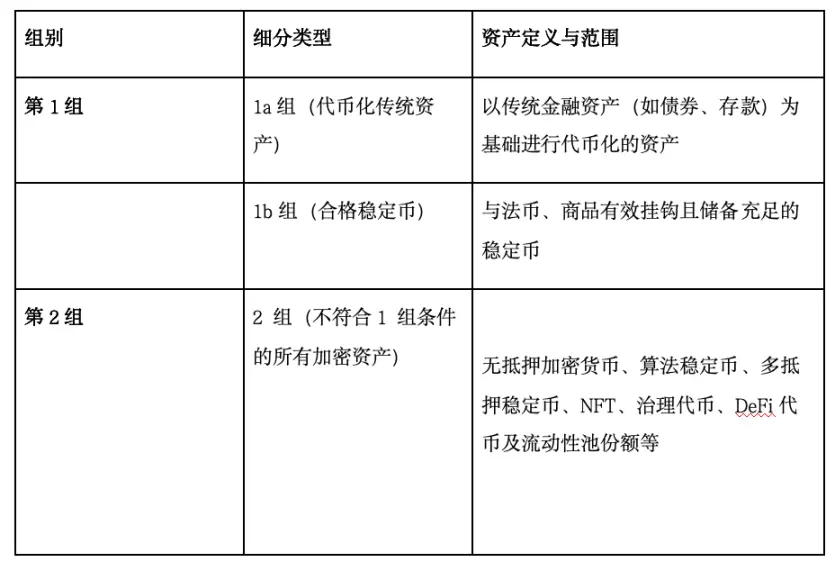
Risk grading is the core logic of the new CRP-1 regulations. The new regulations divide crypto assets into Group 1 (low risk) and Group 2 (high risk) based on their risk mitigation capabilities. The table below provides a clear overview of these core categories.
02. Connection and Differences between CRP-1 and International Rules (BCBS Standards)

(1) BCBS Standard Core Logic

The Basel Committee on Banking Supervision (BCBS), as the core institution of global banking supervision, issued the "Prudent Treatment of Crypto-Asset Risk Exposures" in December 2022 and launched the "Revision of Crypto-Asset Standards" in July 2024, building a global unified crypto-asset regulatory framework. Its core logic can be summarized as "risk classification and prudent control."

The BCBS standards focus on "preventing and controlling cryptoasset risks and ensuring adequate bank capitalization" to prevent the transmission of cryptoasset risks to the traditional banking system and maintain global financial stability. Within the core framework, the BCBS classifies cryptoassets into "Group 1" and "Group 2" based on risk, setting strict capital requirements for high-risk assets while also promoting global regulatory coordination to prevent regulatory arbitrage.

The launch of the BCBS standard stems from the rapid development and risk accumulation of the global crypto asset market. It aims to provide a unified regulatory benchmark for internationally active banks, balance "financial stability" and "responsible innovation", and provide a reference framework for regulators in various countries.

(2) Integration of CRP-1 and BCBS

The new CRP-1 regulations and BCBS standards are consistent in many key areas, demonstrating Hong Kong's commitment as an international financial center to keeping pace with global regulation.

In terms of asset classification, CRP-1 divides crypto assets into "Group 1" and "Group 2," while BCBS divides them into "Group 1" and "Group 2." The core criterion for both classifications is the ability of an asset to manage risk. For example, relatively low-risk and reliable assets like compliant stablecoins fall into "Group 1" under BCBS and "Group 1" under CRP-1. Both require clear legal regulations for such assets and effective risk management. For higher-risk assets, both sides implement strict regulations on the amount of capital that financial institutions must maintain to manage risk, fully embodying the principle of "the greater the risk, the stricter the management."

In terms of fund supervision requirements, CRP-1 largely continues the BCBS's approach to prudent management. The BCBS stipulates that for certain high-risk crypto assets, financial institutions must maintain a reserve of funds equivalent to 1250% of the asset's value to mitigate risk. CRP-1 also applies this standard to Group 2b assets. For highly liquid crypto assets, the BCBS requires trading on regulated exchanges and achieving a certain market size. CRP-1 also imposes similar requirements on Group 2a assets, requiring trading on regulated exchanges and setting market capitalization and trading volume thresholds to ensure that the funds invested align with the asset's risk.

In addition, both CRP-1 and BCBS place particular emphasis on comprehensive supervision. Whether it is the crypto assets held by the bank itself, the assets involved in providing services to customers, or even indirectly related risks, all must be included in the regulatory scope to avoid the emergence of "gray areas" where no one is in charge and to achieve the goal of global unified supervision.

03 CRP-1 Specific Impact of the New Regulations on Crypto Asset Users

After the implementation of the new CRP-1 regulations, banks’ crypto business has undergone major adjustments, which directly affects our friends’ trading, custody, and use of crypto assets.

Let's start with trading options. The new regulations have tightened trading restrictions on both assets and channels. High-risk Category 2b assets, like some NFTs and governance tokens, are no longer permitted by banks, forcing users to switch to other platforms, which can be less reliable. While Category 1 compliant assets are safe, the selection is narrower. Category 2a assets must be traded on licensed exchanges, which require stricter account opening procedures and higher thresholds. Regarding asset security, the new regulations do make asset custody safer, providing priority for recovering funds even if a platform fails. However, the stringent anti-money laundering requirements reduce personal privacy, and the price fluctuations of different assets vary.

For those holding Category 2b NFTs and governance tokens, the Sajie team recommends prioritizing platforms regulated by the Hong Kong Monetary Authority or with international compliance qualifications, and avoiding storing all assets in one place. Those who prefer Category 1 compliant assets can seek the security of a bank, but must accept that they can purchase fewer items. For those trading Category 2a assets, remember to prepare a complete set of documents, including your ID and bank card, in advance to prepare for the exchange's rigorous review. Regardless of the type of asset you hold, you'll need to restructure your portfolio and monitor changes in bank fees. You need to balance the security provided by the new regulations with privacy protection and operational convenience.

Final Thoughts

In summary, the new Hong Kong CRP-1 regulation demonstrates significant foresight in the field of crypto asset regulation, providing new ideas and directions for industry development and risk prevention and control.

Sister Sa recognizes that Hong Kong's cryptoasset regulation will enter a phase of dynamic optimization and deepening practice. Going forward, regulators must closely follow international trends and strengthen cross-border regulatory coordination. Industry participants should establish regular compliance communication mechanisms. I hope Hong Kong will use CRP-1 as an opportunity to improve regulatory technology, balance investor protection and innovation, and set a global regulatory precedent.


Market Opportunity
Moonveil Logo
Moonveil Price(MORE)
$0.001988
$0.001988$0.001988
-5.64%
USD
Moonveil (MORE) Live Price Chart
Disclaimer: The articles reposted on this site are sourced from public platforms and are provided for informational purposes only. They do not necessarily reflect the views of MEXC. All rights remain with the original authors. If you believe any content infringes on third-party rights, please contact service@support.mexc.com for removal. MEXC makes no guarantees regarding the accuracy, completeness, or timeliness of the content and is not responsible for any actions taken based on the information provided. The content does not constitute financial, legal, or other professional advice, nor should it be considered a recommendation or endorsement by MEXC.

You May Also Like

UK Looks to US to Adopt More Crypto-Friendly Approach

UK Looks to US to Adopt More Crypto-Friendly Approach

The post UK Looks to US to Adopt More Crypto-Friendly Approach appeared on BitcoinEthereumNews.com. The UK and US are reportedly preparing to deepen cooperation on digital assets, with Britain looking to copy the Trump administration’s crypto-friendly stance in a bid to boost innovation.  UK Chancellor Rachel Reeves and US Treasury Secretary Scott Bessent discussed on Tuesday how the two nations could strengthen their coordination on crypto, the Financial Times reported on Tuesday, citing people familiar with the matter.  The discussions also involved representatives from crypto companies, including Coinbase, Circle Internet Group and Ripple, with executives from the Bank of America, Barclays and Citi also attending, according to the report. The agreement was made “last-minute” after crypto advocacy groups urged the UK government on Thursday to adopt a more open stance toward the industry, claiming its cautious approach to the sector has left the country lagging in innovation and policy.  Source: Rachel Reeves Deal to include stablecoins, look to unlock adoption Any deal between the countries is likely to include stablecoins, the Financial Times reported, an area of crypto that US President Donald Trump made a policy priority and in which his family has significant business interests. The Financial Times reported on Monday that UK crypto advocacy groups also slammed the Bank of England’s proposal to limit individual stablecoin holdings to between 10,000 British pounds ($13,650) and 20,000 pounds ($27,300), claiming it would be difficult and expensive to implement. UK banks appear to have slowed adoption too, with around 40% of 2,000 recently surveyed crypto investors saying that their banks had either blocked or delayed a payment to a crypto provider.  Many of these actions have been linked to concerns over volatility, fraud and scams. The UK has made some progress on crypto regulation recently, proposing a framework in May that would see crypto exchanges, dealers, and agents treated similarly to traditional finance firms, with…
Share
BitcoinEthereumNews2025/09/18 02:21
Crucial Fed Rate Cut: October Probability Surges to 94%

Crucial Fed Rate Cut: October Probability Surges to 94%

BitcoinWorld Crucial Fed Rate Cut: October Probability Surges to 94% The financial world is buzzing with a significant development: the probability of a Fed rate cut in October has just seen a dramatic increase. This isn’t just a minor shift; it’s a monumental change that could ripple through global markets, including the dynamic cryptocurrency space. For anyone tracking economic indicators and their impact on investments, this update from the U.S. interest rate futures market is absolutely crucial. What Just Happened? Unpacking the FOMC Statement’s Impact Following the latest Federal Open Market Committee (FOMC) statement, market sentiment has decisively shifted. Before the announcement, the U.S. interest rate futures market had priced in a 71.6% chance of an October rate cut. However, after the statement, this figure surged to an astounding 94%. This jump indicates that traders and analysts are now overwhelmingly confident that the Federal Reserve will lower interest rates next month. Such a high probability suggests a strong consensus emerging from the Fed’s latest communications and economic outlook. A Fed rate cut typically means cheaper borrowing costs for businesses and consumers, which can stimulate economic activity. But what does this really signify for investors, especially those in the digital asset realm? Why is a Fed Rate Cut So Significant for Markets? When the Federal Reserve adjusts interest rates, it sends powerful signals across the entire financial ecosystem. A rate cut generally implies a more accommodative monetary policy, often enacted to boost economic growth or combat deflationary pressures. Impact on Traditional Markets: Stocks: Lower interest rates can make borrowing cheaper for companies, potentially boosting earnings and making stocks more attractive compared to bonds. Bonds: Existing bonds with higher yields might become more valuable, but new bonds will likely offer lower returns. Dollar Strength: A rate cut can weaken the U.S. dollar, making exports cheaper and potentially benefiting multinational corporations. Potential for Cryptocurrency Markets: The cryptocurrency market, while often seen as uncorrelated, can still react significantly to macro-economic shifts. A Fed rate cut could be interpreted as: Increased Risk Appetite: With traditional investments offering lower returns, investors might seek higher-yielding or more volatile assets like cryptocurrencies. Inflation Hedge Narrative: If rate cuts are perceived as a precursor to inflation, assets like Bitcoin, often dubbed “digital gold,” could gain traction as an inflation hedge. Liquidity Influx: A more accommodative monetary environment generally means more liquidity in the financial system, some of which could flow into digital assets. Looking Ahead: What Could This Mean for Your Portfolio? While the 94% probability for a Fed rate cut in October is compelling, it’s essential to consider the nuances. Market probabilities can shift, and the Fed’s ultimate decision will depend on incoming economic data. Actionable Insights: Stay Informed: Continue to monitor economic reports, inflation data, and future Fed statements. Diversify: A diversified portfolio can help mitigate risks associated with sudden market shifts. Assess Risk Tolerance: Understand how a potential rate cut might affect your specific investments and adjust your strategy accordingly. This increased likelihood of a Fed rate cut presents both opportunities and challenges. It underscores the interconnectedness of traditional finance and the emerging digital asset space. Investors should remain vigilant and prepared for potential volatility. The financial landscape is always evolving, and the significant surge in the probability of an October Fed rate cut is a clear signal of impending change. From stimulating economic growth to potentially fueling interest in digital assets, the implications are vast. Staying informed and strategically positioned will be key as we approach this crucial decision point. The market is now almost certain of a rate cut, and understanding its potential ripple effects is paramount for every investor. Frequently Asked Questions (FAQs) Q1: What is the Federal Open Market Committee (FOMC)? A1: The FOMC is the monetary policymaking body of the Federal Reserve System. It sets the federal funds rate, which influences other interest rates and economic conditions. Q2: How does a Fed rate cut impact the U.S. dollar? A2: A rate cut typically makes the U.S. dollar less attractive to foreign investors seeking higher returns, potentially leading to a weakening of the dollar against other currencies. Q3: Why might a Fed rate cut be good for cryptocurrency? A3: Lower interest rates can reduce the appeal of traditional investments, encouraging investors to seek higher returns in alternative assets like cryptocurrencies. It can also be seen as a sign of increased liquidity or potential inflation, benefiting assets like Bitcoin. Q4: Is a 94% probability a guarantee of a rate cut? A4: While a 94% probability is very high, it is not a guarantee. Market probabilities reflect current sentiment and data, but the Federal Reserve’s final decision will depend on all available economic information leading up to their meeting. Q5: What should investors do in response to this news? A5: Investors should stay informed about economic developments, review their portfolio diversification, and assess their risk tolerance. Consider how potential changes in interest rates might affect different asset classes and adjust strategies as needed. Did you find this analysis helpful? Share this article with your network to keep others informed about the potential impact of the upcoming Fed rate cut and its implications for the financial markets! To learn more about the latest crypto market trends, explore our article on key developments shaping Bitcoin price action. This post Crucial Fed Rate Cut: October Probability Surges to 94% first appeared on BitcoinWorld.
Share
Coinstats2025/09/18 02:25
Pump Fun Fund Launches $3M Hackathon: Market-Driven Startups

Pump Fun Fund Launches $3M Hackathon: Market-Driven Startups

The post Pump Fun Fund Launches $3M Hackathon: Market-Driven Startups appeared on BitcoinEthereumNews.com. In a bid to evolve beyond its roots as a memecoin launchpad
Share
BitcoinEthereumNews2026/01/20 20:06