The post Google Partners Coinbase to Launch AI Crypto Protocol appeared on BitcoinEthereumNews.com. The protocol supports multiple payment types, such as credit and debit cards, real-time bank transfers, and stablecoins It’s being developed alongside many companies, including Coinbase and Ethereum Foundation, and other non-crypto firms The system uses special digital contracts called “Mandates” and “Verifiable Credentials” to make sure a user gives clear permission for what an AI agent is doing on their behalf Google announced a new open-source protocol called Agent Payments Protocol (AP2) to enable AI agents (apps, bots, and assistants) to conduct payments on behalf of users in a secure and verifiable way.  The protocol supports multiple payment types, such as credit and debit cards, real-time bank transfers, and stablecoins. AP2 is being developed in collaboration with a consortium of partners, including leading crypto companies like Coinbase and the Ethereum Foundation. Also, major traditional financial and tech firms are involved, such as Salesforce, American Express, and Etsy. How AP2 Works The system uses special digital contracts called “Mandates” and “Verifiable Credentials” to make sure a user gives clear permission for what an AI agent is doing on their behalf. The goal here is to help with accountability and fraud prevention, in addition to ensuring that the AI is actually doing what the user wants. By making the framework open-source, Google hopes to encourage adoption across industries while giving regulators and auditors a transparent standard to evaluate. Related: Google to Launch Its Own Layer 1 Blockchain for Payments; Takes Aim At Ripple, Stripe, and Circle Why this matters for crypto Supporting stablecoins in AP2 means digital assets pegged to fiat (for example, USDC) are being taken seriously as payment rails for AI-driven commerce and not just as speculative assets. This could very well open the door for AI services, decentralized apps, and merchant platforms to use stablecoins in payments natively. As… The post Google Partners Coinbase to Launch AI Crypto Protocol appeared on BitcoinEthereumNews.com. The protocol supports multiple payment types, such as credit and debit cards, real-time bank transfers, and stablecoins It’s being developed alongside many companies, including Coinbase and Ethereum Foundation, and other non-crypto firms The system uses special digital contracts called “Mandates” and “Verifiable Credentials” to make sure a user gives clear permission for what an AI agent is doing on their behalf Google announced a new open-source protocol called Agent Payments Protocol (AP2) to enable AI agents (apps, bots, and assistants) to conduct payments on behalf of users in a secure and verifiable way.  The protocol supports multiple payment types, such as credit and debit cards, real-time bank transfers, and stablecoins. AP2 is being developed in collaboration with a consortium of partners, including leading crypto companies like Coinbase and the Ethereum Foundation. Also, major traditional financial and tech firms are involved, such as Salesforce, American Express, and Etsy. How AP2 Works The system uses special digital contracts called “Mandates” and “Verifiable Credentials” to make sure a user gives clear permission for what an AI agent is doing on their behalf. The goal here is to help with accountability and fraud prevention, in addition to ensuring that the AI is actually doing what the user wants. By making the framework open-source, Google hopes to encourage adoption across industries while giving regulators and auditors a transparent standard to evaluate. Related: Google to Launch Its Own Layer 1 Blockchain for Payments; Takes Aim At Ripple, Stripe, and Circle Why this matters for crypto Supporting stablecoins in AP2 means digital assets pegged to fiat (for example, USDC) are being taken seriously as payment rails for AI-driven commerce and not just as speculative assets. This could very well open the door for AI services, decentralized apps, and merchant platforms to use stablecoins in payments natively. As…

Google Partners Coinbase to Launch AI Crypto Protocol

  • The protocol supports multiple payment types, such as credit and debit cards, real-time bank transfers, and stablecoins
  • It’s being developed alongside many companies, including Coinbase and Ethereum Foundation, and other non-crypto firms
  • The system uses special digital contracts called “Mandates” and “Verifiable Credentials” to make sure a user gives clear permission for what an AI agent is doing on their behalf

Google announced a new open-source protocol called Agent Payments Protocol (AP2) to enable AI agents (apps, bots, and assistants) to conduct payments on behalf of users in a secure and verifiable way. 

The protocol supports multiple payment types, such as credit and debit cards, real-time bank transfers, and stablecoins.

AP2 is being developed in collaboration with a consortium of partners, including leading crypto companies like Coinbase and the Ethereum Foundation. Also, major traditional financial and tech firms are involved, such as Salesforce, American Express, and Etsy.

How AP2 Works

The system uses special digital contracts called “Mandates” and “Verifiable Credentials” to make sure a user gives clear permission for what an AI agent is doing on their behalf. The goal here is to help with accountability and fraud prevention, in addition to ensuring that the AI is actually doing what the user wants.

By making the framework open-source, Google hopes to encourage adoption across industries while giving regulators and auditors a transparent standard to evaluate.

Related: Google to Launch Its Own Layer 1 Blockchain for Payments; Takes Aim At Ripple, Stripe, and Circle

Why this matters for crypto

Supporting stablecoins in AP2 means digital assets pegged to fiat (for example, USDC) are being taken seriously as payment rails for AI-driven commerce and not just as speculative assets. This could very well open the door for AI services, decentralized apps, and merchant platforms to use stablecoins in payments natively.

As commerce shifts toward AI agents (personal shopping assistants, recommendation systems, and so on), having a standard means of payment can be more seamless, secure, and auditable. AI agents will be able to transact in a way that both users and merchants can trust.

For crypto companies and projects, having more standardized payment flows means fewer surprises in compliance. As for stablecoins, the total amount in circulation has grown a lot in 2025, from about $205 billion at the start of the year to $289 billion. This increase is a big indicator that there is genuine interest and practical use for them.

Related: Google Adds Prompt Guide to New “Nano Banana” AI Image Model

Other big tech and payment firms are similarly exploring stablecoin or tokenized asset integration. The likes of PayPal, Mastercard, and others have long been investigating stablecoin usage, tokenized money-market funds, or blockchain rails. It’s likely that the move from Google will add more weight to the ongoing trend.

Disclaimer: The information presented in this article is for informational and educational purposes only. The article does not constitute financial advice or advice of any kind. Coin Edition is not responsible for any losses incurred as a result of the utilization of content, products, or services mentioned. Readers are advised to exercise caution before taking any action related to the company.

Source: https://coinedition.com/google-coinbase-crypto-payments-ai-protocol/

Market Opportunity
RealLink Logo
RealLink Price(REAL)
$0.07505
$0.07505$0.07505
-2.11%
USD
RealLink (REAL) Live Price Chart
Disclaimer: The articles reposted on this site are sourced from public platforms and are provided for informational purposes only. They do not necessarily reflect the views of MEXC. All rights remain with the original authors. If you believe any content infringes on third-party rights, please contact service@support.mexc.com for removal. MEXC makes no guarantees regarding the accuracy, completeness, or timeliness of the content and is not responsible for any actions taken based on the information provided. The content does not constitute financial, legal, or other professional advice, nor should it be considered a recommendation or endorsement by MEXC.

You May Also Like

Franklin Templeton CEO Dismisses 50bps Rate Cut Ahead FOMC

Franklin Templeton CEO Dismisses 50bps Rate Cut Ahead FOMC

The post Franklin Templeton CEO Dismisses 50bps Rate Cut Ahead FOMC appeared on BitcoinEthereumNews.com. Franklin Templeton CEO Jenny Johnson has weighed in on whether the Federal Reserve should make a 25 basis points (bps) Fed rate cut or 50 bps cut. This comes ahead of the Fed decision today at today’s FOMC meeting, with the market pricing in a 25 bps cut. Bitcoin and the broader crypto market are currently trading flat ahead of the rate cut decision. Franklin Templeton CEO Weighs In On Potential FOMC Decision In a CNBC interview, Jenny Johnson said that she expects the Fed to make a 25 bps cut today instead of a 50 bps cut. She acknowledged the jobs data, which suggested that the labor market is weakening. However, she noted that this data is backward-looking, indicating that it doesn’t show the current state of the economy. She alluded to the wage growth, which she remarked is an indication of a robust labor market. She added that retail sales are up and that consumers are still spending, despite inflation being sticky at 3%, which makes a case for why the FOMC should opt against a 50-basis-point Fed rate cut. In line with this, the Franklin Templeton CEO said that she would go with a 25 bps rate cut if she were Jerome Powell. She remarked that the Fed still has the October and December FOMC meetings to make further cuts if the incoming data warrants it. Johnson also asserted that the data show a robust economy. However, she noted that there can’t be an argument for no Fed rate cut since Powell already signaled at Jackson Hole that they were likely to lower interest rates at this meeting due to concerns over a weakening labor market. Notably, her comment comes as experts argue for both sides on why the Fed should make a 25 bps cut or…
Share
BitcoinEthereumNews2025/09/18 00:36
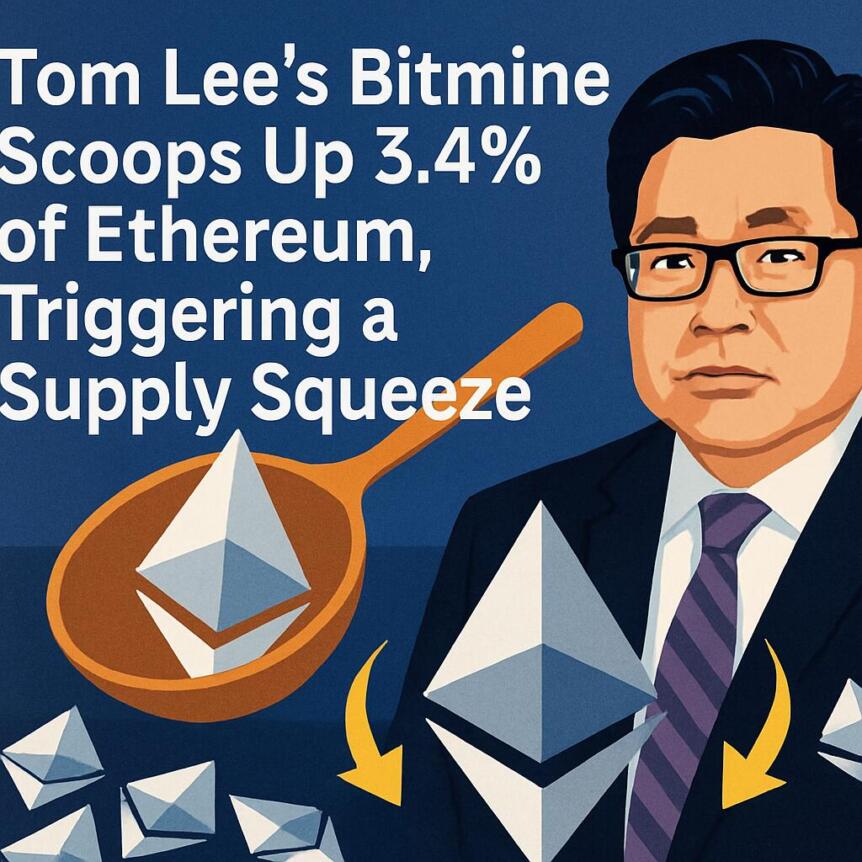
Tom Lee’s Bitmine Scoops Up 3.4% of Ethereum, Triggering a Supply Squeeze

Tom Lee’s Bitmine Scoops Up 3.4% of Ethereum, Triggering a Supply Squeeze

Bitmine Immersion now controls 3.4% of Ethereum amid shrinking exchange supply and rising institutional accumulation.
Share
Crypto Breaking News2026/01/20 16:27
Pendle introduces the sPENDLE mechanism to replace vePENDLE and introduce liquidity staking.

Pendle introduces the sPENDLE mechanism to replace vePENDLE and introduce liquidity staking.

PANews reported on January 20th that, according to an official Pendle announcement, vePENDLE will be completely replaced by the sPENDLE mechanism. sPENDLE is a
Share
PANews2026/01/20 16:38