The post Crypto Stocks Decline Over 10% on Looming Stablecoin Yield Ban appeared first on Coinpedia Fintech News The latest draft of the Clarity Act, a bill seekingThe post Crypto Stocks Decline Over 10% on Looming Stablecoin Yield Ban appeared first on Coinpedia Fintech News The latest draft of the Clarity Act, a bill seeking

Crypto Stocks Decline Over 10% on Looming Stablecoin Yield Ban
2026/03/25 03:45
2 min read
For feedback or concerns regarding this content, please contact us at crypto.news@mexc.com
CLARITY Act

The post Crypto Stocks Decline Over 10% on Looming Stablecoin Yield Ban appeared first on Coinpedia Fintech News

The latest draft of the Clarity Act, a bill seeking to provide better regulatory oversight in the crypto industry, has proposed a ban on stablecoin yields, while permitting active rewards on the same.

Should this bipartisan bill get Senate approval, it would effectively ban passive interest on stablecoin deposits, but allow active rewards for using said digital currencies, even though the actual details on this remain unclear.

Possible stablecoin yield ban sends crypto stocks tumbling

The news sent shockwaves through the crypto industry, with USDC issuer Circle Internet Group Inc. and Coinbase Global Inc. feeling the most heat.

Circle stock (NYSE: CRCL) fell 21.25% in the day to trade at $99.73, with its market cap plunging from over $31 billion to $24.61 billion.
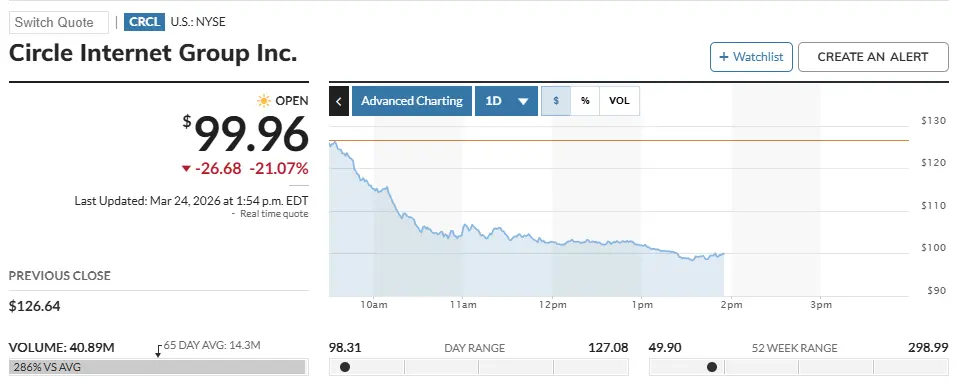
Circle stock plunges following proposal to ban stablecoin yield

Source: MarketWatch

Meanwhile, Coinbase shares (NASDAQ: COIN) shed 11.08% in the day to trade at $178.39, with its market cap falling from $53.3 billion to $47.7 billion post news.
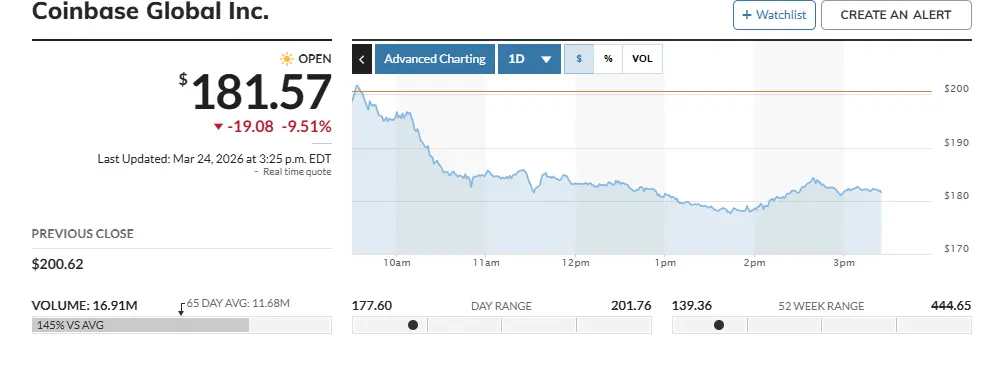
Coinbase stock chart

Source: MarketWatch

Coinbase CEO Brian Armstrong has previously noted that such legislation would hurt user profits on deposits, even though it would increase the company’s short-term profitability since it would have fewer rewards to pay out.

Banks, blockchain, and digital currencies

Notably, the Clarity Act has remained stalled in the Senate as banks lobby for the ban on stablecoin-based interests, reasoning that they create unfavorable competition against bank deposits.

This drew criticism from US President Donald Trump and his crypto-activist son Eric Trump, with the two arguing that banks are delaying clarity development in the crypto industry.

Just recently, former SEC Chair Gary Gensler sided with banks, saying stablecoins “undermine the banking system” and could “destabilize” the economy.

That said, banks have had to bow down to pressure to keep up with blockchain-based investment products. This has led many of them to adopt real-world asset tokenization to foster 24/7 trading with fewer intermediaries, shorter settlement periods, and fractional asset ownership for retail investors. 

JPMorgan Chase, BNY Mellon, and Goldman Sachs are just a few among those bridging traditional finance with blockchain. Bank of Montreal (BMO) and CME Group recently announced plans to launch tokenized cash services late in 2026, pending regulatory approval.


Market Opportunity
Comedian Logo
Comedian Price(BAN)
$0.05683
$0.05683$0.05683
-2.38%
USD
Comedian (BAN) Live Price Chart
Disclaimer: The articles reposted on this site are sourced from public platforms and are provided for informational purposes only. They do not necessarily reflect the views of MEXC. All rights remain with the original authors. If you believe any content infringes on third-party rights, please contact crypto.news@mexc.com for removal. MEXC makes no guarantees regarding the accuracy, completeness, or timeliness of the content and is not responsible for any actions taken based on the information provided. The content does not constitute financial, legal, or other professional advice, nor should it be considered a recommendation or endorsement by MEXC.

You May Also Like

Cashing In On University Patents Means Giving Up On Our Innovation Future

Cashing In On University Patents Means Giving Up On Our Innovation Future

The post Cashing In On University Patents Means Giving Up On Our Innovation Future appeared on BitcoinEthereumNews.com. “It’s a raid on American innovation that would deliver pennies to the Treasury while kneecapping the very engine of our economic and medical progress,” writes Pipes. Getty Images Washington is addicted to taxing success. Now, Commerce Secretary Howard Lutnick is floating a plan to skim half the patent earnings from inventions developed at universities with federal funding. It’s being sold as a way to shore up programs like Social Security. In reality, it’s a raid on American innovation that would deliver pennies to the Treasury while kneecapping the very engine of our economic and medical progress. Yes, taxpayer dollars support early-stage research. But the real payoff comes later—in the jobs created, cures discovered, and industries launched when universities and private industry turn those discoveries into real products. By comparison, the sums at stake in patent licensing are trivial. Universities collectively earn only about $3.6 billion annually in patent income—less than the federal government spends on Social Security in a single day. Even confiscating half would barely register against a $6 trillion federal budget. And yet the damage from such a policy would be anything but trivial. The true return on taxpayer investment isn’t in licensing checks sent to Washington, but in the downstream economic activity that federally supported research unleashes. Thanks to the bipartisan Bayh-Dole Act of 1980, universities and private industry have powerful incentives to translate early-stage discoveries into real-world products. Before Bayh-Dole, the government hoarded patents from federally funded research, and fewer than 5% were ever licensed. Once universities could own and license their own inventions, innovation exploded. The result has been one of the best returns on investment in government history. Since 1996, university research has added nearly $2 trillion to U.S. industrial output, supported 6.5 million jobs, and launched more than 19,000 startups. Those companies pay…
Share
BitcoinEthereumNews2025/09/18 03:26
Circle Expands USDC Into Africa Through Sasai Deal, Targeting Cross-Border Payments Boom

Circle Expands USDC Into Africa Through Sasai Deal, Targeting Cross-Border Payments Boom

USDC integration into Sasai signals rising stablecoin demand for cross-border trade and FX stability in Africa. Circle Internet Group agreed to a landmark partnership
Share
LiveBitcoinNews2026/03/25 06:39
Ether Machine Files S-4 for IPO via Dynamix Merger

Ether Machine Files S-4 for IPO via Dynamix Merger

 Ether Machine files draft S-4 with the SEC, which is a significant step toward a public Ethereum-centric IPO involving a merger with Dynamix. Ether Machine has decisively moved to become a publicly traded company. As part of the planned Initial Public Offering, it submitted an initial registration statement on Form S-4, confidentially with the U.S. […] The post Ether Machine Files S-4 for IPO via Dynamix Merger appeared first on Live Bitcoin News.
Share
LiveBitcoinNews2025/09/18 12:00