

Qtonic Quantum Debuts Industry’s First Independent Scoring Platform For Post-Quantum Cryptography At Rsac 2026
Miami, Florida (PinionNewswire) — Qtonic Quantum Corp, the independent post-quantum cybersecurity advisory firm, today announced the launch of Qtonic Quantum Lab (qtonicquantum.com/lab), the first vendor neutral, quantitative scoring platform for post-quantum cryptography implementations. The announcement comes during RSAC 2026 Conference in San Francisco, where more than 40,000 cybersecurity professionals are gathered this week.
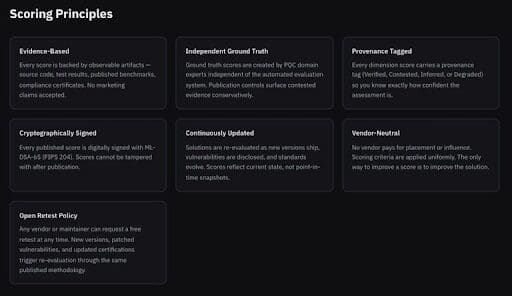 Scoring Principles
Qtonic Quantum Lab evaluates 215 PQC implementations across 12 categories. These include cryptographic libraries, hardware security modules, certificate management platforms, browsers, VPNs, and silicon providers. Each implementation is scored across 10 weighted dimensions with published thresholds and a dual-consensus methodology. Scores update continuously as new evidence emerges. This is not a point-in-time snapshot. It is a living benchmark.
The Gap No One Has Filled
NIST finalized FIPS 203, 204, and 205 in August 2024. OMB has mandated federal PQC migration under M-23-02. The federal deadline is January 1, 2029. Nation-state adversaries are already running Harvest Now, Decrypt Later campaigns, collecting encrypted traffic today with the expectation of breaking it once cryptographically relevant quantum computers arrive. Every enterprise and government agency must now select PQC libraries, HSMs, and platforms for migration. Until today, there was no independent, quantitative comparison data to guide those decisions.
Vendors self-report. NIST standardizes algorithms but does not rank implementations. MITRE catalogs vulnerabilities but does not score PQC readiness. Government certifications through the CMVP carry a two-year-plus backlog. Academic benchmarks measure speed and nothing else. The Big Four consult but do not publish. There has been no Consumer Reports for post quantum crypto. Until now.
How Qtonic Quantum Lab Works
Qtonic Quantum Lab scores every major PQC implementation across 10 dimensions: Algorithm Correctness, Performance, Key and Ciphertext Size, Side-Channel Resistance, Interoperability, Standards Compliance, Maturity, Documentation, Supply Chain Integrity, and Quantum Resistance. Each dimension carries a published weight and threshold. A dual-consensus architecture ensures no single evaluation pathway determines a final score.
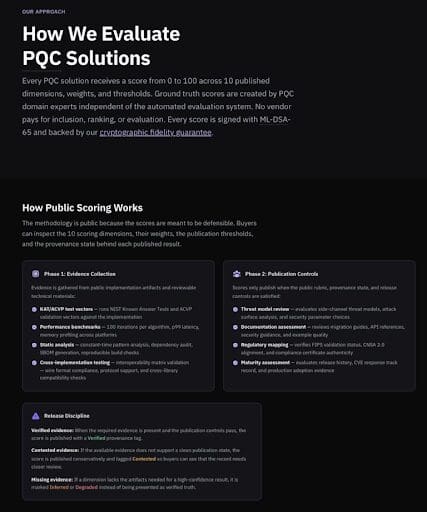 How we evaluate
The 12 categories under continuous evaluation include libraries (liboqs, OpenSSL, BoringSSL, wolfSSL), HSMs (Thales, Entrust, Futurex), platforms (Keyfactor, Venafi, IBM), browsers (Chrome, Firefox), VPNs (NordVPN, Mullvad), and silicon (NVIDIA, Infineon, NXP). The platform runs 24/7/365. No vendor pays for inclusion, ranking, or evaluation.
Every score is cryptographically signed with ML-DSA-65 (FIPS 204), one of the actual post quantum signature algorithms the platform evaluates. Each score carries a tamper-evident hash chain that any buyer can independently verify. The platform stakes its credibility on the same cryptography it evaluates.
The complete scoring rubric, all 10 dimensions, weights, thresholds, and dual-consensus rules, is published at qtonicquantum.com/lab/methodology. No other PQC evaluation platform publishes its rubric in full.
What Buyers Are Hearing
“Every organization we talk to asks the same question: How do I evaluate solutions in our PQC transition? Until now, the honest answer was that no one could tell them. Qtonic Quantum Lab provides the market with an in depth comparison tool that delivers risk reduction and defensibility: Real scores. Published methodology. No vendor bias. And by signing every score with the ‘gold standard’ NIST Algorithm (ML-DSA-65), the scores themselves are quantum resistant and tamper-proof, embodying the very ‘crypto-agility’ Qtonic Quantum helps clients achieve.”– Stephen Marchewitz, Vice President, Quantum Sales, Qtonic Quantum Corp
“As the industry converges on post-quantum timelines, the transition is already underway. Enterprises are making long-term cryptographic decisions today, but lack a clear, objective way to compare solutions. Qtonic Quantum Lab establishes a transparent, vendor-neutral standard for evaluating PQC implementations, bringing the rigor and accountability the market has been missing.”– Chris Fraser, Growth Advisor, Qtonic Quantum Corp
Qtonic Quantum Lab by the Numbers
- 215 PQC implementations tracked and evaluated across 12 categories
• 10 scoring dimensions with published weights and thresholds
• Every score cryptographically signed with post-quantum ML-DSA-65 (FIPS 204)
• Scored continuously, 24/7/365
• No vendor pays for inclusion, ranking, or evaluation
Availability
Qtonic Quantum Lab is live and publicly accessible at qtonicquantum.com/lab. The scoring methodology is published at qtonicquantum.com/lab/methodology. QScout, the company’s cryptographic risk and vulnerability intelligence platform, is available as a freemium offering on Azure Marketplace, and the QScout Free Scanner is live for immediate use.
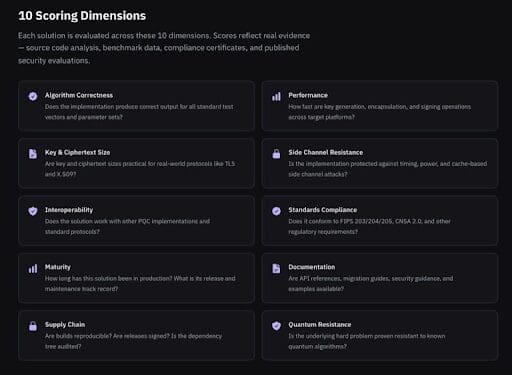 10 Scoring Dimesnions
About Qtonic Quantum
Qtonic Quantum Corp is a vendor-neutral quantum cybersecurity advisory firm headquartered in Miami with R&D in Be’er Sheva, Israel. The company delivers three core services: QScout (cryptographic risk and vulnerability intelligence), QStrike (quantum penetration testing), and QSolve (PQC migration advisory). Qtonic Quantum has completed 50+ Fortune 1000 engagements, cataloged more than 162,000 cryptographic findings with a 99% HNDL exposure rate and zero false positives, and backs its work with a commercially underwritten $2M Quantum Challenge. The company’s Intelligence Model, LLM26, powers narrative enrichment across all service lines. Qtonic Quantum evaluates implementations across 8 quantum platforms spanning 5 modalities. The company is chaired by Lt. Gen. Mark E. Weatherington, USAF (Ret.) and is a SAM.gov registered federal contractor (UEI: FRYFAD3GW5W5, CAGE: 14E99). Learn more at qtonicquantum.com.
Additional Resources (Available on Request)
Methodology documentation for reporters who want to verify claims before publishing
Anonymized scoring extracts for editorial reference
Embargo arrangements available for feature coverage with exclusive access
Media Contact
Jessica Gold
Vice President, Quantum Marketing
Qtonic Quantum Corp
Email: Media@qtonicquantum.com
Phone: +1 (866) 4-QTONIC
Web: qtonicquantum.com
You May Also Like

BitGo expands its presence in Europe

Wormhole launches reserve tying protocol revenue to token

