The post UK Crypto Industry Pushes Back on Bank of England Stablecoin Caps appeared on BitcoinEthereumNews.com. UK crypto groups are resisting against the Bank of England’s proposed stablecoin limits, stating they are unrealistic and damaging.  The rules are made to protect financial stability. The Bank of England has proposed plans to fix how much individuals and businesses can hold in systemic stablecoins, drawing sharp dispute from crypto industry groups. Based on that , individuals could be limited to between £10,000 and £20,000 (~US$13,600–$27,200), while businesses might face a top amount of about £10 million (~US$13.6 million). The proposal is aimed at protecting financial stability, especially by reducing the risk of big deposit outflows from banks. Critics, however, warn it would create heavy enforcement challenges, leave UK users and firms at a disadvantage, and push activity toward more lenient markets abroad. Pushback from Industry: Key Objections Industry voices argue the proposed caps are “unworkable” in real-world terms. Tom Duff Gordon of Coinbase said the limits would hurt UK savers and the City of London and even weaken sterling. Simon Jennings of the UK Cryptoasset Business Council warned that enforcing the rules would mean building costly new identity systems, since issuers don’t usually track token holders day to day. Riccardo Tordera-Ricchi of the Payments Association added that such restrictions make no more sense than putting caps on cash or bank account balances. The UK could come off as more restrictive than other major markets. In the U.S., for example, the recently passed GENIUS Act regulates stablecoin issuers, reserves, and redemptions but doesn’t set limits on how much people can hold. The European Union has also taken a similar decision under MiCA, focusing on issuer and consumer safeguards instead of hard limits on personal holdings. The public argues that stricter limits in the UK risk undermining its competitiveness in the global crypto industry. The Possible Path Forward Officials like… The post UK Crypto Industry Pushes Back on Bank of England Stablecoin Caps appeared on BitcoinEthereumNews.com. UK crypto groups are resisting against the Bank of England’s proposed stablecoin limits, stating they are unrealistic and damaging.  The rules are made to protect financial stability. The Bank of England has proposed plans to fix how much individuals and businesses can hold in systemic stablecoins, drawing sharp dispute from crypto industry groups. Based on that , individuals could be limited to between £10,000 and £20,000 (~US$13,600–$27,200), while businesses might face a top amount of about £10 million (~US$13.6 million). The proposal is aimed at protecting financial stability, especially by reducing the risk of big deposit outflows from banks. Critics, however, warn it would create heavy enforcement challenges, leave UK users and firms at a disadvantage, and push activity toward more lenient markets abroad. Pushback from Industry: Key Objections Industry voices argue the proposed caps are “unworkable” in real-world terms. Tom Duff Gordon of Coinbase said the limits would hurt UK savers and the City of London and even weaken sterling. Simon Jennings of the UK Cryptoasset Business Council warned that enforcing the rules would mean building costly new identity systems, since issuers don’t usually track token holders day to day. Riccardo Tordera-Ricchi of the Payments Association added that such restrictions make no more sense than putting caps on cash or bank account balances. The UK could come off as more restrictive than other major markets. In the U.S., for example, the recently passed GENIUS Act regulates stablecoin issuers, reserves, and redemptions but doesn’t set limits on how much people can hold. The European Union has also taken a similar decision under MiCA, focusing on issuer and consumer safeguards instead of hard limits on personal holdings. The public argues that stricter limits in the UK risk undermining its competitiveness in the global crypto industry. The Possible Path Forward Officials like…

UK Crypto Industry Pushes Back on Bank of England Stablecoin Caps

For feedback or concerns regarding this content, please contact us at crypto.news@mexc.com
  • UK crypto groups are resisting against the Bank of England’s proposed stablecoin limits, stating they are unrealistic and damaging. 
  • The rules are made to protect financial stability.

The Bank of England has proposed plans to fix how much individuals and businesses can hold in systemic stablecoins, drawing sharp dispute from crypto industry groups. Based on that , individuals could be limited to between £10,000 and £20,000 (~US$13,600–$27,200), while businesses might face a top amount of about £10 million (~US$13.6 million). The proposal is aimed at protecting financial stability, especially by reducing the risk of big deposit outflows from banks. Critics, however, warn it would create heavy enforcement challenges, leave UK users and firms at a disadvantage, and push activity toward more lenient markets abroad.

Pushback from Industry: Key Objections

Industry voices argue the proposed caps are “unworkable” in real-world terms. Tom Duff Gordon of Coinbase said the limits would hurt UK savers and the City of London and even weaken sterling. Simon Jennings of the UK Cryptoasset Business Council warned that enforcing the rules would mean building costly new identity systems, since issuers don’t usually track token holders day to day. Riccardo Tordera-Ricchi of the Payments Association added that such restrictions make no more sense than putting caps on cash or bank account balances.

The UK could come off as more restrictive than other major markets. In the U.S., for example, the recently passed GENIUS Act regulates stablecoin issuers, reserves, and redemptions but doesn’t set limits on how much people can hold. The European Union has also taken a similar decision under MiCA, focusing on issuer and consumer safeguards instead of hard limits on personal holdings. The public argues that stricter limits in the UK risk undermining its competitiveness in the global crypto industry.

The Possible Path Forward

Officials like Sasha Mills, Executive Director for Financial Market Infrastructure, argue that large stablecoin balances could ignite sudden outflows that may weaken banks’ deposit bases. The limits are also seen as a temporary step to manage risks connected to payment systems using stablecoins that are already systemic or expected to get there.

The biggest hurdle is enforcement. Regulators would need ways to track stablecoin movements, monitor who holds what, and flag large accounts—no small task given crypto’s decentralized setup and the pseudonymous nature of most tokens. Critics argue there are smarter fixes: stronger reserve rules for issuers, tighter governance and oversight standards, or regulation focused on issuance and redemption instead of putting limits on how much people can hold.

Highlighted Crypto News Today

‌Whale Transfers Massive Ether; Is ETH Price Decline Inevitable?

Source: https://thenewscrypto.com/uk-crypto-industry-pushes-back-on-bank-of-england-stablecoin-caps/
Market Opportunity
Threshold Logo
Threshold Price(T)
$0.006726
$0.006726$0.006726
-2.66%
USD
Threshold (T) Live Price Chart
Disclaimer: The articles reposted on this site are sourced from public platforms and are provided for informational purposes only. They do not necessarily reflect the views of MEXC. All rights remain with the original authors. If you believe any content infringes on third-party rights, please contact crypto.news@mexc.com for removal. MEXC makes no guarantees regarding the accuracy, completeness, or timeliness of the content and is not responsible for any actions taken based on the information provided. The content does not constitute financial, legal, or other professional advice, nor should it be considered a recommendation or endorsement by MEXC.

You May Also Like

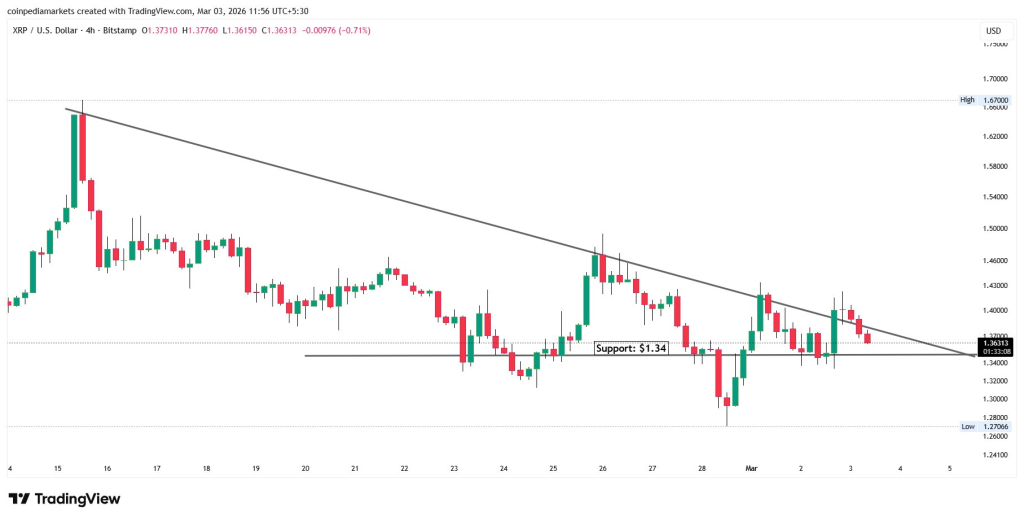
Warning Signs Flash for $XRP as $1.34 Support Gets Tested

Warning Signs Flash for $XRP as $1.34 Support Gets Tested

XRP lagged behind Bitcoin and Ethereum during yesterday’s relief bounce. In fact, BTC and ETH pushed higher over $70K and $2K respectively, but XRP only managed
Share
Captainaltcoin2026/03/03 14:49
PiDex Testnet Launch: What It Means for Pi Network and Picoin Value

PiDex Testnet Launch: What It Means for Pi Network and Picoin Value

Pi Network’s decentralized exchange, PiDex, went live on the testnet, marking a significant technical milestone for the ecosystem. Despite the launch, the m
Share
Hokanews2026/03/03 14:27
UK and US Seal $42 Billion Tech Pact Driving AI and Energy Future

UK and US Seal $42 Billion Tech Pact Driving AI and Energy Future

The post UK and US Seal $42 Billion Tech Pact Driving AI and Energy Future appeared on BitcoinEthereumNews.com. Key Highlights Microsoft and Google pledge billions as part of UK US tech partnership Nvidia to deploy 120,000 GPUs with British firm Nscale in Project Stargate Deal positions UK as an innovation hub rivaling global tech powers UK and US Seal $42 Billion Tech Pact Driving AI and Energy Future The UK and the US have signed a “Technological Prosperity Agreement” that paves the way for joint projects in artificial intelligence, quantum computing, and nuclear energy, according to Reuters. Donald Trump and King Charles review the guard of honour at Windsor Castle, 17 September 2025. Image: Kirsty Wigglesworth/Reuters The agreement was unveiled ahead of U.S. President Donald Trump’s second state visit to the UK, marking a historic moment in transatlantic technology cooperation. Billions Flow Into the UK Tech Sector As part of the deal, major American corporations pledged to invest $42 billion in the UK. Microsoft leads with a $30 billion investment to expand cloud and AI infrastructure, including the construction of a new supercomputer in Loughton. Nvidia will deploy 120,000 GPUs, including up to 60,000 Grace Blackwell Ultra chips—in partnership with the British company Nscale as part of Project Stargate. Google is contributing $6.8 billion to build a data center in Waltham Cross and expand DeepMind research. Other companies are joining as well. CoreWeave announced a $3.4 billion investment in data centers, while Salesforce, Scale AI, BlackRock, Oracle, and AWS confirmed additional investments ranging from hundreds of millions to several billion dollars. UK Positions Itself as a Global Innovation Hub British Prime Minister Keir Starmer said the deal could impact millions of lives across the Atlantic. He stressed that the UK aims to position itself as an investment hub with lighter regulations than the European Union. Nvidia spokesman David Hogan noted the significance of the agreement, saying it would…
Share
BitcoinEthereumNews2025/09/18 02:22